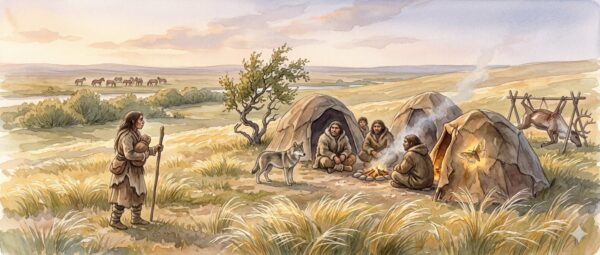
Did Neanderthals marry? Not in any form we would recognise today — there were no ceremonies, no rings, no vows preserved in the archaeological record. But did Neanderthal adults form lasting pair bonds, share responsibility for specific children, and maintain those relationships across years of Ice Age life? The genetic and skeletal evidence says yes — almost certainly. Stripped of the cultural institution, Neanderthal partnership emerges as a structured, sustained, and cognitively sophisticated feature of their social world. This post examines what recent genetic studies reveal about Neanderthal family life, pair bonding, fatherhood, jealousy, and the shape of relationships in a species that lived and loved through hundreds of thousands of years of European prehistory.
Did Neanderthal Fathers Live With Their Children?
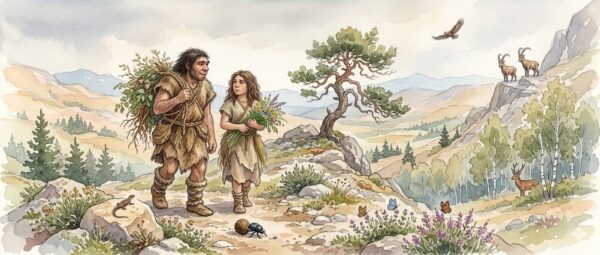
Yes — at least some of them did, and for years at a time. In 2022, a landmark genetic study of thirteen Neanderthals from Chagyrskaya and Okladnikov Caves in the Altai Mountains identified a specific father-daughter pair living in the same community. The girl was in her teens. Her father was present in her life long enough for both of them to die in proximity, their remains recovered from the same cave system roughly 54,000 years later.
This is a small finding with large implications for our understanding of Neanderthal family structure. It establishes that Neanderthal fathers co-resided with their offspring through adolescence — sustained paternal presence is not universal in mammals, and most primate males disperse after mating. A second pair of relatives at the same site, possibly an aunt or grandmother with a young boy, suggests multigenerational Neanderthal households that extended beyond the mother-child unit.
Whether these fathers were also bonded to the mothers of their children is the harder question, and one genetic data alone cannot settle. But the physical presence of fathers in their daughters’ daily lives is now directly confirmed.
Did Neanderthals Form Pair Bonds?
The evidence points strongly toward yes, though not toward lifelong monogamy. Evolutionary biology predicts pair bonding in species where male parental care significantly improves offspring survival — and Neanderthal ecology met that condition almost exactly. Children were dependent well into adolescence. Winters were long and food was irregular. A mother provisioning alone would have struggled to keep herself and a young child alive through a lean season. A committed male partner — one who hunted, shared meat, and defended shared offspring — materially improved a child’s chances of reaching adulthood.
Small group size reinforced this logic. In a Neanderthal band of a dozen or so individuals, every adult knew every other adult intimately. A male who fathered children and ignored them could not disappear into anonymity — the group was too small, the accountability too direct. The social geometry of tiny communities produces obligation, because there is nowhere else to go.
This does not prove lifelong monogamy. Pair bonds among modern humans vary enormously in duration and exclusivity, and the same was almost certainly true of Neanderthals. What the ecological pressures suggest is not a specific institutional form but a baseline: bonds long enough, and exclusive enough, for a child to benefit from two committed adults during the years it mattered most.
Were Neanderthals Jealous? Evidence of Conflict and Violence
Neanderthal skeletons carry clear evidence of interpersonal violence — though its specific causes remain unknown. Pair bonding in any species that forms it generates competition. Where bonds exist, so does the possibility of rivalry, infidelity, and retaliation. Neanderthal remains show an unusually high frequency of healed traumatic injuries: cranial fractures, broken ribs, and damaged forearms.
For decades the default explanation was hunting accidents; large-game ambush hunting with thrusting spears is genuinely dangerous, and the injury profile broadly matches rodeo injuries among modern humans. But not all of the trauma fits that pattern. Some cranial injuries show depression fractures consistent with blows from another human. Some forearm fractures are of the type produced when someone raises an arm to block an overhead strike — defensive wounds.
These injuries are not diagnostic of mate conflict specifically. Violence has many causes. But they confirm that interpersonal aggression occurred in Neanderthal society and sometimes left survivors. Small-group life would have forced conflicts to resolve rather than escalate — a band of twelve cannot absorb the permanent loss of a member to feud or exile. Whatever jealousy, rivalry, or betrayal occurred, the group had to metabolise it through reconciliation, mediation, or the simple exhaustion of grievance.
How Long Did Neanderthal Relationships Last?
Most Neanderthal pair bonds probably lasted years rather than a full lifetime — not by choice, but because of mortality. Skeletal studies suggest few Neanderthal adults reached forty, and many died much younger. A pair bond lasting “for life” in this context might have meant five or ten years, not fifty. The dissolution of a bond by death was routine, and a surviving partner with dependent children would have needed to form new attachments quickly — either to another adult or to a cooperative kin network — simply to keep the children alive.
This is a different model of Neanderthal partnership from the modern Western ideal. Bonds were probably serial rather than singular, shaped by who survived as much as by who chose whom. The death of a spouse was not a rare tragedy but a predictable life event that demanded practical reorganisation. Children who lost a parent were absorbed into the surviving social fabric, cared for by relatives, stepparents, or the band as a whole.
What voluntary separation looked like, if it happened, is invisible to us. Some of the female movement detectable in the genetic record may have been first-time transfers of young adults, but some may equally have been redistributions after the death or abandonment of an earlier bond.
How Did Neanderthals Choose Their Partners?
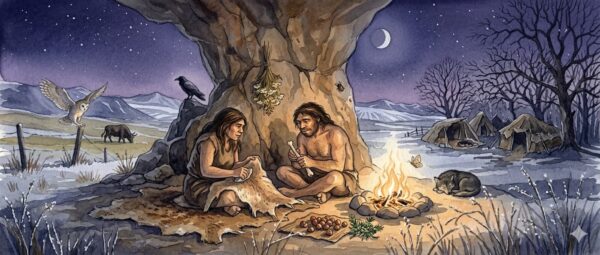
Pairings were deliberate and negotiated, not anonymous. How specific pairings formed is one of the hardest questions to approach. In modern foraging societies, the answer varies widely — from arrangements organised by elders to considerable individual choice, often a combination of both. Neanderthal social complexity was sufficient to support either pattern, or something else entirely.
What the archaeological record does tell us is that someone was making decisions — whether the individuals themselves, their kin, or elders brokering arrangements between groups. The logistics of bringing a new adult into a band, across a landscape where neighbouring groups lived days apart, where encounters were rare, and where a new arrival had to be fed through her first winter, all suggest these movements were planned rather than accidental.
The capacity for coordinated decision-making about mating is itself a marker of cognitive and social sophistication. Anonymous fluid mating does not require negotiation; structured arrangements do. The Neanderthal pattern is the signature of a species organising its reproductive life through something more than instinct.
What the Evidence Rules Out About Neanderthal Family Life
The evidence cannot tell us the exact form of Neanderthal pair bonds, but it does rule out several long-standing misconceptions:
- It rules out purely matrifocal societies where males played no sustained role. The Chagyrskaya father-daughter finding contradicts this directly.
- It rules out the “primitive horde” of nineteenth-century speculation, where mating was indiscriminate and fatherhood unknown. Small-group accountability argues strongly against it.
- It rules out isolated nuclear families. Neanderthal children grew up in groups, not households, and multiple adults shared in their care.
What remains is a spectrum of plausible arrangements — serial pair bonds, cooperative child-rearing embedded in kin networks, and mating choices constrained by small numbers and shaped by deliberate movement of individuals between groups.
What Neanderthal Family Life Means Today
Modern debates about family structure often proceed as if one arrangement is “natural” and others are recent inventions. The Neanderthal evidence suggests the opposite. Family was adaptive — shaped by mortality, group size, ecological pressure, and the practical demands of keeping children alive through winters that killed. The bond between a Neanderthal man and woman, whatever form it took, was not a contract with an institution; it was a working relationship built around the survival of specific children. Everything else followed from that.
Lesser-Known Facts About Neanderthal Relationships
- The 2022 Chagyrskaya study was the first to identify a specific Neanderthal father-daughter pair through direct genetic analysis.
- Neanderthal adult mortality was high enough that pair bonds lasting a full reproductive lifetime would have been exceptional rather than typical.
- Healed blocking fractures of the forearm — indicative of defensive postures during assault — are documented across multiple Neanderthal skeletal assemblages.
- The genetic diversity of some Neanderthal communities was low enough to resemble endangered species, yet these bands maintained sophisticated cultural traditions — a reminder that social structure can compensate for small numbers.
Myth vs. Evidence: Neanderthal Mating and Family
Common misconception: Neanderthals mated indiscriminately, without sustained bonds or structured family life.
The evidence: Fathers co-resided with their offspring through adolescence. Pairings were deliberate and negotiated rather than anonymous. Interpersonal violence occurred but was bounded by the accountability of small groups. Some form of pair bonding was almost certainly present, though its exact duration and exclusivity remain beyond recovery.
Try This
Think of people you know who have lost a partner early — to accident, illness, or circumstance. Notice how quickly the practical world demands that life reorganise: children need care, households need running, the machinery of daily existence does not pause for grief. For Neanderthals, this was not an exception but an ordinary rhythm. Any model of Neanderthal pair bonding has to account for the fact that death was a regular interruption, and that the bonds holding a group together had to be flexible enough to re-form quickly when one was broken.
What We Still Don’t Know About Neanderthal Relationships
Did Neanderthal bonds involve exclusivity, or was there tolerance for multiple simultaneous partners? How were pairings initiated — by the individuals themselves, by elders, by negotiation between bands? What happened when a bond failed for reasons other than death? Did Neanderthals mourn lost partners, and for how long? Did they form same-sex bonds, and if so, what role did these play in group life? Was there a concept of infidelity, and what were its social consequences? These intimate questions sit beyond the reach of genetic and skeletal evidence, and they may remain unanswerable.
Summary: What We Know About Neanderthal Marriage and Family
The Chagyrskaya father-daughter finding confirms that Neanderthal fathers co-resided with their offspring, establishing sustained paternal presence in at least some communities. The ecological conditions of Ice Age life — extended child dependency, long winters, and resource scarcity — created strong selective pressure for pair bonding in some form, though the specific duration and exclusivity of these bonds cannot be determined. Small group size constrained conflict and enforced accountability, making anonymous mating unlikely and structured arrangements probable. High adult mortality likely produced serial rather than singular bonds, with surviving partners forming new attachments as a matter of practical necessity. While the institutional form of Neanderthal marriage remains invisible, the pattern that emerges is of a species organising its reproductive life through sustained, accountable, and cognitively sophisticated social arrangements.
Frequently Asked Questions About Neanderthal Family Life
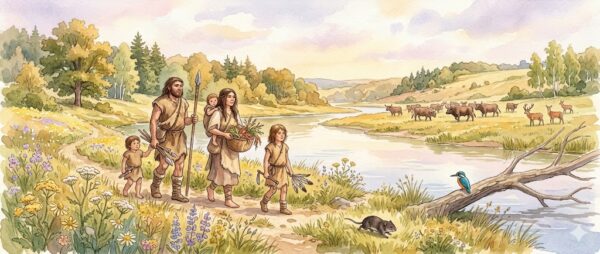
Did Neanderthals marry?
Not in a ceremonial or institutional sense, but genetic evidence strongly suggests they formed sustained pair bonds and family units organised around shared child-rearing.
Did Neanderthal fathers raise their children?
Yes. A 2022 genetic study at Chagyrskaya Cave identified a Neanderthal father and his teenage daughter living in the same community, confirming sustained paternal co-residence through adolescence.
Were Neanderthals monogamous?
The evidence does not confirm strict monogamy. Pair bonding almost certainly occurred, but high mortality likely produced serial bonds rather than lifelong partnerships.
Did Neanderthals experience jealousy?
Neanderthal skeletons show healed injuries consistent with interpersonal violence, including defensive wounds. While specific causes cannot be identified, conflict over mates is one plausible explanation among several.
How big were Neanderthal families?
Neanderthal bands typically contained ten to twenty individuals spanning multiple generations, with children forming a numerically dominant presence.
For a wider look at how Neanderthal bands spent their time together — play, communication around the fire, visits between groups, and the everyday texture of communal life — see After the Hunt Was Over: The Social Life of a Neanderthal Band.
In 2022, a landmark genetic study of thirteen Neanderthals from Chagyrskaya and Okladnikov Caves in the Altai Mountains identified a specific father-daughter pair living in the same community. The girl was in her teens. Her father was present in her life long enough for both of them to die in proximity, their remains recovered from the same cave system roughly 54,000 years later.
For a closer look at how Neanderthal communities avoided inbreeding despite their small numbers, see Did Neanderthals Have an Incest Taboo? What Ancient Genetics Reveals.
