We have reconstructed the hunt. We have mapped the hearths, measured the scrapers, catalogued the bones. We know what Neanderthals ate, what tools they made, where they sheltered, and how they survived winters that would kill an unequipped modern human in hours. But what happened when the work was done? After the meat was butchered and the fire fed, there were hours — particularly in summer, when daylight at mid-European latitudes stretches past sixteen hours — with nothing urgent to do. Did children play? Did adults talk through the long dark evenings? Did neighbouring bands visit? The archaeological record is not designed to answer these questions. But the evidence, read carefully, tells us more than you might expect about Neanderthal society and its social texture.
Did Neanderthal Children Play?

Did Neanderthal Children Play? Almost certainly yes. Play is not a human invention — it is a mammalian trait documented in every social species studied.
A couple of years back before our neighbourhood became a concrete jungle we had regular visits from a racoon family. I especially remember one evening a large group of raccoon youngsters jostling each other on my neighbour’s deck. They were certainly not fighting and it was really very touching to see them playing and having a happy moment.
In every living human culture, children play. No exception has ever been recorded. For Neanderthal children — whose dental development shows dependency lasting well into the teenage years — play would have been a developmental necessity, not a luxury. (Strong inference from evidence — based on comparative primate behaviour and universal patterns in human childhood.)
The physical evidence supports this. At Le Rozel in Normandy, France, footprint trackways preserved in dune sand revealed a group of 10 to 13 Neanderthals — the majority children and adolescents — running, turning, moving actively across the landscape. These were not children hidden at the back of a cave. At the Maastricht-Belvédère site in the Netherlands, dating to approximately 250,000 years ago, over 85 percent of stone cores in one activity area showed characteristic beginner’s knapping errors — “stacked steps” and “face battering.” Originally attributed to poor raw material quality, reanalysis argued convincingly that children were responsible: these were practice pieces, young hands imitating adult work. (Strong inference from evidence.)
A 2024 study from the Prado Vargas Cave in Spain recovered 15 marine fossils from a Neanderthal layer dating to 39,800–54,600 years ago. These fossils — molluscs, sea urchins, gastropods — showed no signs of tool use or modification. They had been carried into the cave from formations up to 30 kilometres away, apparently for no practical reason. The researchers noted that collecting behaviour in modern humans emerges between ages three and six, and that remains of Neanderthal children were found at the site. The possibility that children assembled this collection was explicitly raised — the largest non-utilitarian assemblage ever recovered from a Neanderthal site.
What Happened Around the Fire at Night?
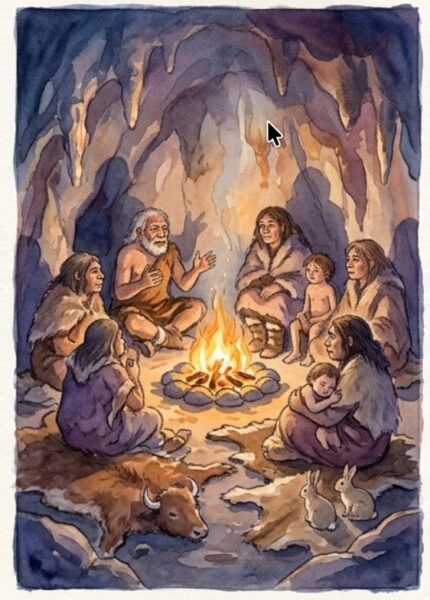
In winter, darkness lasted 16 hours or more. Fire was the only light. At sites like Abric Romaní in Spain and Kebara Cave in Israel, spatial analysis shows all domestic activity — knapping, butchering, eating, sleeping — organized tightly around the hearth. Fire was the centre of Neanderthal daily life.
Could they talk? The evidence has shifted decisively toward yes. The hyoid bone from the Kebara 2 skeleton in Israel — the small throat bone anchoring speech muscles — is virtually identical to the modern human hyoid in both external shape and internal microstructure. Biomechanical analysis in 2013 demonstrated that its internal trabecular architecture was consistent with the same mechanical use as modern human speech bones. It was not merely shaped like ours — it was used in the same way. A 2021 auditory bioengineering study built virtual 3D models of Neanderthal ears and found their hearing sensitivity in the 4 to 5 kilohertz range — where human speech occurs — closely resembled modern humans. Their “occupied bandwidth” was similar to ours. Their ears were tuned for speech. Add the FOXP2 gene, found in Neanderthal DNA in a form identical to the modern human variant, and the biological apparatus for complex vocal communication was clearly present.
None of this proves storytelling. But consider what Neanderthals needed to communicate: stone tool traditions maintained across hundreds of generations, seasonal prey movements across vast landscapes, distant raw material sources, birch pitch production at precise temperatures, medicinal plant identification. This knowledge could not have been transmitted by demonstration alone. It required sustained, sequential communication — and winter nights around the fire, with children listening, were the ideal setting. (Strong inference from evidence.)
Did Neanderthals Visit Other Groups?
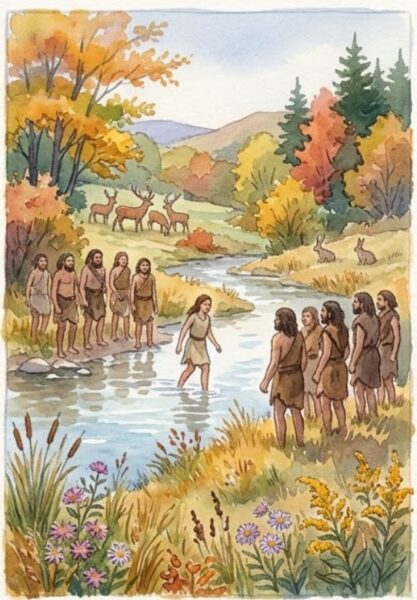
Did Neanderthals Visit Other Groups? They had to. At Chagyrskaya Cave in Siberia, genetic analysis of 13 individuals showed extremely low Y-chromosome diversity but higher mitochondrial DNA diversity — consistent with patrilocal residence where males stayed while females migrated in from other bands. At El Sidrón in Spain, three adult males shared mitochondrial lineage while three adult females each carried different lineages. This pattern requires inter-group contact. Women did not wander Ice Age landscapes alone. Bands had to meet, communicate, and negotiate transfers of individuals. In groups of 10 to 20, without regular influx of unrelated mates, inbreeding would have become genetically catastrophic within generations.
No confirmed aggregation sites have been identified in the Middle Palaeolithic record. (Unknown/debated.) But seasonal convergence at resource-rich locations — river crossings during autumn migrations, coastal shellfish beds — would have created natural meeting points. (Plausible but unproven.) Lithic evidence also points to connections: at multiple sites, stone tools made from materials sourced 50, 80, even 100 kilometres away have been identified. The Chagyrskaya and Okladnikov caves in Siberia, separated by approximately 100 kilometres, shared similar raw materials and closely related genetic profiles — suggesting a network of connected populations.
What happened when bands met? We cannot reconstruct the conversations. But the outcomes are visible: genetic material exchanged, distant stone present at campsites, and tool traditions shared across wide regions.
How Did Adults Relate to Their Children?
Weaning occurred at approximately 2 to 2.5 years, as determined by calcium-to-barium isotope ratios in tooth enamel — indicating intensive infant care at least as long as in modern human populations. After weaning, children remained dependent for years, with full adult dentition not achieved until the mid-teens. The progression from simple to complex tool manufacture — novice and expert knapping debris found side by side — shows adults gave children materials, guided them through processes, and let them practise. Care of sick children is also attested: dental pathology in Neanderthal juveniles shows survived infections, meaning ill children were cared for through fever and incapacity.
At Amud Cave in Israel, a Neanderthal infant was buried with an intact red deer jawbone deliberately placed against its pelvis — someone placed it there with care and attention. (Archaeologically confirmed — symbolic meaning unknown/debated.)
Was There Leisure? What Did Ice Age Free Time Look Like?
Quantitative studies of modern foraging societies find that food acquisition and processing occupy approximately 20 to 45 hours per week. A 2019 study of the Agta in the Philippines found foraging communities spent roughly 20 hours weekly on subsistence, with approximately 30 hours for leisure. (Ethnographic comparison — not direct evidence for Neanderthals.) For Neanderthals, hunting a single large herbivore could feed a small band for days. Summer days at latitude 45 to 50 degrees offered 15 to 16 hours of daylight. Substantial portions of each day would have been uncommitted.
The archaeological evidence confirms this indirectly. Eagle talon ornaments across a dozen sites spanning 130,000 years. The Einhornhöhle carved bone — a giant deer toe incised with a deliberate chevron pattern, boiled before carving, with no utilitarian function. Shaped ochre “crayons” used to mark surfaces. These objects are evidence of leisure — hours spent doing things that mattered for reasons other than staying alive.
What This Means Today
The assumption that Paleolithic life was nothing but grinding survival is a projection of industrial anxieties onto the deep past. Neanderthal daily life included play, social contact, creative expression, and extended communal rest. The social bonds that held a band together were not a by-product of survival — they were survival. The group that played together, communicated together, and invested deeply in its children was the group that maintained the knowledge and genetic health required to endure 300,000 years of Ice Age survival strategies.
How Social Bonds Sustained Neanderthal Ecology
Female migration between bands maintained genetic diversity. Play among children built the skills future hunters and foragers would need. Communication around winter fires preserved ecological knowledge accumulated across thousands of years. Every social behaviour had an ecological function. The Neanderthal band was not just a family — it was an ecosystem of knowledge, maintained through relationships.
Lesser-Known Facts
At Prado Vargas Cave, 15 marine fossils with no utilitarian purpose were found in a Neanderthal layer — the largest non-utilitarian collection from a Neanderthal site, possibly gathered by children. The Kebara 2 hyoid bone shows not just external similarity but identical internal microstructure to modern human speech bones. Over 85 percent of stone cores at one area of Maastricht-Belvédère showed beginner’s errors consistent with child knappers. (Strong inference from evidence.) Neanderthal ears were tuned to the same frequency range as modern human speech. Modern forager societies typically spend only 20 to 30 hours per week on subsistence, suggesting Paleolithic daily life was not the survival grind often imagined. (Ethnographic comparison.)
Myth vs. Evidence
Common misconception: Neanderthal life was “nasty, brutish, and short” — an unrelenting struggle with no time for social connection, play, or communication. Evidence: Neanderthal biology supported complex vocal communication. Children were active, central participants in group life. Inter-group contact was genetically necessary and archaeologically attested. Non-utilitarian objects demonstrate leisure time and creative expression. The picture is not of creatures barely surviving, but of a deeply social species whose survival depended on the richness of their social bonds.
Try This
Next time you are near a campfire — or even a candle in a quiet room — notice what happens to conversation. It slows. It gets quieter. People lean in. Now imagine that same fire extended through sixteen hours of winter darkness with no alternative light source, surrounded only by people you have known your entire life, and the children among you need to learn everything about the landscape, the animals, and the seasons before they can survive alone. Whatever you imagine happened — something like it probably did, hundreds of thousands of times, in the firelit caves of Ice Age Europe.
What We Still Don’t Know
Did Neanderthal bands have regular meeting places or seasonal gatherings? What was the emotional texture of inter-group contact — celebratory, cautious, ritualized? Did children have identifiable games beyond knapping imitation and exploration? Did Neanderthals laugh, sing, or produce rhythmic sounds for pleasure? The hyoid bone and auditory evidence tell us they could speak, but not what they said — and the gulf between biological capacity and cultural expression remains one of the deepest unknowns in Paleolithic archaeology.
Summary
Neanderthal social life extended far beyond the demands of Paleolithic survival. Children played actively, practised toolmaking, and may have collected objects for curiosity or pleasure. The biological apparatus for speech was present — hyoid bone, FOXP2 gene, and auditory tuning for speech frequencies. Winter nights provided the conditions for cultural transmission. Inter-group contact was genetically necessary, with female exogamy ensuring bands did not exist in isolation. Adults invested deeply in children through extended dependency, guided learning, and care during illness. Non-utilitarian objects confirm leisure time and creative expression. The Neanderthal band was a social world — intimate, communicative, intergenerational, and connected to neighbouring groups across the Ice Age landscape. Understanding Neanderthal intelligence requires understanding not just what they made, but how they lived together.
Seen this way, the world of stone age stops being just the past. It becomes a way of understanding what matters. That idea sits at the centre of why I return to the Stone Age again and again.
