Blog

  • What did Stone Age people actually do on a Saturday night 100,000 years ago?

    A Saturday Night 100,000 Years Ago

    Makeup, firelight, and a prehistoric world richer than you were told

    The oldest Saturday night in the world

    Think about what you do when you go out for an evening. You wash your face. You look in a mirror. You smooth something coloured onto your cheeks or your lips. You pick clothing that feels right. You catch your own eye in the glass and make a small private decision about how you want to be seen tonight. Then you go.

    That sequence of actions is older than you think.

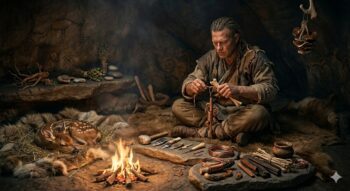
    A hundred thousand years ago, on a stretch of coastline near what is now the southern tip of South Africa, a woman did roughly the same thing. She ground red ochre into fine powder on a flat stone. She mixed the powder with warmed marrow fat until it loosened into a paste the colour of dried blood. She stored the paste in a shell the size of her palm, an abalone shell with a natural pearl-white interior that flashed in firelight when she tilted it. And in the early evening of a day whose other details we will never know, she used that paste on her own skin and the skin of people she loved.

    We know this because the shell survived.

    Here is a fun fact to carry with you through the rest of this post. Makeup is not a modern invention. It is not even a sapiens invention. Neanderthals in southern Spain were using pigment on their bodies at least 115,000 years ago — about fifteen thousand years before modern humans reached Europe. The urge to decorate a human face appears to be older than our species. It comes, in a deep sense, with the body.

    Which means that the woman at Blombos, getting ready for her evening, was not doing something new. She was doing something already old.

    In plain English. When you get ready for a Saturday night — the mirror, the lip colour, the small private moment of deciding how you want to be seen — you are doing one of the oldest activities known to our species. A hundred thousand years ago on the South African coast, a woman at Blombos Cave was doing something almost identical. She ground red ochre, mixed it with marrow fat, stored it in an abalone shell, and used it on her own skin and the skin of people she loved. Neanderthals were doing something similar even earlier. Makeup is older than our species. It is almost as old as the body.

    The paint kit from Blombos Cave

    Blombos Cave sits in a limestone cliff about a hundred metres from the surf, on the Indian Ocean coast of the Western Cape. It has been excavated since the 1990s by a team led by Christopher Henshilwood, and it has produced one of the richest Middle Stone Age records anywhere on Earth.

    In 2008, the excavation hit the layer that matters for this post. In a part of the cave that had been undisturbed for a hundred thousand years, the team found two abalone shells used as paint containers. Each shell held a residue: red ochre ground to powder, mixed with charcoal, quartz grit, and traces of bone — likely marrow or fat — that had served as a liquid binder. Around the shells lay the full workshop. Hammerstones for breaking off chunks of haematite from a larger nodule. Grindstones for pulverising the chunks into powder. A bone spatula with pigment residue clinging to its edge. Ochre crayons — worked lumps with ground facets — that had been used either to draw lines or to apply pigment directly to something soft. It was not a casual discovery. It was a complete and intact hundred-thousand-year-old cosmetics kit, frozen in the moment somebody last used it and walked away.

    The recipe itself is interesting. Ochre on its own is not good makeup. It is a dry mineral dust that rubs off the moment it is touched. To make it stick, you need a binder — a fat, an oil, an egg, a blood protein, a plant gum, anything that will carry the pigment and lock it to a surface. The Blombos recipe used animal fat, probably seal or antelope marrow. That is the same trick a Renaissance tempera painter used with egg yolk. It is the same trick a modern cosmetics chemist uses with petrolatum. The principle does not change. Only the scale of the manufacturing does.

    And there is one more thing from Blombos. In a layer dated to around 73,000 years ago, the excavators found a small flake of silcrete with nine deliberate cross-hatched lines drawn on it in red ochre crayon. It is the oldest unambiguous abstract drawing in the world — around thirty thousand years older than the famous European cave paintings at Chauvet and Lascaux. Whoever drew it did so with the same ochre that filled the cosmetics shells. The pigment that decorated a face decorated a stone. The line between art and adornment, at Blombos, was a line that probably did not yet exist.

    In plain English. In 2008, archaeologists digging at Blombos Cave in South Africa found something amazing. Two abalone shells, a hundred thousand years old, each containing a real cosmetics recipe: red ochre ground into powder, mixed with animal fat as a binder, stored in a shell that fits in your palm. Around the shells were all the tools of the workshop — hammerstones, grindstones, a bone spatula, crayons of worked ochre. It is basically a Stone Age makeup kit, intact, frozen in the moment somebody last used it. And from the same cave comes the oldest known abstract drawing in the world: nine cross-hatched lines in red ochre on stone, 73,000 years old. The line between art and makeup was, at Blombos, a line that hadn’t been drawn yet.

    The evening tide

    She walked down from the cave in the last hour before sunset, barefoot on the path her mother and her mother’s mother had walked before her, a shallow basket woven from coastal rush held against her hip. The path fell steeply through shrubs that smelled like warm resin. Behind her, the cliff held the day’s heat and released it in slow waves against the backs of her shoulders. Ahead, the ocean went from green to copper to the deep metallic red that only the Cape coast produces, the kind of light that turns every face on the beach into something out of a half-remembered story.

    On the rocks below, three other women were already at work. She heard the sound before she saw them — the dry clack of limpet shells being knocked from their rock with a wooden stick, the lower thud of mussels prised free with a bone wedge. One of the women looked up and raised a hand. She raised her own in return. They did not speak. They did not need to. The work was the same work they had done together every low tide for most of their lives.

    She picked her way across the wet black rocks to her own preferred patch and began. The limpets came first, a practised flick of the wrist under each shell. The mussels after, in clusters. A small crab that had wedged itself into a crack watched her with sideways eyes. She let it go. There would be enough.

    The sun went down behind the land. The sea turned the colour of a bruise. Cold wind came up off the water, and she felt it on the sweat between her shoulder blades and knew it was time to go back. She climbed the path with the full basket on her hip, the shellfish clinking softly against each other like coins in a purse, and the cave mouth above her glowed orange where someone had already built up the evening fire.

    Somewhere inside the cave, she knew, her shells were waiting.

    In plain English. That was the scene — a woman coming back from the tide pools with a basket of shellfish, climbing up to a cave where someone is already building the evening fire. It reads like a short story. It is also, mostly, grounded. The next section unpacks which parts we can support from the archaeology and which parts are inference. The short answer: more than you would think.

    How we know what the evening looked like

    The Blombos shell middens — the accumulated food waste on the cave floor — tell us a great deal about the daily rhythm. Across the site’s hundred-thousand-year occupation, the dominant food category is marine shellfish. Brown mussels. Limpets. Whelks. A few larger species when the tide or the season cooperated. The people who lived at Blombos were coastal foragers with a heavily tidal routine, and the Middle Stone Age archaeology across southern Africa confirms that this was not unusual. Sites from Pinnacle Point to Klasies River all tell the same story. The people who would eventually walk out of Africa and populate the world first spent tens of thousands of years perfecting the art of living on a productive shoreline.

    The tide dictates the day. Low tide means harvest. High tide means rest, or inland work, or the long gathering of firewood. Shellfish gathering at low tide is one of the most richly documented female-coded activities in the ethnographic record, from the Khoisan of the Cape in recent centuries all the way to the Torres Strait Islanders and the coastal peoples of the Pacific Northwest. We cannot know whether the Blombos division of labour looked exactly like any of these later patterns. But the tidal harvest itself is as solid an inference as anything gets.

    The basket she carried is extrapolation. No Middle Stone Age basket survives from Blombos or from any contemporary site, because plant fibre simply does not last a hundred thousand years. But we know the raw materials were there — coastal rush, reed, papyrus — and we know the hands were skilled enough, because Neanderthals elsewhere were already making three-ply cord. To say a Blombos woman carried her harvest in a basket is to say she was at least as capable of weaving fibre as her distant Neanderthal cousins, which the rest of the evidence strongly supports.

    Here is a fun fact. The Blombos excavations document continuous human presence at the same cave across more than a hundred thousand years. Think about that. The cave was occupied, abandoned, reoccupied, and held in memory across a span of time longer than the entire history of agriculture, cities, writing, metalwork, and religion combined. The woman coming up from the tide pools in the vignette above was walking a path her ancestors had walked for a thousand generations. That path is still there, under the modern South African scrub. You can stand on it.

    In plain English. The archaeology tells us most of what the scene above describes. The Blombos people ate a mostly shellfish diet. Low tide meant harvest. Shellfish gathering was usually women’s work in every ethnographic record we have of coastal foragers. The basket is the one bit we are extrapolating — we know plant fibre existed, we know the hands were skilled, but the basket itself rotted a hundred thousand years ago. And the wildest fact of all: the same cave was occupied for more than a hundred thousand years. Longer than the entire history of agriculture, writing, cities, and everything else combined. That is an actual, walkable path her ancestors walked for a thousand generations.

    Grinding the colour

    She set the basket down at the mouth of the cave and let the other women take the shellfish to the fire. Her evening work was different tonight. She crossed into the quieter part of the cave where the grindstones were kept, knelt on the sand floor, and pulled the familiar weight of the flat sandstone slab toward her.

    The haematite nodule sat in a small leather pouch beside it. She weighed the nodule in her palm, feeling for the best edge. The stone was the colour of dried liver. When she first struck it with the hammerstone, the fragments that flew off were the same colour. Only when she began to grind — slowly, in circular strokes, her weight forward through her shoulders — did the real colour come out. The powder accumulating on the slab was not dark red. It was deeper than that. It was almost violet in the failing light. It looked like something pulled out of a body.

    She ground until she had enough, her wrists warming from the work, her breath slow. Then she reached for the shell.

    The abalone shell was the one her mother had given her, the pearl interior iridescent in even this dim light, greens and blues and pinks moving across the surface as she tilted it. She tipped the ochre powder in. Added the charcoal, a pinch of quartz grit for texture. Then the fat.

    The marrow had been warming in a smaller shell beside the fire. When she poured it in, the smell rose up — rich, greasy, warm, a little sweet. It was not an unpleasant smell. It was the smell of an evening.

    She stirred the mixture with the smoothed end of a bird bone until it was the consistency of thick cream. Then she dipped two fingers and touched them to her collarbone to test the colour. The red was perfect. Dark and wet and alive.

    In plain English. The grinding scene above is anchored closely in what the excavation actually found. The haematite nodule, the flat grindstone, the hammerstone, the charcoal, the quartz grit, the bone spatula, the abalone shell, the fat as binder — every one of those things was in the actual Blombos paint kit. The sensory texture (the violet shift of the powder, the smell of warm marrow, the iridescent shell interior) is the bit where imagination does some honest work. The archaeology gives us the recipe. The rest is what the recipe must have felt like to make.

    What ochre actually does on skin

    Haematite is iron oxide. When you grind it to powder and suspend it in a fatty binder, you produce a pigment that binds unexpectedly well to human skin. The fat carries the particles into the microscopic irregularities of the skin surface; the iron oxide is chemically inert, so it does not break down overnight; and the whole compound resists being wiped off by ordinary touch. A good ochre paint applied to a washed face will last through an evening of firelight and dancing, and often through the next morning.

    We know this because people have reconstructed the Blombos recipe and worn it. Experimental archaeologists who have replicated the paste report that it goes on cool, warms quickly to body temperature, and deepens in colour as it dries down over five to ten minutes. It reads differently in different light. In daylight it looks like what it is — red-brown mineral pigment, handsome but not dramatic. In firelight it becomes something else. The iron oxide scatters low-frequency light in a way that makes the pigment glow faintly, the way a ember glows faintly. It is not subtle. Faces painted with ochre around a Stone Age fire would have been visibly, strikingly transformed.

    Here is the fun fact, and it is a good one. The Himba people of northern Namibia, a few hundred kilometres north of Blombos, still wear a daily ochre-and-fat compound they call otjize. The recipe is essentially the same as the Blombos recipe: red ochre, animal fat, sometimes a small addition of aromatic herbs. Himba women apply it to their skin and hair every morning. It has been worn continuously in that region for at least several thousand years, and probably much longer. If you want to know what the Blombos woman’s painted collarbone looked like, you do not need a time machine. You need a flight to Windhoek.

    The point, which should not get lost, is that the Blombos recipe was not a crude proto-cosmetic. It was a sophisticated emulsion with a long shelf life, a working binder system, and a specific aesthetic effect optimised for firelight. It is a designed product. Somebody figured it out. And somebody taught somebody else. And somebody taught somebody else. For a hundred thousand years.

    In plain English. The Blombos recipe actually works. Ochre mixed with fat binds to skin for hours, warms to body temperature, and glows softly in firelight because iron oxide scatters low-frequency light in a particular way. Modern experimental archaeologists have worn it and confirmed this. And here is the best part: the Himba women of northern Namibia, just north of the Blombos site, still wear almost exactly the same recipe every day. It is called otjize. Red ochre and animal fat, sometimes with herbs. If you want to see what the Blombos woman’s painted face looked like, you do not need a time machine. You need a flight to Namibia. The recipe is still alive.

    The gathering

    By the time she came to the main fire, the painting was done. Her collarbones and the tops of her shoulders were marked with dark red. A thin line ran from the outside corner of each eye down along her cheekbone. A smaller dot sat at the centre of her forehead, a piece of memory carried from her grandmother, who had worn her ochre the same way.

    The band was mostly already gathered. The fire was generous tonight, a proper fire, built of driftwood the children had dragged up from the tideline earlier in the day. Two of the men were laughing about something. A woman she had known all her life was nursing a baby at the edge of the light, humming low. An old man, the oldest in the band, sat on a folded hide and chewed slowly on a piece of roasted mussel, his eyes half-closed, listening.

    She sat down in her usual place. Someone passed her a shell of warm fat with shellfish in it. She ate. She laughed once at something someone said. She caught the eye of the man she was going to sit beside later, and he looked at her face in the firelight and did not look away for a long moment, and neither did she.

    The wind outside the cave mouth picked up. The sea murmured. A child asleep somewhere behind her shifted and settled again. The firelight moved across a dozen painted faces and the air smelled of smoke and ochre and marrow and salt.

    It was a good night.

    Here is a fun fact that belongs to this scene specifically. A Neanderthal man from Shanidar Cave in Iraqi Kurdistan — a different place and a different species, but contemporary with the Blombos woman in the grand scheme — had a crushed skull, a withered arm, a lame leg, and was deaf in one ear. He lived to about forty. The only way a person with those injuries reaches that age is if someone is feeding him, helping him across rough ground, and including him in the fire every evening. Which means that a Stone Age gathering around a fire, a hundred thousand years ago, already had the emotional shape of a modern gathering around a fire. People were cared for. People were kept warm. People stayed in the circle of light.

    In plain English. The gathering scene above is the emotional payoff of the whole post. Painted faces in firelight. Shared food. A baby being nursed. An old man half-listening. A glance across the fire between two people who will sit together later. None of this is pure invention. Every element is supported by evidence from Middle Stone Age African sites and by the universal patterns of small-band forager life documented in every ethnographic record we have. The Neanderthal man at Shanidar — crushed skull, withered arm, lame leg, cared for until he died at forty — is the final piece of evidence. A Stone Age evening around a fire already had the shape of a modern one. People were loved. People were kept warm.

    A hundred thousand years

    Here is what I want you to carry away from this.

    Cosmetics — the preparation and application of coloured pigment to the human face — is one of the oldest documented human activities. Older than agriculture. Older than pottery. Older than the oldest cave paintings. Older, probably, than language as we would recognise it. A woman at Blombos Cave, a hundred thousand years ago, reached for a shell of red pigment and put it on her own skin for reasons she understood. Those reasons may have been social, ceremonial, aesthetic, erotic, protective, or all of the above at once. We do not know. What we know is that she did it.

    And she was not an isolated genius. She was one node in a tradition that stretched back before her and forward past her. Her great-great-grandmother had worn ochre. Her great-great-granddaughter would wear ochre. The Neanderthals in Spain had been wearing ochre for fifteen thousand years before she was born. The Himba in Namibia are wearing ochre tonight. The cosmetics counter in the Mumbai department store, the mirror in the Parisian dressing room, the small tube of lip colour in the pocket of a woman on a subway platform in Toronto — these are the most recent entries in a tradition that is essentially continuous with Blombos.

    When we talk about the Stone Age world, we usually talk about what it lacked. No metal. No wheel. No writing. No cities. The negative framing is the default. What we almost never talk about is what it had. It had bands of people who looked at each other across firelight and saw other people. It had evenings. It had the small, specific, human pleasure of getting ready for an occasion. It had the deeper pleasure of being seen. A hundred thousand years ago, a woman on the Cape coast of what would eventually be called South Africa put on her makeup for an evening with people she loved, and that single sentence may be the most important thing anyone could ever say about the prehistoric world.

    We have been human for a long time. We have been getting ready for Saturday night for almost as long.

    A hundred thousand years is a long time. And it is no time at all.

    In plain English. The takeaway is simple and huge. Makeup is one of the oldest human activities on Earth. Older than agriculture, older than writing, older than cave paintings. A hundred thousand years ago at Blombos Cave, a woman put on red ochre for an evening with people she loved, and that was already an ancient tradition even then. The Himba in Namibia are still doing it tonight. You will do a version of it the next time you go out. When we describe the Stone Age, we usually list everything it lacked — no metal, no wheel, no cities. What it had was people who looked across firelight and saw each other. People who got ready. People who wanted to be seen. A hundred thousand years is a long time. And it is no time at all.

  • Why Stone Age Historical Fiction Gets Closer to the Truth Than Your History Class

    What prehistoric fiction readers see that archaeology keeps missing

    The Stone Age world most people imagine

    Close your eyes and picture a Stone Age scene. A campfire. A band of people eating around it. The low glow of ochre on cheekbones. Someone singing. Someone knapping a flake. Firelight moving on the walls of a cave or the hide of a shelter. A child in a fur wrap asleep against a grandmother’s shoulder.

    Where did you get that picture?

    Not from archaeology. Archaeology gives us flakes, postholes, charcoal stains, and broken bone. The scene you just imagined — the warmth, the singing, the ochre, the grandmother — that came from somewhere else. It came from novels, from films, from an accumulated modern sense of what human beings are like when you strip away the modern and leave the human. That sense is not trivial. It might, in fact, be closer to the prehistoric truth than the textbook is.

    Here is a fun fact to keep you reading. The Lascaux cave paintings, which have defined the popular image of the European Upper Paleolithic for almost a century, were discovered in 1940 by four teenagers chasing a runaway dog into a hole in the ground. The single most-visited Paleolithic art site in the world was found by accident, by people roughly the age of a high school senior. Everything we now think we know about Upper Paleolithic art started, in effect, when someone whistled for their dog and the dog didn’t come back.

    That is worth sitting with. The picture we have of prehistory is stitched together from finds that happened to be stumbled upon. What we know is not the whole. It is the bit that got lucky. And the interesting question is not whether the reader’s imagined Stone Age is accurate — it is whether anyone actually knows the answer to that question, and why we so often behave as though we do.

    In plain English. The Stone Age scene in your head — firelight, ochre, a grandmother, a song — didn’t come from science. It came from your own imagination filling in what the archaeology doesn’t show. The scientific record is mostly stones and bones. Everything else is guesswork. Even Lascaux, the most famous cave paintings on Earth, were only found because four French teenagers chased a lost dog into a hole in 1940. The picture we have of prehistory is built from a handful of lucky accidents. And the scene in your head might be more accurate than the textbook. Seriously.

    What survives from the Stone Age is a statistical accident

    Try a thought experiment. Imagine a future archaeologist digging up your apartment ten thousand years from now.

    By then, everything organic in your home is gone. Every book has rotted. Every photograph has crumbled. Every item of clothing, every piece of wooden furniture, every scrap of food, every pillow, every curtain, every plant — gone. Decomposed to dust and then to nothing. What remains? Some concrete foundations. A tangle of corroded metal plumbing. The porcelain bowl of the toilet. The occasional glass bottle. A ceramic plate or two if they didn’t shatter.

    From that, the future archaeologist reconstructs your life. They write papers. They classify you. They place you on a typological chart between Early 21st-Century Industrial and Late Fossil-Carbon Transition. They argue, plausibly and in peer-reviewed journals, about whether you ever read books.

    This is not a thought experiment. This is roughly the situation we are in with the Stone Age, except worse.

    Roughly ninety-nine percent of what survives from the Middle Paleolithic is stone. Stone tools, stone flakes, the occasional stone core. Some bone survives when conditions cooperate. Some teeth. If a site is extraordinarily lucky, some ochre. What the people who made those stone tools actually lived with — wood, bast fibre, sinew, leather, horn, feather, bark, resin, cordage, basketry, textile, hide — was almost entirely organic. These materials rot. In temperate soil in the open air, wood is gone inside a few decades. Plant fibre and hide are measured in years.

    Only four preservation windows let anything organic leak through into the present. Waterlogging in anoxic mud. Desiccation in desert caves. Freezing in permafrost. Rapid burial by fine sediment. Outside those four conditions, the record goes silent. Not because prehistoric people didn’t make things. Because whatever they made is now compost under somebody’s pasture.

    Here is a fun fact that should unsettle you. The oldest known polished wooden artifact in the world is a fragment of a plank from Gesher Benot Ya’aqov in Israel, preserved only because the site flooded in the exact moment the object was dropped. It is 780,000 years old. Exactly one plank. From 780,000 years of wood use across a continent. The fact that we have *any* Lower Paleolithic wood is a miracle. The fact that we have so little of it tells us, essentially, nothing about how much wood was being worked.

    What we see is not what was there. What we see is what happened to escape decay. And once that sentence settles properly in your head, the confident tone of most prehistory writing starts to sound a little less confident.

    In plain English. Here is the thing nobody says out loud. Ninety-nine percent of what survives from the deep Stone Age is stones. Everything else — wood, leather, cloth, rope, baskets, food, all the actual stuff of daily life — rotted away long ago. So when the textbook tells you “Stone Age people didn’t have X,” what it is really saying is “we haven’t found X.” Those are not the same thing. Imagine future archaeologists digging up your apartment in ten thousand years, after every book and photograph and piece of clothing has decomposed. They would reconstruct your life from some toilet porcelain, a few glass bottles, and some bent metal plumbing. That is basically the situation we are in with the Stone Age. It is worse than most people realise.

    Prehistoric fiction readers keep getting vindicated

    In 1980, Jean Auel published a novel that imagined Neanderthals with rich inner lives, complex ritual, aesthetic sensibility, and a communication system that fell just short of spoken language only because the archaeology of the late 1970s wouldn’t quite let her go further. Serious scientists of the period called the book sentimental. The real Neanderthal, they said, was a more limited creature. Duller. Colder. Less us.

    Fast-forward forty-five years. Every single one of Auel’s “sentimental” instincts has been vindicated. Neanderthals share the same FOXP2 language gene as modern humans and have the hyoid bone anatomy that makes articulate speech physically possible. Neanderthals built ring-shaped stone structures deep inside the Bruniquel cave system in France about 176,000 years ago, and nobody has a non-symbolic explanation for why. The Shanidar flower burial, dismissed for decades as ancient pollen contamination, has been at least partially rehabilitated by new excavations finding additional articulated Neanderthal remains at the site. Neanderthals decorated themselves: pigment-filled shells from Cueva de los Aviones in Spain are around 115,000 years old, predating any modern-human presence in Europe by tens of millennia. They made birch-tar adhesive — a thermoplastic polymer, produced by controlled pyrolysis — by 200,000 years ago. They made three-ply rope, by 50,000 years ago, with the same reverse-wrap geometry as any modern hand-spun cord.

    And Neanderthals, it turns out, are us. Every non-African person alive today carries between one and four percent Neanderthal DNA. When your great-great-grandmother looked in the mirror, a small but measurable fraction of what she saw came from a lineage the 1970s textbooks insisted was a separate and inferior species.

    But the vindication isn’t only about Neanderthals. Across the whole Stone Age world, the readers who imagined richness have been quietly winning a series of arguments they didn’t even know they were having.

    Upper Paleolithic people made music. The Hohle Fels flute, carved from the hollow wing-bone of a griffon vulture forty thousand years ago, is tuned to a functional musical scale. You can play modern melodies on a replica. The earliest known human instrument is not a crude noise-maker. It is a precision object. A skilled musician made it for other skilled musicians. There was a repertoire.

    Upper Paleolithic people made textiles. The Dzudzuana flax fibres, spun and dyed turquoise and grey, are thirty-six thousand years old. A spindle of some kind was used to spin them. The spindle rotted long ago. There was, almost certainly, a loom. The loom rotted too. What we have is a handful of threads.

    Upper Paleolithic people sailed. Humans reached Australia at least sixty-five thousand years ago, which required multiple ocean crossings including at least one leg of around ninety kilometres out of sight of land. These were not rafts accidentally drifting. They were crewed voyages. Somebody, sixty-five thousand years ago, looked at an ocean horizon and decided to cross it on purpose.

    Here is the fun fact. A Neanderthal man buried at Shanidar Cave in what is now Iraqi Kurdistan had a crushed skull, a withered right arm, a lame leg, and was deaf in one ear. He lived to about forty years old, which in Paleolithic terms is a full lifespan. Someone was feeding him. Someone was walking with him. Someone was making sure he didn’t fall behind when the band moved camp. The word for that is care.

    The reader who imagined a Neanderthal speaking a language, a Gravettian woman in dyed linen, a Stone Age flautist playing something like music, a Paleolithic sailor watching an island rise out of the sea — that reader has been quietly, repeatedly, vindicated. The textbook keeps catching up to the novel. And the novel keeps getting there first.

    In plain English. Here is something almost nobody tells you. Every time a prehistoric fiction writer has imagined Stone Age people as richer, smarter, more musical, more loving, more human than the scientific textbooks allowed — the textbooks have, eventually, agreed. Neanderthals had language genes. They buried their dead with care. They wore pigment on their bodies a hundred and fifteen thousand years ago. They made rope. They made glue more sophisticated than some modern industrial adhesives. Upper Paleolithic people made flutes you could play modern melodies on. They made dyed linen. They crossed open oceans in boats. A Neanderthal man with a crushed skull and a withered arm and deafness was cared for by his band until he died at forty. The “sentimental” reader was right. The “realistic” textbook was wrong.

    The cabinet you should keep at the back of your mind

    Before we go further, look at this.

    It is a visual cabinet of twelve prehistoric technologies, split into two columns. On one side, things we have actually found evidence of — rope, cord, dyed linen, ocean-crossing boats, bone flutes, bow-and-arrow, high-temperature kilns, birch-tar adhesive. On the other side, things where every single material and every necessary skill existed tens of thousands of years before the technology is first attested — magnetism, lenses, the camera obscura, the electric telegraph.

    [Infographic: The Cabinet of Latent Technologies — embed the HTML block here]

    Sit with the cabinet for a moment.

    The left column alone — the confirmed column — is already enough to erase the pulp image of the Stone Age. These are not primitive people. They are a continent-spanning tradition of skilled specialists producing adhesives measured in megapascals of shear strength, rope with modern geometry, kiln-fired ceramic objects, dyed and spun textiles, open-ocean watercraft, composite bow-and-arrow systems, precision musical instruments.

    The right column is where the argument of this whole post lives. Every single item on the right had its component materials present in the Paleolithic. Often for hundreds of thousands of years. The technology itself was never built. Why? Not because the people were incapable. Not because the materials weren’t there. Because the particular insight that turns a list of materials into a working device hadn’t yet crossed whatever mental threshold it needed to cross.

    Here is the fun fact. Every component of a working electric telegraph existed in the Upper Paleolithic. Copper (lying on the ground in purity of ninety-five percent or better, all around Lake Superior). A second metal for the battery (meteoric iron, or accidentally-reduced lumps from any hot charcoal fire). Acid for the electrolyte (vinegar, from fruit left too long in a pot). Wax for insulation (from any honey-bearing tree). Cord for the coil (Neanderthals had already mastered three-ply bast-fibre rope). An iron core (any soft iron bar). A spring (hammered and tempered from the same iron). The only thing missing was the idea.

    And when you look at the cabinet — at the fact that the left column is already extraordinary, and the right column is full of things *that could have been built* — the question the rest of this post circles around starts to feel unavoidable. If the left column is what accidentally survived, and the right column is what was possible, how sure are we about anything in between?

    In plain English. The infographic above is worth a careful look. On the left, things prehistoric people definitely made — rope, dyed linen, boats that crossed oceans, bone flutes tuned to real musical scales, and adhesives that would still work today. On the right, things they had every material to make and never did — compasses, lenses, pinhole cameras, electric telegraphs. Every single component of a working telegraph existed in the Stone Age. Every one. The only thing missing was someone putting the pieces together. Which is a whole different kind of ceiling than “they were primitive.”

    Visualizing the Stone Age world beyond the sterile scientific trope

    Here is a phrase you should learn to distrust.

    “The archaeology shows.”

    It is used in museum plaques, textbooks, documentaries, and serious academic journals. It is used as if it were a statement about the Stone Age. It is not. It is a statement about the ground under modern feet. It is a report on which fragments happened to survive decay, escape collectors, and reach an excavation team. It is not, and cannot be, a report on what Stone Age people actually did.

    The estimated survival rate of Paleolithic material culture runs between roughly 0.1 and 1 percent. For the Middle Paleolithic and earlier, probably less. This means the sentence “we have no evidence of X in the Paleolithic” is mathematically compatible with tens of thousands of generations of people doing X without interruption. “No evidence” is not “no practice.” The inference is legitimate only when the preservation conditions for X would have been similar to the preservation conditions for things we *do* find — and for anything organic, they aren’t.

    So let your imagination do some honest work. One question is whether what has survived from the Stone Age is statistically representative of what was actually made, or whether there are entire categories of prehistoric culture completely outside the realm of what has survived. And the honest answer, once you actually sit with the preservation numbers, is that we don’t know. We can’t know. Not from the current archaeology alone.

    Think about what would have vanished.

    Music. We have the Hohle Fels bone flute because vulture wing-bones are dense and survive well. Every wooden flute from the same era rotted. Every drum, every rattle, every stringed instrument — gone. A lyre made of willow and gut, strummed fifty thousand years ago around a campfire in what is now Siberia, is as archaeologically invisible as it is physically plausible.

    Textiles. Dzudzuana gives us spun and dyed flax from thirty-six thousand years ago. The loom that almost certainly wove those threads is gone. Was there a treadle? Was there a warp-weighted loom? Were there tapestries? Cloaks with patterns? Wall hangings? Braided ceremonial belts? All of it, if it existed, decomposed inside a few decades of its maker’s death.

    Pharmacology. Ötzi the Iceman, only 5,300 years old, was carrying a medicinal fungus in his kit. The ethnographic record shows modern hunter-gatherer societies routinely knowing hundreds of medicinal plant species each. The Paleolithic archaeological record for plant medicine is essentially empty. Is that because Paleolithic people didn’t know any medicine? Or because plants and preparations and recipes do not survive burial? The question answers itself.

    Language and story. Languages leave no physical trace at all. Neither do oral literatures. Neither do religious systems, kinship rules, legal traditions, games, dances, songs, jokes, or the body of stories told by firelight night after night across ten thousand generations. None of it fossilises. None of it. A Paleolithic woman might have been the custodian of an epic as elaborate as the Mahabharata, and we would have no way to tell.

    Now stretch the frame further. Think about the species that came before modern humans.

    Homo erectus existed as a species for roughly two million years. Two million. Modern humans have existed for about three hundred thousand. Homo erectus outlasted us, so far, by a factor of more than six. Their stone tool industry — the Acheulean handaxe — was standardised across three continents with such consistency that a specialist can pick up a hand-axe from Tanzania and one from India and recognise them as products of the same tradition. For two million years. Think about what else they must have done, in that time, that simply did not survive. Think about how many camps they built, how many songs they sang, how many ideas they had about the world around them. We have handaxes, postholes, burned bone, and almost nothing else. The default scholarly assumption — that they did little because we’ve found little — is not science. It is a preservation bias mistaken for a finding.

    Denisovans are known from a few bones and a genome. Almost nothing else. The Hobbits of Flores are known from a cave, a handful of skeletons, some tools. We have no idea what they believed, what they said, what they made out of wood and fibre and hide. We have almost no idea what they looked like when they were alive and warm and moving. Their entire material world, outside of stone, is erased.

    And sapiens ourselves — the species that has existed for the past three hundred thousand years — lived, for most of that time, on a planet whose shorelines are now under tens of metres of water. During the last glacial maximum, around twenty thousand years ago, global sea levels were around one hundred and twenty metres lower. A band of land the size of Europe, running along every continental coastline, was dry and habitable. The Sunda Shelf in Southeast Asia was a continuous continent larger than India. The Persian Gulf was a lush river valley with a freshwater lake at its head. Beringia connected Siberia to Alaska across a thousand kilometres of steppe. Doggerland connected England to mainland Europe. These weren’t marginal landscapes. They were some of the richest ecosystems on the planet. They are where you would expect the densest populations and the largest settlements.

    All of that is underwater now. Most of it has never been excavated. The great coastal centres of the Upper Paleolithic, if they existed, are inaccessible. They are under tens of metres of marine silt that has been accumulating for twelve thousand years.

    Here is the fun fact. Homo erectus is the most successful large-bodied primate species in the history of Earth. Two million years. Modern humans have existed for one-tenth as long. Most of what they did, we will never know. And they are only the most famous of at least half a dozen hominin species — Neanderthals, Denisovans, Floresiensis, heidelbergensis, naledi, the mystery Siberian population implied by Denisovan DNA — who shared this planet within the span of archaeological recovery. Their material lives are, almost entirely, lost.

    The reader of prehistoric fiction who imagines a Stone Age world richer than the archaeology can see is not indulging a fantasy. She is doing inference the archaeology is too honest to do out loud. She is filling in, from human first principles, the categories of life that cannot physically survive the tens of thousands of years between now and then. The imagination, here, is the more rigorous tool. It is the archaeologist’s confidence that is the indulgence.

    In plain English. The scientific record is a catastrophe of missing evidence. We have maybe one percent of what Stone Age people actually made, and nothing at all of what they said, sang, believed, or thought. A prehistoric woman could have been the custodian of an epic as long as the Mahabharata and we would never know it existed. Homo erectus — a whole different human species — lived for two million years, six times longer than we have so far, and we have essentially nothing but stone tools from them. Most of the Stone Age happened on coastlines that are now a hundred metres underwater. So when you read a prehistoric novel and the Stone Age world in it feels bigger, richer, more human than the textbook — that is not the author making things up. That is inference filling in what the preservation filter erased. Your imagination is doing the job the archaeology is too careful to do out loud.

    Fun facts that should change how you read Stone Age fiction

    A quick palate cleanser. Ten facts that, taken together, should change the texture of every prehistoric scene you read from now on.

    One. Every non-African person alive today carries 1 to 4 percent Neanderthal DNA. Some East Asian populations also carry small amounts of Denisovan DNA. You are not descended from Neanderthals in the direct sense, but you contain some. They never entirely went extinct. They walked into us.

    Two. The oldest known figurative cave art is not in Europe. It is a hand stencil on a limestone wall in Leang Tedongnge cave on the Indonesian island of Sulawesi, and it is at least 45,500 years old — older than any comparable European art by several thousand years. Our mental map of where Paleolithic art “started” is mostly wrong.

    Three. An eyed bone sewing needle from Denisova Cave in Siberia is about 50,000 years old and fine enough to stitch tailored clothing. This means the first modern humans to reach Europe almost certainly arrived wearing fitted garments, not draped skins.

    Four. The Schöningen spears, around 300,000 years old, were tested by modern javelin athletes throwing accurate replicas. They hit hay-bale targets reliably to 20 metres with enough kinetic energy to kill horse-sized game. A hand-thrown Paleolithic spear is a lethal weapon at a distance modern people associate with rifles.

    Five. The Hohle Fels vulture-bone flute is so precisely tuned that you can play modern pentatonic melodies on a replica. If you walked into a music-supply store today and asked for a functional five-hole flute, you would get roughly what Aurignacian Europeans were making forty thousand years ago.

    Six. Neanderthals had larger brains, by absolute volume, than modern humans do. The average Neanderthal endocranial capacity exceeds ours by about ten percent. Whatever they were doing with those brains, they had more material to do it with.

    Seven. The Dolní Věstonice Venus figurine, made in what is now the Czech Republic twenty-nine thousand years ago, is fired clay. A ceramic object. The Gravettians had ceramic pyrotechnology twenty thousand years before the Fertile Crescent “invented” pottery. They just didn’t use it to make pots.

    Eight. The paintings in Chauvet Cave use perspective, shading, and foreshortening to depict animals in motion. Western painting forgot these techniques after the Upper Paleolithic and did not rediscover them until the Italian Renaissance, roughly thirty thousand years later.

    Nine. At Shanidar Cave, a Neanderthal man named Shanidar 1 (by archaeologists, not by his band) had a crushed skull, a withered arm, a lame leg, and was deaf in one ear. He lived to about forty. Someone was feeding him. In the Paleolithic, that is a society with the surplus and the inclination to take care of its disabled.

    Ten. The Hohle Fels ivory “rope-making tool” — a 20 cm mammoth-tusk object with four precisely spiral-grooved holes — turned out, on experimental reanalysis, to be exactly what it looks like. Aurignacian humans had a dedicated cord-production workshop tool at least forty thousand years ago. Not making cord by hand, band by band. Making cord as a specialised craft with purpose-built equipment.

    None of these facts is uncertain. Most of them are from the last ten to fifteen years. Which means the textbook you read in school is already out of date — and the one your kids will read next year will be out of date by the time they graduate. The Stone Age keeps getting stranger. It has never once gotten simpler.

    In plain English. You carry Neanderthal DNA. The oldest cave art is in Indonesia, not France. Fifty-thousand-year-old sewing needles mean people wore tailored clothing, not draped skins. Neanderthal brains were bigger than ours. A two-hundred-thousand-year-old wooden spear can kill a horse at twenty metres in modern throwing tests. Aurignacian people had a dedicated factory tool for mass-producing rope. The Chauvet cave painters used shading and perspective techniques that Europe forgot for thirty thousand years. And a disabled Neanderthal man at Shanidar was fed and cared for by his people until he died at forty. All of this is from the last fifteen years of research. The textbook you read in school is already wrong.

    Why the Stone Age world in your head is already ahead of the science

    Three threads. Let me pull them together.

    First: what survives from the Stone Age is a statistical accident. Somewhere between 0.1 and 1 percent of Paleolithic material culture is still accessible to us. The rest has rotted, or been ground to dust by glaciers, or been buried under a hundred metres of seawater, or been subducted into the mantle. The confidence with which textbooks describe what prehistoric people “did” is almost always a confidence inherited from a filter, not earned from a dataset.

    Second: in every specific case where prehistoric fiction has imagined the Stone Age world as more human, more linguistic, more musical, more capable of love and grief and care — the science has eventually caught up. The Neanderthal who spoke, the Gravettian woman in dyed linen, the Paleolithic flautist playing a real scale, the Stone Age sailor crossing an ocean horizon on purpose — every one of them has moved from “romantic embellishment” to “peer-reviewed finding” within the last two generations of archaeology. The next two generations will almost certainly continue the pattern. Prehistoric fiction has been, repeatedly, ahead of the curve.

    Third: the imaginative leap into the Stone Age world is not a failure of rigour. It is a form of reasoning the archaeology cannot quite do for itself. When a reader pictures the firelight on a grandmother’s face as she tells a story to grandchildren in a cave forty thousand years ago, she is not indulging. She is inferring from human first principles what the preservation filter can never tell us directly. There were grandmothers. There were stories. There was firelight, and there were faces, and the faces looked at each other while the stories were told. This is not romance. This is the most rigorous available hypothesis.

    So here is the honest closing thought. The Stone Age world in your head, the one you populated when you read a novel or watched a film or dreamed a vivid dream set in the deep past — that world is not a fantasy. It is a hypothesis. It is a hypothesis you constructed from what you already know about human beings, extended backwards into a period in which human beings were, cognitively and emotionally, essentially what they are now. The evidence keeps agreeing with you. Quietly, almost reluctantly, one funded excavation season at a time.

    The textbook is careful and the textbook is slow. It has to be. It can only advance when a lucky preservation window opens and hands it another piece of the puzzle. The imagination is faster. The imagination has always been faster.

    What are we standing on?

    Most of a prehistoric world. Mostly vanished. Mostly waiting.

    In plain English. Three things to remember. One: the scientific record of the Stone Age is maybe one percent of what actually existed. Two: every time prehistoric fiction has imagined the Stone Age as richer and more human than the textbook allowed, the textbook has eventually caught up. Three: the imagination is not a cheat. It is a form of inference — filling in what you already know about human beings into a period where human beings were essentially what they are now. The Stone Age world in your head, built from reading and daydreaming and imagining, is not a fantasy. It is a hypothesis. And the evidence keeps agreeing with you.

  • The Stone Age World Was Nothing Like You Imagine

    The Stone Age World Was Nothing Like You Imagine

    Neanderthal chemists, Paleolithic engineers, and the things prehistoric humans almost invented

    Six weeks in the New Jersey woods

    In the summer of 2009, a New Jersey artist named Jamie O’Shea walked into the woods and spent six weeks trying to build an electric telegraph.

    The rules he set himself were strict. Every material had to come from the forest or the ground beneath it. He made fire by friction. He knapped flint from riverbed cobbles. He felled trees with axes he’d chipped from those flints. He dug copper out of shallow veins and hammered it cold, the way the Great Lakes Archaic smiths had for three thousand years before anyone smelted an ore. He roasted minerals in charcoal pits until he had a second metal and an oxidised flux. He fermented fruit into vinegar. He rendered pine resin and beeswax for insulation. He spun bast fibre into cord. He did all of this on foot, alone, in the rural northeast of the United States, with nothing available to him that would not have been available to a skilled craftsperson thirty thousand years ago.

    By the end of six weeks he had a functioning voltaic pile running on vinegar. He had copper wire he’d drawn, grimly, through a hardened stone die. He had a hand-wound electromagnet coiled around a soft iron core. He had a hinged wooden key. He had a sounder made from an iron bar and a leaf spring. He had all of this hooked together. Current flowed. The sounder clicked.

    The telegraph was not a good telegraph. The voltages were marginal. The wire drawing had been excruciating. His fuel-to-metal ratio — the weight of wood he burned to extract each gram of usable copper — was worse by a factor of forty than the worst modern industrial smelter. And for several days in the middle of the experiment he was mildly poisoned by arsenic, which came off the roasted ores in a vapour he had no way to avoid breathing. But the device itself worked. The point was not to build a beautiful machine. The point was to find out whether it was possible at all.

    O’Shea called the project Immaculate Telegraphy, and when it was written up in the art and technology press the headlines framed the story as a curiosity. One man, six weeks, a wire in the woods. What the headlines missed is the question the experiment actually answers.

    If a single modern person with access to nineteenth-century blueprints can bootstrap electrical telegraphy from a Paleolithic toolkit in a month and a half, what was stopping societies of thousands, over tens of thousands of years, from doing the same thing?

    The answer is not what most people think. And once you see it properly, the whole picture of the Stone Age starts to bend.

    What this experiment really does is crack open the Stone Age world itself—not as a place of limitation, but as one of unrealised possibility.

    In plain English. In 2009 an artist named Jamie O’Shea walked into the woods in New Jersey with nothing modern on him. Six weeks later, using only materials he’d foraged — copper he dug up, vinegar from fermented fruit, wax from bees, wire he hammered and drew by hand — he’d built a working electric telegraph. The whole point was to find out whether it was possible. It was. Every single one of those materials was already lying around on planet Earth thirty thousand years ago. Which raises an uncomfortable question: if one modern guy can do this in six weeks, why didn’t anyone back then?

    What a telegraph actually needs

    Think about what an electric telegraph actually needs. It is a surprisingly modest list.

    You need copper wire — a lot of it, drawn thin — for the coils and the line. You need a second metal to make a battery, something with a different electrode potential than copper so that when both are immersed in a weak acid a voltage appears between them. You need the weak acid itself: brine, vinegar, citric juice, stale urine. You need insulation to keep the current where you want it: pine resin, beeswax, birch tar. You need a coil of wire wrapped around a piece of soft iron, so that current turns it into a magnet and the absence of current releases it. You need a hinged lever that makes and breaks the circuit at the sending end. And you need a second lever, a metal tongue held above the coil by a spring, that snaps down when the electromagnet activates. That is a sounder. That is a telegraph.

    Now walk that list back into prehistory and watch what happens.

    Copper first. In the western Great Lakes, for roughly three thousand years beginning around 6,500 BCE, hunter-gatherers were mining native copper from surface deposits on Isle Royale and the Keweenaw Peninsula and shaping it — by cold hammering and careful reheating — into knives, awls, arrowheads, and fishhooks. The metal was ninety-five to ninety-nine percent pure, because it had been deposited that way by geology, not refined by industry. The people who worked it never smelted anything. They didn’t need to. The copper that a Vinča-culture metallurgist five thousand years later would build a whole pyrotechnical tradition to extract from ore was already, for the Old Copper Complex, sitting on the ground. These smiths eventually abandoned copper, around three thousand years ago, because in functional terms their soft cold-worked tools performed no better than the bone and stone ones they replaced. But softness is not an obstacle to drawing wire. Repeated annealing and pulling through a small hole in a hardened substrate is, mechanically, a Stone Age operation.

    A second metal for the battery’s other electrode is not a hard problem either. Meteoric iron has been worked as a prestige material for as long as records exist and almost certainly longer. Any charcoal fire hot enough to refine copper incidentally produces small amounts of accidentally-reduced iron as a waste product, and the evidence of this scatters across early copper sites in the Balkans and Anatolia. Tin-bearing cassiterite showed up as a curiosity stone in dozens of European and African locations long before anyone deliberately smelted it. The materials for the second electrode were not rare. They were simply never dropped into the same vessel of vinegar as the copper.

    The vinegar is trivial. Any fruit-fermenting culture makes it by accident. Birch tar as an insulator is attested at at least two hundred thousand years ago at sites where Neanderthals were using it to glue stone flakes into wooden handles. Beeswax appears wherever there are honey-eating humans, which is always. Linden bast and pine resin are everyday materials. Cordage for winding the coil is a craft older than Homo sapiens: Neanderthals in the Ardèche were making three-ply rope from conifer inner bark between forty and fifty thousand years ago, and the tools they used to make it at scale — a spiral-grooved mammoth-ivory jig at Hohle Fels in southern Germany — are Aurignacian, some forty thousand years old.

    Which leaves the coil and the iron core. These are the elegant parts. A coil is just wire wound in rings around a soft iron rod. An iron rod is a piece of meteoric iron, or a lump of bog iron, or an accidentally-reduced ore. Winding a wire is something any cord-maker, weaver, or bowyer can do without thinking.

    Every component was available. Not just in the Neolithic, not just in the Copper Age, but in the Upper Paleolithic. Thirty thousand years before Morse.

    In plain English. A telegraph is a surprisingly short shopping list: copper wire, two different metals, something acidic like vinegar, some wax for insulation, an iron rod, and a spring. That is it. Every one of those things was available to Stone Age people. Copper was lying on the surface around Lake Superior for three thousand years before anyone “invented” metal — people were already making knives and fishhooks out of it. Vinegar happens when fruit ferments by accident. Beeswax happens wherever there are bees. The fact that nobody built a telegraph is not about the materials. The materials were there. It is about the idea.

    The pattern was everywhere

    The telegraph is a vivid example, but it is not a special one. Once you start looking for this pattern — the gap between what was materially possible and what anyone thought to try — the prehistoric world starts to show it everywhere.

    Consider pyrotechnology, which is the gate to almost everything else. The temperature needed to smelt copper out of oxide ore, in a charcoal fire with a reducing atmosphere, sits between roughly seven and nine hundred degrees Celsius. That is a technical ceiling. Cross it and a new class of materials opens up. Stay below it and you don’t.

    By twelve thousand years ago, Natufian villagers at sites scattered across the Levant — ʿAin Mallaha, Hayonim, Jericho, ʿAin Ghazal — were producing lime plaster for the floors of their round stone houses. Making lime plaster requires calcining limestone, and calcining limestone requires holding a fire in that exact temperature range long enough to drive the carbon dioxide out of the rock. They were hitting it routinely, in open hearths and purpose-built pits. Some of these settlements were also sitting on copper-bearing geology. They never put the green rock into the white-hot fire. They used the fire for floors.

    Go further back. At the open-air site of Dolní Věstonice in what is now the Czech Republic, Gravettian foragers twenty-nine thousand years ago were firing figurines of women and animals out of wet loess and bone ash. The kilns ran hot, often above seven hundred degrees. They produced thousands of objects. They never produced a pot. Ceramic vessels — the container technology that would eventually transform food storage and underwrite the agricultural revolution — were, as a design problem, about twenty thousand years from being invented. The temperature to make them existed. The shape did not.

    Or consider magnetism. In the ruins of the early Olmec center at San Lorenzo, a small rectangular bar of hematite has been on record since its publication in the mid-1970s. A groove is cut along one face of the stone, aligned with its natural magnetic axis. Floated on a piece of wood in a bowl of water, it rotates and settles, like any compass needle, along magnetic north. This is a thousand years before the earliest Chinese lodestone compass. There is no evidence that the Olmecs used it for navigation. There is evidence, in the groove, that someone had understood this particular stone pointed in a preferred direction. The material was there. The application wasn’t.

    Or consider optics. Any dim enclosed space with a single small aperture — a hide tent with a patched hole, a cave with a constricted mouth, a roofed pit — spontaneously projects an inverted, moving image of the scene outside onto the surface opposite the hole. That is a camera obscura. It is not, strictly speaking, an invention. It is a default property of dim boxes. Any Paleolithic family that ever sat inside a sealed tent in bright daylight, with a worn spot on the far wall, saw the scene outside rendered upside down in colour on the inside. The first person to notice was likely thirty thousand years earlier than the first person to write it down.

    Or consider textiles. At Dzudzuana Cave in Georgia, wild-flax fibres — some spun, some dyed turquoise and grey, some laid into structures that required spinning — have been recovered from sediments spanning a window from twenty-six to thirty-six thousand years ago. That is dyed linen, produced by Upper Paleolithic hunter-gatherers, in an era nobody is supposed to have had a textile industry at all. The looms they used, if they used looms, rotted long before any archaeologist found them. What survived was a handful of fibres in a cave floor.

    Each of these is a case where the physics was solved and the conceptual leap was not. Each case also represents something that, if preserved at scale, would have changed the textbook picture of its era. What survives from these Upper Paleolithic industries is almost nothing. A splinter of cord. Four shaped holes in an ivory tube. A scatter of spun fibres. But the existence of those scraps is the existence of a craft tradition that must have produced tens of thousands of metres of rope, hundreds of kilograms of spun fibre, across hundreds of generations. Nobody makes a six-millimetre fragment of three-ply cord as a first attempt. It is made because somebody’s aunt taught them, and her aunt taught her.

    This version of the past rarely shows up in popular imagination, even though it sits just under the surface of most prehistoric fiction.

    In plain English. The telegraph thing is not a one-off coincidence. The same pattern — they had the stuff, they just didn’t make it — shows up everywhere once you look. Natufian villagers twelve thousand years ago were making plaster floors at exactly the temperature that would melt copper out of rock; they just never threw the right rock into the fire. Twenty-nine thousand years ago at Dolní Věstonice people were firing kilns hot enough to make ceramics but only made figurines. The Olmecs carved a working compass out of magnetic hematite a thousand years before China. Any dim tent with a pinhole is a camera obscura. Upper Paleolithic people were spinning dyed linen thirty-six thousand years ago. Over and over again, the physics was solved and the application wasn’t.

    The missing majority

    Here is the uncomfortable fact that reframes everything above.

    Roughly ninety-nine percent of what survives from the Middle Paleolithic is stone. Stone tools, stone flakes, the odd stone core. Some bone survives. Some teeth. If the site is extraordinarily lucky, some ochre. What the people who made those tools actually lived with — what they sat in and walked in and ate off of and carried their children in — was almost entirely organic. Wood. Bast. Sinew. Leather. Horn. Feather. Bark. Resin. Cordage. Basketry. Textile. These materials rot. In temperate soil in the open air, wood is gone inside a few decades. Plant fibre and hide are measured in years. What has come down to us from prehistory is, in effect, the least representative fraction of prehistoric material culture imaginable — the bits that could not decay.

    Only a few preservation windows let anything organic leak through into the present. A site has to have been waterlogged in anoxic mud, or desiccated by desert conditions, or sealed into permafrost, or buried rapidly by fine sediment. Outside those four conditions the record goes silent — not because prehistoric people didn’t make things, but because whatever they made is now compost under somebody’s pasture.

    When one of those windows does open, the effect on scholarship is severe. Schöningen is the cleanest example. In the 1990s a German open-cast lignite mine in Lower Saxony started turning up wooden spears. They were preserved because a Pleistocene lakeshore had risen over the site at the right moment and sealed them in anaerobic mud. By the time the excavation was finished there were ten complete spears and around a hundred and eighty other wooden artifacts, all at least two hundred thousand years old. The makers were almost certainly Homo heidelbergensis or early Neanderthals.

    Before Schöningen, the dominant position in anthropology, argued most forcefully by Lewis Binford, was that pre-Neanderthal hominins had been primarily scavengers. They lacked, the argument went, the cognitive and technical wherewithal to hunt large prey systematically. They cleaned up what predators had left. A single waterlogged lakeshore erased that model in a single publication. The Schöningen spears are finely tuned weapons. In experiments run by Annemieke Milks, trained javelin athletes threw accurate replicas and hit hay bales reliably at distances up to about twenty metres, with enough kinetic energy at impact to kill horse-sized game. These were not improvised sticks. They were the fruit of a deep weapons tradition, and every member of that tradition’s user base had been carving similar spears somewhere — except that everywhere else on earth, in the same epoch, their work turned to leaf mould.

    The same lesson runs through almost every surprising find of the last thirty years. A single fragment of Neanderthal cord at Abri du Maras. A single cache of spun flax at Dzudzuana. A single ceremonial center at Göbekli Tepe that shifted the chronology of monumental architecture by millennia. In every case the correct reading is not “they just started doing this” but “they have been doing this for a hundred thousand years, and we finally caught them at it.”

    The archaeologist Linda Hurcombe has called the problem “the missing majority.” It is not a rhetorical flourish. It is a statistical claim about the composition of the archaeological record. What we see is not what was there. What we see is what happened to escape decay.

    Which means that every confident statement about what prehistoric people could not do is, in fact, a statement about what we have not yet found. Those are not the same thing. The list of things we now know prehistoric humans did, which the textbooks of the 1970s said they could not, is long and growing. And the list is itself a ruler. It measures the gap between our image of the prehistoric world and the world as it was actually lived.

    In plain English. Here is the thing that reframes everything. Ninety-nine percent of what survives from the Middle Paleolithic is stone. Stones and bones. But actual prehistoric people lived surrounded by wood, rope, leather, cloth, basketry, all of which rots in decades. Our entire picture of the Stone Age is built from the most boring and least representative one percent of what they actually owned. Every time we find a site that accidentally preserved organic material — a waterlogged lakeshore, a frozen cave — we rewrite the textbook. In the 1990s a German mine spat out two-hundred-thousand-year-old wooden hunting spears so good that modern javelin athletes can kill horses with replicas at twenty metres, single-handedly demolishing the prior theory that early hominins could only scavenge. The uncomfortable conclusion: when a textbook says “they didn’t have X,” it almost always means “we haven’t found X.” Those are not the same thing.

    Ideas, not stone

    If the materials were there, and the intelligence was there — and every cognitive benchmark we can run on Paleolithic skulls, brains, hands, and products says that the intelligence absolutely was there — then what actually kept prehistoric people from the inventions that were sitting right in front of them?

    Two things. Ideas and organisation.

    The telegraph did not appear in human history in 1837 because 1837 was suddenly the year copper wire got invented. Copper wire had existed for roughly five thousand years. The telegraph appeared in 1837 because a long chain of smaller insights — the discovery of current electricity, the discovery that current electricity generates a magnetic field, the realisation that magnetism could be used to close a circuit at a distance, the standardisation of a signalling alphabet, the development of the relay as a way of regenerating a signal over long wires — had finally accumulated into a sequence that, assembled in the right order, was a new thing. And it appeared in a society that had postal networks, capital markets, and a commercial reason to want faster messaging. Every piece of that stack was needed.

    Prehistoric people had the materials. What they did not have was the stack. They didn’t have the chain of small insights that, in combination, named a target for the materials to aim at. And they did not have the kind of settled, specialist-dense society in which someone could afford to spend a lifetime drawing copper wire for a machine nobody had yet conceived.

    This is the honest shape of the prehistoric ceiling. It was not a ceiling of stone. It was not a ceiling of cognition. It was a ceiling of composition — of which ideas had crossed which borders, of how many skilled specialists a band of a few hundred people could sustain, of whether anyone had a reason to want the thing in the first place.

    Seen clearly, the usual picture of the Stone Age — a slow stumbling ascent up a ladder from simple tools to complex ones to civilisation — starts to look wrong in an interesting way. The reality is closer to a vast latent capacity, most of it never converted into anything, waiting for combinations nobody yet had reasons to try. Neanderthal chemists were making thermoplastic polymers in temperature-controlled pits and using them to haft their tools. Gravettian potters were hitting kiln temperatures in Moravia that nobody in the Fertile Crescent would match for another twenty thousand years. Upper Paleolithic weavers were spinning linen at Dzudzuana before anyone had domesticated flax.

    This changes the default picture. The Neanderthal is not a shaggy brute around a fire. The Neanderthal is a chemist with a birch-tar pit, a rope-maker who understood reverse-wrap geometry, a cosmetic user who painted shells with powdered minerals, a speaker of something like language, a burier of the dead with flowers. The Upper Paleolithic Gravettian is not a cave-dwelling primitive. The Upper Paleolithic Gravettian is a weaver, a potter, a sculptor, a trader across continental distances, a musician with a flute carved from the hollow wing-bone of a vulture. The prehistoric world we are still catching up to imagining is stranger and more capable than the pulp version. It is a world of people as smart as you and I, doing their best, living on top of futures they had no way yet to picture.

    What are we standing on?

    In plain English. If the materials were there and the intelligence was there — and every test of Stone Age cognition says it was — then what was missing? Two things: the chain of ideas that would tell you what to build, and the kind of settled, specialist-heavy society that could afford to build it. The telegraph did not show up in 1837 because copper wire was suddenly invented; copper wire had existed for five thousand years. It showed up because a hundred smaller insights had finally clicked together in a society with reasons to want fast messaging. The version of the Stone Age in most people’s heads — Neanderthals as shaggy brutes, Paleolithic people as clueless savages — is wrong. These were people like you and me, as smart as us, doing the best they could, living on top of futures they had no way yet to see.

    Extending the experiment

    Start with O’Shea in the woods. His telegraph worked, but what he built was really a bench demonstration — a proof that current could be made to flow and a metal tongue could be made to click. A working telegraph network is a different animal. It needs three things his experiment didn’t attempt. It needs range, which means relay stations. It needs insulation that survives weather, which means wire coated in tar and beeswax and either buried or hoisted on poles. And most interestingly, it needs a code — a shared convention that turns clicks into words.

    Every one of those three has a prehistoric counterpart already in the record.

    A relay is just another electromagnet and battery, dropped into the line to regenerate a weakening pulse. Build one, build ten. Build a hundred at two-kilometre intervals and you’ve spanned a continent. Each one is a duplicate of the original assembly, and each requires the same foraged inputs. The limiting resource is not ingenuity; it’s patience and copper. A Gravettian society with the motivation and the population to spare could, in theory, have done this. It would have taken them a century. They would have had nothing more urgent to do with their copper than this.

    Insulation is trivial once you have birch tar. Wrap a cord of bast around a copper wire, impregnate the whole thing with tar, and you have a weatherable cable. This is not difficult. It is simpler than tanning hide.

    The code is where it gets interesting. Morse is arbitrary — any thirty-two-sign system does the same job, because all you need is a one-to-one mapping between the signs and the things you want to signal. And it turns out that Paleolithic people already had notational systems with roughly that resolution. Alexander Marshack argued decades ago that engraved bone plaques from the European Upper Paleolithic recorded lunar cycles. Genevieve von Petzinger catalogued thirty-two recurring abstract signs across Upper Paleolithic cave art from France to Indonesia. Whether or not those signs encode a calendar or proto-language (the debate is live and fierce), the cognitive substrate — abstract marks standing for specific referents, used consistently across thousands of kilometres — is demonstrably there.

    The pieces of a telegraph network, in other words, are not only present in the Paleolithic toolkit. They are present in the Paleolithic cognition, too. The signalling part, which would seem to be the hardest to explain, is the easiest.

    What was missing was never the capacity. It was the reason to do it.

    In plain English. O’Shea only built a bench telegraph. A real telegraph network needs three more things: relay stations to boost the signal over distance, weather-proof insulation on the wire, and a code like Morse that turns clicks into words. All three have prehistoric counterparts. Relays are just more of what he already built. Insulation is birch tar wrapped around bast cord, which Neanderthals made routinely. And the code — this is the wild one — prehistoric humans already had abstract notation systems. There are thirty-two recurring abstract signs across Upper Paleolithic cave art from France to Indonesia. That is a working lexicon. The cognitive part of telegraphy, which would seem hardest, was actually the easiest. What was missing was never the capacity. It was the reason to want it.

    The Cabinet of Latent Technologies

    The telegraph is just one case. There are at least a dozen others that behave the same way — materials present, sometimes even a near-miss application present, but the full technology never assembled. The pattern is clearer at a glance.

    Below is a cabinet of twelve such cases, grouped by whether the technology was actually used in the Paleolithic or only latent in it. The USED tiles are the ones the archaeology confirms. The LATENT tiles are the ones where every input existed, sometimes for hundreds of thousands of years, and the technology itself only got assembled much later by societies whose only real advantage was conceptual.

    The pattern is what matters. Look at the tiles marked USED and you see prehistoric humans across a hundred and fifty thousand years routinely producing adhesives with measured shear strength, rope with modern geometry, kiln-fired ceramic objects, dyed and spun textiles, ocean-crossing watercraft, composite bow-and-arrow systems, seven-hole bone flutes tuned to functional scales. This is not primitive technology. It is a deep, skilled, continent-spanning material tradition.

    Look at the tiles marked LATENT and you see a different list: magnetism, lens optics, pinhole projection, controlled distillation, the electric telegraph. Every one of them was within materials reach of a competent Paleolithic craftsperson. None of them was ever built. The gap between the two lists is not a gap of hands. It is a gap of minds that had, or didn’t have, the right insight at the right time.

    In plain English. The infographic below lays out twelve prehistoric technologies side by side. USED means the archaeology confirms they actually built it. LATENT means the materials and skills existed but nobody assembled the idea. Ocean-crossing boats sixty-five thousand years ago: USED. Bows and arrows sixty-four thousand years ago: USED. Dyed linen thirty-six thousand years ago: USED. Bone flutes tuned to real musical scales forty thousand years ago: USED. Meanwhile: floating compass LATENT for tens of thousands of years. Ground lenses LATENT. Camera obscura LATENT. Electric telegraph LATENT for over two hundred thousand years. Same brains. Same hands. Same materials. Different ideas.


    The Cabinet of Latent Technologies

    What the Stone Age toolkit could have made — and sometimes did

    USED — actually attested in the archaeological record
    LATENT — materials existed, technology did not

    USED

    Birch-tar adhesive

    bark · fire · cool stone surface

    A Paleolithic thermoplastic polymer. Neanderthals used it to haft stone flakes into wooden handles, with measurable shear strength in the megapascal range.

    ~200,000 BP · Neanderthal (Campitello, Königsaue)

    USED

    Three-ply cordage

    bast fibre · S-twist plied Z-wise

    Reverse-wrap rope geometry identical to modern hand-spun cord. A six-millimetre Neanderthal fragment survived in the Ardèche, implying a continent-wide tradition.

    ~50,000 BP · Neanderthal (Abri du Maras)

    USED

    High-temperature kiln

    charcoal · clay · forced draft

    Gravettian potters fired loess figurines at 500–800°C in purpose-built kilns. The same temperatures would have smelted copper oxide. They never made a single pot.

    ~29,000 BP · Dolní Věstonice

    USED

    Dyed linen textiles

    wild flax · spinning · mineral dye

    Spun flax fibres coloured turquoise and grey, recovered from a Georgian cave. The looms that must have existed to produce them rotted without a trace.

    ~36,000 BP · Dzudzuana Cave

    USED

    Ocean-crossing watercraft

    wood or reed · cord · sealant

    Humans reached Australia across open ocean when Sahul was separated from Sunda by at least ninety kilometres of water out of sight of land. Deliberate, crewed voyages.

    ~65,000 BP · Sahul crossing (Madjedbebe)

    USED

    Bow and arrow

    bent wood · tension cord · hafted microlith

    Impact fractures on microliths at Sibudu Cave in South Africa point to bow-propelled, stone-tipped arrows. The bows themselves rotted away within centuries of discard.

    ~64,000 BP · Sibudu Cave

    USED

    Bone-flute music

    hollow bird bone · drilled finger-holes

    A vulture-bone flute from Hohle Fels, tuned to a functional musical scale. Upper Paleolithic Europe had an instrument tradition and, by implication, a repertoire.

    ~40,000 BP · Hohle Fels, Germany

    USED

    Lime plaster — smelting temperatures

    calcined limestone · 750–900°C

    Natufian villagers made plaster floors at exactly the temperatures needed to reduce copper ore. They were a green rock away from the Copper Age, and nobody took the step.

    ~12,000 BP · ʿAin Mallaha, Hayonim, Jericho

    LATENT

    Magnetism · floating compass

    lodestone · wood float · water bowl

    An Olmec lapidary at San Lorenzo ground a magnetised hematite bar with a sighting groove. The materials had been lying on the ground for tens of thousands of years.

    Materials: Paleolithic · first attested: ~3,000 BP (Olmec)

    LATENT

    Ground rock-crystal lens

    quartz · abrasive · patient grinding

    The Nimrud lens is an Assyrian object with a twelve-centimetre focal length. Crystal-working with the necessary abrasives predates it by tens of millennia.

    Materials: Paleolithic · first attested: ~2,700 BP (Nimrud)

    LATENT

    Camera obscura

    any dim enclosed space · one small aperture

    Not an invention — a default property of dim boxes. Any Paleolithic hide tent with a worn hole in bright daylight projected the outside world onto the opposite wall, inverted and in colour.

    Materials: Paleolithic · first described: ~2,400 BP (Mozi)

    LATENT

    Electric telegraph

    native copper · vinegar · iron · wax

    Every component existed in the Paleolithic. A modern artist rebuilt a working prototype from foraged materials in six weeks in 2009 — with stone-age tools, no more.

    Materials: Paleolithic · first built: 1837 CE

    Perhaps our dates are wrong

    The earliest confirmed copper smelting sits at Belovode and Pločnik in Serbia, roughly seven thousand years ago. That is the number you will find in every textbook. What the textbooks do not say, because it isn’t their job, is that the number is a lower bound defined entirely by the preservation and discovery of two specific sites. It does not rule out copper smelting at ten thousand years ago. It does not rule out copper smelting at fifty thousand years ago. It reports only that, in the sample of ancient pyrotechnical sites we have actually dug up, the oldest one with unambiguous smelting slag is Belovode.

    This distinction matters more than it sounds, because of where the archaeological record is missing.

    During the last glacial maximum, somewhere around twenty thousand years ago, global sea levels were around one hundred and twenty metres below their current position. That means a band of land the area of Europe, running along every continental coastline, was dry. The Sunda Shelf in southeast Asia was a single continent the size of India. The Persian Gulf was a lush river valley with a freshwater lake at its head. Beringia connected Siberia to Alaska across a thousand kilometres of steppe. Doggerland connected England to Germany and the Netherlands. These were not marginal landscapes. They were, by every ecological indicator we have, some of the richest and most habitable territory on earth — coastal, river-laced, biodiverse. They are where you would expect to find the densest concentration of human populations, and therefore the largest and most technologically ambitious settlements.

    All of that land is underwater now. Almost none of it has been excavated. We are reconstructing the technological history of the Paleolithic from the inland fraction, which is the marginal fraction — and from it, largely, from the caves and waterlogged sinks that happen to preserve organic material. If the great coastal centres of the Upper Paleolithic existed, they are inaccessible. They are not only underwater; they are under tens of metres of marine silt that has been accumulating for twelve thousand years.

    And the missing territory isn’t only underwater. Volcanic eruptions at the scale of the Toba event, seventy-four thousand years ago, can lay down ash sheets the size of small countries. Tectonic subduction, over a two-hundred-thousand-year timeframe, carries entire continental margins back into the mantle. Glacial ice scours bedrock smooth. River systems rewrite their valleys. A site that existed two hundred thousand years ago in what is now a coastal plain has, statistically, been rebuilt by nature a hundred times over.

    Which means that the serious version of the question — the version an archaeologist would entertain without rolling their eyes — is something like this. Our “first attested” dates are a function of where we can still look. When a lucky preservation window opens, the date moves back. It has moved back, sharply, in almost every technology under discussion here. Why would this time be different? Why would we be the generation that finally saw the bottom?

    There is a popular version of this question, which reaches for Atlantis and lost advanced civilisations and civilisations that built pyramids and then got wiped out. That version is mostly wrong, because it reaches too far — it imagines prehistory as a different kind of present rather than as a different kind of thing. But there is a defensible version underneath it, and the defensible version goes like this. Groups of people demonstrably capable of complex craft and abstract thought lived in places from which no archaeological record can now be recovered. What they made, whether it was more or less than what we have found elsewhere, is a question that cannot be answered with current methods. Their descendants, if any, may have been absorbed into later populations whose material culture looks nothing like what theirs would have looked like. Their ideas, if they had ideas we’d recognise, are gone.

    It is not the stuff of Hollywood. But it is an enormous blind spot in the picture. And it means that the honest answer to “when did humans first do X” is usually not a date. It is a shrug, and a footnote that reads: this is the oldest we have happened to find.

    In plain English. Every textbook date for when something was “first invented” is actually a lower bound. It means “the earliest evidence we have found,” not “nothing like this ever existed before.” And here is the problem: huge amounts of the land that Stone Age humans actually lived on is now underwater. Sea levels rose a hundred and twenty metres since the last Ice Age. Entire continents drowned — Doggerland in the North Sea, Sundaland in Southeast Asia, the Persian Gulf as a dry river valley, Beringia connecting Siberia to Alaska. That is where the densest populations and biggest settlements would have been. We cannot dig them up. Which means “we have never found Paleolithic metal-smelting” does not prove Paleolithic people never smelted metal. It proves the tiny fragment of the record we can access does not include it. Entire advanced groups could have lived and vanished whose evidence is now under forty metres of marine silt. Not Atlantis. Not aliens. Just statistics.

    What we don’t know

    This piece has been driving, for a while, toward a set of questions I don’t know how to answer.

    Do we know prehistory, or do we know the sliver of it that survived? The archaeological record is a brutal filter. It keeps the hardest, driest, most inert materials and destroys everything else. What it tells us about the past is, in a real sense, a measure of what escaped the filter — not what the past actually was. This isn’t a postmodern complaint; it’s a statistical observation. The inference from “we have not found X” to “X did not exist” is only as strong as our confidence in the representativeness of the sample. And by any honest reading, the sample isn’t very representative at all.

    Were prehistoric people savages, or is our method of reading them primitive? The word savage has mostly fallen out of polite academic use, but the assumption survives in softer forms: that Paleolithic life was nasty, brutish, and short; that cognitive sophistication arrived late and gradually; that there is something specific about agriculture or writing or cities that kicked real thought into gear. Every one of these assumptions has been dented, and some of them shattered, by the last thirty years of excavation. And yet the pop image of the cave-dweller persists because it is emotionally convenient. It lets us feel progress. It lets us imagine that we are the part of the story that gets things done.

    What are we projecting? We reconstruct Paleolithic minds by analogy to two things: great apes, and living foragers. Both analogies are leaky. Chimpanzees branched off from our line some six million years ago; they are our cousins, not our ancestors, and the behaviours we see in them are their own adaptation to their own niche rather than a snapshot of an earlier human. Modern hunter-gatherer societies, from the San to the Hadza to the Pirahã, have been shaped by ten thousand years of contact with agricultural neighbours, displacement into marginal habitats, and the pressures of being the last holdouts of a vanishing mode of life. They are not time capsules. When we imagine a Gravettian woman at Dolní Věstonice by blending a chimpanzee’s social instincts with a modern San tracker’s ecological knowledge and adding the makeup of a Victorian anthropologist’s fantasy, we produce a chimera that probably resembles nothing that ever actually lived.

    What are we standing on? This is the question the whole piece keeps circling, and it’s the one I don’t have a clean answer to. Every generation of archaeologists has discovered that the previous generation underestimated the Paleolithic. Another fifty years will find the same thing. Fifty years after that, the same. There is no reason to think the last word has been spoken on any of this, and several reasons to think it hasn’t been spoken on most of it.

    So the honest picture of the Stone Age world is not the one in the textbook, and not the one in the novel, and not the one in the museum diorama. The honest picture is a figure standing in fog. We see outlines. We see where the fog thins and where it thickens. We see, occasionally, a flash of detail when a bog or a cave or a drowned lakeshore opens a window. And we extrapolate from those flashes, with all the dangers of extrapolation, toward a world we can feel but not yet see.

    It is a picture of the past that runs quietly against the grain of most Stone Age historical fiction.

    The prehistoric world, as we keep discovering, is wilder and more capable and stranger than we have been willing to imagine. Neanderthal chemists. Paleolithic engineers. Gravettian weavers and Natufian pyrotechnologists and Olmec geomagicians. A hundred and fifty thousand years of people as smart as us, building what they could think to build, with materials we still can’t entirely account for, on a planet most of whose coastlines have since been washed under the sea.

    We are walking on their graves and their libraries both, and we can’t tell which is which.

    And the most uncomfortable thing of all — the thought that keeps returning when you put this essay down and look around your own life — is that future readers will almost certainly think the same thing about us. They will wonder what we missed. They will wonder what was sitting in our pockets, in our waste streams, in the ground under our feet, that we never put together.

    We would not be the first.

    Stone Age craftsperson working with copper and resin, suggesting early technological experimentation

    In plain English. The real takeaway is a set of questions nobody actually has the answer to. One: do we know prehistory, or do we just know the weirdly-preserved one percent of it that happened to survive? Two: were Stone Age people actually primitive, or are we the ones using primitive methods to look at them? Three: when we imagine them by mixing chimpanzees with modern forager tribes, we build a picture that probably does not match anyone who ever actually lived — so what IS the right picture? And four, the scary one: what are we missing right now? What is sitting under our feet, in our pockets, in our waste streams, that someone ten thousand years from now is going to find obvious? We are walking on prehistoric people’s graves and their libraries both. We cannot tell which is which. And future readers will say the same about us.

    Appendix: How to build a stone age telegraph

    How a telegraph signal actually travels (wired, over distance)

    A telegraphic message is not wireless. Two devices—even a mile apart—are connected by a continuous conductor, ideally an insulated copper wire. Together with a battery, that wire forms a closed electrical loop. At the sending end is a key (a simple switch). At the receiving end is an electromagnet with a small moving armature. When the key is pressed, the loop closes and current flows through the entire length of wire; when released, it opens and the current stops. That on/off pattern is the signal.

    Nothing “jumps” the distance. The same current that leaves the battery flows through every part of the loop, including the far-end coil. Over a mile (or ten), the constraint is resistance: a long, thin conductor drops voltage and reduces current. The design question is therefore whether the current that arrives is still high enough to actuate the receiver.

    The receiver converts current into motion using a coil and an iron core. Wind many turns of copper wire around a soft iron rod. When current flows, the magnetic field produced by the coil is proportional to turns times current (B∝NI). That field pulls a nearby iron armature against a light spring and makes a click; when current stops, the spring returns it. Sensitivity comes from maximizing turns and minimizing the force needed to move the armature.

    With primitive materials, you make the system work by trading efficiency for margin. Increase voltage by stacking many simple cells in series (each copper–iron–acid unit adds a little more push). Reduce line resistance by using the thickest copper you can make and by keeping joints short, clean, and mechanically tight. Increase receiver sensitivity with more coil turns, a soft iron core, and a very light armature with a weak return spring. Keep leakage low by insulating the line (fiber wrapping impregnated with resin or wax) and by keeping it off damp ground (hung on wooden supports) or shallow-buried in dry conditions.

    Physically: hammer native copper into rods and work it into a continuous conductor; wrap and seal it for insulation; build a multi-cell battery from repeated metal–acid vessels wired in series; use a lever as a key; and at the far end mount the coil/armature assembly so it just trips at the expected current. It will be weak, slow, and maintenance-heavy, but it will transmit distinct clicks over distance. For longer runs, insert relay stations—each with its own battery and electromagnet—to regenerate the signal for the next segment.

    A rough “Stone Age materials” recipe

    Start with the conductor. Native copper can be cold-hammered into rods and then worked thinner by repeated hammering and annealing (heating and cooling) to keep it from cracking. You won’t get uniform modern wire, but you can make a continuous conductor. Where lengths meet, overlap and bind tightly, then hammer to improve contact. To limit leakage, wrap the copper in plant fibre (bast) and seal it with resin or beeswax. Keep the line off wet ground—hang it on wooden stakes or run it along dry supports.

    For the power source, build a simple multi-cell battery. Each cell is just two dissimilar metals (copper and iron, for example) placed in an acidic liquid—vinegar from fermented fruit, or any sour plant extract. Put each pair in a separate container (wooden bowls, clay vessels, even lined pits), then connect them in series: copper of one cell to iron of the next. Each cell adds a small voltage; many cells together create a usable push.

    At the sending end, the key is purely mechanical. A small wooden lever with a metal contact that touches another metal surface will do. Press to close the circuit, release to open it. The only requirement is that the contact surfaces are clean and make firm contact, otherwise resistance at the switch will eat your already weak current.

    At the receiving end, build the electromagnet. Wrap as many turns of your copper conductor as you can around a soft iron core (a forged or worked piece of iron, even if impure). Mount a thin iron strip (the armature) close to the core, held back by a light spring—this can be a bent piece of wood, sinew tension, or thin metal if available. When current flows, the core magnetizes and pulls the armature, making a click; when it stops, it snaps back.

    To make it work over distance, accept trade-offs. Use many battery cells in series, keep the line as thick and continuous as possible, and make the receiver extremely sensitive (light armature, many coil turns). Expect weak signals and constant adjustment. For longer distances, you would need intermediate stations—each one detecting a faint click and re-sending a fresh, stronger signal onward.

    Note: The currents involved in such a setup are extremely weak—far below anything dangerous—but working with metals, acids, and heat, fire still requires basic care.

  • Did Neanderthals Have an Incest Taboo? What Ancient Genetics Reveals

    Did Neanderthals Have an Incest Taboo? What Ancient Genetics Reveals

    Did Neanderthals have an incest taboo? The question sounds almost too modern to ask of a species that vanished 40,000 years ago — but the answer, drawn from recent studies of Ice Age DNA, is more interesting than you might expect. Neanderthals lived in communities so small that inbreeding should have been inevitable. Bands of ten to twenty individuals, isolated across vast Ice Age landscapes, had very few possible partners. And yet the genetic evidence shows, clearly and consistently, that close-relative mating was rare. Some mechanism — whether a conscious rule, an instinctive aversion, or a social custom we would not recognise — was keeping Neanderthal families from collapsing into genetic disaster. This post examines what ancient DNA can tell us about Neanderthal incest avoidance, how we know it was happening, and what it reveals about the social intelligence of our extinct cousins.

    Why Was Inbreeding a Real Risk for Neanderthals?

    Neanderthal young woman travelling between communities across an Ice Age valley

    Because their communities were tiny. Genetic studies of Neanderthal remains from across their range point to band sizes of roughly ten to twenty individuals. In a group that small, the number of available unrelated partners at any given moment was often only two or three. Subtract anyone too young, too old, or too closely related, and the pool could shrink to nothing.

    Compare this to the minimum viable populations geneticists calculate for modern endangered species. Many conservation biologists consider five hundred breeding adults the rough threshold for long-term genetic health. Neanderthal communities were operating at a fraction of that — and they did so not for a few generations but for hundreds of thousands of years. By every expectation of population genetics, they should have accumulated lethal levels of inbreeding and disappeared within a few thousand years of any isolation event.

    They did not. Neanderthals survived, reproduced, and maintained sophisticated cultural traditions across an enormous span of time and geography. Something in their social structure was preventing the genetic catastrophe that their small numbers would otherwise have guaranteed.

    How Can We Detect Inbreeding in Ancient DNA?

    Inbreeding leaves a specific, measurable signature in the genome. When two close relatives have a child, that child inherits long stretches of DNA that are identical on both chromosomes — because both copies trace back to the same recent ancestor. Geneticists call these stretches runs of homozygosity, and their length tells a surprisingly detailed story.

    Long, numerous stretches point to very close recent mating — parents who were siblings, or a parent and child. Moderate stretches suggest cousin-level relationships. Short, scattered stretches are normal in any population that has been small for a long time but is not practising close incest. The pattern is distinctive enough that researchers can examine a single ancient genome and form a reasonable picture of how its parents were related.

    When this analysis is applied to Neanderthal remains, a consistent result emerges. Neanderthal genomes do show elevated homozygosity — their communities were small, and everyone was somewhat related to everyone else over many generations. But the pattern is the signature of long-term small population size, not of recent close-relative mating. Parents and children, or full siblings, do not appear to have been regularly producing offspring together. Something was steering mating away from the closest relationships.

    How Did Neanderthals Actually Avoid Inbreeding?

    By moving women between communities. This is the single most important finding from recent Neanderthal genetics, and it shows up across multiple sites and time periods. When researchers compare the diversity of mitochondrial DNA — inherited only from mothers — with the diversity of Y-chromosome DNA — inherited only from fathers — they find a striking asymmetry. Mitochondrial diversity is high. Y-chromosome diversity is low.

    The interpretation is straightforward. Males in a Neanderthal community were typically related to each other through the paternal line. Females, in contrast, came from a variety of different maternal lineages. The only pattern of behaviour that produces this signature across generations is one where females leave their birth communities and join neighbouring groups when they reach reproductive age, while males stay where they were born.

    This pattern — which anthropologists call female exogamy — is the functional equivalent of an incest-avoidance system. A young woman born into a tiny band might have no suitable partners among the males she grew up with, because they were her brothers, cousins, uncles, and father. Joining a different community, where the men were unrelated to her, solved the problem. Over hundreds of thousands of years, this movement of women between groups maintained the genetic diversity that kept Neanderthal populations from collapsing into the inbreeding their small numbers would otherwise have caused.

    Was It a Taboo, or Just Biology?

    The honest answer is that we do not know — and may never know. The genetic data shows the outcome. It cannot directly reveal the mechanism. Several possibilities exist, and they are not mutually exclusive.

    The first is a conscious cultural rule — a genuine taboo, understood and enforced by the community. Modern human societies almost universally prohibit close-relative mating, often with explicit social rules about who may or may not partner with whom. Whether Neanderthals had articulated rules of this kind is beyond what genetics alone can tell us, but their capacity for complex communication — documented through hyoid bone anatomy, hearing sensitivity, and the transmission of sophisticated tool traditions — suggests they had the cognitive apparatus such rules would require.

    The second possibility is instinctive aversion. Anthropologists have long observed something called the Westermarck effect: children raised in close daily proximity during early childhood tend to develop sexual disinterest in each other as adults, regardless of whether they are biologically related. This is thought to be an evolved psychological mechanism that uses early co-residence as a rough proxy for kinship. If Neanderthals experienced something similar, much of their incest avoidance would have happened automatically, without anyone needing to articulate a rule.

    The third possibility is that female exogamy itself — women moving between communities at reproductive age — produced the outcome without requiring either a conscious taboo or an instinctive aversion. If the social custom was simply that young women left to find partners elsewhere, close-relative mating would become rare as a matter of logistics, not principle.

    The most likely answer is some combination of all three. Whatever the internal experience of Neanderthal individuals, the external pattern is unmistakable: their societies were organised in ways that kept close relatives from reproducing together, and they maintained this organisation across a timespan longer than modern humans have existed as a species.

    What About the Cases Where Inbreeding Did Happen?

    Neanderthal children playing at the edge of their community's camp. Depiction of prehistoric stone age family life.

    Some Neanderthal remains do show signs of closer inbreeding — and these appear to represent communities in crisis. A small number of individuals from various sites show homozygosity patterns consistent with parents who were close relatives. What these cases typically share is ecological isolation — bands cut off from their neighbours by climate, geography, or population decline, forced to mate within their own dwindling numbers because no alternative was available.

    This reinforces rather than contradicts the main finding. When the system of female movement between communities functioned, inbreeding was rare. When that system broke down — when bands became isolated from their neighbours — inbreeding increased, with predictable genetic consequences. The cases of close inbreeding in the Neanderthal record are the exception that proves the rule: avoidance was the default, and it required maintained contact between communities to keep working.

    This may also help explain the final chapter of Neanderthal history. As their populations shrank and fragmented during the late Pleistocene, the networks of intergroup contact that had sustained them for hundreds of thousands of years began to fail. Bands became isolated. Inbreeding increased. Genetic health deteriorated. The disappearance of Neanderthals was almost certainly caused by many factors working together, but the collapse of the social network that had kept their small communities genetically viable was likely among them.

    What This Means for How We Think About Neanderthals

    The old picture of Neanderthals as brutish, instinct-driven creatures sharing caves with whoever happened to be nearby has been steadily dismantled over the past two decades. The incest-avoidance evidence is one more piece of that dismantling. A species that organises its reproductive life around the movement of individuals between communities — and maintains that organisation across hundreds of thousands of years — is doing something cognitively and socially complex. Whether it rises to the level of a conscious rule is perhaps the wrong question. What matters is that the behaviour existed, that it worked, and that it required the kind of sustained intergroup cooperation that used to be considered unique to modern humans.

    Lesser-Known Facts About Neanderthal Genetic Health

    • Neanderthal communities typically numbered around ten to twenty individuals — far below the thresholds modern conservation biologists use for long-term population viability.
    • Despite these small numbers, the pattern of close-relative inbreeding typical of genuinely collapsing populations is absent from most Neanderthal remains studied to date.
    • The asymmetry between mitochondrial and Y-chromosome diversity — high in the former, low in the latter — is consistent across multiple Neanderthal sites, suggesting female movement between communities was a long-standing, widespread practice.
    • Cases of higher inbreeding in the Neanderthal record tend to cluster in populations that appear to have been ecologically isolated, supporting the view that intergroup contact was the mechanism keeping inbreeding rare.

    Myth vs. Evidence: Neanderthals and Inbreeding

    Common misconception: Neanderthals, living in small isolated bands, must have been heavily inbred — and this genetic weakness is part of why they went extinct.

    The evidence: Most Neanderthal remains show genomic patterns consistent with small populations that were nevertheless actively avoiding close-relative mating, primarily through the regular movement of females between communities. Inbreeding became a serious problem only late in Neanderthal history, when the intergroup networks that had maintained genetic diversity appear to have broken down.

    Try This

    Think about the unwritten rules in your own family or community about who may partner with whom. Most people do not need to consult a rulebook to know that marrying a sibling is off the table — the idea simply never presents itself. Whether this is because of cultural teaching, instinctive aversion, or the simple fact that you grew up together is usually impossible to separate. Neanderthals almost certainly experienced some version of the same quiet, unexamined steering away from close relatives. The mechanisms may have differed; the outcome was the same.

    What We Still Don’t Know

    Did Neanderthals have explicit rules governing who could partner with whom, articulated in language and taught across generations? Did the movement of women between communities involve individual choice, family negotiation, or community-level arrangements? Were there Neanderthal concepts of kinship that shaped these decisions? When close-relative mating did occur, was it socially sanctioned, ignored, or actively punished? How did the collapse of intergroup networks feel from inside a Neanderthal community — as a creeping constraint, as a sudden crisis, as something noticed at all? These are questions genetics cannot answer. They may yield, over time, to better archaeological evidence from aggregation sites, seasonal gathering places, and the material traces of intergroup contact — but for now they remain among the most intimate unknowns of Neanderthal life.

    Summary: How Neanderthals Avoided Inbreeding

    Neanderthal communities were small enough that inbreeding should have destroyed them within a few thousand years of isolation, yet they persisted for hundreds of thousands. The genetic evidence shows they avoided close-relative mating through a system of female movement between communities, creating a pattern where women regularly joined new bands at reproductive age while men remained in their birth groups. Whether this practice was enforced by conscious rule, instinctive aversion, or simple custom cannot be determined from ancient DNA alone, but the outcome is clear: Neanderthal societies were organised in ways that steered reproduction away from the closest relationships. When this system functioned, inbreeding was rare. When it failed — as it appears to have done in the final millennia of Neanderthal history — the consequences were severe. The evidence points to a species capable of sustained, cooperative, multi-generational social arrangements, operating across landscapes and time on a scale that challenges older assumptions about Neanderthal cognitive and social life.

    Frequently Asked Questions About Neanderthal Incest Avoidance

    Were Neanderthals inbred?
    Most Neanderthal remains studied to date show genomic patterns consistent with small but not severely inbred populations. Some isolated communities late in Neanderthal history show higher inbreeding, but the overall pattern is one of active avoidance.

    How did Neanderthals avoid inbreeding in such small groups?
    Primarily through female exogamy — young women leaving their birth communities to join neighbouring groups at reproductive age. This kept genetic diversity flowing between small bands across the landscape.

    Did Neanderthals have an incest taboo?
    The genetic evidence shows they were avoiding close-relative mating, but whether this was a conscious cultural rule, an instinctive aversion, or an emergent consequence of female movement between groups cannot be determined from DNA alone.

    What is the Westermarck effect and did Neanderthals experience it?
    The Westermarck effect is a proposed psychological mechanism in which children raised in close proximity during early childhood develop sexual disinterest in each other as adults. Whether Neanderthals experienced this is unknown, but it is a plausible contributor to their incest-avoidance patterns.

    Did inbreeding cause Neanderthal extinction?
    Inbreeding likely contributed, particularly in late populations where intergroup networks had broken down, but Neanderthal extinction was caused by many factors working together — including climate change, competition with modern humans, and the fragmentation of the social networks that had maintained genetic health.

    For more on Neanderthal pair bonding, family structure, and the question of whether Neanderthals formed lasting partnerships, see Did Neanderthals Marry? Pair Bonding, Jealousy, and Neanderthal Family Life. For a broader look at how Neanderthal bands lived day to day, see After the Hunt Was Over: The Social Life of a Neanderthal Band.

  • Did Neanderthals Marry?

    Did Neanderthals Marry?

    neanderthal woman arriving at a new band

    Did Neanderthals marry? Not in any form we would recognise today — there were no ceremonies, no rings, no vows preserved in the archaeological record. But did Neanderthal adults form lasting pair bonds, share responsibility for specific children, and maintain those relationships across years of Ice Age life? The genetic and skeletal evidence says yes — almost certainly. Stripped of the cultural institution, Neanderthal partnership emerges as a structured, sustained, and cognitively sophisticated feature of their social world. This post examines what recent genetic studies reveal about Neanderthal family life, pair bonding, fatherhood, jealousy, and the shape of relationships in a species that lived and loved through hundreds of thousands of years of European prehistory.

    Did Neanderthal Fathers Live With Their Children?

    Neanderthal father and teenage daughter — evidence of Neanderthal family life

    Yes — at least some of them did, and for years at a time. In 2022, a landmark genetic study of thirteen Neanderthals from Chagyrskaya and Okladnikov Caves in the Altai Mountains identified a specific father-daughter pair living in the same community. The girl was in her teens. Her father was present in her life long enough for both of them to die in proximity, their remains recovered from the same cave system roughly 54,000 years later.

    This is a small finding with large implications for our understanding of Neanderthal family structure. It establishes that Neanderthal fathers co-resided with their offspring through adolescence — sustained paternal presence is not universal in mammals, and most primate males disperse after mating. A second pair of relatives at the same site, possibly an aunt or grandmother with a young boy, suggests multigenerational Neanderthal households that extended beyond the mother-child unit.

    Whether these fathers were also bonded to the mothers of their children is the harder question, and one genetic data alone cannot settle. But the physical presence of fathers in their daughters’ daily lives is now directly confirmed.

    Did Neanderthals Form Pair Bonds?

    The evidence points strongly toward yes, though not toward lifelong monogamy. Evolutionary biology predicts pair bonding in species where male parental care significantly improves offspring survival — and Neanderthal ecology met that condition almost exactly. Children were dependent well into adolescence. Winters were long and food was irregular. A mother provisioning alone would have struggled to keep herself and a young child alive through a lean season. A committed male partner — one who hunted, shared meat, and defended shared offspring — materially improved a child’s chances of reaching adulthood.

    Small group size reinforced this logic. In a Neanderthal band of a dozen or so individuals, every adult knew every other adult intimately. A male who fathered children and ignored them could not disappear into anonymity — the group was too small, the accountability too direct. The social geometry of tiny communities produces obligation, because there is nowhere else to go.

    This does not prove lifelong monogamy. Pair bonds among modern humans vary enormously in duration and exclusivity, and the same was almost certainly true of Neanderthals. What the ecological pressures suggest is not a specific institutional form but a baseline: bonds long enough, and exclusive enough, for a child to benefit from two committed adults during the years it mattered most.

    Were Neanderthals Jealous? Evidence of Conflict and Violence

    Neanderthal skeletons carry clear evidence of interpersonal violence — though its specific causes remain unknown. Pair bonding in any species that forms it generates competition. Where bonds exist, so does the possibility of rivalry, infidelity, and retaliation. Neanderthal remains show an unusually high frequency of healed traumatic injuries: cranial fractures, broken ribs, and damaged forearms.

    For decades the default explanation was hunting accidents; large-game ambush hunting with thrusting spears is genuinely dangerous, and the injury profile broadly matches rodeo injuries among modern humans. But not all of the trauma fits that pattern. Some cranial injuries show depression fractures consistent with blows from another human. Some forearm fractures are of the type produced when someone raises an arm to block an overhead strike — defensive wounds.

    These injuries are not diagnostic of mate conflict specifically. Violence has many causes. But they confirm that interpersonal aggression occurred in Neanderthal society and sometimes left survivors. Small-group life would have forced conflicts to resolve rather than escalate — a band of twelve cannot absorb the permanent loss of a member to feud or exile. Whatever jealousy, rivalry, or betrayal occurred, the group had to metabolise it through reconciliation, mediation, or the simple exhaustion of grievance.

    How Long Did Neanderthal Relationships Last?

    Most Neanderthal pair bonds probably lasted years rather than a full lifetime — not by choice, but because of mortality. Skeletal studies suggest few Neanderthal adults reached forty, and many died much younger. A pair bond lasting “for life” in this context might have meant five or ten years, not fifty. The dissolution of a bond by death was routine, and a surviving partner with dependent children would have needed to form new attachments quickly — either to another adult or to a cooperative kin network — simply to keep the children alive.

    This is a different model of Neanderthal partnership from the modern Western ideal. Bonds were probably serial rather than singular, shaped by who survived as much as by who chose whom. The death of a spouse was not a rare tragedy but a predictable life event that demanded practical reorganisation. Children who lost a parent were absorbed into the surviving social fabric, cared for by relatives, stepparents, or the band as a whole.

    What voluntary separation looked like, if it happened, is invisible to us. Some of the female movement detectable in the genetic record may have been first-time transfers of young adults, but some may equally have been redistributions after the death or abandonment of an earlier bond.

    How Did Neanderthals Choose Their Partners?

    neanderthal couple sharing a hearth

    Pairings were deliberate and negotiated, not anonymous. How specific pairings formed is one of the hardest questions to approach. In modern foraging societies, the answer varies widely — from arrangements organised by elders to considerable individual choice, often a combination of both. Neanderthal social complexity was sufficient to support either pattern, or something else entirely.

    What the archaeological record does tell us is that someone was making decisions — whether the individuals themselves, their kin, or elders brokering arrangements between groups. The logistics of bringing a new adult into a band, across a landscape where neighbouring groups lived days apart, where encounters were rare, and where a new arrival had to be fed through her first winter, all suggest these movements were planned rather than accidental.

    The capacity for coordinated decision-making about mating is itself a marker of cognitive and social sophistication. Anonymous fluid mating does not require negotiation; structured arrangements do. The Neanderthal pattern is the signature of a species organising its reproductive life through something more than instinct.

    What the Evidence Rules Out About Neanderthal Family Life

    The evidence cannot tell us the exact form of Neanderthal pair bonds, but it does rule out several long-standing misconceptions:

    • It rules out purely matrifocal societies where males played no sustained role. The Chagyrskaya father-daughter finding contradicts this directly.
    • It rules out the “primitive horde” of nineteenth-century speculation, where mating was indiscriminate and fatherhood unknown. Small-group accountability argues strongly against it.
    • It rules out isolated nuclear families. Neanderthal children grew up in groups, not households, and multiple adults shared in their care.

    What remains is a spectrum of plausible arrangements — serial pair bonds, cooperative child-rearing embedded in kin networks, and mating choices constrained by small numbers and shaped by deliberate movement of individuals between groups.

    What Neanderthal Family Life Means Today

    Modern debates about family structure often proceed as if one arrangement is “natural” and others are recent inventions. The Neanderthal evidence suggests the opposite. Family was adaptive — shaped by mortality, group size, ecological pressure, and the practical demands of keeping children alive through winters that killed. The bond between a Neanderthal man and woman, whatever form it took, was not a contract with an institution; it was a working relationship built around the survival of specific children. Everything else followed from that.

    Lesser-Known Facts About Neanderthal Relationships

    • The 2022 Chagyrskaya study was the first to identify a specific Neanderthal father-daughter pair through direct genetic analysis.
    • Neanderthal adult mortality was high enough that pair bonds lasting a full reproductive lifetime would have been exceptional rather than typical.
    • Healed blocking fractures of the forearm — indicative of defensive postures during assault — are documented across multiple Neanderthal skeletal assemblages.
    • The genetic diversity of some Neanderthal communities was low enough to resemble endangered species, yet these bands maintained sophisticated cultural traditions — a reminder that social structure can compensate for small numbers.

    Myth vs. Evidence: Neanderthal Mating and Family

    Common misconception: Neanderthals mated indiscriminately, without sustained bonds or structured family life.

    The evidence: Fathers co-resided with their offspring through adolescence. Pairings were deliberate and negotiated rather than anonymous. Interpersonal violence occurred but was bounded by the accountability of small groups. Some form of pair bonding was almost certainly present, though its exact duration and exclusivity remain beyond recovery.

    Try This

    Think of people you know who have lost a partner early — to accident, illness, or circumstance. Notice how quickly the practical world demands that life reorganise: children need care, households need running, the machinery of daily existence does not pause for grief. For Neanderthals, this was not an exception but an ordinary rhythm. Any model of Neanderthal pair bonding has to account for the fact that death was a regular interruption, and that the bonds holding a group together had to be flexible enough to re-form quickly when one was broken.

    What We Still Don’t Know About Neanderthal Relationships

    Did Neanderthal bonds involve exclusivity, or was there tolerance for multiple simultaneous partners? How were pairings initiated — by the individuals themselves, by elders, by negotiation between bands? What happened when a bond failed for reasons other than death? Did Neanderthals mourn lost partners, and for how long? Did they form same-sex bonds, and if so, what role did these play in group life? Was there a concept of infidelity, and what were its social consequences? These intimate questions sit beyond the reach of genetic and skeletal evidence, and they may remain unanswerable.

    Summary: What We Know About Neanderthal Marriage and Family

    The Chagyrskaya father-daughter finding confirms that Neanderthal fathers co-resided with their offspring, establishing sustained paternal presence in at least some communities. The ecological conditions of Ice Age life — extended child dependency, long winters, and resource scarcity — created strong selective pressure for pair bonding in some form, though the specific duration and exclusivity of these bonds cannot be determined. Small group size constrained conflict and enforced accountability, making anonymous mating unlikely and structured arrangements probable. High adult mortality likely produced serial rather than singular bonds, with surviving partners forming new attachments as a matter of practical necessity. While the institutional form of Neanderthal marriage remains invisible, the pattern that emerges is of a species organising its reproductive life through sustained, accountable, and cognitively sophisticated social arrangements.

    Frequently Asked Questions About Neanderthal Family Life

    stone age family

    Did Neanderthals marry?
    Not in a ceremonial or institutional sense, but genetic evidence strongly suggests they formed sustained pair bonds and family units organised around shared child-rearing.

    Did Neanderthal fathers raise their children?
    Yes. A 2022 genetic study at Chagyrskaya Cave identified a Neanderthal father and his teenage daughter living in the same community, confirming sustained paternal co-residence through adolescence.

    Were Neanderthals monogamous?
    The evidence does not confirm strict monogamy. Pair bonding almost certainly occurred, but high mortality likely produced serial bonds rather than lifelong partnerships.

    Did Neanderthals experience jealousy?
    Neanderthal skeletons show healed injuries consistent with interpersonal violence, including defensive wounds. While specific causes cannot be identified, conflict over mates is one plausible explanation among several.

    How big were Neanderthal families?
    Neanderthal bands typically contained ten to twenty individuals spanning multiple generations, with children forming a numerically dominant presence.

    For a wider look at how Neanderthal bands spent their time together — play, communication around the fire, visits between groups, and the everyday texture of communal life — see After the Hunt Was Over: The Social Life of a Neanderthal Band.

    In 2022, a landmark genetic study of thirteen Neanderthals from Chagyrskaya and Okladnikov Caves in the Altai Mountains identified a specific father-daughter pair living in the same community. The girl was in her teens. Her father was present in her life long enough for both of them to die in proximity, their remains recovered from the same cave system roughly 54,000 years later.

    For a closer look at how Neanderthal communities avoided inbreeding despite their small numbers, see Did Neanderthals Have an Incest Taboo? What Ancient Genetics Reveals.

  • 40+ Books on Women’s History, from the Stone Age to the Present

    40+ Books on Women’s History, from the Stone Age to the Present

    She hunted. She healed. She painted the cave walls. Here are the books that let you live inside her world.

    A loose watercolor illustration of a Neolithic mud-brick interior at dusk, featuring two women in prehistoric clothing talking by a warm oil lamp, children playing with a baby goat on a woven mat, and a young man resting on a wooden chest in the background.

    Nine thousand years ago, in the high Andes of Peru, a young woman was buried with her hunting toolkit — projectile points, scrapers, processing blades. For decades, archaeologists assumed the skeleton was male. It wasn’t. Genomic analysis confirmed what the grave goods had been saying all along: she hunted big game, and she was buried with the tools of her craft.

    She wasn’t alone. A broader study of early American burials found that women with hunting toolkits weren’t rare exceptions — they were a substantial presence in the archaeological record. Meanwhile, in a cave in northern Spain, analysis of 50,000-year-old Neanderthal teeth revealed that women’s teeth bore distinctive wear patterns from repetitive skilled work — gripping, pulling, scraping — the signatures of hide preparation and craft production that had left their mark on the body itself. In Mesolithic Germany, a woman was buried wearing an antler headdress, surrounded by ornaments and ochre, in an assemblage so extraordinary that it’s become one of the most studied ritual burials in European prehistory. And on cave walls across Ice Age Europe, biometric analysis of hand stencils suggests that women and children pressed their palms against the rock alongside the men — participants in the oldest art tradition on Earth.

    The bones are telling us something. The teeth are telling us something. The graves and the cave walls are telling us something. And increasingly, so are the books.

    This is a reading list — but I didn’t write it as one. I wrote it as a journey. It starts in the Ice Age and ends in the present, and every book on it was chosen because it drops you inside a woman’s world so completely that a historical era becomes something you feel rather than study. Not women who set out to change history. Just women who lived — and whose daily reality, when you inhabit it through a great book, changes how you see everything.

    If you’re looking for the best books about women in history, the best prehistoric fiction with female protagonists, or just your next immersive page-turner — start walking. The trail begins 30,000 years ago.

    What makes this list different from other book lists about women in history? Most lists start at ancient Greece. This one starts in the Stone Age — because the story of women doesn’t begin with civilization. It begins with survival. The prehistoric fiction section is the longest, the deepest, and the part you won’t find anywhere else. If you love books like Clan of the Cave Bear, this is where you’ll find your next ten reads.


    The Deep Past: When Survival Was the Story

    Prehistoric fiction · Stone age historical fiction · Ice Age to Neolithic · 30,000–3,000 BCE

    This is my territory. The stone age world is what I write about, what I read about, and what I dream about. If you’re here because you searched for “stone age historical fiction” or “books like Clan of the Cave Bear” — welcome. You’ve found the right campfire. This section is the longest by design, because prehistoric fiction centered on women is a richer genre than most readers realize, and some of its finest works are almost unknown.

    The Clan of the Cave Bear — Jean M. Auel (1980)
    Ice Age Europe, ~30,000 BCE · Over 45 million copies sold

    You already know this one. Ayla, a Cro-Magnon orphan raised by Neanderthals, grows from terrified child to brilliant healer to outcast — navigating a clan whose rules mark her intelligence as dangerous. The first book is an absolute page-turner and the reason an entire generation fell in love with prehistoric fiction. The six-volume Earth’s Children series follows Ayla across Ice Age Europe through love, motherhood, innovation, and spiritual awakening. Auel’s depiction of Neanderthal–Sapiens interbreeding was remarkably prescient — confirmed by DNA evidence decades after she imagined it. If you haven’t read it, start here. If you have, keep reading — because the books below will take you places Auel never went.

    Reindeer Moon — Elizabeth Marshall Thomas (1987)
    Ice Age Siberia, ~20,000 BCE · The hidden masterpiece

    Yanan is thirteen years old, living in Ice Age Siberia. She will marry, bear children, starve, and die before the book is half over — and then keep narrating from the spirit world, inhabiting the bodies of animals as she watches over the descendants she left behind. Thomas spent years living with !Kung San hunter-gatherers in the Kalahari, and her ethnographic experience saturates every sentence. You will shiver with cold. You will ache with hunger. This is arguably the most anthropologically authentic prehistoric novel ever written — and it appears on almost no recommendation lists. A genuine hidden masterpiece that I recommend to everyone who loves stone age fiction.

    Mother Earth Father Sky — Sue Harrison (1990)
    Prehistoric Alaska, ~7000 BCE · Translated into 13 languages

    Chagak’s entire tribe has been massacred. She is alone in the Arctic, pregnant, with nothing but the skills her mother taught her — how to hunt seals, build a skin boat, and survive. Harrison studied six Native American languages over nine years of research, and the cultural specificity shows on every page. The Ivory Carver Trilogy follows three generations of women, each centering a different kind of survival. The Washington Post called it more successful than Clan of the Cave Bear.

    Daughter of the Red Deer — Joan Wolf (1991)
    Ice Age France (Pyrenees), ~15,000 BCE · The fastest page-turner in the genre

    Alin, daughter of a matriarchal tribe’s priestess, is captured by men of a patriarchal horse-hunting clan — and must negotiate power, love, and the possibility of a new kind of society from inside the world of her captors. This moves faster than anything else on this list. Kirkus called it an exceedingly strong contender with sharper characters than Auel. If you love prehistoric fiction with romance, start here.

    The Year the Horses Came — Mary Mackey (1993)
    Neolithic Brittany to the Ukrainian steppe, ~4372 BCE · NYT Bestseller

    Marrah is a young priestess of a peaceful, matrilineal coastal society. Then the horse-nomads arrive from the East, and her world shatters. This is the Neolithic collision that may have transformed gender relations across an entire continent — dramatized with scholarly depth by an author who holds a PhD and based the story on archaeologist Marija Gimbutas’s groundbreaking research. The four-volume EarthSong Series has been translated into twelve languages. If you want stone age historical fiction grounded in real archaeological theory, this is the one.

    The Gathering Night — Margaret Elphinstone (2009)
    Mesolithic Scotland, ~6000 BCE · One of the finest novels of prehistory

    The women of the Auk People gather around a campfire and tell stories. Slowly, through their overlapping voices, a world emerges — foraging on the Scottish coast, healing, birth, kinship, the arrival of a stranger, and then the tsunami (the real Storegga Slide that destroyed Doggerland). Elphinstone made flint tools and built a cowhide coracle for research. The authenticity shows in every detail. This isn’t a conventional page-turner — it’s a campfire you sit down beside and don’t leave until morning. Ranked alongside Reindeer Moon by critics as one of the two finest novels of prehistory.

    Children of the Ice — Charlotte Prentiss (1993)
    North America, ~15,000–2,000 BCE · Five volumes spanning 15,000 years

    Laena leads her people south from the Bering land bridge at the end of the Ice Age. Each subsequent volume follows one of her female descendants across thousands of years — facing raiders, drought, a warming world. The five-volume Laena’s Children saga is one of the most ambitious spans in all of prehistoric fiction. Adventure-driven and compulsive.

    People of the Fire — Kathleen O’Neal Gear & W. Michael Gear (1991)
    Prehistoric Montana, ~5000 BCE · Over 18 million copies sold across the series

    A fearless woman faces drought-stricken Montana in this entry from the massive North America’s Forgotten Past series — nineteen novels spanning from 13,000 BCE through pre-Columbian civilizations, all written by professional archaeologists. The authenticity is real, and the adventure is relentless.

    She Who Remembers — Linda Lay Shuler (1988)
    American Southwest, ~1200s CE · Literary Guild selection

    Kwani is called a witch by her people. She becomes “She Who Remembers” — keeper of ancient women’s knowledge passed through generations — while navigating spiritual power and the politics of cliff-dwelling societies. Three volumes of immersive pre-Columbian life.

    When Women Held the Fire: Seven Prehistoric Stories of Healing and Survival in the Stone Age — Zavesti
    Neolithic Europe, ~6000–2600 BCE

    Seven women across four thousand years of the stone age world — healers, mothers, foragers, survivors — each facing a crisis that archaeology says actually happened. The plant medicine is real. The archaeological sites are real. The women are imagined from the evidence they left behind. If you’ve read this far and you want prehistoric fiction that uses specific archaeological discoveries as plot drivers rather than backdrop, this is what I wrote it for. Available on Amazon.

    If you’re searching for stone age historical fiction with strong female characters, the books above represent the most comprehensive collection of prehistoric fiction centered on women available anywhere. From Ice Age Siberia to Mesolithic Scotland to Neolithic Brittany, these novels immerse you in the daily lives of ancient women — their plant knowledge, their survival skills, their healing, their art. This is the stone age world as it was actually lived, and women were at the center of it.

    The nonfiction that changed everything: Three books belong on every shelf next to the fiction. The Invisible Sex by J.M. Adovasio and Olga Soffer argues that women invented the technologies that actually mattered — clothing for cold climates, nets for communal hunting, ropes for rafts. Women’s Work: The First 20,000 Years by Elizabeth Wayland Barber proves that textile production was one of the most important technologies in human history, and it was overwhelmingly done by women. And Lady Sapiens by Thomas Cirotteau synthesizes research from 33 specialists to reconstruct prehistoric women as hunters, artists, toolmakers, and community leaders. Together, these three books demolish every outdated stereotype about women in prehistory.


    The Ancient World Through Her Eyes

    Bronze Age · Classical Greece · Ancient Egypt · Biblical era

    The mythological past has experienced a renaissance in women-centered retellings, and the best of these don’t just retell old stories — they excavate the female experience that was always there but never given voice.

    Circe — Madeline Miller (2018) · #1 NYT Bestseller, 32+ languages, Goodreads Choice Award
    The goddess born powerless among Titans, exiled to an island, who discovers witchcraft and chooses mortality. Miller’s prose has a dreamlike luminosity, and the story of a woman finding her voice in a world that punishes female power is timeless. Read it in one sitting.

    The Red Tent — Anita Diamant (1997) · 25+ languages, Lifetime miniseries
    Dinah, the voiceless daughter of Jacob in Genesis, finally tells her own life — childhood, womanhood, exile — inside the tent where women give birth, share stories, and forge bonds that outlast wars. A massive word-of-mouth phenomenon.

    The Silence of the Girls — Pat Barker (2018) · Shortlisted for Women’s Prize for Fiction
    The Trojan War from the women’s side. Briseis, a queen enslaved by Achilles, witnesses the Iliad from the powerless center. More visceral than Circe — a perfect companion that shows the same world through very different eyes. First of the magnificent Women of Troy trilogy.

    Lavinia — Ursula K. Le Guin (2008) · Locus Award for Best Fantasy Novel
    Le Guin’s last novel — Lavinia, the silent wife of Aeneas, tells her own story in the half-wild world before Rome existed. Quieter and more luminous than anything else here. Pure linguistic beauty.

    Nefertiti — Michelle Moran (2007) · National Bestseller, 20+ languages
    Through the eyes of Nefertiti’s pragmatic younger sister — palace intrigues, religious revolution, opulent temples, Nile-side gardens. Moran delivers the sensory experience of ancient Egypt more vividly than almost any other novelist.

    Hand of Isis — Jo Graham (2009)
    Cleopatra’s half-sister narrates the last days of pharaonic Egypt — political intrigue, love, and the fall of a dynasty in atmospheric Hellenistic Alexandria.


    Medieval Women in Full Dimension

    7th century through the Renaissance · Norway · England · Ireland · Florence

    These books demolish the myth that medieval women were passive bystanders. They were headstrong, brilliant, fierce, and fully alive.

    Kristin Lavransdatter — Sigrid Undset (1920–1922) · Nobel Prize in Literature (1928)
    A headstrong Norwegian woman followed from childhood through forbidden love, turbulent marriage, motherhood of seven sons, and final reckoning during the Black Death. At 1,124 pages, it is the most psychologically honest portrayal of a medieval woman’s complete life ever written. Read the Tiina Nunnally translation.

    Hild — Nicola Griffith (2013) · Washington State Book Award, Nebula finalist
    The future Saint Hilda of Whitby navigates Anglo-Saxon Northumbria as a king’s seer — mead halls, marshes, forges, and an extraordinary mind reading the world like a map. Compared to Wolf Hall for its dense immersion in a vanished political world.

    Matrix — Lauren Groff (2021) · National Book Award finalist, Obama’s Favorite Books
    Marie de France, cast out of Eleanor of Aquitaine’s court, transforms a crumbling abbey into a thriving women’s community through sheer will and radical vision. At 260 pages, the shortest and most concentrated entry here — poetic intensity on every page.

    The Birth of Venus — Sarah Dunant (2003) · International bestseller
    Fifteen-year-old Alessandra in 1490s Florence, caught between art and arranged marriage as Savonarola’s fanaticism threatens everything beautiful. Dunant writes like a painter.

    Daughter of the Forest — Juliet Marillier (2000) · ALA Alex Award
    Sorcha must remain completely silent while weaving shirts from stinging nettles to save her six enchanted brothers — enduring exile, pain, and an impossible choice. Readers describe devouring it in one sitting. Historical fantasy at its most immersive.

    The Pillars of the Earth — Ken Follett (1989) · Oprah’s Book Club, one of the bestselling novels of all time
    Aliena — stripped of everything, rebuilt through the wool trade — is the emotional heart of this 900-page cathedral epic. The ultimate big-canvas page-turner.


    Early Modern Women: Constrained, Inventive, Brilliant

    Dutch Golden Age · Elizabethan England · Jacobean witch trials · Victorian London

    An era when a woman’s world was often the size of a single household — and the household itself became an arena of power, desire, and resistance.

    Girl with a Pearl Earring — Tracy Chevalier (1999) · 5 million copies, 39 languages, Oscar-nominated film
    Griet, a maid in Vermeer’s household, becomes the painter’s secret muse. You’ll feel the scrub brush on your knuckles and the cold light of Delft on your skin.

    Hamnet — Maggie O’Farrell (2020) · Women’s Prize for Fiction
    Shakespeare’s wife — never named, only “the wife,” “the mother” — as a fierce healer, herbalist, and falconer whose world collapses when plague takes her son. The domestic world of Elizabethan herbal medicine, childbirth, and mourning becomes as vivid as any stage. Over 2 million copies sold.

    Year of Wonders — Geraldine Brooks (2001) · By the Pulitzer Prize-winning author of March
    Anna Frith becomes an unlikely healer when her village quarantines itself during the plague of 1666. Based on the true story of Eyam, Derbyshire — the village that sealed itself shut to save its neighbors.

    The Miniaturist — Jessie Burton (2014) · Waterstones Book of the Year, BBC series
    Nella arrives in 1686 Amsterdam for an arranged marriage and discovers candlelit canals, warehouse secrets, and a mysterious dollhouse maker who seems to know the future. Atmospheric and suspenseful — over a million copies in its first year.

    The Confessions of Frannie Langton — Sara Collins (2019) · Costa First Novel Award
    Frannie, educated as a scribe on a Jamaican plantation, stands trial for murder in Georgian London — narrating a story of love, identity, and fierce intelligence. A gothic page-turner that won one of Britain’s most prestigious literary prizes.

    The Familiars — Stacey Halls (2019) · Sunday Times bestseller
    A pregnant gentlewoman discovers her midwife has been accused of witchcraft during the Pendle trials of 1612. Pregnancy, herbal medicine, and the lethal intersection of women’s knowledge and suspicion.

    Fingersmith — Sarah Waters (2002) · Shortlisted for the Booker Prize
    A young pickpocket is recruited for a con targeting a naïve heiress — then the plot spirals into one of the most audacious twists in modern fiction. Victorian domestic detail so thick you can smell the glove leather. Adapted as the acclaimed Korean film The Handmaiden.


    Modern Women, Modern Witness

    China · Korea · Naples · Occupied France · Ghana · American South · Idaho

    These books carry the weight of living memory — often written by women about periods their own mothers and grandmothers survived.

    Wild Swans: Three Daughters of China — Jung Chang (1991) · 13 million copies, 37 languages
    The book that inspired this entire list. Three generations of Chinese women — bound feet, Communist fervor, Cultural Revolution — whose daily lives immerse you in a century of upheaval without a single moment that feels like a textbook. If you read one book on this list, let it be this one.

    Pachinko — Min Jin Lee (2017) · NYT 100 Best Books of the 21st Century, Apple TV+ series
    Sunja, a fisherman’s daughter in occupied Korea, launches four generations fighting poverty and prejudice in 20th-century Japan. Kimchi-making, market stalls, raising children — an epic told through the texture of ordinary life.

    My Brilliant Friend — Elena Ferrante (2012) · Named #1 NYT Best Book of the 21st Century
    Elena and Lila in postwar Naples — two girls forging a friendship of fierce intellectual rivalry and desperate love that spans decades. Thousands of readers report being unable to stop until they’ve finished all four volumes.

    The Nightingale — Kristin Hannah (2015) · 4.5 million copies, 45 languages
    Two French sisters during WWII — one keeping her daughter alive under occupation, one smuggling Allied pilots over the Pyrenees. Inspired by real-life Belgian heroine Andrée de Jongh. A quintessential page-turner.

    Homegoing — Yaa Gyasi (2016) · PEN/Hemingway Award for Debut Novel
    Two half-sisters in 18th-century Ghana — one married to a British slaver, one sold into slavery beneath the same castle — launch parallel lineages across 300 years. Gyasi was 26 when she wrote it.

    The Color Purple — Alice Walker (1982) · Pulitzer Prize, National Book Award
    Celie, writing letters to God, slowly finds her voice and self-worth through the love of other women. The daily texture of early 20th-century Black Southern life — kitchen, church, porch — becomes viscerally real. The first novel by an African American woman to win the Pulitzer.

    Beloved — Toni Morrison (1987) · Pulitzer Prize; Morrison won the Nobel Prize in Literature
    The weight of history in a woman’s body. Sethe, an escaped slave, is haunted by the ghost of the daughter she lost. Morrison’s prose is dense, lyrical, and unforgettable — ranked #1 work of American fiction by a New York Times survey of writers and critics.

    Educated — Tara Westover (2018) · #1 NYT Bestseller for 132+ weeks, TIME’s 100 Most Influential People
    No birth certificate, no schooling, survivalist parents, and the long road from an Idaho junkyard to a PhD at Cambridge. A riveting account of intellectual freedom fought for tooth and nail.

    The Glass Castle — Jeannette Walls (2005) · 5 million copies, NYT Bestseller for 420+ weeks
    A chaotic, nomadic childhood with a brilliant alcoholic father and an artist mother — hunger, resilience, and escape. Reads like an adventure novel. Adapted into a film with Brie Larson.


    Nonfiction That Changes How You See Everything

    These aren’t academic texts. They’re page-turners that happen to be true — and each one reshapes your understanding of women’s place in the human story.

    Invisible Women — Caroline Criado Pérez (2019) · Royal Society Science Book Prize, FT Business Book of the Year
    Exposes the gender data gap — from crash-test dummies built for male bodies to cities planned for male commuters. Infuriating in the best possible way. #1 international bestseller.

    Women & Power: A Manifesto — Mary Beard (2017) · NYT Bestseller
    Traces the silencing of women in public life back to Homer’s Odyssey. At 128 pages, it can be read in one sitting and will rearrange your thinking permanently.

    The Dawn of Everything — David Graeber & David Wengrow (2021) · #1 NYT Bestseller
    A 30,000-year history of human social arrangements — including women-led governance, seasonal shifts between hierarchy and equality, and female-centered agricultural innovation. Seven hundred pages of ideas that haven’t stopped generating new conversations since publication.

    A Room of One’s Own — Virginia Woolf (1929)
    The foundational argument that women need financial independence and physical space to create. Based on lectures at Cambridge in 1928. At 112 pages, it reads in an afternoon — and its insights have only deepened with time.


    The Trail Circles Back

    Watercolor illustration of a prehistoric valley at golden hour, showing a woman healer beside a fire with medicinal plants, and a winding trail stretching into the distance through changing landscapes with other women visible along the path

    I started this list with a 9,000-year-old female hunter in the Andes. Let me end with three more facts that the archaeology keeps delivering.

    In Bronze Age Spain, a woman was buried beneath a building that archaeologists describe as a palace — wearing a silver diadem, surrounded by emblems of political authority. She wasn’t an “elite wife.” The evidence suggests she was the ruler.

    In Neolithic and Bronze Age Bavaria, isotope analysis of cemetery populations revealed that women were more mobile than men — traveling between communities, carrying knowledge, forming the alliances that built new societies. Women weren’t static. They were the demographic engine that connected the ancient world.

    And in a Latvian Stone Age cemetery spanning five thousand years, a 2025 study found that flaked stone tools — long assumed to be male grave goods — were deposited with women and children just as often as with men. The assumption that “tools = man” was never based on evidence. It was based on habit.

    The archaeology keeps revising itself. The bones keep surprising us. And every time they do, the story gets bigger, richer, and more interesting.

    Every book on this list is a doorway into a woman’s world — a world that archaeology is now confirming was far more complex, more skilled, and more powerful than anyone assumed. The best stone age historical fiction isn’t just entertainment. It’s an act of reconstruction — imagining the lives that the evidence insists were there.

    I wrote When Women Held the Fire because I wanted to live inside those lives. The 40+ books above are the ones that let me do exactly that — and I hope they do the same for you.

    If this list introduced you to a book you love, share it with another reader. The trail is better with company.


    What to Read Next on This Site

  • Were Hunter-Gatherers Healthier Than Farmers? What the Bones Tell Us

    Were Hunter-Gatherers Healthier Than Farmers? What the Bones Tell Us

    The Cursed Harvest: When Farming Made Women Sick

    Agriculture wasn’t a gift from the gods. For the first women who tried it, it was a biological horror story.

    A young woman grinds grain on a flat stone at dawn in a Neolithic river valley settlement, dust rising in the hazy light, while a listless child sits nearby against a mud-brick wall

    There is a grinding stone in every archaeological museum in the world. It sits in a glass case, usually near the flint tools and the pottery shards, with a small label that says something like “Neolithic, circa 7000 BCE, used for processing grain.”

    Nobody stops to look at it. It’s a rock with a dip in the middle. Compared to a polished axe head or a painted pot, it is aggressively boring.

    But if you could read that stone the way you read a skeleton — the wear pattern, the depth of the hollow, the silica dust ground into its pores — it would tell you a horror story. It would tell you about a woman who knelt on that stone for eight hours a day, every day, crushing emmer wheat into powder. It would tell you about the grit that wore her teeth to the pulp. The fungal spores — ergot, aspergillus — she inhaled with every stroke. The grinding stress that deformed her toe joints and collapsed the cartilage in her knees.

    And if you could read the tiny skeleton buried near the stone — the child who didn’t make it past age four — it would tell you something worse. That child’s bones are porous, pitted, stunted. Its teeth came in soft and rotting. It died of something its grandmother’s grandmother had never seen.

    The “gift” of agriculture was a curse. And women’s bodies paid the price first.


    A woman pauses in a doorway at dusk as rain begins, watching a coughing goat in the pen beside her house, while a rat slips into an uncovered grain pit across the muddy yard

    The Body Count

    Bones don’t lie. Before agriculture, European forager men averaged about 178 centimeters tall. Women averaged 168. They were robust, long-limbed, and their skeletons show remarkably few signs of chronic disease. Their teeth were mostly intact.

    After the transition to farming, men dropped to 165 centimeters. Women fell to 155. A loss of thirteen centimeters — over five inches — in a single generation. It took until the twentieth century for average European height to recover to pre-Neolithic levels. Ten thousand years to undo the damage of the first harvest.

    Women were hit hardest. Skeletal studies spanning six thousand years show that female body size was disproportionately impacted — more growth impairment, more developmental stress, more bone lesions than males in the same settlements. Dental caries exploded: 68 percent of early Neolithic farmer adults had cavities, with women trending higher at most sites. Among foragers, the rate was near zero. Analysis of ancient dental plaque revealed that farming permanently altered the bacterial ecosystem inside the human mouth, shifting it toward a disease-associated state that has persisted for ten thousand years.

    And it wasn’t just the food. For two hundred thousand years, humans had been too fast, too scattered, too few for a plague to catch. Then we stopped moving. We packed into mud-brick villages. We penned goats and cattle next to our sleeping quarters. We stored grain in underground pits that attracted rodents. For the first time in human history, we were dense enough to die.

    Measles descended from rinderpest, a cattle plague. Influenza jumped from pigs and ducks. Tuberculosis likely crossed from cattle or goats. Brucellosis — which causes fever, joint pain, and miscarriage in pregnant women — spread through unpasteurized goat’s milk. At one of the world’s earliest farming towns in central Turkey, nine thousand years old, skeletons reveal a cascade of infections that foragers had never faced. A study of ancient DNA showed that the Neolithic literally rewired the European immune system — evolution favored genes that throttled back inflammatory responses, because hyper-inflammation was killing farmers faster than the diseases themselves.

    And then came the fertility trap. More grain meant more calories. More calories meant earlier puberty, more pregnancies, shorter intervals between births. More babies born into a sick, pathogen-saturated village meant more infant death. The more they farmed, the more they bred. The more they bred, the sicker they got. The sicker they got, the more desperately they had to farm.

    The first farmers didn’t just live next to animals. They lived inside the same disease cloud. And they had no immunity, no word for “contagion,” and no medicine that worked — yet.

    This is what most stone age historical fiction gets wrong. The Neolithic is almost always written as progress — bigger villages, better food, the dawn of civilization. But the skeletons tell the opposite story. The first farmers were shorter, sicker, and died younger than the foragers they replaced. If your image of prehistoric fiction is brave hunters and golden harvests, the bones have bad news. The real stone age world was darker, stranger, and more desperate than any novel has dared to show — until now.


    Pandora’s Jar Was a Grain Storage Vessel

    Every early agricultural civilization tells the same story. Paradise was lost when humans started farming.

    In Genesis, Eden is a garden where food grows without labor. God’s curse on Adam is not a metaphor — it is a clinical description of the Neolithic transition: “Cursed is the ground because of you; through painful toil you will eat food from it all the days of your life.” Scholars have argued directly that this story “seems openly to lament the Neolithic revolution” and “regards an agricultural way of life as a cursed way of life.”

    In Greek myth, Hesiod describes a Golden Age when humans lived like gods — the earth gave food without toil, old age didn’t exist, disease was unknown. Then Pandora opens her pithos. Not a box — a storage jar, the signature container of grain-farming societies. Out pour disease, suffering, and death. Hesiod even instructs farmers to “build your granaries” — to pour their hope of survival into Pandora’s jar.

    The Sumerian paradise of Dilmun — a place without sickness, death, or suffering — predates Genesis by centuries. Chinese tradition describes an “age of perfect virtue” destroyed by an unquenchable thirst for knowledge. The Popol Vuh of Mesoamerica recalls a beautiful land “full of pleasures” before the fall.

    These myths aren’t allegories invented by philosophers. They are cultural memories — compressed and transmitted across millennia — of the most traumatic transition in human history. The skeletons confirm what the stories remember.

    Every civilization recalled the same thing: there was a time before the grain, when we were taller, healthier, and free. We called it paradise. We called its loss a curse. The bones say we were right.

    There’s a reason stone age fiction stays with you. Eden, Dilmun, the Golden Age — every culture on Earth remembers a paradise that was lost. We feel it when we read prehistoric fiction set before the harvest: something true underneath the story, something our bodies recognize even if our minds have forgotten. That feeling isn’t nostalgia. It’s ten thousand years of biological memory — encoded in our crowded teeth, our grain-dependent guts, and our immune systems still shaped by the first epidemic. The stone age world isn’t ancient history. It’s the operating system we’re still running.


    The Healer’s War

    Here is where the story turns. Because the cursed harvest didn’t just create disease. It created medicine.

    The healers of the stone age world before farming carried knowledge that was tens of thousands of years deep. Dental calculus from a 50,000-year-old Neanderthal at a cave in northern Spain contained chemical residues of yarrow and chamomile — bitter plants with no nutritional value but potent anti-inflammatory and antimicrobial properties. Willow bark — the biochemical ancestor of aspirin — appears across the Paleolithic record. Birch bark tar, used as an antiseptic wound sealant, dates back over 200,000 years. Forager healers knew hundreds of plants: which roots reduced fever, which leaves stanched bleeding, which bark eased the pain of a difficult birth.

    But that pharmacopoeia was built for forager problems — hunting injuries, parasitic infections, dental abscesses, wound care. It was not built for what the Neolithic unleashed: zoonotic fevers jumping from goats to humans, grain-storage mold poisoning winter food supplies, crowd diseases ripping through settlements of three hundred people sharing the same water, the same air, the same mud.

    The elders wanted sacrifice. Kill a goat. Burn the grain. Appease the angry earth spirit. The healer was doing something else. She was looking at the water. She was looking at the rot in the stored grain. She was looking at the goat’s cough and the child’s fever and seeing a pattern — a connection between the animal pen and the sickroom that nobody else could see. She was the world’s first epidemiologist, and her only instruments were her tongue, her nose, and a memory of which roots her mother’s mother once used for something that felt like this but wasn’t quite the same.

    And she found things.

    In dental calculus from early Neolithic skeletons along the White Nile in Sudan, a plant called Cyperus rotundus — purple nutsedge — appears over and over. Today it’s the world’s most expensive weed, an agricultural pest that costs billions to control. But it has powerful antibacterial properties, including the ability to inhibit Streptococcus mutans, the primary bacterium behind tooth decay. The Neolithic population that consumed it regularly had unexpectedly low caries rates — far lower than their grain-heavy diet should have produced. Someone, somewhere, connected the weed to the absence of rot. Someone tested it. Someone passed the knowledge on.

    At a site in what is now Baluchistan, nine-thousand-year-old molars show evidence of deliberate drilling — eleven teeth, bored with flint-tipped bow drills, with clear signs of bone healing around the holes. The patients survived. This is not crude butchery. This is Neolithic dentistry — a practiced technique, repeated across multiple patients, requiring anesthesia (likely herbal), precision, and nerve. At sites across Neolithic Europe, trepanation — the deliberate cutting of openings in the skull — appears with survival rates that prove these were not desperate last resorts but established medical traditions performed by people who had done it before and expected to do it again.

    Fermentation, too, was likely a healer’s discovery as much as a brewer’s. Fermenting grain breaks down phytic acid — the compound that blocks iron absorption and contributes to the anemia visible in Neolithic bones. Fermented foods are easier to digest and less hospitable to the molds that poison raw stored grain. Beer may have been invented not as a luxury but as a medical intervention — a way to make the cursed harvest safe enough to eat.

    The women who tended the sick were not passive victims. They brought the forager’s deep plant knowledge into the settlement and began testing it, systematically, against diseases the world had never seen. Where the old remedies failed, they improvised. Where improvisation succeeded, they taught their daughters. What emerged, across generations, was an entirely new tradition — agricultural herbalism, built on Paleolithic foundations but adapted to Neolithic horrors. The least documented and most consequential medical revolution in human history.

    She couldn’t name the pathogen. She didn’t know what a bacterium was. But she found a weed that fought the rot, a ferment that unlocked the iron, and a drill that saved the tooth. Her pharmacy was a mortar and a fire. And it was enough to keep the species alive.


    The Longest Prescription

    A healer grinds medicinal roots by firelight at the edge of a Neolithic settlement on a clear winter night, dried herbs spread before her, while an owl descends toward a fence post nearby

    Here is where it lands.

    Around five thousand years ago — five thousand years after the cursed harvest began — someone in Sumer pressed a reed stylus into wet clay and wrote down the world’s first pharmacopoeia. Twelve recipes. Over 250 plants. Instructions for poultices, washes, and infusions. It is the oldest medical text on Earth. But the knowledge in it is not five thousand years old. It is the tail end of a transmission chain that stretches back through every generation of Neolithic healers who passed their discoveries from mother to daughter without a single written word.

    Aspirin — the most consumed drug in human history — is synthesized salicylic acid. Its source is willow bark. The same willow bark found in the dental calculus of a Neanderthal who lived 50,000 years before the first pill was pressed. The World Health Organization estimates that 80 percent of the global population — roughly six billion people — still relies on traditional plant-based medicine as their primary form of healthcare. The woman with the mortar isn’t ancient history. She is the majority.

    Twenty-five percent of all modern pharmaceutical drugs are derived directly from plants. Morphine from poppies. Quinine from cinchona bark. Digoxin from foxglove. Taxol, one of the most effective chemotherapy drugs ever developed, from the Pacific yew tree. Every one of these was a plant that somebody, somewhere, long before clinical trials and double-blind studies, put in their mouth and noticed what it did. Somebody who was desperate. Somebody who was watching a child die and refused to accept that the land was cursed.

    This is the story I keep coming back to in my fiction — the healer at the hinge of the world, holding knowledge the settlement doesn’t understand yet. In When Women Held the Fire, she doesn’t have a laboratory. She has a mortar, a fire, and ten thousand years of plant memory passed from mother to daughter in a chain that began when the first forager noticed that chewing a bitter root stopped the bleeding. That chain has never broken. Your pharmacist is standing at the end of it.

    Ten thousand years ago, a woman knelt over a dying child with a handful of roots and no instructions. Tonight, in a village without a clinic, another woman is doing exactly the same thing. The mortar changed. The plants changed. The species of the pathogen changed.

    The courage didn’t.


    What to Read Next

    If the cursed harvest gripped you, here are 3 more from the stone age world:

    Share this post if it changed how you see a loaf of bread.

  • The String Revolution: The Technology That Won the Ice Age

    The String Revolution: The Technology That Won the Ice Age

    Spears Didn’t Win the Ice Age. String Did.

    And the People Who Made It Were Written Out of History

    The Cord Maker
A Neanderthal woman twists bark fibers into cord at the edge of a limestone rock shelter in an autumn river valley, while a heron descends toward the water below

    Anyone who has ever lashed a handle to a blade knows the truth before the archaeologists do.

    The blade gets all the attention. You hold it up. People admire the edge, the symmetry, the knapping. But the binding — the cord twisted from bark or sinew that holds the handle to the stone — that’s what makes it a tool instead of a rock. Without the binding, you’re just holding a sharp thing that will slice your palm open the first time you swing it.

    I think about this every time I carve. The wood gets the compliment. The joint gets ignored. But the joint is what makes the chair a chair. The lashing is what makes the axe an axe. The invisible thing — the flexible thing — is always doing the real work.

    And it turns out, that’s the story of the entire stone age world. We just spent a century looking at the wrong half of it.


    The Most Important Object Nobody Talks About

    In a rock shelter in the Ardèche River valley of southeastern France — a place locals have used for shade since before anyone carved a name for it — a tiny scrap of cord was found stuck to the underside of a flint tool.

    It is 6.2 millimeters long. About the width of a pencil eraser.

    It is roughly 50,000 years old. And a Neanderthal made it.

    Under a scanning electron microscope, this speck revealed three separate bundles of conifer bark fiber, each individually twisted clockwise, then plied together counter-clockwise to form a three-ply cord. That’s the same engineering principle used in modern climbing rope. Most survivalist cordage today is only two-ply. This Neanderthal outdid your average bushcraft YouTuber by one full ply — fifty millennia ago.

    The cord survived only because it was trapped against the stone tool in sediment that sealed out air and moisture. Nobody was looking for string. They were looking for weapons.

    For a century, archaeology had an unspoken rule: if it couldn’t kill something, it wasn’t important. That rule hid the most important technology humans ever invented.


    The Math That Kills the Hero Story

     The Net at Dawn
A woman and child approach a fiber net strung across a misty spring clearing at sunrise, with rabbits caught in the mesh and dew clinging to the knots

    Here’s the image we all carry in our heads: muscular men with heavy spears, charging a woolly mammoth across a frozen steppe. The apex predator. The conqueror. The survivor.

    Here’s the math.

    A mammoth kill yields roughly a million calories. Spectacular. But the hunt fails far more than it succeeds. Hunters get gored, trampled, broken. Between kills: days or weeks of nothing. Hungry children. Injured men who can’t hunt again for months. One bad season and the whole band is finished.

    Meanwhile, one net — woven from twisted plant fiber, set overnight by a woman and two children — catches dozens of rabbits. Every morning. No danger. No drama. Just food.

    At Ice Age sites across Iberia, rabbit bones make up over 90 percent of all recovered animal remains. Not mammoth. Not bison. Rabbit. Computer modeling published in 2024 showed that these massive rabbit accumulations are best explained by mass collection using nets and a division of labor that included women, children, and elders — not individual spear-wielding hunters.

    The mammoth hunter makes a great bronze statue. But the person feeding the village was sitting by a hearth, checking snare lines at dawn.

    And she didn’t leave a single artifact that survived in the ground. Because string rots. Stone doesn’t. We built a whole mythology around what happened to survive.


    Why Neanderthals Had String but Still Went Extinct

    The Needle Worker
A woman sews a fitted fur sleeve by firelight between hide tents on a snowy winter steppe, a sleeping child curled against her, while a fox crosses the darkness beyond

    This is the mystery at the heart of the story.

    Neanderthals could make cord. That 50,000-year-old three-ply fragment proves it. They had the knowledge, the hands, and the cognitive ability. Making that cord requires understanding which inner bark to harvest (conifer — likely pine or juniper), which season to strip it (early spring, when the fibers thicken), how to twist fibers in one direction and ply them in the other, and how to track twist direction across multiple strands simultaneously. Linguists call that recursive logic — the same “infinite use of finite means” that underlies language.

    So why are they gone?

    Because they had the spark but never built the fire. Not a single confirmed Neanderthal site has yielded an eyed bone needle. No evidence of nets. No woven textiles. No tailored clothing. They could twist a cord. They couldn’t sew a sleeve.

    And in the Ice Age, that was the difference between existing and extinction.


    The Thermal Kill Line

    This is the part that would make you stop scrolling.

    A draped fur cloak — a hide thrown over your shoulders, tied at the throat — provides roughly 1 clo of thermal insulation. (Clo is the actual unit scientists use to measure clothing warmth.)

    Tailored, multi-layered fur garments — sleeves enclosing the arms, trouser legs, a fitted hood — provide 3 to 4 clo.

    Arctic survival requires a minimum of 3–4 clo.

    The difference between 1 and 4 is not “more comfortable.” It is alive versus dead in two hours.

    A bone needle — five centimeters of carved bird bone with a tiny hole drilled through one end — is the only tool that turns 1 clo into 4. No needle, no sleeves. No sleeves, no sealed seams. No sealed seams, the wind enters and your core temperature drops and you die on your feet.

    Near Moscow, at a burial site dating to roughly 34,000 years ago, an adult was interred with approximately 3,000 mammoth ivory beads, and two children with over 10,000 beads each, arranged in patterns tracing the outlines of fitted garments — shirts with sleeves, trousers with legs, and what appear to be two layers. Each bead took about an hour to produce. The children’s burial clothes alone represent years of accumulated labor.

    Neanderthals, despite 200,000 years in Ice Age Europe, never made eyed needles. Their robust, stocky bodies — evolved for cold — reduced the pressure to innovate. When temperatures dropped beyond what biology-plus-draped-hides could handle, they had no technological reserve. Homo sapiens, the tropical newcomer who desperately needed technology to survive, had already invented the parka.

    The Ice Age wasn’t won by whoever had the sharpest spear. It was won by whoever had the smallest needle.


    The Oldest Cloth on Earth Was as Fine as Your T-Shirt

    In the Pavlov Hills of southern Moravia — rolling countryside in what is now the Czech Republic, where vineyards grow above Ice Age mammoth-hunter camps — two clusters of sites have produced perhaps the most underappreciated discovery in all of archaeology.

    Among thousands of fired clay fragments dating to 28,000–25,000 years ago, a tiny fraction — about 0.9 percent — bear impressions of woven material pressed into soft clay before firing. When these impressions were finally identified in 1993, they revealed an astonishing range of textile technology: single-ply and multi-ply cordage, braided string, knotted netting with identifiable weaver’s knots, plaited basketry, plain-woven cloth, twilled fabric, and diagonal twining. The finest examples had a thread count comparable to thin cotton or linen. At least eight distinct weaving techniques. Made from nettles — Urtica, the stinging weed you avoid on hiking trails.

    The discovery was delayed by decades. Not because the evidence was hidden, but because nobody was looking for fabric at a mammoth-hunter camp. They were looking for mammoth. When the find was published, it met hostile resistance from some established scholars. The researchers who made the discovery eventually published a paper with the sardonic title “Their Fingers Were Too Fat to Weave” — a direct quote of the dismissal their work received.

    Twenty-five thousand years ago, someone wove cloth as fine as modern linen. We didn’t notice for a century because it was pressed into clay, and we were too busy admiring the spear points beside it.


    The Venus Figurines Were Wearing Clothes the Whole Time

    For over a hundred years, the Gravettian “Venus” figurines were interpreted as naked women. Fertility symbols. Mother goddesses. Prehistoric pin-ups. Depends which decade you ask.

    Then, in 2000, textile experts looked at them — and saw what everyone else had missed.

    They’re dressed.

    The Venus of Willendorf’s famous “hairstyle” is actually a radially hand-woven cap, resembling coiled basketry, with a visible knotted center. Figurines from sites in Russia display twisted bands worn across the chest — body bandeaux made from cord. And the Venus of Lespugue, from the foothills of the French Pyrenees and dated to about 25,000 years ago, wears what is unmistakably a string skirt. The carver incised not only the twist of individual strings but the way the twist angle changes — from about 40 degrees near the waist to nearly straight at the hem. The twist direction is identifiable as Z-twist.

    That level of detail could only have been carved by someone who knew textile production intimately. Probably a weaver.

    The garments provide neither warmth nor modesty. They are communicative — status markers, ritual wear, or signals of identity. And their appearance on female figurines, alongside the textile evidence from those same sites, suggests that fiber technology wasn’t marginal busywork. It was a domain of cultural prestige.

    We spent a century staring at “naked prehistoric women.” They were dressed. We just didn’t know what clothes looked like before cloth.


    The Baby Problem

    Every other primate infant can cling to its mother’s body hair from birth. Chimpanzee babies grip. Gorilla babies grip. Orangutan babies grip.

    Human babies cannot hold their heads up.

    This is because our brains are enormous relative to our birth canals, so human infants are born at an earlier developmental stage than any other primate, with most brain growth happening after birth. The result is a uniquely helpless newborn — and a uniquely brutal engineering problem. A bipedal, hairless mother crossing frozen tundra with a baby she cannot put down and cannot carry one-handed. Without a sling, the baby dies. Without the baby, the lineage dies.

    At a burial cave on the Ligurian coast of northwestern Italy, a female infant — nicknamed “Neve” by the excavation team — was found interred at roughly 40 to 50 days old, some 10,000 years ago. She was buried with more than 70 perforated marine shells, worn smooth from heavy use that couldn’t have occurred in her brief life. High-resolution imaging showed the beads curving around her upper arm bones, tracing the outline of something that had decayed — a wrap or carrier. Other beads were positioned as though sewn onto a garment. She was carried in a sling. The sling rotted. The beads stayed.

    Every human alive descends from a mother who figured out how to carry a baby hands-free. That invention has no name, no credited inventor, and no museum exhibit. But without it, none of us exist.


    “Text” Means “Woven”

    The word “text” comes from Latin texere — to weave. “Fabric” gave us “fabricate.” “Spinster” meant a woman who spins thread. “Wyrd” — the Old English word for fate — shares a root with the Norse Norn Urd’s name, from Proto-Germanic “to turn,” the motion of a spindle.

    Every civilization on Earth built the same myth: women who spin thread control life and death.

    The Greek Moirai — Clotho the Spinner, Lachesis the Measurer, Atropos the Cutter — held the thread of every mortal life. Even Zeus could not overrule them. The Norse Norns tended the World Tree; in one poem, Valkyries weave warriors’ fates on a loom strung with human entrails. Slavic mythology preserves Mokosh — the only female deity in the old Kievan pantheon — a tall figure with long arms who spins flax at night and determines women’s fates. The Baltic goddess Laima prophesies newborns’ futures while spinning their life-threads. In Navajo tradition, Spider Woman was first to weave the web of the universe; a bit of spider web rubbed into an infant girl’s palms ensures she becomes a good weaver.

    Fairy tales encode the same memory. Sleeping Beauty is cursed by a spindle. Rumpelstiltskin — estimated by folklorists to be roughly 4,000 years old — is about spinning straw into gold. In The Six Swans, a sister must weave shirts from stinging nettles to save her brothers. Stinging nettles — the same plant identified as the likely fiber source at those Moravian Ice Age camps, 25,000 years ago.

    Every civilization encoded the same truth: the women who twisted thread held power over life itself. We put it in our fairy tales. Then we forgot it was real.


    From the Hearth to the Charkha

    The string skirt carved onto Venus figurines 25,000 years ago. The string skirt preserved on the Egtved Girl in a Danish peat bog, buried around 1370 BCE. The fringed apron still worn in Balkan folk costume into the twentieth century, where a divorced woman cuts the fringes to signal her changed status. One garment. Twenty-five thousand years. Unbroken.

    String never stopped being power.

    When the spinning wheel became so economically devastating that one person could produce more thread in a day than ten people working by hand, the British Empire banned hand-spinning in India to force dependence on English textile mills. A tropical colony reduced to buying back its own cotton as finished cloth. The oldest industrial exploitation in modern history — and it was about fiber.

    Gandhi picked up the charkha. He spun cotton every day. He put the spinning wheel on the Indian flag. His revolution wasn’t fought with weapons. It was fought with string. The same technology that won the Ice Age won Indian independence.

    And the loom’s binary logic — over/under, warp/weft — inspired the Jacquard punch card in the 1800s, which inspired Babbage’s engine, which inspired the computer. The fiber-optic cable carrying this blog post to your screen is literally a thread of glass transmitting light.


    The Invisible Revolution

    Here is the deepest irony of the stone age world.

    The most important technology in human history is the one that almost never survives. String decays. Cloth rots. Baskets crumble. What endures is stone, bone, and fired clay — the hard, weapon-like artifacts that have shaped a century of prehistoric fiction and museum dioramas around the image of Man the Hunter.

    But at the rare sites where preservation conditions are extraordinary — waterlogged lake edges, arid desert caves, impressions in accidentally fired clay — the perishable world floods back in. And it outnumbers stone tools twenty to one.

    Our understanding of the entire stone age world — every documentary, every novel, every museum — is based on less than five percent of actual material culture. The other ninety-five percent rotted. And it took with it the contributions of the people who made it.

    This is what I write about. The inventors history forgot. The women who wove the survival of our species into every basket, every stitch, every knot. The flexible technology that held everything together while the hard technology got all the credit.

    Fifty thousand years ago, a Neanderthal twisted bark fibers into cord in a rock shelter in France. In 1947, a man in a loincloth spun cotton on a wooden wheel and broke the British Empire. You’re reading this on a glass thread.

    The technology never changed. It was always string.


    What to Read Next

    If this story gripped you, here are five more from the stone age world that will change how you see prehistory:

    If you love stone age fiction that takes the archaeology seriously: My novel When Women Held the Fire: Seven Prehistoric Stories of Healing and Survival in the Stone Age is available on Amazon. I don’t write about “crafting.” I have written the stories of the string-keepers and the needle-smiths — the women who realized that a twisted vine could be a bridge, a net, or a lifeline.

    Please share this post if it changed how you see a piece of string – and women.

  • Best Books Like Clan of the Cave Bear (20+ Prehistoric Fiction Picks)

    Best Books Like Clan of the Cave Bear (20+ Prehistoric Fiction Picks)

    There are thousands of books set in the Stone Age. Most lists just dump them in a pile. This guide organises them the way archaeologists organise time — by era, by theme, and by what kind of reader you are. Whether you want Ice Age survival, Neanderthal encounter, the first farmers, or women who held knowledge before writing existed — you’ll find your next read here.

    Note: This guide includes titles from across the genre, including one published by this site’s author.


    prehistoric valley showing ice age, forest, and early farming landscape across time

    Start Here — What Kind of Prehistoric Reader Are You?

    Prehistoric fiction spans hundreds of thousands of years and several human species. Before diving into the list, pick the experience you’re looking for:

    Or scroll through the full guide below.


    The Badge System

    Every book in this guide carries one or more of these markers so you know what you’re getting before you start:

    🏺 Archaeology-forward — author has research credentials or the work is widely praised for scientific grounding
    🌀 Speculative / shamanic — imaginative prehistory with spirits, visions, or mythologised elements
    👩 Female protagonist — woman at the centre of the story
    🦴 Neanderthal / hominin focus — Neanderthals or other hominins are central
    📚 Series — part of a longer sequence
    🌍 Non-European setting — Americas, Africa, Asia, or Arctic


    Paleolithic and Ice Age Europe

    The deep Ice Age — roughly 300,000 to 10,000 BCE. Mammoths, cave lions, and the humans who painted them. The era most people picture when they think “prehistoric fiction.”

    ice age paleolithic landscape with mammoths, early humans near cave fire, and open tundra steppe

    Earth’s Children Series — Jean M. Auel

    🏺 👩 📚 | Starting with The Clan of the Cave Bear (1980), this is the series that defined the genre for millions of readers. Auel spent years researching Ice Age Europe and it shows — the botanical knowledge, the tool-making, the social structures are informed by real archaeology. Ayla is one of the most compelling protagonists in historical fiction: a Cro-Magnon woman raised by Neanderthals, navigating two worlds simultaneously. The series spans six volumes and takes the reader from Ice Age France to the cave paintings of Lascaux. The first book remains the strongest entry point and one of the most widely read pieces of prehistoric fiction ever published.

    Start with: The Clan of the Cave Bear (1980)

    Dance of the Tiger — Björn Kurtén

    🏺 🦴 | Written by a Finnish palaeontologist, this is one of the most scientifically grounded prehistoric novels ever published. Kurtén coined the term “paleofiction” and this book — set during the Neanderthal-Cro-Magnon encounter in Ice Age Scandinavia — remains a benchmark for archaeological authenticity. Spare, precise, and quietly moving.

    The Quest for Fire — J.-H. Rosny aîné

    🌀 | One of the earliest prehistoric adventure novels, first published in 1911 and still compelling. A band of early humans sets out to recover fire after their flame is extinguished. A foundational text of the genre — among the first works to demonstrate that prehistoric people could carry a novel.

    Shaman — Kim Stanley Robinson

    🏺 | Robinson spent years researching the Chauvet Cave paintings and this novel — set 32,000 years ago in Ice Age Europe — is the result. A young shaman-in-training navigates a winter journey. Beautifully written, carefully researched, and one of the most immersive prehistoric novels of the modern era.

    Reindeer Moon — Elizabeth Marshall Thomas

    🏺 👩 🌍 | Written by an anthropologist with decades of fieldwork, this Siberian Ice Age novel follows a young woman navigating survival, love, and loss. The anthropological grounding is exceptional. Often overlooked in favour of Auel but deserves equal attention.

    The Inheritors — William Golding

    🏺 🦴 | Nobel laureate Golding’s extraordinary novel told from a Neanderthal point of view — written before current research began reshaping views of Neanderthal intelligence. The cognitive difference between Neanderthal and Sapiens perception is rendered through prose structure itself. A literary achievement as much as a prehistoric novel.


    Neanderthal Fiction

    Neanderthals lived in Europe and western Asia for over 300,000 years. They made tools, buried their dead, cared for their sick, and created symbolic art. Modern fiction is beginning to reflect what the archaeology actually shows.

    neanderthal group in forest shelter caring for each other with deer, trees, and natural surroundings

    The Last Neanderthal — Claire Cameron

    🏺 👩 🦴 | A dual-timeline novel alternating between a Neanderthal woman in 40,000 BCE and a modern archaeologist making a discovery that connects them. The Neanderthal sections are vivid and ecologically precise — Cameron’s portrayal of a species fully adapted to its world is one of the most considered in recent fiction.

    Hominids — Robert J. Sawyer

    🌀 🦴 📚 | A parallel-Earth science fiction premise — a world where Neanderthals survived and became the dominant species. More speculative than archaeological, but the Neanderthal civilisation Sawyer constructs is thoughtful and draws on real paleoanthropology. Gateway fiction for readers who come from science fiction rather than historical fiction.

    Dance of the Tiger — Björn Kurtén

    See Paleolithic section above. The definitive literary Neanderthal encounter novel.


    Female-Led Prehistoric Fiction

    The healer, the gatherer, the keeper of knowledge. Women have been central to prehistoric fiction since Auel — but the genre is expanding beyond one template. These books put women at the heart of survival, medicine, and social life in ways informed by what the archaeology suggests.

    prehistoric woman preparing herbal remedies with plants by a river surrounded by community and nature

    When Women Held the Fire — Zavesti

    🏺 👩 📚 | Seven women healers across four thousand years in prehistoric Central Europe — from 6000 BCE, when glaciers were still retreating, to 2600 BCE, when the first stone circles were being raised. Each story stands alone, each features a different healer facing a different crisis: glacial melt poisoning rivers, copper smelting producing toxic fumes, volcanic ash burying the valley, early agriculture breeding new diseases. The crises are drawn from interpretations of the archaeological record — no magic, no mythology, just women with botanical knowledge, ecological intelligence, and the courage to act. One of the more archaeology-focused recent entries in the genre, and particularly strong for readers interested in prehistoric plant medicine and women’s daily lives.

    View on Amazon →

    The Clan of the Cave Bear — Jean M. Auel

    🏺 👩 🦴 📚 | Ayla remains the template for the female prehistoric protagonist — a Cro-Magnon woman of extraordinary intelligence and botanical knowledge living among Neanderthals. The healer arc, the resistance against patriarchal authority, the detailed portrayal of plant medicine — these elements have influenced every female-led prehistoric novel written since 1980.

    Mother Earth, Father Sky — Sue Harrison

    🏺 👩 🌍 📚 | Set in prehistoric Alaska among the ancestors of the Aleut people, this is a survival epic built around a young woman navigating extraordinary hardship with resilience and intelligence. Harrison’s research into Arctic prehistory is meticulous. A major series that deserves more readers than it has.

    The Last Neanderthal — Claire Cameron

    See Neanderthal section above.

    Reindeer Moon — Elizabeth Marshall Thomas

    See Paleolithic section above.


    Archaeology-Forward Fiction

    For readers who want the drama to come from the land, the body, and the actual challenges of prehistoric survival — not from magic systems or invented mythology. These books stay close to what current evidence and informed inference allow.

    When Women Held the Fire — Zavesti

    🏺 👩 | See Female-Led section above. Each crisis is drawn from documented geological and archaeological events; each plant remedy is informed by current archaeological and ethnobotanical evidence where it exists, and extended through careful inference where it does not.

    Dance of the Tiger — Björn Kurtén

    🏺 🦴 | Written by a working palaeontologist. A benchmark for archaeological grounding in Neanderthal fiction.

    Shaman — Kim Stanley Robinson

    🏺 | Years of research into Chauvet Cave and Ice Age Europe. One of the most carefully constructed prehistoric novels of the modern era.

    People of the Wolf — W. Michael Gear and Kathleen O’Neal Gear

    🏺 🌍 📚 | Both authors are archaeologists by training. Their North America’s Forgotten Past series — over 20 volumes — covers prehistoric North America from the peopling of the continent through the complex cultures of the late pre-contact era. Exceptional archaeological grounding throughout.

    The Gathering Night — Margaret Elphinstone

    🏺 | Set in the Mesolithic — one of the most underserved periods in prehistoric fiction. Elphinstone’s portrayal of a hunter-gatherer community on the Atlantic coast of prehistoric Scotland is quiet, precise, and deeply human. Essential reading for anyone who wants the Mesolithic rather than the more commonly depicted Ice Age or Neolithic.


    Mesolithic, Neolithic, and Copper Age Fiction

    The often-overlooked middle chapters of prehistoric time — the retreating ice, the first farmers, the invention of copper, the raising of megaliths. Roughly 10,000 BCE to 2,000 BCE.

    neolithic farming village with wheat fields, huts, domesticated animals, and early copper smelting activity

    When Women Held the Fire — Zavesti

    🏺 👩 📚 | Spans the full range — from late Mesolithic through the Copper Age and into the Megalithic period. One of the few recent works to cover this sweep in a single volume, using one valley as the constant and seven women as the through-line across four thousand years.

    Circle of Days — Ken Follett

    🌀 👩 | Ken Follett’s 2025 Neolithic epic — set around 2500 BCE on the Great Plain of England during the construction of Stonehenge. A large-cast saga following flint miners, herders, farmers, and priestesses as they navigate inter-tribal conflict and the monumental ambition of building in stone. Follett worked with archaeologist Mike Pitts as a consultant. An accessible entry point for readers new to the Neolithic period, written in the epic Follett tradition.

    The Gathering Night — Margaret Elphinstone

    🏺 | Mesolithic Atlantic Scotland. See Archaeology-Forward section above.

    Pillar of the Sky — Cecelia Holland

    🌀 | Set during the construction of a Stonehenge-like monument. Holland brings genuine dramatic tension to the Neolithic world of monument-builders and competing clans.


    Non-European Prehistoric Fiction

    Prehistoric fiction has long been dominated by Ice Age Europe. These books expand the map significantly.

    People of the Wolf — W. Michael Gear and Kathleen O’Neal Gear

    🏺 🌍 📚 | The peopling of the Americas from Asia. Archaeologist authors, exceptional research, a decades-long series. Start here for North American prehistoric fiction.

    Mother Earth, Father Sky — Sue Harrison

    🏺 👩 🌍 📚 | Prehistoric Alaska. See Female-Led section above.

    Reindeer Moon — Elizabeth Marshall Thomas

    🏺 👩 🌍 | Siberian Ice Age. See Paleolithic section above.


    Young Adult and Children’s Prehistoric Fiction

    The Stone Age is core curriculum in many schools, and the YA market for prehistoric fiction is substantial. These books introduce younger readers to the genre — and many adult readers have found their lifelong obsession with prehistory through titles in this section.

    Wolf Brother — Michelle Paver

    🏺 📚 | Set 6,000 years ago in a northern European forest world, this is one of the finest pieces of Mesolithic fiction for any age. Torak, a young boy, and his wolf companion navigate a world of forests, rivers, and clans in language so precise and ecologically rich that many adult readers rate it alongside adult prehistoric fiction. The Chronicles of Ancient Darkness series runs six volumes. Paver’s research into Mesolithic forest ecology is exceptional.

    Start with: Wolf Brother (2004)

    Ivory and Bone — Julie Eshbaugh

    👩 📚 | YA prehistoric fiction with a female lead, drawing on Ice Age settings and inter-clan conflict. Accessible and well-paced for teenage readers discovering the genre.

    Ug: Boy Genius of the Stone Age — Raymond Briggs

    📚 | For younger children — a gentle, funny picture book introduction to Stone Age daily life that avoids the “caveman” clichés. Useful for classroom contexts.


    Hidden Gems Worth Finding

    These titles appear less often in mainstream lists but deserve significantly more readers.

    The Reindeer People — Megan Lindholm

    👩 🌍 | Arctic tundra survival, female protagonist, consistently described by readers as “gritty and realistic.” Frequently recommended in underground prehistoric fiction communities but rarely appears on mainstream lists.

    The Animal Wife — Elizabeth Marshall Thomas

    🏺 🌍 | Thomas’s follow-up to Reindeer Moon, set in the same Siberian Ice Age world. Quieter than the first book but equally precise in its anthropological grounding.

    Dance of the Tiger — Björn Kurtén

    Already listed above — included here because it remains one of the most overlooked prehistoric novels despite being written by a leading palaeontologist.


    Go Deeper — YouTube and Podcasts

    Prehistoric fiction readers are typically people who want to understand the real world behind the stories. These channels and podcasts provide the visual and audio grounding that turns a good novel into a full experience.

    YouTube Channels

    PBS Eons — The largest and most accessible prehistory channel on YouTube, covering human evolution, Ice Age megafauna, and the deep timeline of life on Earth. Essential companion to any prehistoric fiction reading. Particularly useful for understanding the Neanderthal-Sapiens relationship and the pace of environmental change across the Stone Age.

    Miniminuteman — Archaeology and archaeo-debunking with genuine depth. Particularly strong on Neolithic monuments, European prehistory, and separating what the evidence actually shows from popular mythology. One of the most useful channels for readers who want to fact-check their fiction.

    Ancient Archives — Long-form ancient history content with strong coverage of prehistoric Europe and the Near East. Good for understanding the Neolithic revolution and the emergence of the first complex societies that prehistoric fiction often culminates in.

    Podcasts

    The Prehistory Guys — The most directly relevant podcast for prehistoric fiction readers. News, discussion, and deep dives from the world of prehistoric archaeology. Available on Podbean and Apple Podcasts.

    Tides of History — A weekly history podcast that periodically runs deep-time and prehistory arcs. The episode on ancient DNA and what it’s changing about our understanding of the Ice Age is particularly valuable for fiction readers who want current science.

    Archaeology Podcast Network — A network hosting multiple archaeology shows, ranging from accessible public archaeology to academic discussions. Good for finding niche content about specific periods or regions.

    ArchaeoEd — Archaeology education podcast, monthly releases, consistently accessible for non-specialist listeners. Strong on methodology — how archaeologists actually know what they know.


    Where the Community Gathers

    Prehistoric fiction readers are a committed community. These are the places where they discuss, recommend, and debate.

    Reddit r/HistoricalFiction — The primary Reddit community for adult prehistoric fiction. Search for “Stone Age” or “Clan of the Cave Bear” to find active threads. A major source of word-of-mouth recommendation for the genre.

    Reddit r/suggestmeabook — “Books like Clan of the Cave Bear” is one of the most common requests in this community. Active, well-moderated, and genuinely useful for discovery.

    Goodreads — Prehistoric & Ancient History Fiction group — A dedicated niche community that has developed its own classification systems for the genre. Active discussion threads and detailed reading lists.

    Goodreads — Historical Fictionistas — Larger group with active prehistoric themed threads. Good for connecting with readers who span multiple historical periods but have a strong prehistoric interest.

    Risingshadow Paleofiction List — The most comprehensive database of paleofiction titles online, listing over 77 books. Useful as a discovery tool for titles that don’t appear on mainstream lists.


    Frequently Asked Questions

    What’s the best book to start with if I’ve never read prehistoric fiction?
    The Clan of the Cave Bear by Jean M. Auel is the genre’s gateway book for a reason — it’s immersive, detailed, and built around one of historical fiction’s most compelling protagonists. If you want something more recent and tightly paced, When Women Held the Fire offers seven self-contained stories you can read individually before committing to a longer series.

    Are there prehistoric fiction books without sexual violence?
    Yes. When Women Held the Fire, Wolf Brother, Shaman, The Gathering Night, and Dance of the Tiger are all free of this content. The issue is most commonly associated with later volumes of the Earth’s Children series, which some readers find shifts in tone from the first book.

    What’s the best Neanderthal novel?
    For literary quality: The Inheritors by William Golding. For scientific grounding: Dance of the Tiger by Björn Kurtén. For modern narrative accessibility: The Last Neanderthal by Claire Cameron.

    Is there prehistoric fiction set outside Europe?
    Yes — and this is one of the genre’s growth areas. Sue Harrison’s series is set in prehistoric Alaska. The Gear series covers North American prehistory across over 20 volumes. Elizabeth Marshall Thomas’s novels are set in Siberia. The European dominance of the genre reflects publishing patterns more than reader interest.

    What does “archaeologically accurate” actually mean for a prehistoric novel?
    It means the author has grounded their world in what the archaeological record currently suggests — the tools, the plants, the ecological conditions, the evidence for social organisation and healing. It doesn’t mean every detail is confirmed — the Stone Age has enormous gaps in the record. The honest version of accuracy is a novel that distinguishes between what the evidence shows and where the author is filling in the gaps with informed inference. The best archaeology-forward fiction makes this distinction visible.

    Are there prehistoric fiction books about the first farmers?
    This is one of the most underserved periods in the genre. When Women Held the Fire covers the Neolithic farming transition directly — the copper age, the first grain diseases, the emergence of trade routes. Circle of Days by Ken Follett (2025) covers the late Neolithic Stonehenge period. Both are among the few adult novels to engage seriously with this era.


    A Note on This Site

    This guide is written by a researcher and writer focused on prehistoric life, archaeology-informed fiction, and early human societies.

    Zavesti.com is an archaeology blog that reconstructs prehistoric life by cross-referencing multiple lines of evidence — dental calculus analysis, site surveys, ethnobotanical records, tool wear patterns — and following where they converge. The posts here cover Stone Age herbal medicine, Neanderthal technology, prehistoric site selection, and the deep history of women’s knowledge before writing existed.

    The fiction on this site — including When Women Held the Fire — is built on the same research. Every plant remedy is informed by current archaeological evidence. Every ecological crisis is drawn from the geological and archaeological record. The stories are imagined, but the world they inhabit is grounded in what the evidence currently supports.

    If you’ve found your way here through prehistoric fiction and want to go deeper into the actual archaeology — start here.


    This guide is updated as new titles are published and new research emerges. There are additional resources on Wikipedia. If you know a title that belongs here, the contact page is open.

  • What Did a Neanderthal Eat for Breakfast? Reconstructing a Day of Ice Age Meals

    What Did a Neanderthal Eat for Breakfast? Reconstructing a Day of Ice Age Meals

    I split a marrow bone once with a hammerstone — a real one, at an experimental archaeology session. The crack was louder than I expected. The marrow inside was pale, fatty, and surprisingly abundant. I thought about a Neanderthal waking on a cold morning to the remnants of last night’s fire, picking up a long bone from the previous day’s butchering, and cracking it open. No kettle. No bread. No schedule. Just fat, warmth, and the first calories of the day. That image is not speculation. It is grounded in evidence — from cut marks on bones, from isotope analysis of teeth, from starch grains preserved in dental calculus, and from the residues left on stone tools. We cannot reconstruct a Neanderthal daily menu with certainty, but we can reconstruct the range of foods they ate, how they prepared them, and what a plausible day of eating might have looked like.

    Let’s travel back to prehistory!

    Were Neanderthals Really Just Meat-Eaters?

    neanderthal-food-preparation-small

    For decades, the dominant image of the Neanderthal diet was heavily carnivorous. Nitrogen isotope analysis of Neanderthal bone collagen consistently places them at the top of the terrestrial food chain — at a trophic level comparable to wolves and hyenas. Zooarchaeological evidence from hundreds of sites confirms that large herbivores were the primary protein source: red deer, reindeer, wild horses, bison, aurochs, ibex, and occasionally mammoth and woolly rhinoceros. Cut marks on bones, percussion marks from marrow extraction, and burned fragments all demonstrate systematic, skilled butchering and processing of large game.

    But this meat-centric picture has been transformed over the last fifteen years. The revolution came from an unexpected source: dental calculus — the hardite deposits that accumulate on teeth during life and trap microscopic particles of everything that enters the mouth. Analysis of Neanderthal calculus from sites across Europe and the Near East has revealed starch grains from grasses, legumes, and underground storage organs; phytoliths from date palms; traces of cooked plant foods; and even evidence of medicinal plant use.

    A 2017 ancient DNA study of dental calculus from El Sidrón and Spy Cave found striking regional dietary differences. One Neanderthal from Spy had consumed woolly rhinoceros and wild sheep. A contemporary from El Sidrón showed no meat DNA at all — only pine nuts, moss, and mushrooms. A 2024 calcium isotope study of Neanderthal bones from two French sites identified three distinct individual dietary profiles among just three individuals: one diet that included bone-based food, one intermediate diet, and one without bone consumption. The emerging picture is not of a single “Neanderthal diet” but of considerable dietary diversity — between regions, between seasons, and even between individuals within the same landscape.

    What Might a Neanderthal Have Eaten in the Morning?

    Neanderthals almost certainly did not eat three structured meals per day. The concept of breakfast, lunch, and dinner is a product of agricultural and industrial societies, not of Ice Age survival. (Unknown/debated — no direct evidence addresses meal timing.) What the evidence does permit is a reconstruction of the likely sequence of food consumption across a day, based on the types of foods available, their preparation requirements, and the spatial organization of camp activities.

    The most probable first food of the day was leftover meat or bone marrow from the previous evening’s processing. Faunal assemblages at Neanderthal camp sites consistently show evidence of marrow extraction — long bones cracked open with hammerstone percussion, their shafts fragmented into small pieces. Marrow is calorie-dense, rich in essential fatty acids, requires no further cooking, and remains edible within cracked bones for hours after the initial butchering. It is the simplest, most immediate source of morning calories in a camp with yesterday’s leftovers at hand.

    Rendered bone grease — produced by boiling or simmering fragmented bone in water — is another plausible early-day food, though the evidence for this preparation method in Neanderthal contexts is indirect. At Figueira Brava, the highly fragmented faunal assemblage with its underrepresentation of spongy bone and overrepresentation of long bone shaft fragments is consistent with intensive fat extraction practices.

    What About Plants? Evidence for Neanderthal Foraging

    Plant food would have been available throughout much of the year in many Neanderthal habitats, particularly in southern Europe and the Levant. The dental calculus evidence shows that Neanderthals consumed grass seeds, legumes, underground storage organs such as tubers and roots, pine nuts, and various other plant foods. Many of these starch grains show heat-related damage — swelling, surface distortion, and partial gelatinization — that is characteristic of cooking.

    Foraging for plant foods would likely have been an ongoing activity rather than a single meal event. Tubers and roots can be dug opportunistically during travel between locations. Nuts and seeds can be gathered and cached. Edible greens can be picked while other activities are underway. In modern hunter-gatherer societies, plant food collection is often woven into the rhythm of daily movement rather than concentrated into discrete foraging trips. (Plausible but unproven — based on ethnographic analogy, not direct evidence. This comparison must be treated as framework.)

    At Kebara Cave in Israel, macrobotanical remains show that Neanderthals brought a range of plant materials into the cave, including legumes and grass seeds. These foods would have complemented the meat-heavy diet documented by isotope analysis, providing carbohydrates, fiber, and micronutrients that meat alone cannot supply.

    What About Seafood? Evidence from Coastal Neanderthals

    At Figueira Brava on the Portuguese coast, excavations revealed that Neanderthals consumed an extraordinary range of marine foods over a roughly 20,000-year span between approximately 106,000 and 86,000 years ago. The menu included mussels, limpets, clams, brown crabs, spider crabs, eels, sharks, sea bream, mullets, dolphins, and seals. Burns on crab shells, compared to experimental heating studies, showed that the crabs were roasted at temperatures of 300 to 500 degrees Celsius — typical cooking temperatures — before being cracked open for their meat.

    The brown crabs selected by Neanderthals at Figueira Brava were predominantly large adults, with an average shell width of 16 centimeters, yielding approximately 200 grams of meat per animal. This selectivity implies knowledge of where to find the largest crabs, when tides exposed them in rock pools, and how to harvest them efficiently. At Vanguard Cave in Gibraltar, Neanderthals consumed Mediterranean monk seal, dolphins, tuna, sea bream, and purple sea urchins. At Grotte di Castelcivita in Italy, freshwater fish including trout, chub, and eel were exploited. The evidence for Neanderthal seafood consumption is no longer marginal — it is extensive, diverse, and geographically widespread.

    What Did the Evening Meal Look Like?

    The communal hearth was the spatial center of Neanderthal camp life, and the evening meal — eaten by firelight during the long hours of darkness — was almost certainly the day’s main social eating event. Spatial analysis of Neanderthal camps consistently shows that food processing debris — cut-marked bones, burned fragments, and stone tools with use-wear from butchering — clusters around hearths. This concentration implies that food preparation and consumption occurred in the same shared space, not in private or segregated areas.

    The evening meal at a central European winter camp might have included roasted meat from the day’s hunt or from stored cuts, marrow cracked from long bones, and perhaps tubers or roots cooked in the embers. At a coastal site in the Levant or Iberia during warmer months, the meal might instead feature roasted shellfish, fish cooked on hot stones, and gathered plant foods. The specific combination would have varied enormously by season, region, and the day’s foraging success. But the social architecture — a shared fire, communal consumption, the youngest and oldest members present — appears to have been consistent across Neanderthal society.

    What About Medicinal Plants?

    Some of the compounds found in Neanderthal dental calculus are not foods in the conventional sense. At El Sidrón, one individual with a dental abscess showed traces of poplar bark — which contains salicylic acid, the active ingredient in aspirin — and the antibiotic-producing fungus Penicillium. Whether this represents deliberate self-medication or incidental ingestion is debated. But at multiple Neanderthal sites, calculus has revealed bitter, non-nutritive compounds — including yarrow and chamomile at other locations — that would have been unpleasant to eat and are known to have anti-inflammatory and digestive properties. The case for some degree of medicinal plant knowledge among Neanderthals, while not proven beyond doubt, is growing steadily stronger.

    What This Means Today

    The Neanderthal diet was seasonal, regional, and opportunistic — exactly the kind of eating pattern that modern nutritionists increasingly recommend. Their Paleolithic approach to food was governed by what the landscape offered, when the landscape offered it. Meat in winter, supplemented by stored marrow and cached plant foods. Seafood during coastal stays. Fresh greens, roots, and nuts during warmer months. No single food group dominated year-round. No food was wasted — marrow, grease, organs, and plants were all exploited. The modern concept of “eating locally and seasonally” describes a pattern that Neanderthals practiced for hundreds of thousands of years as a fundamental Ice Age survival strategy.

    How Neanderthal Diet Reflected Ecological Balance

    Every food choice was an ecological negotiation. Taking too many crabs from a rock pool would reduce future harvests. Over-hunting red deer in a valley would deplete the herd that sustained winter camps for decades. Neanderthal subsistence required calibrating consumption to renewable capacity — not because of environmental ideology, but because their survival depended on returning to the same landscapes, the same prey populations, and the same plant communities season after season, generation after generation. Their diet was sustainable not by design but by necessity, shaped by the same ecological principles that modern conservation biology now labors to formalize — a quiet testament to Neanderthal intelligence expressed through food.

    Lesser-Known Facts

    A 2024 calcium isotope study found three distinct dietary profiles among just three Neanderthal individuals from two French sites — the first direct demonstration that dietary strategies varied significantly between individuals, not just between regions. Starch grains from Neanderthal dental calculus show heat damage consistent with cooking — Neanderthals were processing plant foods with fire, not eating them raw. At Figueira Brava in Portugal, Neanderthal seafood consumption spanned 20,000 years and included crabs, mussels, fish, dolphins, and seals — rivaling the marine exploitation documented at early Homo sapiens sites in South Africa. One Neanderthal from El Sidrón in Spain showed DNA evidence of pine nuts, moss, and mushrooms in their dental calculus but no detectable meat DNA — suggesting that some individuals or meals were entirely plant-based.

    Myth vs. Evidence

    Common misconception: Neanderthals ate nothing but raw meat, gnawed directly off the bone. Evidence: Dental calculus, isotope analysis, and zooarchaeological evidence demonstrate a diverse diet including cooked plants, roasted seafood, bone marrow, rendered grease, medicinal herbs, and regionally variable combinations of terrestrial and marine foods prepared with fire.

    Try This

    For one day, pay attention to where your food actually comes from — not the store, but the original source. The grain in your bread, the animal in your meat, the plant in your salad. Now imagine having to find every one of those foods yourself, in the landscape within walking distance of your home, using only what the season provides. That exercise will give you a glimpse of the ecological knowledge that underpinned every Neanderthal meal.

    What We Still Don’t Know

    How much of the Neanderthal diet consisted of plant foods? Isotope analysis captures protein sources but underrepresents carbohydrates and fats from plants. Did Neanderthals preserve food — smoking, drying, or caching meat or plant materials for later consumption? No direct evidence confirms or denies this. How did diet change across a Neanderthal’s lifetime — did children eat differently from adults? Did individual food preferences exist, or were dietary choices entirely driven by availability? And did dietary differences between Neanderthals and early Homo sapiens contribute to the eventual replacement of Neanderthal populations — or were their diets more similar than different? These questions remain active areas of research, with each new dental calculus sample and isotopic analysis adding another piece to the puzzle.

    Summary

    The Neanderthal diet was far more diverse than the “meat-only” stereotype suggests. Nitrogen isotope analysis confirms a position at the top of the food chain, but dental calculus reveals widespread consumption of cooked plant foods including grasses, legumes, tubers, pine nuts, and mushrooms. Coastal Neanderthals harvested a remarkable range of marine resources including crabs, shellfish, fish, and marine mammals. A 2024 calcium isotope study demonstrated individual-level dietary diversity among Neanderthals at the same site. Medicinal plants found in dental calculus suggest knowledge of healing properties. The emerging picture is of flexible, regionally adapted, seasonally structured eating — a pattern of Neanderthal daily life grounded in deep ecological knowledge, sophisticated food preparation including cooking with fire, and an intimate understanding of what the Ice Age landscape could provide.

  • How Far Did Neanderthals Travel? The Geography of an Ice Age Life

    How Far Did Neanderthals Travel? The Geography of an Ice Age Life

    I used to imagine Neanderthals as fixed to their caves — born in one, living in it, dying in it. That image is completely wrong. The evidence tells a different story: one of planned movement, seasonal camps, landscape-scale knowledge, and connections stretching across dozens or even hundreds of kilometers. Neanderthals were not sedentary. They were mobile, strategic, and intimately acquainted with the geography of their world. Their teeth, their tools, and their campsites all tell us this — if we know how to read them.

    What Do Neanderthal Teeth Tell Us About How Far They Traveled?

    pleistocene-river-ford

    One of the most powerful tools for reconstructing Neanderthal mobility is strontium isotope analysis of tooth enamel. As teeth form during childhood, they incorporate strontium from food and water, and the ratio of strontium isotopes varies with local geology. By measuring these ratios in Neanderthal teeth and comparing them to the geological signatures of different landscapes, researchers can determine where an individual spent their early years — and whether they later moved to a different region.

    At Payre in the Rhône Valley of southeastern France, strontium isotope analysis of three Neanderthal teeth combined with lithic provenance data revealed that these individuals spent their childhoods in the same general area where their remains were found — moving between the valley floor and the surrounding limestone plateaus. The foraging area suggested by both the dental evidence and the stone tool sources was consistent: a territory spanning roughly 20 to 30 kilometers in different directions, with movement organized along north-south corridors on the ridges and eastward following the river.

    At Lakonis Cave on the Mani Peninsula in Greece, strontium isotope analysis of a Neanderthal tooth indicated a childhood mobility range of approximately 20 kilometers — consistent with the territorial range suggested by local raw material procurement. At Fumane Cave in Italy, isotopic analysis revealed differences in mobility between Neanderthals and later Upper Paleolithic modern humans who occupied the same cave, with one Homo sapiens individual showing evidence of a childhood spent in a geologically different region. These dental studies consistently point to Neanderthal territories measured in tens of kilometers — not the few hundred meters from cave to riverbank, but genuine landscape-scale mobility.

    How Far Did Neanderthals Carry Their Stone Tools?

    stones-from-different-places

    Lithic provenance analysis — identifying the geological source of stone tools and comparing it to the location where the tools were discarded — is the most widely used method for studying Neanderthal migration patterns. The results reveal a consistent but regionally variable pattern across Europe.

    In western Europe, particularly in France and Iberia, the majority of stone tools at Neanderthal sites were made from raw materials sourced within five kilometers. This has sometimes been interpreted as evidence of limited mobility. However, a closer look reveals a more complex picture. At every major Neanderthal site, a small but significant fraction of tools originated from much greater distances — 20, 30, and occasionally over 100 kilometers away. These distant materials were typically the highest-quality flints, often already shaped into finished Levallois flakes or retouched tools, carried as part of a mobile toolkit.

    At Abric Romaní in northeastern Spain, a systematic study of chert provenance identified primary procurement areas between 16 and 24 kilometers from the site, with different occupation layers showing different mobility strategies — some consistent with foraging-radius movements, others suggesting longer logistical expeditions. At Teixoneres Cave, also in Spain, researchers documented a clear distinction between locally knapped quartz tools and imported chert and other rock types brought from a radius of at least 15 kilometers, revealing that Neanderthals arrived at the site already equipped with a planned toolkit.

    In central Europe, transport distances were often greater. Raw materials have been traced to sources exceeding 100 kilometers from their discard location, with some exceptional cases reaching 200 kilometers or more. These longer distances may reflect the more dispersed distribution of high-quality flint in steppe and boreal environments, requiring Neanderthal groups to trek greater distances between resource patches.

    Did Neanderthals Follow Seasonal Rounds?

    neanderthals-travelling

    The faunal evidence strongly suggests that Neanderthal movement was structured by seasonal cycles. At Salzgitter-Lebenstedt in Germany, specialized autumn reindeer hunting left behind extensive remains from animals killed during their annual migration. At sites in the Dordogne of France, different caves show faunal assemblages dominated by different seasons — some with spring-birthing prey, others with autumn-hunted adults — suggesting that Neanderthal bands rotated between camps on a seasonal schedule, returning to the same locations generation after generation.

    Some sites show evidence of sustained occupation lasting weeks or months, while others contain thin, rapidly deposited layers suggesting brief stopovers. This pattern — a few long-duration base camps supplemented by shorter-term task-specific sites — is consistent with the “residential mobility” model documented among modern hunter-gatherers, where the entire group moves between a small number of seasonally preferred locations.

    Cave sites in the Levant show particularly clear evidence of seasonal cycling. At Tabun and Kebara Caves in Israel, Mousterian occupation layers alternate between periods of intensive use and apparent abandonment, consistent with groups moving inland during cooler months and returning to coastal zones during warmer seasons. The same pattern appears in Iberia, where coastal cave sites like Figueira Brava show intensive marine resource exploitation during specific periods, while inland sites show corresponding faunal assemblages dominated by terrestrial game.

    Did Neanderthals Visit Neighboring Groups?

    Genetic evidence makes clear that Neanderthal bands were not reproductively isolated. The 2022 Chagyrskaya study showed that communities were connected through female migration between groups — women moved to new bands, carrying genetic diversity with them. This requires intergroup contact. At minimum, neighboring bands must have encountered each other regularly enough for individuals to transfer between them. Whether these encounters were planned — deliberate visits to known neighboring groups — or opportunistic is unknown, but the sustained gene flow over generations implies a degree of predictability.

    The raw material evidence reinforces this interpretation. At Chagyrskaya and Okladnikov Caves in the Altai — separated by approximately 100 kilometers — the same distinctive raw materials appear at both sites, supporting the genetic evidence that the groups inhabiting them were closely connected. In the Aquitaine Basin of France, refitting studies — physically matching stone flakes to the cores from which they were struck — have demonstrated that the same core was sometimes knapped at multiple locations, with flakes discarded at different sites along a movement route. This proves that Neanderthals carried tools across landscapes and that their movements connected different locations into a coherent territorial system.

    What This Suggests About Neanderthal Intelligence

    The mobility evidence demands cognitive capacities far beyond simple wandering. Seasonal movement between fixed locations requires spatial memory, temporal planning, and the ability to anticipate resource availability weeks or months in advance. Carrying a curated mobile toolkit — pre-made tools selected for anticipated tasks at distant locations — requires forward planning and mental modeling of future needs. Navigating between sites separated by 20 to 100 kilometers across Pleistocene landscapes without maps, compasses, or trails requires an intimate mental geography of the terrain built up over years of experience and transmitted across generations. This is not the behavior of a species operating on instinct. It is the behavior of a species that thinks ahead.

    What This Means Today

    We tend to associate mobility with freedom and settlement with civilization, as if staying in one place represents progress. The Neanderthal evidence inverts this assumption. Their mobility was not aimless — it was strategic, seasonal, and knowledge-intensive. They moved because they understood their landscape deeply enough to know where to be and when. Modern concepts of sustainable land management — rotating resource use, matching consumption to seasonal availability, maintaining connectivity between habitats — are principles that Neanderthals practiced for hundreds of thousands of years. Their geography was not a limitation. It was a technology — and understanding Neanderthal daily life requires recognizing that movement itself was a central feature of Neanderthal society.

    How Neanderthal Mobility Depended on Ecological Knowledge

    Every seasonal move required ecological intelligence. Knowing when reindeer herds would cross a specific river ford. Knowing where flint outcrops were exposed and which produced the highest-quality material. Knowing which valleys offered shelter from winter winds and which south-facing slopes held the last autumn plants. This knowledge was the accumulated inheritance of generations — a mental map of the landscape that encoded not just geography but seasonality, resource quality, and risk. Losing access to this knowledge — through population decline, territory displacement, or the death of key elders — would have been as catastrophic as losing access to food or fire.

    Lesser-Known Facts

    Strontium isotope analysis of Neanderthal teeth consistently shows childhood mobility ranges of approximately 20 to 30 kilometers — not the sedentary cave-dwellers of popular imagination, but genuine landscape-scale foragers. In central Europe, some stone tools found at Neanderthal sites originated from raw material sources over 200 kilometers away. At Le Rozel in France, Neanderthal footprints preserved in coastal dunes suggest the group visited the shoreline specifically during periods of favorable tides — implying knowledge of tidal patterns and seasonal coastal conditions. Refitting studies have shown that individual stone cores were carried between multiple sites and knapped at different locations along a movement route, physically demonstrating landscape-scale connectivity.

    Myth vs. Evidence

    Common misconception: Neanderthals lived in one cave their entire lives, rarely venturing far from home. Evidence: Isotope analysis, lithic provenance studies, and faunal seasonality data all demonstrate that Neanderthals practiced structured seasonal mobility across territories spanning tens of kilometers, with connections to distant groups extending over 100 kilometers or more.

    Try This

    Look at a map of the area within 30 kilometers of your home. Note every distinct terrain feature — rivers, ridges, valleys, forests, open ground. Imagine navigating this landscape on foot, without roads, knowing where to find water, food, stone for tools, and shelter in every season. That mental map, updated continuously and transmitted to the next generation through years of walking together, was the Neanderthal equivalent of infrastructure — invisible, indispensable, and irreplaceable.

    What We Still Don’t Know

    Did all Neanderthal groups practice seasonal mobility, or were some populations more sedentary than others? How did territorial boundaries work — were there contested zones between neighboring bands? Did Neanderthals use landmark navigation, celestial navigation, or some other wayfinding system? How did the arrival of Homo sapiens affect Neanderthal territorial ranges — did competition force them into smaller or less productive territories? And how long did it take a young Neanderthal to learn the full seasonal round — to build the mental map that would sustain them for a lifetime? These questions remain open, awaiting new isotopic data, more extensive lithic sourcing studies, and continued excavation of the seasonal sites that punctuate Neanderthal landscapes across Europe and western Asia. Each answer will deepen our understanding of Neanderthal society and the ecological intelligence that sustained it.

    Summary

    Neanderthal migration was not random wandering — it was structured, seasonal, and strategically planned. Strontium isotope analysis of teeth reveals childhood mobility ranges of 20 to 30 kilometers. Lithic provenance studies show raw material transport over distances ranging from five to over 200 kilometers, with curated mobile toolkits carried between sites. Faunal seasonality data demonstrate that Neanderthal bands rotated between camps on predictable annual cycles. Genetic evidence confirms that bands were connected through female migration, maintaining social networks across landscapes. This Paleolithic mobility was an Ice Age survival strategy grounded in deep ecological knowledge, forward planning, and intimate familiarity with the geography of a world without maps — a testament to Neanderthal intelligence and the sophistication of their daily life.

  • Who Led a Neanderthal Band? Power, Influence, and Survival Politics

    Who Led a Neanderthal Band? Power, Influence, and Survival Politics

    I sometimes wonder what a disagreement looked like. Not a fight — we have the skeletal evidence for those — but the quieter kind of conflict. A decision about when to move camp, or which valley to hunt, or whether to approach the strangers who had been seen on the ridge. Someone had to decide. Someone had to speak first, or act first, or simply be trusted more than the others. We have no written records, no oral histories, no cave paintings depicting council meetings. But we do have genetics, footprints, spatial archaeology, and the physical traces of cooperation — and these tell us more about Neanderthal social structure than most people realize.

    How Big Was a Neanderthal Group?

    A Neanderthal Band

    The most detailed genetic study of Neanderthal social organization to date was published in 2022, based on DNA extracted from 13 Neanderthal individuals at Chagyrskaya and Okladnikov Caves in the Altai Mountains of Siberia. Among the 11 Chagyrskaya individuals — seven males and six females across both sites, including eight adults and five children and adolescents — researchers identified a father and his teenage daughter, as well as a pair of second-degree relatives, possibly a boy and his aunt or grandmother. Shared genetic variants called heteroplasmies — which persist for only a few generations — confirmed that several of these individuals lived at the same time, within the same community.

    The genetic diversity within this group was extremely low, consistent with a community of approximately 10 to 20 individuals. This is much smaller than the genetic diversity found in any known ancient or modern human population, and is more comparable to the group sizes observed in endangered species on the edge of extinction. These were not large, thriving populations. They were small, tight-knit bands whose survival depended on every member.

    Footprint Analysis

    Neanderthal Preserved Footprints

    A separate line of evidence comes from footprint analysis. At Le Rozel in Normandy, France, 257 Neanderthal footprints were preserved in coastal dune sediments dating to approximately 80,000 years ago. Morphometric analysis of foot size indicated a group of 10 to 13 individuals, with the majority being children and adolescents — the youngest estimated at about two years of age. At El Sidrón Cave in Spain, the remains of 13 individuals — seven adults, three adolescents, two juveniles, and an infant — provide another snapshot of group composition, though here the group was more heavily adult.

    Was There a Leader? What the Evidence Suggests About Paleolithic Leadership

    No Neanderthal site has yielded evidence of a chief, a king, or a fixed hierarchy. There are no burial goods that distinguish one individual as more important than others. There are no structures that suggest a central authority figure’s dwelling or workspace. There is nothing in the archaeological record that resembles the status markers — elaborate ornaments, oversized dwellings, disproportionate food stores — that appear much later in human history. (Plausible but unproven — the absence of evidence does not confirm the absence of hierarchy, but no positive evidence exists.)

    What the evidence does suggest is functional, situational leadership — the kind observed in small-scale hunter-gatherer societies documented by ethnographers around the world. In groups of 10 to 20 people, formal authority structures are unnecessary and often counterproductive. Instead, influence flows to whoever possesses the most relevant expertise for the task at hand. The best tracker leads the pursuit. The most experienced knapper guides tool production. The person with the deepest knowledge of plant resources directs foraging decisions. (Plausible but unproven — based on analogy with modern hunter-gatherer governance, not direct archaeological evidence. This must be treated as comparative framework, not evidence.)

    Several lines of indirect evidence support this model. The spatial organization of Neanderthal camps — with communal hearths, shared food processing areas, and no segregated zones indicating privileged access — is consistent with egalitarian social arrangements. The care of injured and disabled individuals documented at sites like Shanidar Cave, where severely wounded Neanderthals survived for years after debilitating injuries, implies collective decision-making about resource allocation — feeding and protecting individuals who could not reciprocate.

    Did Women Move Between Groups? Genetic Evidence for Social Networks

    Neanderthal Cave Life

    The 2022 Chagyrskaya study revealed a striking pattern: mitochondrial DNA diversity — inherited from mothers — was significantly higher than Y-chromosome diversity — inherited from fathers. This implies that Neanderthal communities were connected primarily through female migration. Women moved between groups more frequently than men, carrying new genetic material into neighboring bands. This is consistent with a patrilocal residence pattern, in which males tend to remain in their birth group while females relocate upon reaching reproductive age.

    An earlier genetic study of the El Sidrón group reached a similar conclusion, finding that the three adult males shared the same mitochondrial lineage while the three adult females each carried different lineages — suggesting the women had come from three separate groups. If this pattern was widespread, it has profound implications for Neanderthal social structure. It means that Neanderthal bands were not isolated units. They were nodes in a network — connected by the movement of women between groups, maintaining genetic diversity, transmitting knowledge, and building alliances that prevented complete reproductive isolation.

    The raw materials found at Neanderthal sites reinforce this picture. Stone tools were predominantly made from local sources — typically within five kilometers. But occasional pieces came from 20, 30, or even over 100 kilometers away. Whether these distant materials arrived through trade, exchange, or the movement of individuals carrying their tool kits between groups, their presence confirms that Neanderthal bands were not self-contained. They maintained connections across landscapes.

    What Role Did Elders Play in Neanderthal Society?

    In a group of 10 to 20 individuals living through Ice Age winters, the accumulated knowledge of older members would have been invaluable. Where to find water when streams froze. Which valleys held game in late winter. Which plants were safe and which were toxic. When to move camp. This body of ecological knowledge — impossible to acquire in a single lifetime from scratch — represented the intellectual infrastructure of survival.

    The skeletal record shows that some Neanderthals survived well into their forties and beyond, despite severe injuries and degenerative conditions. The individual known as Shanidar 1, for example, had suffered a crushing blow to the left side of the head, resulting in blindness in one eye and a withered right arm — injuries sustained years before death. He could not have hunted. He could not have defended himself effectively. Yet he survived, which means his group chose to sustain him. Whether this reflects compassion, obligation, or the practical value of his knowledge, it demonstrates that Neanderthal society placed value on individuals beyond their immediate physical utility.

    Cooperation as Survival Strategy: How Neanderthal Intelligence Shaped Group Dynamics

    The hunting evidence makes clear that Neanderthal subsistence required close coordination. Faunal assemblages from sites across Europe show selective hunting of large, dangerous game — bison, wild horses, red deer, and even mammoth and woolly rhinoceros. The close-range thrusting spears that constituted the primary Neanderthal hunting weapon demanded coordinated group action. Bringing down a horse or a bison with handheld spears is not a solitary activity. It requires planning, communication, and trust among multiple hunters acting simultaneously.

    At some sites, kill assemblages suggest mass hunting events. At Mauran in France, remains estimated to represent approximately 4,000 bison have been interpreted as evidence of repeated, organized drives. At Salzgitter-Lebenstedt in Germany, specialized autumn reindeer hunting left behind extensive processing remains. These are not the activities of isolated individuals. They are the products of organized groups operating with shared goals, coordinated timing, and — almost certainly — recognized roles and responsibilities within the group.

    What This Means Today

    The Neanderthal model of leadership — situational, expertise-based, and embedded in a cooperative group structure — is remarkably similar to what organizational researchers now call “distributed leadership.” In small, high-stakes teams where survival depends on collective competence, rigid hierarchies are a liability. Influence flows to whoever knows the most about the problem at hand. The Neanderthal band, with its 10 to 20 members, its female-mediated social networks, and its collective care for the injured and elderly, was not a primitive arrangement. It was an adaptive social technology refined over hundreds of thousands of years.

    How Neanderthal Leadership Was Rooted in Ecological Knowledge

    Leadership in a Neanderthal band was inseparable from ecological competence. The individual who understood when the red deer would cross the river, where the flint outcrop was exposed after spring rains, or which cave offered shelter from specific wind patterns held practical authority that no amount of physical strength could replicate. Neanderthal daily life was governed not by who was strongest but by who knew the land best. This intimate, generation-spanning relationship with the landscape — accumulated through observation, transmitted through apprenticeship, and tested against the unforgiving realities of Ice Age survival — was the true currency of influence.

    Lesser-Known Facts

    Genetic analysis of the Chagyrskaya Neanderthals revealed that the community’s genetic diversity was comparable to endangered species on the brink of extinction — yet they sustained complex social behaviors and sophisticated tool production. The Le Rozel footprints show a group dominated by children and adolescents, suggesting that Neanderthal bands may have included significantly more young members than previously assumed. At El Sidrón, three adult males shared a single mitochondrial lineage while three adult females each carried different lineages — direct evidence that women moved between groups. Some Neanderthal stone tools originated from sources over 100 kilometers away, demonstrating long-distance connections between groups that extend far beyond the image of isolated cave-dwellers.

    Myth vs. Evidence

    Common misconception: Neanderthal groups were led by the biggest, strongest male — an “alpha” who dominated through physical force. Evidence: No archaeological evidence supports fixed dominance hierarchies in Neanderthal groups. The small group sizes, communal spatial arrangements, collective care of injured members, and coordinated hunting all point to cooperative, expertise-based social structures rather than strength-based dominance.

    Try This

    Next time you work on a group project — at work, in a community organization, or even organizing a family event — notice how leadership naturally shifts depending on the task. The person who plans the logistics is different from the person who mediates disagreements, who is different from the person who knows the technical details. That fluid, expertise-based leadership is likely the oldest form of human governance, practiced by Neanderthals for hundreds of thousands of years before the first king was crowned.

    What We Still Don’t Know

    Did Neanderthal bands have any form of recognized authority beyond situational expertise? Were there rituals or ceremonies that reinforced social bonds? Did alliances between bands involve formal agreements, or were they maintained purely through kinship and individual movement? How did groups resolve disputes when members disagreed about critical decisions like when to move camp? Did the female migration pattern hold across all Neanderthal populations, or was it specific to certain regions and time periods? And perhaps most intriguingly — what happened when a band’s most knowledgeable elder died? How much accumulated wisdom was lost, and how did the group recover?

    Summary

    Genetic evidence from Chagyrskaya Cave reveals that Neanderthal bands consisted of approximately 10 to 20 closely related individuals, connected to neighboring groups through the migration of women between communities. Footprint evidence from Le Rozel confirms these small group sizes and reveals a surprising proportion of children. The archaeological record shows no evidence of fixed hierarchy, but abundant evidence of cooperation — communal hearths, collective hunting of large game, and long-term care of disabled members. Neanderthal society was built on distributed, expertise-based leadership, ecological intelligence, and intergroup connectivity. Understanding this Paleolithic family structure reveals a social technology that sustained Neanderthal daily life across diverse environments and through hundreds of thousands of years of Ice Age survival.

  • Did Neanderthals Have “School”? How Ice Age Children Learned to Survive

    Did Neanderthals Have “School”? How Ice Age Children Learned to Survive

    I once watched a nine-year-old try to split a river cobble with a hammerstone at an experimental archaeology workshop. She swung hard, missed the platform angle, and sent the cobble flying off the leather pad. Her second try produced a thick, useless chunk. Her third attempt — after watching more carefully, adjusting her grip, and placing the stone more deliberately — finally popped off a recognizable flake. Her face lit up. That moment of frustration followed by correction followed by success is exactly what archaeologists now believe they can identify in the stone tool record of Neanderthal children. The evidence is subtle — malformed flakes, over-struck cores, and learning curves preserved in lithic assemblages — but it tells us something remarkable. Neanderthal children were not passive. They were apprentices. And someone was teaching them.

    What Evidence Exists for Neanderthal Children Making Stone Tools?

    neanderthal-community-small

    Roughly half of all known Neanderthal skeletal remains belong to children and adolescents — a proportion that reflects high juvenile mortality but also confirms that children were present at occupation sites in significant numbers. These were not background figures. They lived in the same caves, handled the same materials, and left traces of their activity in the archaeological record.

    The most direct evidence comes from lithic analysis — the study of stone tools and the waste products of their manufacture. At Neanderthal sites across Europe, researchers have identified cores and flakes that bear distinctive marks of inexperienced knapping. These include “face battering” — repeated unfocused strikes on the same surface without proper platform preparation — “stacked steps” — sequences of failed flake removals that climb the core face rather than removing material cleanly — and unusually thick, asymmetric flakes with irregular edges. At one well-studied site in the Netherlands, over 85 percent of cores exhibited error patterns commonly attributed to novice knappers.

    A critical study at Nesher Ramla, a Middle Paleolithic open-air site in Israel, applied 3D-based analysis to identify decision errors in knapping sequences. The researchers found a clear correlation between the degree of technological complexity and knapper expertise: simple core technologies — pebble cores and irregular multi-surface cores — were associated with novice work, while more structured technologies, particularly Levallois reduction, were exclusively linked to experienced knappers. This gradient from simple to complex provides a direct window into the learning process. Beginners started with basic techniques. Over time, they progressed to the demanding Levallois method — a technique requiring mental planning, spatial visualization, and precise motor control.

    How Long Did It Take to Learn? Evidence for Extended Apprenticeship

    neanderthal-work-area

    Modern experimental studies illuminate the time investment required. In one study, 26 untrained participants attempted to learn Late Acheulean handaxe production — a technology that shares cognitive demands with Neanderthal Levallois knapping. After up to 90 hours of guided training over several months, most still had not achieved consistent competence. The study identified social support, persistence, and self-control as key factors in successful learning.

    A separate experiment tested whether stone knapping can be learned without any cultural transmission. Twenty-eight naive participants given raw materials but no instruction were able to produce basic Oldowan-style flakes through trial and error. However, more complex techniques — including the systematic platform preparation characteristic of Neanderthal Levallois technology — remained beyond what individual learning could produce. This suggests that while basic flaking may be individually discoverable, the sophisticated reduction sequences found at Neanderthal sites almost certainly required social learning — watching, imitating, and being corrected by experienced practitioners.

    Further experiments compared knapping acquisition under imitation-only, gestural instruction, and verbal instruction conditions. Both gestural and verbal teaching significantly improved performance over imitation alone, with verbal teaching producing the greatest gains. This is relevant to the debate about Neanderthal language — even without full spoken language, gestural demonstration would have substantially accelerated skill transfer from adults to children.

    Did Neanderthals Teach Their Children Around the Fire?

    neanderthal-teaching-kid

    At Qesem Cave in Israel — a site occupied from roughly 400,000 to 200,000 years ago — researchers found more than a thousand flint cores in close proximity to a large, repeatedly used central hearth. Some cores showed expert knapping — long, smooth reduction faces with controlled removals. Others bore the unmistakable marks of beginners — irregular, frustrated sequences of failed removals. Critically, both types were concentrated around the hearth, suggesting that expert and novice knappers worked side by side in the same space, near the fire.

    The researchers interpreted this as evidence of intergenerational teaching. The fire served not only as a source of warmth and light but as the spatial center of learning — a place where children watched skilled adults, received cores to practice on, and gradually developed their own technique. This pattern — expert and novice production debris co-located around hearths — has been identified at other prehistoric sites as well, suggesting it was a widespread feature of Paleolithic family structure.

    What Else Did Neanderthal Children Need to Learn?

    Stone knapping was only one component of a vast body of knowledge required for Ice Age survival. Fire management demanded understanding fuel selection, fire architecture, and ember maintenance — skills that cannot be acquired in a single season. Evidence from sites across Europe demonstrates that Neanderthals maintained fires over extended periods and positioned hearths for optimal airflow.

    Plant identification carried life-or-death stakes. Dental calculus analysis from Neanderthal teeth at sites including El Sidrón in Spain and Shanidar Cave in Iraq has revealed traces of cooked plant starches and bitter medicinal compounds that were deliberately consumed. Distinguishing edible from toxic plants, recognizing seasonal availability, and understanding medicinal properties requires accumulated observational knowledge transmitted across generations.

    Hunting required extensive ecological knowledge beyond physical strength. Faunal evidence from Neanderthal sites shows selective, seasonal hunting of specific prey species — red deer in autumn, reindeer in winter, ibex in highlands — implying deep understanding of animal behavior and migration patterns. The Levallois point — a carefully prepared stone projectile tip — required precise shaping, hafting with adhesive, and attachment to a wooden shaft. Integrating all these elements into a functional weapon was the culmination of years of progressive learning.

    What Can Childhood Growth Patterns Tell Us About Neanderthal Learning?

    How long Neanderthal childhood lasted directly affects how much time was available for learning. Early dental studies suggested accelerated development — faster tooth formation and earlier eruption — implying shorter childhoods. A study of the Scladina juvenile in Belgium found second molars emerging years earlier than in modern children.

    However, more recent evidence complicates this picture. A partial skeleton of a 7.7-year-old Neanderthal from El Sidrón Cave in Spain showed limb bone maturation rates comparable to modern children, though the brain had reached only about 87 percent of expected adult size — compared to 90 percent in modern humans by the same age. This suggests Neanderthal brains may have taken slightly longer to reach full size, allowing more time for cognitive development.

    A 2020 study of three Neanderthal milk teeth from northeastern Italy found that weaning began at five to six months — identical to modern humans — and that deciduous tooth growth rates were comparable between species. The researchers concluded that early-life metabolic demands, driven by growing a large brain, were similar in both species. If the earliest months were metabolically equivalent, the cognitive infrastructure for extended learning may have been in place from birth.

    What Does This Tell Us About Neanderthal Intelligence?

    Levallois technology — the flagship of Middle Paleolithic stone tool production — requires the knapper to visualize a finished tool within an unworked stone, plan a reduction sequence involving dozens of preparatory removals, and execute each step with precise motor control while adjusting to the raw material’s properties. Teaching this skill to a child requires the ability to model a mental process, recognize errors, and communicate corrections — capacities that overlap with what cognitive scientists consider hallmarks of advanced social cognition.

    The gradient from simple to complex technology visible at sites like Nesher Ramla is a learning curve — the same progression that modern apprenticeship systems produce. The concentration of expert and novice work around hearths suggests this learning occurred in a structured social context, mediated by proximity, observation, and guided practice.

    What This Means Today

    Every modern education system — from trade apprenticeships to university lectures — rests on the same basic architecture: an experienced practitioner demonstrates a skill, a novice observes and attempts to replicate it, errors are identified and corrected, and competence develops through repetition over time. The evidence from Neanderthal sites suggests that this pattern extends back at least 200,000 years. Neanderthal children did not stumble into competence by accident. They were guided into it by adults who invested time, attention, and patience in their development. The next time you watch a child struggle with a new skill and then finally get it right, you are witnessing a cognitive process that is, in its essentials, older than our species.

    How Neanderthal Learning Depended on Ecological Knowledge

    Much of what Neanderthal children needed to learn was ecological. Which plants were safe to eat and when they ripened. Where prey animals moved in different seasons. Which stream crossings were passable in winter. Where to find specific types of stone for different tools. This body of environmental knowledge — accumulated over generations and transmitted from elder to child — was the foundation of Ice Age survival strategies. Losing this knowledge through population decline, group fragmentation, or disruption of teaching chains would have been as devastating as losing access to food or fire. The parallel to modern concerns about the loss of indigenous ecological knowledge is direct and sobering.

    Lesser-Known Facts

    Over 85 percent of stone cores at one Neanderthal-associated site in the Netherlands show novice error patterns, suggesting children actively practiced tool-making at occupied camps. Modern experiments show that learning competent handaxe production requires up to 90 hours of guided practice — and participants still do not reach expert levels. Neanderthal dental calculus preserves traces of cooked plants and medicinal compounds, meaning children needed to learn complex botanical identification over years. A 7.7-year-old Neanderthal from El Sidrón had bones maturing at modern rates but a brain still growing — suggesting a longer developmental window than previously assumed.

    Myth vs. Evidence

    Common misconception: Neanderthals operated on instinct rather than learned skill, with each individual figuring out survival independently. Evidence: The complexity of Levallois technology, the presence of learning curves in lithic assemblages, and the co-location of expert and novice work around hearths all point to structured, intergenerational teaching — a hallmark of cultural transmission, not instinct.

    Try This

    Pick up a smooth river stone and try to chip a flake off it using another stone. Notice how much harder it is than it looks — the angle, the force, the aim all have to coordinate simultaneously. Now imagine a child doing this for the first time 100,000 years ago, watching an adult’s hands for guidance. That gap between your first failed attempt and your first successful flake is the learning space where Neanderthal education happened.

    What We Still Don’t Know

    At what age did Neanderthal children begin knapping practice? The lithic evidence does not yet permit a reliable answer. Were there gender differences in which skills children were taught? No direct evidence confirms or denies this for Neanderthals, though some isotopic studies suggest possible differences in diet and mobility between males and females. Was teaching always patient and supportive, or did it involve coercion? We cannot know. Did Neanderthal children play, and if so, does play-related tool production exist in the lithic record, distinguishable from formal learning? This is an active area of research. And the largest question of all: did Neanderthal teaching involve language — spoken instructions, corrections, encouragement — or was it conducted entirely through demonstration, gesture, and observation? The evidence permits either possibility, and the answer would fundamentally reshape our understanding of Neanderthal cognition.

    Summary

    Archaeological evidence demonstrates that Neanderthal children were active participants in tool production, leaving diagnostic error patterns that trace learning trajectories from simple to complex technologies. Experimental archaeology confirms that Levallois technique — central to Neanderthal daily life — could not have been acquired without social learning. The co-location of expert and novice production debris around hearths at multiple sites points to fire-centered apprenticeship. Combined with evidence for extended brain development comparable to modern humans, the picture is one of a species that invested substantially in its children’s education — a key feature of Neanderthal society and Neanderthal intelligence that undermines any characterization of these people as cognitively simple.

  • What a Winter Night in a Neanderthal Camp Might Have Sounded Like

    What a Winter Night in a Neanderthal Camp Might Have Sounded Like

    I try sometimes to strip the noise away. The electrical hum. The road traffic. The distant aircraft. I try to hear what someone sitting beside a fire would have heard 60,000 years ago, deep in a European winter, in a limestone cave overlooking a frozen valley. Not silence — never silence. The Pleistocene night was full of sound. Wind against rock. The crack of frost splitting wood. The low, shuddering calls of animals moving through darkness. And beneath it all, the steady pop and hiss of a fire that someone had to keep alive. This is not fiction. Every element of the soundscape I am about to describe is grounded in archaeological, paleoclimatic, and faunal evidence from Neanderthal occupation sites across Europe. No invented dialogue. No named characters. Just the sounds the evidence allows us to reconstruct.

    How Did Neanderthals Experience Winter? Climate Evidence from the Late Pleistocene

    pleistocene-valley-winter-moonlight

    Neanderthals inhabited Europe during some of the most extreme climatic fluctuations of the last 400,000 years. During glacial periods, winter temperatures across central and western Europe dropped well below modern averages. Ice cores and deep-sea sediment records show that during Marine Isotope Stage 3 — roughly 60,000 to 30,000 years ago, the final millennia of Neanderthal existence — winter temperatures in regions like the Dordogne, the Cantabrian coast, and the Rhine Valley frequently fell to minus fifteen or minus twenty degrees Celsius. Snow cover persisted for months. Daylight hours in central Europe contracted to as few as eight per day. The nights were long, cold, and profoundly dark.

    At the latitude of many known Neanderthal winter camps — approximately 43 to 50 degrees north — midwinter darkness would have lasted from late afternoon to well past dawn. Without artificial light beyond the hearth, the fire was the center of everything: warmth, light, protection, and the organizing principle of the group’s spatial life.

    What Did the Fire Sound Like?

    neanderthal-hearth

    The hearth was the acoustic anchor of a Neanderthal winter camp. Fire produces a distinctive soundscape — the pop of moisture escaping from wood cells, the crackle of bark igniting, the soft roar of sustained combustion, and the periodic collapse of burning wood into embers. These sounds would have been continuous, varying in intensity as fuel was added or consumed.

    At Bolomor Cave in eastern Spain, archaeologists documented a sequence of hearths spanning from approximately 350,000 to 100,000 years ago. The oldest combustion structures from this site include basin-shaped hearths and hearths built on prepared stone beds — insulation layers designed to protect the fire from damp ground. At the Navalmaíllo Rock Shelter near Madrid, spatial analysis of a Neanderthal hunting camp revealed that the distribution of lithic tools, animal bones, and coprolites clustered tightly around hearth locations — confirming that the fire served as the organizing backbone of camp activity.

    Research at Lazaret Cave in southern France and at the recently studied Qesem Cave in Israel demonstrated that Neanderthals and earlier human groups placed their hearths at optimal positions to minimize smoke inhalation while maximizing usable space within the cave. Computer modeling of airflow dynamics at one well-studied site showed that the central cave area — precisely where prehistoric hearths were found — dispersed smoke most effectively. This means the fire’s sound was close. It was surrounded by people. It shaped the acoustic environment of every winter night.

    What Animals Were Calling in the Night?

    neanderthal-cave-interior

    The Pleistocene soundscape outside the cave would have been profoundly different from anything we hear in modern Europe. Faunal assemblages from Neanderthal occupation layers — the bones they discarded, the species they hunted, and the predators whose remains accumulated naturally — paint a vivid picture of the animal communities that surrounded winter camps.

    Wolves were omnipresent. Their bones appear at virtually every Neanderthal site across Europe. In winter, wolf packs are most vocal — long, resonant howls used for territorial communication carry for kilometers across open landscapes. A Neanderthal group camped in a river valley or at the base of a cliff would have heard these calls regularly, particularly at dusk and dawn. The howl of a Pleistocene wolf would have been deeper and more sustained than that of its modern descendant — the wolves of the Late Pleistocene were significantly larger than modern European wolves.

    Cave hyenas occupied many of the same rock shelters that Neanderthals used, their coprolites and gnaw-marked bones interspersed with Neanderthal occupation layers across France, Spain, and Germany. The spotted hyena’s distinctive “whoop” call and unsettling social vocalizations carry for several kilometers — sounds that would have been impossible to ignore in the stillness of a Pleistocene night.

    Cave lions, the largest cats of the Pleistocene, were present across Neanderthal territory. Their remains have been found in cave deposits alongside Mousterian tools. Modern lions produce roars audible at distances of eight kilometers. The cave lion was roughly 25 percent larger than its modern African relative. A roar from a cave lion in a frozen valley at night would have carried enormous distances across still, cold air — sound travels farther and more clearly in cold, dense atmospheric conditions.

    What Sounds Came from the Land Itself?

    Winter in the Pleistocene was an acoustic environment shaped by ice, wind, and stone. Frost-cracking — the splitting of rock caused by the expansion of frozen water in crevices — produces sharp, sudden reports that echo across cliff faces and valley walls, particularly during deep nighttime temperature drops. In limestone karst landscapes, where many Neanderthal caves are located, these sounds would have been frequent and startling.

    Wind was a constant presence. Paleoclimatic modeling indicates that prevailing westerly winds during glacial periods were stronger than today, driven by steeper temperature gradients between ice sheets and the open Atlantic. At cave openings, wind creates distinctive sounds — low moans, high whistles, and fluctuating pressure changes audible inside the shelter. Some caves produce resonant tones when wind conditions are right.

    Nearby streams would have shifted their acoustic character across the winter — from the murmur of open water to the grinding of shifting ice plates to the eerie stillness of a fully frozen watercourse, each stage amplifying every other sound in the landscape.

    What Sounds Came from Inside the Camp?

    The sounds of Neanderthal daily life in a winter camp would have included stone-on-stone percussion from tool maintenance. Mousterian technology — the dominant Neanderthal toolkit — required regular resharpening and flake removal, processes that produce sharp, high-pitched knapping sounds. Use-wear analysis of tools found at winter occupation sites shows evidence of retouching and maintenance performed in situ, near hearths. The sound of a hammerstone striking a flint core is distinctive and percussive, audible across the length of a moderate cave.

    Hide processing is another activity with a clear acoustic signature. Scrapers — among the most common tools in Neanderthal assemblages — were used to clean, soften, and prepare animal hides. Scraping hide produces a rhythmic rasping sound. Faunal analysis at many winter-associated Neanderthal sites shows high frequencies of medium-to-large mammal bones with cut marks consistent with skinning, defleshing, and hide removal. In a cold cave, this work may have continued by firelight during the long evenings.

    And then there is vocalization. Whether Neanderthals possessed language in a form comparable to modern human speech remains debated. Anatomical evidence shows that Neanderthals possessed a hyoid bone — a small bone in the throat critical for speech — virtually identical in shape and structure to that of modern humans. Genetic evidence shows they carried a version of the FOXP2 gene associated with speech and language capacity in modern humans. Reconstructions of the Neanderthal vocal tract suggest they could produce a range of vowel and consonant sounds. Whether these capacities were used for structured language, simpler vocal communication, or something in between remains unknown. But a Neanderthal winter camp was not silent. People communicated. Children made noise. The human voice was part of the soundscape.

    What This Suggests About Neanderthal Society

    A group organized around a carefully positioned hearth, processing hides, maintaining tools, communicating vocally, and monitoring the calls of predators through long winter nights — this is not a picture of a species merely enduring cold. It is a picture of a species adapted to it. The acoustic environment — the wolves, the wind, the cracking frost — was as familiar to them as traffic noise is to a modern city-dweller. Neanderthal daily life in winter was not passive survival. It was active engagement with a complex, information-rich world.

    What This Means Today

    We have engineered silence into our lives at an extraordinary cost. Soundproofing, noise-cancelling headphones, and controlled indoor environments have severed our connection to the acoustic landscape that every human ancestor experienced. The Neanderthal winter night — with its layered complexity of wind, animal calls, fire, and human activity — reminds us that for most of our evolutionary history, sound was information. It told you where the predators were, whether the weather was changing, and whether the fire was dying. Paying attention to the natural soundscape around us is one of the oldest survival skills in the human lineage.

    How Neanderthal Survival Depended on Ecological Awareness

    Every sound in the Neanderthal winter night carried ecological information. Wolf howls indicated pack locations. Hyena calls signaled competition for carcasses. Frost-cracking warned of dangerous temperature drops. The absence of flowing water meant ice coverage affecting travel routes. Neanderthals who survived Ice Age winters read the landscape with all their senses, interpreting environmental signals in real time — a form of ecological intelligence sustained across hundreds of thousands of years.

    Lesser-Known Facts

    Computational modeling of cave airflow confirms that Neanderthals placed hearths in positions minimizing smoke while maximizing living space. Cave hyenas left coprolites and gnaw-marked bones in many of the same caves Neanderthals occupied, sometimes in alternating layers — suggesting direct competition for shelters. Cold air transmits sound more efficiently than warm air, meaning Neanderthals would have heard animal calls from significantly greater distances during winter. The oldest known evidence of deliberate fire-making dates to approximately 400,000 years ago in England.

    Myth vs. Evidence

    Common misconception: Neanderthals lived in caves as a last resort, huddled and miserable. Evidence: Hearth placement patterns, spatial organization of tools and food waste, and repeated seasonal reoccupation of the same sites demonstrate deliberate, planned use of cave shelters as structured living spaces — not desperate refuges.

    Try This

    On a clear winter night, step outside and stand still for five minutes. Close your eyes. Listen. Identify every layer of sound — wind, distant traffic, animal calls, the creak of tree branches. Now subtract the human-made sounds. What remains is closer to the acoustic world that Neanderthals navigated every night. Notice how much richer and more informative the natural soundscape is when you pay attention to it.

    What We Still Don’t Know

    Did Neanderthals use vocalization, song, or rhythmic sound-making during winter nights? No instruments have been unambiguously attributed to Neanderthals — the claimed bone flute from Divje Babe in Slovenia remains highly contested. Did they tell stories? The cognitive and anatomical evidence permits it, but direct evidence is absent. Did they respond to the sounds of predators with calls of their own, or maintain deliberate silence? How much of their nightly routine was shaped by acoustic monitoring of their environment? These questions sit at the boundary of what archaeology can recover and what must remain, for now, in the realm of informed imagination.

    Summary

    Reconstructing the soundscape of a Neanderthal winter night draws on paleoclimate data, faunal assemblages, hearth placement analysis, and acoustic science to create a picture grounded in evidence rather than fantasy. Neanderthal daily life during Ice Age winters revolved around fire — optimally placed for smoke management and spatial efficiency. The night beyond the cave mouth was populated by the calls of wolves, hyenas, and cave lions, the cracking of frost on stone, and the variable voice of wind and water. Inside, the sounds of tool maintenance, hide processing, and human vocalization filled the firelit space. This was not primitive survival. It was a deeply adapted existence within a complex prehistoric ecology — an Ice Age survival strategy shaped by hundreds of thousands of years of accumulated knowledge about how to live through the long darkness.

  • When Neanderthals and Homo Sapiens Shared the Same Valley

    When Neanderthals and Homo Sapiens Shared the Same Valley

    I once stood at the mouth of a limestone cave in southern France and tried to imagine two different peoples watching the same herd of red deer cross the same river — and doing so within a few generations of each other. Not in myth. Not as metaphor. As documented fact. The layers of sediment inside caves across Europe and the Levant contain alternating occupation deposits — Neanderthal tools in one stratum, Homo sapiens tools in the next, and sometimes both in the same region during the same centuries. The question is not whether these two species shared landscapes. The question is what happened when they did.

    What Does the Genetic Evidence Tell Us About Neanderthal Coexistence?

    pleistocene-valley-autumn

    The clearest proof of close contact between Neanderthals and Homo sapiens comes not from stone tools or hearths but from the genome. Every modern human population whose ancestry traces outside sub-Saharan Africa carries approximately one to four percent Neanderthal DNA. The percentage varies by region, with East Asian populations carrying roughly twelve to twenty percent more Neanderthal ancestry than European populations, a pattern that researchers continue to debate. Within Africa, low levels of Neanderthal DNA have also been identified, likely introduced through back-migrations of Eurasian populations over millennia.

    Two major studies published in late 2024 refined the timeline considerably. Using ancient DNA from more than 300 genomes spanning the last 45,000 years — including some of the oldest sequenced Homo sapiens remains from Europe — both research teams independently concluded that the primary period of interbreeding between the two species began approximately 47,000 years ago and lasted for roughly 7,000 years. This is not a single event but an extended period of genetic contact, which implies sustained proximity and repeated encounters between Neanderthal and Homo sapiens groups across multiple regions.

    Individuals who lived closer in time to the interbreeding events carried higher proportions of Neanderthal DNA. A jawbone from Peștera cu Oase in Romania, dated to roughly 40,000 years ago, belonged to a modern human with a Neanderthal ancestor as recent as four to six generations back — possibly a great-great-great-grandparent. This individual did not, however, contribute genes to any modern population. Other encounters may have occurred that left no trace in today’s gene pool.

    Where Did the Two Species Overlap? Sites of Shared Habitation

    levantine-cave-strata

    The Levant — the coastal and inland regions of modern-day Israel, Lebanon, Syria, and Jordan — is the most intensely studied zone of Neanderthal-Homo sapiens overlap. This region served as a corridor between Africa and Eurasia, and fossils of both species have been found in caves within a few dozen kilometers of each other. At Skhul and Qafzeh caves in Israel, early Homo sapiens were present between approximately 120,000 and 90,000 years ago. By around 70,000 years ago, Neanderthals had expanded into the same region, as evidenced at Tabun Cave and elsewhere. Then, after approximately 55,000 years ago, Homo sapiens permanently reoccupied the area.

    Crucially, both species produced nearly identical Mousterian stone tools during their time in the Levant. Whether this reflects cultural transmission between the two groups or independent convergence toward similar solutions to identical environmental challenges remains debated. Some researchers argue for direct contact and learning. Others point out that similar raw materials, prey animals, and ecological pressures could produce functionally identical toolkits without any interaction at all.

    A landmark 2025 study of Tinshemet Cave in central Israel offered the most direct evidence yet for meaningful cultural exchange. Researchers documented human burials, Mousterian tools, and extensive use of ochre pigment — all from layers dated to roughly 130,000 to 80,000 years ago and potentially associated with both Neanderthals and early Homo sapiens. The study concluded that different human groups in the mid-Middle Paleolithic Levant shared technology, hunting strategies, and symbolic behaviors including burial practices and body decoration.

    Did Neanderthals and Homo Sapiens Meet in Europe?

    denisova rock shelter of neanderthals

    In Europe, the overlap was shorter but intense. Homo sapiens arrived carrying proto-Aurignacian technology — characterized by smaller, precisely worked blades — between approximately 42,200 and 42,600 years ago in France and northern Spain. Neanderthal-associated Châtelperronian tools persisted in the same region until approximately 39,800 to 40,800 years ago. Optimal linear estimation models suggest the two populations co-existed in this region for approximately 1,400 to 2,800 years — long enough for dozens of generations of potential contact.

    The Châtelperronian industry itself sits at the heart of one of the most debated questions in paleoanthropology. These tool assemblages combine elements of the older Mousterian tradition — which is securely associated with Neanderthals — with features more typical of the Upper Paleolithic, including small blades, bone tools, and even shell ornaments. At the Grotte du Renne in Arcy-sur-Cure, France, Neanderthal remains have been directly associated with Châtelperronian layers containing sophisticated bone tools and body ornaments. Whether Neanderthals developed these innovations independently, borrowed them from neighboring Homo sapiens populations, or participated in a shared creative tradition remains one of the unresolved questions in Ice Age archaeology.

    What About Denny? Direct Evidence of Interbreeding Between Archaic Humans

    The most striking single piece of evidence for close encounters between different human species is a bone fragment discovered in Denisova Cave in the Altai Mountains of Siberia. Designated Denisova 11 and nicknamed “Denny,” this fragment belonged to a teenage girl who lived approximately 90,000 years ago. Genomic analysis revealed that she was a first-generation hybrid — her mother was a Neanderthal and her father was a Denisovan, a related but genetically distinct archaic human group. Her mitochondrial DNA, inherited exclusively from her mother, was Neanderthal. Her nuclear DNA was split nearly equally between Neanderthal and Denisovan chromosomes with minimal mixing — the hallmark of a direct first-generation cross.

    Out of only about two dozen ancient hominin genomes sequenced from this period, two show recent hybrid ancestry — Denny and the Oase individual from Romania. The fact that two out of such a small sample carry clear signs of very recent interbreeding suggests that mating between different human species was not rare. It was likely a regular feature of life during the Late Pleistocene wherever different human populations overlapped.

    What Does Neanderthal Coexistence Tell Us About Their Society?

    The interbreeding evidence forces a reconsideration of how we think about Neanderthal social behavior. These were not brief or isolated contacts. A 7,000-year period of gene flow implies that generation after generation of Neanderthals and Homo sapiens encountered each other, recognized each other as potential mates, and raised children who survived to adulthood and reproduced. The gene flow appears to have been largely one-directional — Neanderthal DNA entered the Homo sapiens gene pool, but there is currently little evidence of substantial Homo sapiens DNA flowing into Neanderthal genomes. This asymmetry is not yet well understood and may reflect differences in population size, social structure, or simply the vagaries of preservation and sampling.

    Several Neanderthal gene variants that entered the Homo sapiens genome proved advantageous — particularly those related to immune function, skin pigmentation, and metabolism, which increased in frequency over time. These contributions helped our ancestors adapt to Eurasian environments where Neanderthals had evolved for hundreds of thousands of years.

    Not Replacement — Entanglement

    The old narrative — Homo sapiens arrived, outcompeted Neanderthals, and replaced them — is now recognized as an oversimplification. The emerging picture is one of entanglement: overlapping territories, shared or convergent technologies, cultural exchange, and interbreeding that left a permanent genetic legacy. Neanderthals did not simply vanish. They were partly absorbed into the expanding Homo sapiens gene pool. Their DNA persists in billions of living humans today. Fossil evidence of trauma and eventual demographic decline suggest competition for resources occurred, particularly during climatic stress. (Plausible but unproven — direct evidence of violent interspecies conflict is absent.) But the dominant narrative is shifting from confrontation to complexity.

    What This Means Today

    The Neanderthal coexistence story carries an uncomfortable resonance. We tend to narrate encounters between different peoples as competition leading to replacement. The archaeological record suggests something more nuanced — that genetic and cultural exchange between different human groups is not an exception in our evolutionary history but a defining feature of it. The interbreeding was not catastrophic. It was adaptive. Neanderthal genes helped our ancestors survive. The lesson is not about one species triumphing over another. It is about what happens when closely related populations share space, share knowledge, and share their futures.

    A Closer Connection to Prehistoric Ecology

    Both Neanderthals and early Homo sapiens depended on the same ecosystems — the same herds of horses and reindeer, the same rivers and seasonal plant cycles, the same microclimates created by limestone cave systems. Their coexistence was mediated by the landscape itself. During warmer interstadial periods, resources were more abundant and the ecological niche could support both populations. During harsh climatic downturns, competition would have intensified. Understanding their overlap means understanding how two intelligent species navigated shared dependence on the same fragile environments — a dynamic that has obvious parallels to modern ecological challenges.

    Lesser-Known Facts

    Neanderthal DNA accounts for approximately one to four percent of the genome of every living non-African human — roughly 20 percent of the total Neanderthal genome survives in fragments distributed across the modern human population. A first-generation Neanderthal-Denisovan hybrid, discovered in Denisova Cave, demonstrates that interbreeding between different archaic human species also occurred. The primary period of Neanderthal-Homo sapiens interbreeding lasted approximately 7,000 years — not a single event but a sustained era of genetic contact. In the Levant, Neanderthals and Homo sapiens used virtually identical stone tool technologies for tens of thousands of years, making it sometimes impossible to determine which species made which tools from technology alone. Some Neanderthal gene variants, particularly those related to immune function and skin pigmentation, increased in frequency in human populations over time — evidence that they conferred survival advantages.

    Myth vs. Evidence

    Common misconception: Homo sapiens quickly replaced Neanderthals through superior intelligence or technology. Evidence: The two species coexisted in Europe for up to 5,400 years, and in the Levant for far longer. The overlap involved shared technologies, cultural exchange, and sustained interbreeding — not a simple takeover.

    Try This

    Next time you visit a natural area that borders different terrain types — a river valley meeting woodland, or lowland meeting hills — notice how different ecological zones attract different species that nonetheless share the same water, trails, and seasonal resources. This is the kind of overlapping landscape where two different human species once coexisted, competed, and occasionally merged.

    What We Still Don’t Know

    Why did gene flow appear to be primarily one-directional — from Neanderthals into the Homo sapiens genome? Was this a product of population size differences, social organization, or something else? Did Neanderthals and Homo sapiens communicate verbally, and if so, could they understand each other? Were hybrid children raised in Neanderthal groups, Homo sapiens groups, or both? What role did climate change play in determining when and where the two species overlapped? And did the interbreeding that contributed Neanderthal genes to our species also accelerate the demographic decline of Neanderthal populations? These questions remain open, awaiting new genomic data and archaeological discoveries.

    Summary

    Neanderthal coexistence with Homo sapiens was not a brief collision — it was a complex, multi-millennial entanglement that shaped both species. Genetic evidence confirms sustained interbreeding beginning approximately 47,000 years ago and lasting roughly 7,000 years, leaving a permanent legacy in modern human DNA. Archaeological sites across the Levant and Europe document overlapping habitation, shared tool technologies, and possible cultural exchange. The discovery of first-generation hybrid individuals demonstrates that encounters between different human species were intimate and not uncommon. Understanding Neanderthal daily life during this period of overlap — their Ice Age survival strategies, their intelligence, and their society — reveals that our evolutionary story is one of interaction, adaptation, and shared ancestry rather than simple replacement.

  • Did Neanderthals Bury Their Dead? What Flowers in a Cave Might Mean

    Did Neanderthals Bury Their Dead? What Flowers in a Cave Might Mean<

    In 1960, deep inside a cave in the Zagros Mountains of Iraqi Kurdistan, an archaeologist uncovered the skeleton of a Neanderthal man lying on his left side in a partial fetal position. Soil samples taken from around the body were set aside for routine pollen analysis and forgotten for eight years. When a specialist finally examined them, she found something unexpected: dense clumps of pollen from at least seven species of flowering plants — yarrow, cornflower, grape hyacinth, hollyhock, and others. The conclusion seemed remarkable. Someone, roughly 65,000 years ago, had laid flowers over a dead body. The “flower burial” of Shanidar Cave became one of the most famous stories in archaeology, and one of the most fiercely debated. It changed how the world thought about Neanderthals. And then, piece by piece, the story became more complicated.

    What Was Actually Found at Shanidar Cave?

    neanderthal-burial

    Shanidar Cave, situated on Bradost Mountain in the Erbil Governorate of Iraqi Kurdistan, yielded the remains of at least ten Neanderthal individuals dated to between approximately 70,000 and 45,000 years ago. These were not random scatterings of bone. Several individuals were found clustered together in what researchers describe as a unique assemblage — articulated skeletons in deliberate positions, concentrated in one area of the cave. The skeleton designated Shanidar 4, the one associated with the pollen, was an adult male aged approximately 30 to 45 years.

    The pollen clumps were found in soil samples directly associated with the burial, not distributed randomly throughout the cave sediment. The plant species identified — including yarrow, cornflower, bachelor’s button, St. Barnaby’s thistle, ragwort, grape hyacinth, horsetail, and hollyhock — have traditionally been used for medicinal purposes: as diuretics, stimulants, astringents, and anti-inflammatories. This led to the suggestion that the individual may have been not only buried with flowers but possibly laid to rest by someone with knowledge of healing plants.

    Why Is the Flower Burial Debated?

    flower-offerings-neanderthal-grave

    The romantic interpretation did not survive long without challenge. Critics raised several objections that have intensified over the decades. The most significant came from a 2023 reappraisal published in the Journal of Archaeological Science, which presented a compelling alternative explanation: burrowing bees.

    The argument is straightforward. Solitary ground-nesting bees, still active in the cave today, excavate burrows up to half a meter deep and deposit collected pollen within them. The mixed clumps of pollen found near Shanidar 4 are more consistent with bee activity than with a single flower-gathering event, for a critical reason: the plant species represented bloom at different times of year. Under modern conditions, these flowers could not have been collected simultaneously in any single season. This rules out the scenario of someone gathering an armful of fresh flowers at the time of death.

    The lead researcher on the reappraisal favors an alternative possibility: that Neanderthals may have placed branches or vegetation over the bodies, possibly including thorny species like yellow star-thistle as protection against scavengers. But the evidence remains, in his own words, “pretty equivocal.”

    If Not Flowers, Then What? The Broader Evidence for Neanderthal Burial

    neanderthals mourning

    Here is what matters: the flower question, fascinating as it is, has obscured the more significant finding. Whether or not blooms were deliberately placed, the clustered arrangement of multiple Neanderthal bodies at Shanidar — positioned in one part of the cave over what may have been centuries — constitutes strong evidence for deliberate, repeated body placement.

    In 2020, a new skeleton designated Shanidar Z was discovered near the original burial cluster. This individual, possibly in their forties or fifties, was found reclining on their back with one hand tucked under the head. The remains were embedded in sediment that showed no evidence of natural depositional processes — no sorting, no bedding structures, no water-flow indicators — implying a singular, rapid deposition event consistent with intentional burial. Plant tissue fragments were also found within the body cavity fill, and analysis is ongoing.

    A prominent rock next to the head of Shanidar Z may have served as a marker, suggesting that Neanderthals returned to this specific location within the cave to deposit their dead over extended periods. If confirmed, this would represent a site of repeated mortuary practice — what some researchers have called a “site of memory.”

    What Other Sites Tell Us About Neanderthal Mortuary Behavior

    Shanidar is not alone. Across Europe and the Levant, approximately 40 possible Neanderthal burial cases have been reported, though many remain contested. The strongest cases include:

    La Chapelle-aux-Saints, France (approximately 50,000–60,000 years ago): A nearly complete skeleton was found in a pit dug into the cave floor. New excavations beginning in 2011 confirmed the pit was anthropogenic — not a natural depression — and that the skeleton’s preservation was consistent with rapid, intentional burial. Several additional shallow cavities were explored in the same cliff, containing Mousterian artifacts.

    La Ferrassie, France (approximately 41,000–45,000 years ago): Seven Neanderthal individuals were found at this rock shelter, including adults and young children. A 2020 multidisciplinary study of La Ferrassie 8, a two-year-old child, demonstrated that a pit had been dug into a sterile sediment layer and the child’s body deliberately placed within it. The positioning of the body — head slightly elevated — is unlikely to have occurred naturally, and the preservation of the fragile juvenile bones exceeds what would be expected without protected burial.

    Kebara Cave, Israel (approximately 60,000–61,000 years ago): A nearly complete male Neanderthal skeleton was found in a central position within the cave. The excellent preservation, lack of scavenger tooth marks (unlike surrounding fauna), and the curious absence of the skull — apparently removed after soft tissue decomposed, with an upper tooth still in place near the jaw — all suggest intentional burial followed by secondary skull removal.

    A 2024 comparative study of burial sites across the Levant found that both Homo sapiens and Neanderthals buried their dead regardless of sex or age, though Neanderthal infant burials were proportionally more common. Intriguingly, neither species appears to have practiced burial before entering the Levant, where their ranges overlapped — raising the possibility that burial was innovated in a context of demographic pressure and interspecies proximity.

    What This Suggests About Neanderthal Intelligence

    Deliberate burial implies several cognitive capacities: spatial awareness of a place suitable for interment, planning of the physical act of digging, and — most provocatively — some relationship to the dead body that extends beyond practical disposal. Whether this represents symbolic thought, emotional attachment, hygiene concerns, or scavenger management remains impossible to determine from physical evidence alone.

    What can be said is that repeated use of the same location for body placement — as seen at Shanidar and possibly La Ferrassie — suggests place-based memory and the transmission of that memory across time. A group that returns to the same spot in a cave to deposit its dead is a group with a concept of continuity.

    Living with the Land and the Dead: A Note on Prehistoric Ecology

    Neanderthal burial sites are almost always caves or rock shelters — the same places used for habitation. The dead were placed among the living, within the landscape that sustained both. This is a profoundly different relationship to death and place than modern Western practice, which separates the dead into designated spaces away from daily life. Neanderthals, by contrast, appear to have integrated their dead into the fabric of their occupied landscape, treating certain caves as multi-generational sites of both residence and remembrance. The ecological implication is subtle but important: these were people whose sense of place was deep enough to encompass both the living and the dead within the same valued terrain.

    What This Means Today

    In a world where ancient burial sites are routinely bulldozed for development, the Neanderthal evidence serves as a quiet reminder that the impulse to mark where someone has been laid to rest may be far older than our species. Respecting ancient landscapes — whether they contain the remains of Neanderthals, early Homo sapiens, or later peoples — is not merely a matter of cultural heritage law. It is an acknowledgment of a behavior so deep in our shared evolutionary lineage that it predates everything we think of as civilization.

    Try This: Visit a local cemetery, burial mound, or ancient site near you. Observe its relationship to the surrounding landscape. Notice whether it occupies elevated ground, sheltered ground, or a place with a distinctive view. Then consider: what might have made this place feel significant enough to mark with the dead?

    Lesser-Known Facts

    The pollen species found near Shanidar 4 bloom at different times of year — a detail that undermines the idea of a single flower-gathering event but was not widely discussed until 2023, more than fifty years after the original excavation.

    At Kebara Cave, the skull of the buried Neanderthal appears to have been deliberately removed after decomposition. An upper tooth was still in anatomical position near the jaw, suggesting the skull was intact when the body was first placed. This hints at a possible secondary mortuary practice — the manipulation of remains after initial burial.

    A 2024 study found that both Neanderthals and Homo sapiens may have innovated burial independently in the Levant, possibly driven by increased population density in a region where the two species coexisted.

    The Gorham’s Cave Complex in Gibraltar, a UNESCO World Heritage Site, preserves over 100,000 years of Neanderthal occupation — but no confirmed Neanderthal burials. Burial was not universal. Regional variation in mortuary practices is a key feature of the archaeological record.

    Myth vs. Evidence

    Misconception: The Shanidar “flower burial” proves Neanderthals had funerals with elaborate rituals.
    Evidence: The pollen clumps near Shanidar 4 are now more plausibly attributed to burrowing bee activity. However, the deliberate placement of multiple bodies in one area of the cave — including the newly discovered Shanidar Z — provides strong independent evidence that Neanderthals repeatedly and intentionally interred their dead at this site.

    What We Still Don’t Know

    We do not know whether Neanderthal burial carried symbolic meaning or was purely practical. We cannot determine whether they experienced grief in a way we would recognize. The question of whether vegetation was deliberately placed with the dead — branches, thorny plants, or otherwise — remains open and under active investigation. Whether burial practices were culturally transmitted between generations, or independently reinvented by different groups, is unknown. And the relationship between Neanderthal and early Homo sapiens burial practices — whether one influenced the other, or both arose from shared cognitive capacities inherited from a common ancestor — remains one of the most fascinating open questions in the study of Neanderthal coexistence with Homo sapiens.

  • Neanderthal Art Wasn’t an Accident: What Cave Marks Reveal About Their Minds

    Neanderthal Art Wasn’t an Accident: What Cave Marks Reveal About Their Minds

    I keep thinking about fingers pressed into soft stone. Not the kind of accidental smudge you leave on a windowpane, but deliberate, organized strokes — someone dragging their fingertips through damp cave walls to produce patterns of lines, curves, and dots. When this was first identified at a cave in the Loire Valley of France, the instinct was to credit Homo sapiens. Our species, after all, was supposed to hold the patent on art. But the cave had been sealed by sediment for more than 57,000 years — thousands of years before any modern human is known to have set foot in the region. The fingers that made those marks belonged to Neanderthals. And they were not working at random.

    What Were Neanderthals Marking on Cave Walls?

    french-limestone-cave-interior

    The evidence for Neanderthal visual expression comes from a growing number of sites scattered across Europe, each contributing a different piece to the puzzle. The most significant cases span from France to Spain to Germany to Gibraltar, and they involve both pigment application and physical engraving — two distinct techniques that imply different methods of preparation and intent.

    At La Roche-Cotard cave in the Centre-Val de Loire region of France, researchers identified hundreds of finger-flutings — marks made by pressing and dragging fingers through soft tuffeau limestone — distributed across the longest and smoothest wall of the cave interior. A 2023 study published in PLoS ONE used 3D photogrammetry to create precise digital models of the marks and compared them to both known human-made finger flutings from other caves and experimental flutings made by researchers in laboratory conditions. The shape, spacing, and arrangement of the La Roche-Cotard marks matched intentional human finger-work, not animal scratches or natural weathering.

    Critically, optically-stimulated luminescence dating of the cave’s sediments established that the entrance became sealed by flood deposits approximately 57,000 years ago, with stratigraphic evidence suggesting the markings may be closer to 75,000 years old. All stone tools found in the cave are exclusively Mousterian — the technology associated with Neanderthals. No Homo sapiens artifacts were found. The researchers described the marks as forming organized panels — a circular composition of ogive-shaped tracings and a separate wavy panel of sinuous lines — arranged in what appears to be a deliberate spatial composition on the wall.

    Did Neanderthals Use Pigment? Evidence from Iberian Caves

    stalgmite-dome-spain

    Three caves in Spain — La Pasiega in Cantabria, Maltravieso in Extremadura, and Ardales in Andalusia — have produced some of the most provocative and contested evidence for Neanderthal pigment use. Uranium-thorium dating of calcium carbonate crusts overlying painted surfaces yielded minimum ages of approximately 64,800 years for a red ladder-like pattern at La Pasiega, more than 66,000 years for hand stencils at Maltravieso, and over 60,000 years for red ochre applied to a stalagmite dome at Ardales. All three dates predate the earliest confirmed arrival of Homo sapiens in Europe by approximately 20,000 years.

    At Ardales, a 2021 chemical analysis demonstrated that the red pigment on a massive stalagmite dome was ochre brought from outside the cave — not naturally occurring iron oxide. Multiple application methods were identified, including spattering and blowing, with different pigment compositions at different layers indicating the stalagmite was visited and marked on multiple occasions. The dome sits more than 100 meters into the cave, requiring prepared light sources and deliberate navigation through total darkness.

    Skeptics have raised legitimate concerns about the uranium-thorium dating methodology, noting that irregular cave formation growth and uranium leaching can distort age calculations. However, the chemical evidence confirming the pigment was transported into the cave and applied by deliberate action is not in dispute.

    What About Engraving? The Gorham’s Cave Cross-Hatch

    tone-tools-cave-bear-skull-germany

    At Gorham’s Cave on the Rock of Gibraltar, archaeologists identified a cross-hatched engraving carved into a bedrock platform — intersecting lines approximately 20 centimeters wide and 18 centimeters high. Microscopic analysis revealed that the first eight lines required between 179 and 312 individual strokes each with a pointed stone tool. The engraving was sealed beneath an undisturbed Mousterian layer dated to between 38,500 and 30,500 years ago. Use-wear analysis showed the marks were made by a right-handed individual sitting near the platform, at a point approximately 90 meters from the cave mouth where the cave changes orientation — a transitional zone that may have held significance for its occupants. The labor-intensive nature of the carving rules out accidental or utilitarian origin.

    A Carved Bone from Unicorn Cave: Planning, Preparation, and Symbolism

    In 2019, archaeologists working at Einhornhöhle (“Unicorn Cave”) in the Harz Mountains of central Germany uncovered a small bone — the toe bone of a giant deer — engraved with a chevron pattern of stacked inverted V-shapes. Radiocarbon dating placed the object at a minimum of 51,000 years old, and the archaeological context was exclusively Middle Paleolithic, associated with Neanderthals. A 2021 study published in Nature Ecology and Evolution described it as representing one of the most complex known expressions of Neanderthal symbolic behavior.

    Several details make this find remarkable. The giant deer was exceptionally rare north of the Alps at this time, suggesting the bone was chosen for its rarity and possibly its association with an impressive animal bearing enormous antlers. Experimental recreation using cow bones showed that the bone was almost certainly boiled before carving — softening it to allow deep, controlled incisions with a flint tool. This implies a multi-step production process: acquiring a rare bone, preparing it through heating, and then executing a precise geometric design. The study concluded that the artifact had no practical utility — the geometric pattern itself was the entire purpose of the object.

    The carved bone was found alongside the shoulder blade of a deer and the intact skull of a cave bear, an assemblage that researchers noted may suggest a ritual context. With a calibrated age predating the arrival of Homo sapiens in central Europe by approximately 10,000 years, the researchers argued for independent Neanderthal authorship — though one commentary noted that recent genetic evidence of interbreeding could not entirely rule out some earlier exchange of knowledge between populations.

    What Does This Tell Us About Neanderthal Intelligence?

    The cognitive implications are significant. Creating marks deep inside caves required advance planning: preparing light sources, carrying pigment or tools into darkness, navigating to specific locations. Applying pigment across multiple visits implies both remembered intention and a transmittable cultural practice. Carving a design into softened bone requires sequential planning across at least three distinct stages. These behaviors require what cognitive scientists call conceptual imagination — the capacity to envision a design before executing it. The emerging pattern suggests that symbolic expression in Neanderthals was geographically widespread, appearing independently across western Europe over tens of thousands of years.

    From Shells to Symbols: Early Ornaments at Cueva de los Aviones

    Even older evidence comes from southeast Spain. At Cueva de los Aviones, perforated marine shells and shell containers bearing pigment residues — red and yellow colorants — have been dated to between 115,000 and 120,000 years ago using uranium-thorium methods. If the dates hold, these represent the oldest known personal ornaments anywhere in the world, predating equivalent African finds by 20,000 to 40,000 years. This challenges not only the assumption that symbolic behavior was unique to Homo sapiens but also the directional model in which cultural complexity always flowed from Africa to Europe.

    Ecology and Expression: Why Caves Mattered

    Neanderthals did not mark random surfaces. The pattern across sites — deep cave interiors, impressive geological formations, transitional zones — suggests the choice of location was itself meaningful. Caves were not merely shelters; they were landscape features with acoustic, spatial, and visual qualities that Neanderthals recognized and responded to. Marking a stalagmite dome 100 meters underground, or engraving a platform where a cave turns, reflects an awareness of environment beyond utilitarian survival. This relationship between Neanderthal daily life and the places they inhabited is part of a broader pattern of prehistoric ecology — a deep engagement with terrain that modern societies have largely lost.

    What This Means Today

    The idea that art is uniquely human has been central to how we define ourselves as a species. The Neanderthal evidence does not demolish that claim — figurative art, representational painting, and sculptural traditions remain firmly associated with Homo sapiens. But it complicates the boundary. If symbolic thought, abstract mark-making, and the deliberate creation of non-utilitarian objects existed in our closest evolutionary relatives, then the capacity for creative expression is older and more broadly distributed in the human family tree than once believed. That realization should inspire humility rather than alarm.

    Try This: Find a natural surface — a patch of soft earth, wet sand, clay by a riverbank — and make a deliberate mark with your hand. Notice how it feels to leave a trace of yourself on the landscape. Then consider that this impulse may be more than 100,000 years old.

    Lesser-Known Facts

    The La Roche-Cotard cave in France was sealed by natural sediment approximately 57,000 years ago and not reopened until quarry workers accidentally exposed the entrance in 1846. The finger-flutings inside had been preserved in their original condition for the entire intervening period.

    The giant deer bone carved at Einhornhöhle was almost certainly boiled before engraving. Experimental recreation showed that the deep, controlled incisions could not be replicated on raw bone with Paleolithic flint tools — only on bone softened by boiling.

    At Cueva de los Aviones in southeast Spain, perforated shells and pigment containers dated to approximately 115,000–120,000 years ago may represent the oldest known personal ornaments on Earth — tens of thousands of years older than equivalent finds in Africa.

    The “Mask of La Roche-Cotard,” a proto-figurine consisting of a flint nodule with a bone fragment inserted into a natural hole to enhance a face-like appearance, was found in the Mousterian layer at the cave entrance. It has been dated to approximately 75,000 years ago and remains one of the most debated Neanderthal artifacts.

    Myth vs. Evidence

    Misconception: Neanderthals were incapable of symbolic thought and only Homo sapiens produced art.
    Evidence: Multiple independent lines of evidence — finger-flutings in France, pigment application in Spain, engraving in Gibraltar, carved bone in Germany, and ornamental shells in southeast Spain — demonstrate that Neanderthals engaged in deliberate, non-utilitarian mark-making and object creation tens of thousands of years before Homo sapiens arrived in Europe. The dating of some sites remains debated, but the overall pattern is increasingly difficult to dismiss.

    What We Still Don’t Know

    We do not know what any of these marks meant — whether they functioned as territorial signals, personal expressions, group identifiers, spatial markers, or something outside our conceptual vocabulary. We cannot determine whether Neanderthal symbolic practices were transmitted culturally or independently reinvented by different groups. The uranium-thorium dates for the Spanish cave paintings remain contested. Most fundamentally, we do not know whether Neanderthal and Homo sapiens symbolic traditions developed in parallel from shared cognitive ancestry, whether one influenced the other during periods of coexistence, or whether the similarities reflect convergent cognitive evolution.

  • They Lived to 50 and 60: How Neanderthals Kept Their Elders Alive

    They Lived to 50 and 60: How Neanderthals Kept Their Elders Alive

    I once stood in a museum gallery staring at a plaster cast of a skeleton so battered it looked like it had been through a war. Crushed eye socket. Withered arm. Two broken legs healed at odd angles. And yet the bones told a quieter story beneath the damage: this person had lived with those injuries for years, possibly more than a decade, before dying somewhere between the ages of 35 and 50. Someone had fed him. Someone had kept him warm. Someone had chosen, again and again, not to leave him behind. That skeleton belongs to a Neanderthal known to science as Shanidar 1, and what his bones reveal about Neanderthal society is among the most compelling evidence we have for deep compassion in the Ice Age.

    How Long Did Neanderthals Actually Live?

    neanderthal-feeding-old-man

    The popular image of Neanderthals dying young — collapsing at thirty from exhaustion and injury — is outdated. A 2019 genomic study using DNA methylation as a biological clock estimated a natural maximum lifespan of approximately 37.8 years for Neanderthals, nearly identical to the 38-year estimate for early Homo sapiens before modern medicine. But “natural lifespan” and “actual age at death” are not the same thing. Fossil analysis comparing adult mortality patterns in Neanderthal and early modern human populations found roughly equivalent proportions of individuals surviving past 40 in both groups. The scarcity of elderly Neanderthal remains in the fossil record likely reflects taphonomic bias — older individuals who could not keep pace with mobile groups may have died in locations where their remains were scattered by scavengers and lost to time, not a genuine absence of older individuals.

    In short, the biology suggests that Neanderthals could live as long as contemporary Homo sapiens. Some individuals clearly did. The title of this post — “lived to 50 and 60” — reflects an estimate at the outer edge of possibility, based on skeletal aging methods that carry uncertainty margins. Whether any specific individual truly reached 60 remains unknown and debated, but reaching the late forties was demonstrably within range.

    What Do Healed Bones Tell Us About Neanderthal Healing Practices?

    neanderthal-elderly-man

    An estimated 79 to 94 percent of Neanderthal specimens show evidence of healed major trauma. That is a staggering number, and it tells two stories at once: Neanderthal daily life was physically brutal, and Neanderthal society was equipped to help people survive it.

    Consider Shanidar 1, excavated from Shanidar Cave in Iraqi Kurdistan (dated to approximately 45,000–70,000 years ago). This individual suffered a crushing blow to the face, likely blinding or partially blinding the left eye. The damage to the brain area controlling the right side of his body led to a withered right arm — the lower arm and hand were eventually lost, possibly through deliberate amputation, one of the earliest known surgical interventions. He walked with a pronounced limp from two healed leg fractures. A 2017 analysis confirmed that bony growths in his ear canals would have caused profound hearing loss. Every one of these injuries shows signs of healing, meaning none of them killed him. He lived with this constellation of disabilities for an estimated ten to fifteen years before death.

    He could not have survived alone. Provisioning food, maintaining warmth, assisting mobility, ensuring safety from predators — these are not passive kindnesses. They are sustained, daily acts of care that require group coordination.

    Was Shanidar 1 an Exception?

    He was not. Across Europe and the Levant, the pattern repeats. The individual known as La Chapelle-aux-Saints 1, excavated from a small cave in southwestern France (dated to approximately 50,000–60,000 years ago), suffered from extensive tooth loss with severe periodontal disease, degeneration of the jaw joint, osteoarthritis in both shoulders, a healed rib fracture, chronic inflammation in the hip, and massive degenerative disease in the neck vertebrae that would have restricted movement. Despite all of this, he survived for years with these conditions. A detailed bioarchaeology of care analysis concluded he likely received extensive healthcare provision, including assistance with feeding given his dental condition.

    La Ferrassie 1, also from southwestern France (approximately 43,000–45,000 years ago), displayed evidence of recovered fractures in both legs, bilateral periostitis in the femur and tibia, and probable periods of severely limited mobility during recovery. That these individuals were mobile again after serious leg injuries suggests not merely passive tolerance but active support through immobilization, rest, and sustained provisioning during recovery periods.

    Other examples span geographically from Krapina in Croatia to Kiik-Koba in Crimea to the Levant. The sheer number of healed injuries across the known Neanderthal skeletal sample — with 37 to 52 percent classified as severely injured — makes caregiving not an anomaly but a demographic pattern.

    What This Suggests About Neanderthal Society

    Debate continues about whether this care was motivated by emotional compassion or by practical calculation — keeping alive a valued group member who held cultural knowledge or high social status. Some researchers have argued that survival could result from passive group tolerance in small bands rather than active altruism. Others, particularly those working with the bioarchaeology of care methodology, argue that the severity and duration of disabilities in cases like Shanidar 1 required practices far beyond incidental food sharing: wound management, temperature regulation, hygiene assistance, sleep facilitation, and mobility support.

    The truth may encompass both. In small groups of ten to twenty-five individuals — the likely size of a Neanderthal band based on archaeological and genetic evidence — the loss of even one member had outsized consequences. Healthcare provisioning made practical sense as a survival strategy, alongside other collaborative risk-pooling behaviors such as group hunting and food sharing. But the sustained, multi-year investment evident in cases like Shanidar 1 exceeds what simple utility would predict. Whatever word we use for it — altruism, kinship obligation, empathy — the bones point to something beyond indifference.

    Did Neanderthal Elders Pass Down Knowledge?

    No archaeological evidence directly confirms oral knowledge transmission in Neanderthals. However, the inference is ecologically compelling. Mastering Levallois and Mousterian stone tool production requires years of practice. Birch tar manufacture demands precise temperature control and multi-step planning. Identifying medicinal plants — evidenced by dental calculus analysis showing compounds like yarrow and chamomile — requires accumulated observational knowledge unlikely to be independently rediscovered by each generation. The survival of older, experienced individuals would have been the primary mechanism for transmitting this knowledge in a pre-literate society.

    Living Within the Group: An Ecology of Mutual Dependence

    neanderthal-band-with-sick

    Neanderthal survival depended on ecological balance in a double sense: balance with the landscape and balance within the group. The same Ice Age survival strategies that demanded knowledge of seasonal animal migrations, plant availability, and terrain also demanded that no individual be treated as expendable. In a small band navigating a harsh Pleistocene environment, the elder who remembered where water flowed during drought, or which valley held shelter during storms, carried irreplaceable value. This is not a sentimental projection — it is a demographic and ecological reality. Neanderthal society, as revealed through the fossil record, appears to have been structured around mutual dependence rather than individual self-sufficiency.

    What This Means Today

    Modern societies often treat eldercare as a burden — an economic problem to be managed rather than a relationship to be honored. The Neanderthal evidence suggests a different framework: that caring for those who can no longer provide for themselves is not a luxury that only “advanced” civilizations can afford, but one of the oldest observable behaviors in our evolutionary lineage. It predates agriculture, writing, cities, and every institution we associate with civilization by tens of thousands of years.

    Try This: Spend time with an elder in your community — a grandparent, a neighbor, a mentor — and ask them what they know that you do not. Seasonal patterns. Old remedies. The name of a plant or a bird. Notice how knowledge lives in people, not only in books.

    Lesser-Known Facts

    Neanderthals’ natural maximum lifespan, estimated through DNA methylation analysis, was nearly identical to that of early Homo sapiens — approximately 37.8 years before modern medicine, compared to our 38 years. The difference between them and us was not biology but circumstance.

    Shanidar 1 may have undergone one of the earliest known surgical amputations. The sharp distal fracture of his right humerus is consistent with deliberate removal of the lower arm, and the bone had fully healed afterward.

    The individual from La Chapelle-aux-Saints was originally reconstructed in 1911 as a stooped, brutish figure — an image that dominated public perception of Neanderthals for decades. Later re-examination showed the slouching posture reflected the scientist’s prejudices, not the skeleton’s anatomy. The individual’s degenerative arthritis was severe but would not have produced the posture originally depicted.

    A 2018 analysis argued that Neanderthal healthcare was likely not exceptional behavior but an expected collaborative strategy, similar to group hunting and food sharing — a routine feature of Neanderthal daily life rather than a rare act of kindness.

    Myth vs. Evidence

    Misconception: Neanderthals rarely lived past 30.
    Evidence: Fossil analysis and genomic studies indicate Neanderthals had the same biological potential for lifespan as early Homo sapiens, with confirmed individuals surviving well into their forties and possibly beyond.

    What We Still Don’t Know

    We do not know whether Neanderthal caregiving was motivated by emotional attachment, practical calculation, or something we have no modern word for. We cannot determine whether care was extended equally to all group members or was selective. The degree to which older individuals served as knowledge repositories — and whether their survival was partly valued for that reason — remains plausible but unproven. And the question of whether Neanderthals experienced grief, loneliness, or gratitude in ways comparable to our own lies beyond what bones alone can answer.

  • Clothing Before Needles: How Neanderthals Survived Ice Age Winters

    Clothing Before Needles: How Neanderthals Survived Ice Age Winters

    Think about putting on a coat this winter. You reach into a closet, pull something off a hanger, and zip it up in three seconds. Now strip that away — all of it. No zippers, no buttons, no thread, no needles, no loom, no cotton, no wool from domesticated sheep. You are standing in a European river valley sixty thousand years ago. The temperature is dropping below minus twenty. Wind is cutting across open steppe. You have stone tools, fire, and the body of a deer you killed this morning. And you need to be warm enough to survive the night, and the next night, and every night through a winter that will last five months. This was the world Neanderthals inhabited. They did not merely endure it — they thrived in it for over three hundred thousand years, across some of the coldest periods the Northern Hemisphere has experienced. How they clothed themselves without any of the technologies we associate with garment-making is one of the most fascinating puzzles in Paleolithic archaeology.

    Did Neanderthals Actually Wear Clothes?

    neanderthal-clothing-deer-hide

    The short answer is: almost certainly yes, at least in colder regions. The longer answer involves a surprising amount of debate, because Neanderthal clothing — made from animal hides, furs, and possibly plant fibres — does not survive in the archaeological record. Leather and fur decompose completely within a few thousand years under most conditions. No Neanderthal garment has ever been found. We have a 5,000-year-old leather outfit from the famous Alpine mummy, but nothing remotely that old from Neanderthal contexts. As one biological anthropologist has noted, we are likely never going to find direct archaeological evidence of Neanderthal clothes — the materials simply do not preserve.

    What we have instead is a rich body of indirect evidence. First, there is the thermoregulation argument. Neanderthals lived from the Iberian Peninsula to Siberia, across a range of climates that included full glacial conditions. Their bodies were cold-adapted — stocky, broad-chested, with shorter limbs that reduced heat loss — but physiological modelling studies indicate that body shape alone would not have been sufficient for survival in the coldest periods without some form of thermal insulation. Exposed skin in sustained sub-zero temperatures leads to frostbite and tissue death. Analysis of Neanderthal skeletal remains has revealed surprisingly little evidence of frostbite damage, which researchers have cited as indirect evidence that extremities were covered. If Neanderthals were regularly going bare in deep winter, we would expect to see far more cold-injury pathology than we do.

    What Tools Did Neanderthals Use to Process Hides?

    neanderthal bone lissoir (smoother) on a piece of animal hide

    The strongest archaeological evidence for Neanderthal clothing comes not from garments themselves but from the tools used to make them. Neanderthal lithic assemblages are rich in scrapers — stone tools with a worked edge designed for drawing across a surface. Use-wear analysis of these scrapers reveals microscopic patterns consistent with hide processing: the distinctive polish, edge rounding, and striations that form when stone is repeatedly dragged across animal skin to remove flesh, fat, and membrane. These patterns are archaeologically confirmed at numerous sites across Europe and the Levant.

    At the site of Neumark-Nord in Germany, dating to approximately 200,000 years ago, a stone scraper was found with organic residue still adhering to its surface. Chemical analysis revealed that this residue contained tannin from oak bark — a substance used in tanning, the process of chemically preserving animal hides to prevent decay and make them supple. If confirmed as intentional tanning, this would be the oldest known evidence of leather production in the world.

    Bone tools add further depth to the picture. At several Neanderthal sites, including Pech-de-l’Azé and Abri Peyrony in France, researchers have found “lissoirs” — smooth, rounded bone tools interpreted as leather-working implements. Similar tools are still used today by traditional leather workers to smooth and soften hides. At the Grotte du Renne in France, bone smoothers found in Châtelperronian layers associated with late Neanderthals (approximately 45,000–42,000 years ago) confirm that hide-working was part of Neanderthal technological practice.

    Additionally, stone and bone awls — pointed tools suitable for piercing holes in hide — appear at some late Neanderthal sites. These suggest Neanderthals could have joined pieces of hide together by threading cordage or sinew through punched holes, even without the eyed needles that appear only later in association with Homo sapiens.

    How Did Neanderthals Make Clothing Without Needles?

    This is where archaeology meets inference. Eyed needles — the kind with a hole for threading — first appear in the archaeological record around 40,000 years ago, primarily at Homo sapiens and possibly Denisovan sites. No eyed needles have been found at Neanderthal sites. This absence has led some researchers to argue that Neanderthals wore only simple, cape-like wraps rather than fitted, tailored garments.

    But the distinction between “wrapped” and “tailored” may be overstated. You do not need a needle to create functional cold-weather clothing. Awls can punch holes through which sinew or cord can be threaded. Strips of hide can be tied, knotted, or wrapped. Birch bark tar — which Neanderthals were manufacturing up to 200,000 years ago — could have been used to glue edges of hide together or to seal seams against wind and moisture. A 2023 experimental pilot study suggested that birch bark glue was a plausible component for making waterproof garments. And the three-ply cord fragment discovered at Abri du Maras in France, dating to between 41,000 and 52,000 years ago, demonstrates that Neanderthals had the fibre technology needed for lacing, binding, and tying — skills directly applicable to garment construction.

    Dental wear patterns in some Neanderthal populations are consistent with using teeth to soften hides — a technique documented among historical Inuit peoples, who chew leather to make it pliable for clothing. Cut marks on the foot bones of wolves, foxes, and other fur-bearing animals at Neanderthal sites indicate careful skinning — the kind of precise hide removal needed to preserve pelts intact for clothing use.

    Were Neanderthal Bodies Their First Line of Defence?

    Ice Age Steppe

    Before focusing entirely on technology, Neanderthal bodies were themselves a form of cold-weather adaptation. Their physique — barrel-shaped torsos, broad shoulders and pelvises, relatively short forearms and lower legs — follows biogeographical rules for cold-adapted mammals: maximise volume relative to surface area, and reduce extremity length. Their larger nasal cavities warmed and humidified cold air before it reached the lungs. This is archaeologically confirmed through extensive skeletal analysis.

    But physiology has limits. Thermal modelling indicates Neanderthal body shape alone sustained comfortable activity only down to roughly 0–5°C without clothing. Below that — and Ice Age winters routinely plunged far below — additional insulation was necessary. The combination of biological adaptation and hide technology represents a dual strategy: the body provided thermal baseline, and clothing extended it into survivable territory. This integration of biology and technology is itself a form of intelligence.

    What Neanderthal Clothing Tells Us About Sustainable Craft

    Every Neanderthal garment was locally sourced, biodegradable, and produced with zero waste. The hide came from an animal that also provided meat, marrow, sinew, and bone tools. Processing used stone scrapers that could be resharpened indefinitely, bone tools shaped from the same carcass, and adhesives made from locally gathered birch bark. Nothing was imported. Nothing was synthetic.

    This offers a striking contrast with modern textile production, which generates enormous quantities of waste annually. Neanderthal clothing was slow fashion in its purest form: made by the wearer, from materials the wearer hunted and processed, to meet real rather than manufactured needs. Understanding how Neanderthals clothed themselves illuminates the hidden labour behind every garment — killing the animal, skinning it precisely, scraping the hide, softening the leather, punching holes, lacing pieces together. A single hide garment represented hours of skilled work. Neanderthal society depended on that labour and transmitted the knowledge to make it possible.

    Try This: Visit a local leather-working shop or craft fair and ask about the process of hand-tanning a hide. The steps — fleshing, dehairing, softening, stretching — are essentially the same ones Neanderthals performed with stone and bone tools. Feeling the weight of an unprocessed hide helps you appreciate the physical effort involved in every garment our ancestors made.

    Lesser-Known Facts

    Evidence Snapshot:

    The oldest direct evidence of fibre technology — a three-ply cord made from conifer inner bark — was found on a Neanderthal stone tool at Abri du Maras in France, dating to between 41,000 and 52,000 years ago. The ability to make cord implies the ability to lace, bind, and attach hides — fundamental skills for garment construction.

    Neanderthal lithic assemblages contain significantly higher proportions of scrapers compared to many early Homo sapiens assemblages. The frequency of these hide-working tools correlates strongly with colder climate periods, suggesting that clothing production intensified when temperatures dropped.

    Bones of fur-bearing animals — wolves, foxes, bears — appear at Neanderthal sites in higher proportions than would be expected for food alone. Cut marks on paw bones indicate precise skinning to preserve pelts intact.

    Genetic studies of human head lice and body lice suggest these populations diverged between 83,000 and 170,000 years ago. Body lice live exclusively in clothing, so their evolutionary origin provides a molecular clock for when habitual clothing use began — well within the Neanderthal period.

    Neanderthals at Abri du Maras also processed reindeer sinew, which can be used as strong, flexible thread for stitching hides together. Evidence comes from use-wear analysis of stone tools.

    Common Misconception vs Evidence

    Misconception: Neanderthals were covered in thick body hair like apes and did not need or wear clothing.

    Evidence: There is no evidence that Neanderthals had significantly more body hair than modern humans. Genetic analysis of Neanderthal DNA has not identified genes associated with heavy body hair coverage. Their cold-adapted body shape provided some thermal advantage, but thermal modelling confirms this was insufficient for deep winter survival. Stone scrapers, bone smoothers, hide-processing residues, and faunal evidence collectively indicate that Neanderthals processed animal hides into functional garments — and may have been doing so for over 200,000 years.

    What We Still Don’t Know

    We do not know what Neanderthal clothing looked like. Were garments simple wraps or more structured coverings with laced seams? Did they include separate pieces for different body parts, including feet? The absence of eyed needles at Neanderthal sites is suggestive, but needles are small and fragile — their absence may reflect preservation bias. We do not know whether Neanderthals in warmer regions wore clothing regularly or only seasonally, nor whether clothing influenced social identity or was decorated. The organic materials that would answer these questions have long since returned to the earth, leaving us to reconstruct an invisible technology from the stone and bone shadows it left behind.

    Summary

    Neanderthals survived Ice Age winters for over three hundred thousand years by combining cold-adapted physiology with sophisticated hide-processing technology — stone scrapers, bone smoothers, fibre cordage, and birch tar adhesives — to create functional clothing without needles or thread. Understanding Neanderthal clothing challenges assumptions about their intelligence, reveals the complexity of Paleolithic family life, and offers a counterpoint to modern disposable fashion. Their Ice Age survival strategies remind us that ecological knowledge, skilled handcraft, and resourcefulness sustained human populations long before industrial technology — and that Neanderthal society deserves recognition as one of the most durable and adaptable cultures in human history.

  • Did Neanderthals Have Animal Allies? What Wolves and Ravens May Have Noticed

    Did Neanderthals Have Animal Allies? What Wolves and Ravens May Have Noticed

    neanderthals skinning animal

    I once stood at the edge of a forest clearing in central Germany, watching a pair of ravens circle overhead while a fox picked through scrub at the treeline. It struck me then — not for the first time — that the animals around us are watching, always watching. They notice where we go, what we leave behind, what patterns we repeat. And they adjust. If that’s true now, in our world of concrete and noise, imagine how much truer it was two hundred thousand years ago, when a small band of Neanderthals moved through an Ice Age valley, trailing the scent of blood and fire. Who was paying attention? Almost certainly, wolves. Almost certainly, ravens. And the relationships that grew from that mutual awareness may have been among the most quietly important in all of Neanderthal daily life.

    Did Wolves Follow Neanderthal Camps?

    Wolves and Neanderthals were both apex predators occupying the same Ice Age ecosystems across Europe and western Asia. They hunted the same prey — red deer, reindeer, horses, and occasionally larger animals like bison. They both operated in cooperative social groups. They both relied on seasonal knowledge of prey movements. In ecological terms, they were competitors. But competition does not always mean conflict. In environments where resources are patchy and unpredictable, scavenging becomes a survival strategy. And where there are successful hunters, scavengers gather.

    It is archaeologically confirmed that wolves and Neanderthals coexisted across Europe for hundreds of thousands of years. Faunal assemblages from Neanderthal occupation sites frequently include wolf remains, though the nature of that presence — whether hunted, scavenged, or simply overlapping — is debated. What we can say with confidence is that wolves would have been drawn to kill sites. A group of Neanderthals butchering a deer carcass would have generated blood, viscera, and marrow-cracked bone — an olfactory signal detectable by wolves from considerable distance. Over time, wolves trailing Neanderthal groups would have learned that these bipedal hunters meant food. This is strong inference from ecological modelling, though direct archaeological proof of sustained wolf-camp association in the Middle Palaeolithic remains limited.

    The key question — did Neanderthals tolerate or even encourage this trailing behaviour? — has no definitive answer. No Neanderthal sites have yet produced canid remains that show clear evidence of domestication or deliberate partnership, unlike later Homo sapiens sites in Central and Eastern Europe. But absence of evidence is not evidence of absence. Wolves circling a camp at a respectful distance, cleaning up discarded bone and sinew, would have left little archaeological trace. And Neanderthals, who survived in these landscapes for over three hundred thousand years, were keen observers of animal behaviour. They would have noticed the wolves. The question is what they did about it.

    What Were Ravens Doing at Neanderthal Kill Sites?

    Ravens are among the most intelligent bird species alive today, and they have an ancient, well-documented relationship with large predators. In modern ecosystems, ravens follow wolf packs to scavenge from their kills. They also follow human hunters. This behaviour — called synanthropy, meaning an ecological dependence on human activity — may go back tens of thousands of years, possibly much further.

    A study published in Nature Ecology and Evolution examined raven bones from Gravettian archaeological sites in Moravia (modern Czech Republic), dating to over 30,000 years ago. Stable isotope analysis of those bones revealed that the ravens’ diet overlapped significantly with human food sources, suggesting they were feeding on scraps from human hunting camps. The number of raven remains at sites like Předmostí was remarkably high — unusual for wild bird assemblages of that period. Researchers concluded that ravens had adapted their feeding behaviour around human settlement activities, one of the earliest known examples of this pattern.

    But the connection goes deeper — and older. Research from Gibraltar’s Gorham’s Cave and other sites has demonstrated that Neanderthals had a sustained and widespread association with corvids (the raven and crow family) and raptors (eagles and vultures). A landmark study analysing nearly 1,700 Pleistocene bird fossil sites across Eurasia found a statistically significant correlation between Neanderthal occupation and the presence of corvids and raptors. Crucially, the bird bones found at these sites were disproportionately wing bones — not the breast or leg bones you would expect if the birds were being eaten for meat. And many of these wing bones showed cut marks from stone tools, concentrated precisely where large flight feathers attach. This is archaeologically confirmed evidence that Neanderthals were removing feathers from ravens, eagles, and vultures — almost certainly for symbolic or decorative use.

    A decorated raven bone from Zaskalnaya VI in Crimea, dated to between 38,000 and 43,000 years ago, shows deliberate, evenly spaced notches that microscopic analysis confirmed were intentionally carved, not accidental. Two additional notches appear to have been added later to improve the visual regularity of the pattern. This is one of the earliest known examples of deliberate mark-making on bone — and it was made by Neanderthals, on a raven.

    How Does Shared Landscape Create Interdependence?

    The archaeological evidence does not support claims that Neanderthals domesticated wolves or kept ravens as companions in any modern sense. That would be overclaiming. What the evidence does suggest — and this is strong inference from multiple data sources — is that Neanderthals existed within a web of ecological relationships with these species that went beyond simple predator-prey dynamics.

    Wolves following camps. Ravens trailing kills. Eagles circling overhead. These animals were not passive features of the landscape. They were active participants in Ice Age ecosystems, and their behaviours were shaped by what Neanderthals did. In turn, Neanderthal intelligence — their capacity for observation, pattern recognition, and ecological knowledge — would have made them acutely aware of what these animals could signal. A circling raven might indicate a carcass. Wolves gathering in a valley might mark the path of a migrating herd. These are the kinds of ecological cues that experienced hunters read instinctively.

    This suggests a Neanderthal society embedded in its environment, not standing apart from it. Their survival depended on reading the land, the weather, and — critically — the other animals sharing that land. Ice Age survival strategies were not just about making tools and building fires. They were about understanding the network of life in which Neanderthals were one node among many.

    What Neanderthal Ecology Teaches About Living with the Natural World

    Neanderthal survival depended on ecological balance in ways we have largely forgotten. They did not manage their environment — they participated in it. The wolves that trailed their camps were not pests to be exterminated; they were fellow travellers in a landscape of shared risk and shared reward. The ravens that picked at their kill sites were not nuisances; they were indicators, part of a vast information network written in movement and sound.

    Modern conservation biology increasingly recognises that ecosystems function through webs of interdependence. The reintroduction of wolves to certain landscapes has cascading positive effects — controlling deer populations, allowing vegetation to recover, stabilising riverbanks. Ravens serve as indicator species, their behaviour reflecting the health of the broader ecosystem. These insights feel modern, but Neanderthals lived them daily for hundreds of millennia. They had no choice. In a world without agriculture, without storage infrastructure, without any buffer against ecological collapse, staying attuned to the animals around you was not philosophy. It was survival.

    Try This: Spend a week observing the birds in your neighbourhood. Notice which species appear at what times of day, what they eat, and how they respond to human presence. You may be surprised how much information about your local ecology is written in their behaviour — information our ancestors would have read fluently.

    Lesser-Known Facts

    neanderthal sites ravens

    Neanderthals appear to have preferentially collected feathers from dark-plumed birds — ravens, black vultures, choughs — suggesting an aesthetic or symbolic preference for dark feathers. This is supported by statistical analysis of bird species found at Neanderthal sites compared to the regional species pool.

    The Golden Eagle was the most frequently targeted raptor by Neanderthals, consistent with its prominence in human cultures across Eurasia and North America in later periods. The tradition of catching large raptors appears to date back at least 130,000 years.

    Eagle talons found at the Krapina Neanderthal site in Croatia — dating to approximately 130,000 years ago — show signs of having been strung together, possibly as a necklace or other ornament. This is among the oldest known evidence of jewelry in the human lineage.

    A 46,000-year-old three-ply cord fragment from Abri du Maras in France suggests Neanderthals had sophisticated fibre technology. If they could make string, they could have made snares, nets, or tethers — technologies that would have significantly expanded their interactions with animals.

    No Neanderthal sites have yet been found containing canid remains that clearly demonstrate domestication. The wolf-human partnership that eventually produced dogs appears to have been established by Homo sapiens, possibly between 23,000 and 40,000 years ago — after the Neanderthal period.

    Common Misconception vs Evidence

    Misconception: Neanderthals were solitary brutes who had no relationship with other species beyond hunting them.

    Evidence: Multiple lines of archaeological data — feather extraction, eagle talon collection, raven bone decoration, and faunal association patterns — demonstrate that Neanderthals had complex, sustained relationships with birds and likely with wolves. These relationships involved symbolic behaviour, ecological awareness, and possibly mutual benefit. The emerging picture is of a species deeply embedded in its ecosystem, not isolated from it.

    What We Still Don’t Know

    Did Neanderthals deliberately encourage wolves to follow their groups, or simply tolerate their presence? Were raven behaviours incorporated into Neanderthal hunting strategies — for example, following ravens to locate carcasses? Did the collection of dark feathers serve a ritual, identity, or purely aesthetic purpose? Why did Neanderthals apparently not develop the kind of wolf-human partnership that later Homo sapiens did — was this a matter of cognitive difference, social structure, population density, or simply timing? How far back do these interspecies relationships extend — were early Neanderthals 300,000 years ago already paying attention to the animals that followed them? These are questions the archaeological record has not yet answered, and may never fully resolve. What is clear is that Neanderthal coexistence with other species was richer and more layered than we once imagined.

    Summary

    neanderthal cave home

    Neanderthal daily life unfolded within a complex Ice Age ecosystem where wolves, ravens, eagles, and other animals were constant companions — not as domesticated allies, but as ecological partners shaped by shared landscapes and overlapping survival strategies. Archaeological evidence from sites across Europe confirms that Neanderthals systematically collected raptor and corvid feathers, decorated raven bones, and existed in close ecological proximity to wolves. These early human-animal relationships offer a window into Neanderthal intelligence, Neanderthal society, and the deep roots of interspecies interdependence. Understanding how Neanderthals coexisted with the animals around them challenges the outdated image of these Ice Age people as simple or solitary, and reveals a world of quiet observation, ecological knowledge, and shared survival that resonates with modern insights into prehistoric ecology and sustainable living.

  • How Stone Age People Chose a Campsite — And Why the Logic Still Works

    How Stone Age People Chose a Campsite — And Why the Logic Still Works

    Stone Age camps were never random. Every site reveals a precise calculation of wind, water, plants, predators, and sightlines — made by people who read the landscape the way you read a street sign.


    stone age reed marsh and birch forest

    Star Carr, Yorkshire, England. Roughly 9,000 BCE.

    A woman stands at the edge of a low ridge where birch forest gives way to reed marsh and the marsh gives way to a wide, still lake. It’s early spring. The birch buds are tight but swelling. Midges aren’t hatching yet — two more warm days, maybe three, and they’ll be unbearable at the water’s edge, but not today. Today the air is clean and cold and smells like wet peat and the faintest green edge of thaw.

    She’s been walking since yesterday. The group is behind her — nine adults, four children, everything they own on their backs in rolled hides. They need a camp. Not for a night. For the season.

    She looks down at the confluence below and reads it like a page.

    The south-facing slope on the far bank catches morning sun and holds warmth past midday — dry ground for sleeping, firewood in reach, limestone outcrop for wind shelter. The reed marsh offers cattail root, bulrush pith, nesting waterfowl and their eggs. The open water holds pike and perch. The birch forest behind the ridge means bark, sap, fungus, and the deer that browse the woodland edge at dusk. Game trails converge at the shallow river crossing — she can see the mud churned by hooves from here. Willow lines the water. Yarrow will be coming up on the open ground in a month.

    Water, food, medicine, shelter, fuel, game, sightlines, wind protection. All within a five-minute walk.

    She didn’t find this place by accident. She was taught it by her mother, who was taught it by hers. They’ve been coming here since before anyone alive can remember.

    When archaeologists excavated Star Carr beginning in 1949, they found one of the richest Mesolithic sites in Europe — a lakeside platform built at exactly the junction of three ecosystems, occupied and reoccupied across centuries. The researchers called the site selection “optimal.” The woman who chose it would have called it obvious.

    Why Here? The Logic of Site Selection

    prehistoric english village
    One of the most persistent myths about Stone Age people is that they wandered randomly — nomads drifting across an empty landscape, stopping wherever exhaustion or nightfall caught them. The archaeological record tells a completely different story. Prehistoric camps were chosen with a precision that would impress a modern surveyor.

    The factors were consistent across tens of thousands of years and thousands of miles, because the physics of survival don’t change.

    Wind direction came first. A camp needs fire, and fire needs predictable airflow. You want wind at your back, blowing smoke away from the sleeping area and toward the surrounding landscape — where the smoke serves double duty as an insect repellent and a scent-mask that makes it harder for predators to smell you. A camp placed in a wind tunnel is miserable. A camp in a dead-air hollow fills with smoke and biting insects within hours. The sweet spot is a sheltered position with gentle, consistent airflow — a south-facing slope below a ridge, the lee side of a rock outcrop, a riverbank with prevailing wind running parallel to the water.

    Water access mattered, but proximity was a careful calculation. Too close to standing water meant mosquitoes, midges, damp ground, and flooding risk. Too far meant hauling water for drinking, cooking, and hide-processing — exhausting work, especially with children. The ideal was close enough to reach in two or three minutes, far enough to sleep dry and avoid the worst of the insects. Most well-documented Paleolithic and Mesolithic campsites sit between fifty and two hundred meters from their water source. That’s not coincidence. That’s policy.

    Elevation provided visibility — you could see what was coming, whether weather, game, or threat — and drainage, which kept sleeping areas dry after rain. Even a modest rise of a few meters above the surrounding terrain made the difference between waking dry and waking in a puddle. Southern exposure in the Northern Hemisphere meant more sunlight hours, faster warming in the morning, and snow that melted earlier in spring. At site after site after site, Paleolithic camps cluster on south-facing or southeast-facing slopes. The pattern is so consistent it’s essentially a rule.

    And then there’s the factor that pulls all the others together: what grows nearby. Because camp selection wasn’t just about comfort. It was about pharmacy, pantry, and workshop, all within walking distance.

    Choosing a place wasn’t just about safety or water — it quietly determined how everything inside the camp would work: where people slept, where tools were kept, where fire lived and spread.
    You can see how those choices shaped daily life in how space was organized inside the camp.

    Gathering Places: Where the Plants Grew

    mesolithic landscape

    A hunting camp can move to follow the game. A gathering camp sits where the plants are, because plants don’t move. And since gathering provided the caloric majority of the diet in most Stone Age societies — estimates range from 60 to 80 percent of total food intake in temperate and tropical environments — the person who knew where the plants grew had the strongest voice in deciding where the group lived.

    Different ecosystems offered different resources, and an experienced gatherer read them the way a chef reads a market.

    Riverside margins: willow bark for pain relief, cattail for starch and fiber and wound dressing, watercress and water mint in the shallows, sedge for basket-weaving and mat-making. Rivers also meant smooth stones for grinding, clay for pottery or sealant (in later periods), and the fish, crayfish, and freshwater mussels that supplemented lean-season diets.

    Forest edges: hazel for nuts — one of the highest-calorie wild foods in temperate Europe — plus berries, bark, fungus, deadfall firewood, birch for tar and sap, and the understory plants that thrive in dappled light: wood sorrel, wild garlic, violets. The forest edge was also where deer browsed at dawn and dusk, making it a convergence zone for both plant gatherers and hunters.

    Open grassland and meadow: tubers and roots in spring, seed heads in late summer, yarrow and meadowsweet for medicine, dried grass for bedding and tinder. Open ground also offered sightlines — you could see a storm coming, a herd moving, or a predator approaching from a distance that gave you time to respond.

    The richest campsites in the archaeological record sit at ecological boundaries — the places where two or three of these zones overlap. Star Carr: lake, marsh, forest. Ohalo II in Israel (23,000 BP): lake shore, grassland, woodland edge. Dolní Věstonice in Moravia (26,000 BP): river floodplain beneath limestone hills. The pattern is universal. Stone Age people camped where the ecosystems converged, because convergence meant maximum resource diversity in minimum travel distance.

    And the person who knew which ecosystem held which resource at which time of year — the person who could look at a landscape and see the invisible calendar of ripening, flowering, dying back, returning — was the person who chose the camp.

    Sacred and Practical Were the Same Place

    Modern people split the world into sacred and secular. Prehistoric people almost certainly didn’t.

    Consider springs. A spring is clean water rising from the earth — filtered through stone, cold in summer, warm in winter, reliable when rivers freeze or dry up. In practical terms, a spring is the most valuable water source in a landscape. In experiential terms, a spring is uncanny — water appearing from solid rock, from the ground itself, with no visible source. It’s easy to see how a spring could be simultaneously the best place to camp and the most symbolically powerful feature in the territory.

    The same logic applies to caves. A south-facing cave entrance is prime shelter — wind-blocked, dry, thermally stable. It’s also a threshold between the known world and the absolute dark, between daylight and the underground, between the living surface and whatever lies beneath. The practical value and the symbolic power don’t compete. They reinforce each other. A cave is sacred *because* it sustains life. A spring is holy *because* it provides what nothing else can.

    Göbekli Tepe, built around 9,600 BCE in southeastern Turkey, is the clearest monumental expression of this principle. Massive carved stone pillars arranged in circles on a hilltop — the oldest known large-scale ritual architecture in the world — built by people who had not yet domesticated a single crop or animal. The hilltop location offered commanding views of the surrounding landscape. Natural springs emerge nearby. Game converged from multiple directions along the valleys below. The site that became the world’s first temple was first and foremost an outstanding campsite. The ritual use didn’t replace the practical logic. It grew out of it.

    When Stone Age people returned to the same springs, the same caves, the same hilltop convergence zones generation after generation, they were doing something that looks like both logistics and worship — because for them, there was no gap between the two.

    Lake Villages and the Water’s Edge

    By the Neolithic period — roughly 5,000 to 2,500 BCE in Central Europe — something remarkable happened at the edges of Alpine lakes in what is now Switzerland, southern Germany, Austria, and northern Italy. People built permanent settlements over the water.

    The lake dwellings — *Pfahlbauten* in German — were timber-framed houses built on platforms supported by wooden piles driven into the lakebed. Entire villages of twenty, thirty, fifty houses clustered along the shallow shores of lakes like Constance, Zürich, and Neuchâtel. The waterlogged conditions preserved organic materials that normally rot to nothing: wooden tools, woven textiles, food remains, seeds, even bread. These sites are archaeological treasure chests — UNESCO World Heritage sites today — offering a level of detail about daily Neolithic life that dry-land sites simply can’t match.

    But why the water?

    The advantages were layered. Lake margins offered the same ecological convergence that drew Mesolithic people to Star Carr — fish, waterfowl, reeds, lakeshore plants, plus the forest and farmland behind. The water itself was a transport route — a canoe moves goods faster and more efficiently than a human back on a forest trail. The lake provided natural defense — an attack from the water side required boats, which meant noise and visibility. Humidity from the lake moderated temperature extremes. And the constant dampness preserved perishable materials in daily use — basketry, cordage, stored grain — better than dry ground.

    The lake village wasn’t a primitive hut on stilts. It was a calculated decision to build at the most resource-rich, defensible, and logistically efficient point in the landscape. The people who built them were reading the same variables — water, wind, food, safety, access — that the woman at Star Carr read seven thousand years earlier. The technology changed. The logic didn’t.

    She Read the Wind

    Here’s what doesn’t show up in the site reports and excavation plans.

    Someone had to decide. When the group reached a new valley, or returned to a seasonal territory, or was forced to relocate by flooding or fire or the failure of a food source — someone had to stand on the ridge and read the land and say: here. Not there. Here.

    That person needed to hold in their mind simultaneously: where the wind would carry smoke, where the water ran clean, where the ground drained, where the yarrow and willow grew, where the game trails crossed, where the cave bears denned, where the sun hit first in the morning, where the rock face held warmth past sunset, where the children could play within earshot, where the midges would be worst in three weeks when the weather warmed.

    That’s not instinct. That’s expertise. It’s environmental science, pharmacology, meteorology, zoology, and risk assessment performed in real time, on foot, by someone carrying an infant and responsible for the survival of fifteen people.

    In most documented forager societies, the decision of where to camp involves extensive consultation — but the person whose judgment carries the most weight on matters of plant availability, water quality, and seasonal timing is typically the most experienced woman. Not always. Not by rigid rule. But by the logic of who holds the deepest knowledge of the landscape’s resources across all four seasons.

    The woman at Star Carr didn’t command the group. She didn’t need to. She simply knew more about what the land offered and what it threatened than anyone else standing on that ridge. When she pointed to the confluence below the birch forest and said *here*, nobody argued — the same way nobody argues with the navigator who can read the stars.

    She wasn’t just choosing a campsite. She was reading a pharmacy, a kitchen, a nursery, a fortress, and a calendar — all written in the same landscape, in a language she’d been learning since she could walk.

    They Came Back

    Star Carr was occupied and reoccupied for over two hundred years. Generation after generation, people returned to the same lakeside platform, rebuilt it, extended it, burned it, rebuilt it again. The site accumulated layers of worked bone, flint tools, antler headdresses, and charred timber — centuries of returning.

    They came back because it worked. The wind still blew from the north. The lake still held fish. The birch still grew on the ridge. The yarrow still came up in the meadow in late spring. The deer still crossed at the shallow ford. Everything the first woman read in the landscape remained true for her granddaughter, and her granddaughter’s granddaughter, and the generations beyond counting who stood on that same ridge and looked down at the same confluence and recognized what it offered.

    The knowledge of *why* this place worked was the real infrastructure. Not the timber platform — that rotted and was rebuilt every few decades. The knowledge persisted because someone taught it, and someone learned it, and someone carried it in her head across every winter and every migration and passed it to the next woman who would one day stand on the ridge and read the land.

    A good campsite wasn’t just a location — it was a structure waiting to happen.
    Once chosen, it defined the rhythm of movement, work, and rest within it.

    Next time you choose a seat in a restaurant — back to the wall, facing the door, near the window for light — or pick a campsite, or lay a blanket in a park, notice what you’re scanning for. Sight lines. Shelter. Sun. Wind. Access to what you need, distance from what might threaten you.

    You’re running the same assessment she ran. You’ve just forgotten you know how to do it.

    She never forgot.

  • How Neanderthals Survived Alongside Ice Age Giants (Without Destroying Them)

    How Neanderthals Survived Alongside Ice Age Giants (Without Destroying Them)

    Have you ever stood in a natural history museum staring at the reconstructed skeleton of a woolly mammoth? The shoulder height of the woolly mammoth was about three metres — roughly level with the top of a delivery van. The tusks curved forward and upward like enormous parentheses, each one longer than you are tall. Standing there, youl may try to imagine being a Neanderthal on a cold steppe, armed with a wooden spear, facing this animal in the flesh. Not in a display case but in a world where it was breathing, moving, capable of killing you with a single swing of its head. And then you try to imagine something harder: living alongside this animal for tens of thousands of years without driving it to extinction.

    woolly mammoth Pleistocene steppe landscape

    That is precisely what Neanderthals did. For over 200,000 years, they coexisted with woolly mammoths, woolly rhinoceroses, giant deer, cave bears, cave lions, and a suite of other megafauna across Europe and western Asia. They hunted some of these animals. They competed with predators for access to others. And yet, throughout the entire span of Neanderthal existence, these great Ice Age animals persisted. The megafauna extinctions that did eventually sweep across the globe came later — long after Neanderthals themselves had disappeared.

    What Animals Did Neanderthals Hunt? Faunal Evidence from Kill Sites

    Paleolithic ecosystem during Neanderthals' times

    The archaeological record offers detailed evidence of Neanderthal hunting, primarily through the analysis of faunal remains — animal bones found at occupation sites and kill sites. Across hundreds of Middle Paleolithic sites in Europe, the most commonly hunted prey were medium-to-large ungulates: red deer, horses, bison, aurochs, ibex, chamois, and reindeer. These were the staple prey species that formed the backbone of Neanderthal subsistence.

    Faunal assemblages from major sites such as Abric Romaní in Spain, Pech-de-l’Azé in France, and Grotta di Fumane in Italy consistently show that Neanderthals focused their hunting efforts on medium-sized herbivores. Cut marks on bones, patterns of marrow extraction through deliberate fracturing, and the selective transport of high-yield carcass parts (particularly hindlimbs rich in meat and fat) all confirm active, organised hunting rather than opportunistic scavenging.

    Megafauna — mammoths, woolly rhinoceroses, and straight-tusked elephants — do appear in the faunal record at Neanderthal sites, but typically in smaller proportions. At Spy Cave in Belgium, mammoth remains account for about ten percent of the faunal assemblage, while horse dominates at nearly forty percent. At a Norfolk quarry in eastern England, a cluster of mammoth remains was found alongside Neanderthal hand axes, with one tool actually lodged inside a mammoth skull. Whether this represents direct hunting or processing of a naturally deceased animal remains debated at this and many similar sites.

    Were Neanderthals Selective Hunters or Opportunistic Killers?

    One of the most illuminating lines of research into Neanderthal hunting behaviour comes from mortality profiles — the analysis of the ages at death of prey animals. By examining tooth eruption patterns and wear stages in the teeth of hunted animals, researchers can determine whether Neanderthals were targeting specific age classes or killing indiscriminately.

    At Abric Romaní, a major Neanderthal rock shelter occupied between roughly 43,000 and 55,000 years ago, the evidence shows that Neanderthals employed both selective and non-selective hunting strategies depending on the prey species and circumstances. Horses consistently show prime-dominated mortality profiles, meaning Neanderthals targeted animals in their physical prime — the individuals carrying the most meat and fat. Deer show more variable profiles, suggesting a mix of targeted ambush hunting and opportunistic encounter hunting.

    At the French site of Mauran, thousands of bison bones reveal that Neanderthals used natural landscape features — bottlenecks, ravines, natural depressions — to funnel herds into positions where they could be ambushed and killed in large numbers. But even here, the evidence reveals selectivity: after the kill, Neanderthals chose the fattest carcasses for processing and transported only the highest-value body parts back to their living sites, leaving less desirable portions behind. They were, as one analysis memorably concluded, excellent tacticians and discerning diners.

    Did Neanderthals Follow Seasonal Hunting Patterns?

    Evidence from multiple sites indicates that Neanderthal hunting was organised around seasonal cycles. At Axlor Cave in the Basque Country of northern Spain, dental analysis of prey teeth shows that different species were hunted at different times of the year: wild goat and bison in spring, red deer, wild goat, and possibly horse in summer, and the widest range of species in autumn, when animals were carrying their heaviest fat reserves before winter. Winter hunting appears to have been avoided at this particular site.

    Seasonal scheduling has also been identified at sites in southwestern France, where reindeer were exploited at specific times that coincide with their seasonal migration patterns. At Abri du Maras, a reindeer-dominated assemblage dated to the beginning of Marine Isotope Stage 3 reveals a focused, almost monospecific hunting pattern targeting at least sixteen individual reindeer — evidence of seasonal, scheduled subsistence embedded in a broader pattern of landscape mobility.

    This kind of temporally structured hunting — arriving at the right place at the right time to intercept prey on predictable seasonal routes — requires sophisticated knowledge of animal behaviour, landscape geography, and climatic patterns. It is the hallmark of a species that had mapped its world with considerable precision.

    Why Didn’t Neanderthals Drive Megafauna to Extinction?

    This is perhaps the most interesting question of all, and the answer appears to lie in a combination of population size, hunting strategy, and ecological integration.

    Neanderthal populations were small — genetic evidence consistently points to low population densities across their entire geographic range. Groups likely numbered between ten and twenty-five individuals, and total Neanderthal population at any given time may have been in the low thousands across all of Europe. This alone meant that their collective hunting pressure on megafauna populations was far lower than the pressure later exerted by anatomically modern humans, who eventually reached much higher population densities.

    Additionally, Neanderthals appear to have focused their regular hunting efforts on medium-sized prey — deer, horse, bison — rather than routinely targeting the largest and most dangerous animals. Mammoth and rhinoceros were hunted or scavenged occasionally, but they were not the dietary staple. Isotope analysis of Neanderthal bones confirms a heavily meat-based diet, but zooarchaeological data — the actual bones found at sites — suggest that the meat came primarily from medium-sized ungulates, not megafauna.

    There may also have been an element of ecological pragmatism. Killing a mammoth was extraordinarily dangerous for close-range hunters who did not possess projectile weapons like bows or atlatls. The caloric reward was enormous, but so was the risk. At the German site of Taubach, where Neanderthals hunted rhinoceros at warm springs around 120,000 years ago, the prey profile is telling: forty out of a minimum seventy-six rhinoceros individuals were juveniles between one and one-and-a-half years old. The hunters waited for calves to wander far enough from their mothers before striking. This was not reckless aggression — it was calculated risk management.

    What This Means Today

    The modern world is in the midst of a biodiversity crisis driven largely by habitat destruction, industrial agriculture, and overexploitation of wildlife. Against this backdrop, the Neanderthal record offers a striking counterpoint: a human species that lived alongside large, ecologically important animals for hundreds of thousands of years without precipitating their collapse.

    This is not to romanticise Neanderthal life or to suggest they were conscious conservationists. They were not. But the structural conditions of their existence — small populations, localised hunting pressure, seasonal mobility, and a deep dependence on functioning ecosystems — created a dynamic in which human predation and megafaunal survival were compatible. The animals were not just prey. They were part of the system that made Neanderthal daily life possible: mammoths maintained open steppe habitats through their grazing, large herbivores cycled nutrients through the landscape, and the predator-prey relationships that Neanderthals navigated kept ecosystems in dynamic balance.

    The broader research on megafauna extinctions increasingly points to later human populations — with higher densities, more effective projectile weapons, and landscape-level habitat modification — as the primary drivers of large mammal loss. The Neanderthal period, by contrast, demonstrates that coexistence with megafauna is possible when human impact remains within ecological limits.

    Neanderthal Hunting and Ecological Balance

    The relationship between Neanderthals and Ice Age megafauna was not one of dominance but of interdependence. Neanderthals needed the animals for food, fat, hide, and bone. The animals needed functioning habitats that Neanderthals, by virtue of their small numbers and mobile lifestyle, did not significantly alter. Predator respect — an awareness of the danger posed by cave lions, hyenas, and bears competing for the same prey — further modulated Neanderthal behaviour. They were not the apex predator of their world in the way modern humans have become. They shared the landscape with formidable competitors, and their survival strategies reflected that reality.

    This mutual embeddedness in a shared ecosystem offers a model of sustainable hunting that contemporary conservation science is beginning to take seriously. Concepts like rewilding, trophic cascades, and the ecological role of large herbivores are all premised on the same insight that Neanderthal survival embodied: large animals are not just resources to be extracted. They are structural components of the ecosystems on which all life — including human life — depends.

    Lesser-Known Facts

    1. At Neumark-Nord in Germany, cut marks on 120,000-year-old fallow deer bones match the trajectory of wooden spear thrusts, providing direct forensic evidence of cooperative Neanderthal hunting with hand-crafted weapons.

    2. Neanderthals and woolly mammoths shared molecular adaptations to cold climates, including variants in genes related to fat storage, hair and skin, and thermoregulation — a remarkable case of convergent evolution in two African-origin species that independently adapted to Ice Age Europe.

    3. Neanderthals were adept at identifying landscape features that disadvantaged prey — ravines, blind corners, natural bottlenecks, and watering holes — and reused the same kill sites over long periods, indicating detailed territorial knowledge.

    4. At Grotta di Fumane in Italy, Neanderthals selectively transported only the highest-yield body parts (femora, tibiae, metatarsals) from kill sites back to camp, leaving bulky, low-nutrition components behind — a practice that mirrors modern field-dressing techniques.

    5. Marks on the ribcage of a 48,000-year-old cave lion skeleton in Germany suggest that Neanderthals killed even apex predators on occasion — possibly in territorial defence or for the use of pelts.

    What We Still Don’t Know

    The question of whether Neanderthals actively hunted mammoths or primarily scavenged from natural deaths and predator kills remains contested at many sites. The proportion of megafauna in their diet versus medium-sized prey continues to be refined through new isotope analyses. We do not know whether different Neanderthal populations had markedly different hunting strategies across their vast geographic range — from the Iberian Peninsula to the Altai Mountains of Siberia. The role of inter-species competition (with hyenas, cave lions, and wolves) in shaping Neanderthal hunting behaviour is still poorly understood. And perhaps most importantly, we do not yet have a clear picture of how Neanderthal hunting patterns changed over time as climate shifted between glacial and interglacial periods, bringing different megafaunal communities into and out of their territories. The Ice Age was not a single, static cold spell — it was a dynamic sequence of environmental transformations, and understanding how Neanderthals adapted their hunting to each phase is one of the great ongoing projects in Paleolithic archaeology.

    Summary

    Neanderthals coexisted with Ice Age megafauna — including woolly mammoths, woolly rhinoceroses, and cave lions — for over 200,000 years without driving any of these species to extinction. Faunal evidence from kill sites across Europe reveals that Neanderthal hunting was selective, seasonally organised, and primarily focused on medium-sized prey such as deer, horse, and bison. Neanderthal intelligence included detailed knowledge of animal behaviour, landscape geography, and sustainable hunting strategies that kept human predation within ecological limits. This Neanderthal coexistence with Homo sapiens-era megafauna contrasts sharply with later extinction events and offers lessons for modern conversations about prehistoric ecology, Ice Age survival strategies, and the ecological role of large animals in healthy ecosystems.

  • They Made Synthetic Glue 200,000 Years Ago. We Called Them Primitive

    They Made Synthetic Glue 200,000 Years Ago. We Called Them Primitive

    prehistory
    Here is a thought experiment worth sitting with. Take a modern structural engineer — someone with a postgraduate degree, two decades of field experience, and a working knowledge of materials science. Now drop them into the Pleistocene. No smartphone. No reference library. No supply chain. No colleagues to call. Just a forest, a flint outcrop, and the need to stay alive through a winter that would kill an unprepared person within days.

    Who is the smartest person in that landscape? It isn’t the engineer.

    This is the central problem with how we think about prehistoric intelligence. We have spent over a century confusing technological accumulation with cognitive capacity. The Stone Age person didn’t have fewer ideas — they had fewer inherited tools. The hardware running their thinking was, neurologically speaking, identical to ours. In the case of Neanderthals, whose average cranial capacity exceeded that of modern humans, it may have been more robust. What they lacked was the compounding advantage of written records, institutional knowledge, and ten thousand years of prior art to build on. What they had instead was something we’ve largely lost: an intimate, encyclopaedic, operationally precise understanding of the physical world around them.

    The evidence for this isn’t speculative. It’s sitting in European caves, fossilised into ancient teeth, and embedded in flint tools that archaeologists are still learning to read correctly. The case for Paleolithic intelligence doesn’t rest on feeling — it rests on data.

    Pillar One: The Chemistry of the Forest

    Birch trees don’t produce glue. That’s the first thing to understand. Unlike pine or spruce, which ooze visible resin from bark wounds, a birch tree gives you no obvious clue that anything sticky lives inside it. The bark is papery, white, almost translucent. You could handle it for years and never suspect what it contains.

    And yet, sometime around 200,000 years ago, a Neanderthal in what is now Italy worked out how to transform that bark into a black, viscous, waterproof adhesive strong enough to bind stone tools to wooden handles under the mechanical stress of a kill. The resulting substance — birch bark tar — is the oldest known synthetic material in human history. It does not exist in nature. It has to be manufactured.

    The manufacturing process is not simple. Birch bark must be subjected to dry distillation in an oxygen-restricted environment — essentially, the bark is heated in conditions where it cannot fully combust, forcing a chemical transformation rather than simple burning. The tar migrates out of the bark and collects as a concentrated residue. A 2023 chemical analysis of birch tar artefacts from Königsaue in Germany found that the specific molecular signatures of the tar matched an underground distillation method — bark buried, heat applied from above, tar extracted through a process where the critical reaction happens entirely out of sight, beneath the surface.

    Think about what this requires. The maker cannot see what is happening once the process begins. Every variable — the burial depth, the bark quantity, the heat level, the timing — must be set correctly in advance, based on an internalised model of how the material behaves. There is no mid-process correction. Either you understand the chemistry well enough to set it up right the first time, or you get charcoal.

    This is not a behaviour that emerges from trial and error in a single lifetime. The researchers who analysed the Königsaue tar concluded that this level of technical specificity implies a cumulative technological tradition — knowledge built up, refined, and transmitted across generations. Birch bark tar is not a fluke. It is the product of a culture that had been developing and sharing materials science for an extended period.

    The oldest confirmed example dates to at least 190,000 years ago. That is not a primitive moment. That is the invention of synthetic chemistry.

    The same attention that went into making something as precise as adhesive didn’t stop at tools — it extended to the body as well.

    What they chewed, applied, and carried for pain shows the same quiet experimentation.

    Pillar Two: The Dental Ledger

    Fossilised teeth are archives. The calculus — mineralised plaque — that accumulates on teeth during a lifetime traps microscopic particles of everything that passes through the mouth: food, plants, bacteria, smoke, environmental compounds. Once mineralised, this record survives for tens of thousands of years in a state of remarkable chemical preservation. Modern analytical techniques, specifically gas chromatography-mass spectrometry, can extract and identify those compounds with high precision.

    What the dental calculus of Neanderthals contains is not what the old stereotype predicted.

    At El Sidrón Cave in northern Spain, researchers analysing calculus from a Neanderthal individual who also had a dental abscess found chemical signatures of two specific plants: yarrow (Achillea millefolium) and chamomile (Matricaria chamomilla). Neither plant has nutritional value. Both are intensely bitter. Critically, the same individual carried the TAS2R38 gene — the gene that confers sensitivity to bitter taste. This person could detect bitterness and, under normal circumstances, would have avoided these plants. The combination of an active infection and the deliberate ingestion of bitter, non-nutritional plants with documented anti-inflammatory properties is not coincidence. It is self-medication.

    Across seventeen archaeological sites in Europe, researchers have now identified over sixty different plant taxa in Neanderthal dental calculus. Some starch granules show evidence of heat treatment — the Neanderthals were cooking their plant foods. Wood smoke compounds and bitumen residues appear alongside the botanical evidence, giving us a detailed forensic picture of a daily life far more varied and deliberate than the hunting-only narrative allows.

    This is not story. This is a record. The dental calculus is a biological ledger, and what it documents is systematic health management — the identification of specific plants with specific properties, and the deliberate application of those plants during illness. A bumblebee will selectively visit plants containing compounds that reduce parasite loads, not for nutrition but for their medicinal effect. If we accept that a bumblebee can identify a medicinal plant by instinct refined over millions of years of evolution — is it really so difficult to accept that a Neanderthal with an identical bitter-taste gene and a working understanding of the local flora could do the same thing deliberately, consciously, and with accumulated knowledge behind the decision?

    Pillar Three: Three-Dimensional Forecasting in Flint

    The Levallois technique — a specific method of prepared-core stone tool production that appears in the archaeological record around 300,000 years ago and is strongly associated with Neanderthal toolmakers across Europe and the Near East — is frequently described in academic literature as evidence of “advanced planning.” That description undersells it.

    To produce a Levallois flake, the maker must begin with a raw nodule of flint and systematically reshape it — removing carefully placed preparatory flakes around its perimeter and across its face — until the core has been transformed into a precise platform from which a single, predetermined flake of specific shape and size can be struck. The final tool exists, in the maker’s mind, before a single strike has been made. Every preparatory strike is made in service of a three-dimensional model of the finished object that the maker is holding in their working memory throughout the process.

    Mistakes cannot be undone. Flint doesn’t heal. An incorrectly placed strike — one that doesn’t account for the internal flaws of the nodule, the angle of force, or the structural geometry of the platform — can shatter the core and waste the raw material entirely. Levallois knappers were working with high-stakes spatial geometry under conditions where raw material was often scarce and had to be carried significant distances to the work site.

    Experimental archaeologists who have learned to knap Levallois cores consistently report that it takes years of practice to achieve reliable results. The skill is not transferable from other kinds of knapping — it has to be learned specifically, progressively, and with sustained attention to failure. It is, in every meaningful sense, a professional skill. The people who made these tools with the consistency and precision we see in the archaeological record were craftspeople operating at the top of their domain.

    This wasn’t accidental knowledge. It came from watching, testing, and remembering — whether binding a spear point or easing pain after the hunt.

    The Continuity of the Mind

    Lay the evidence out in sequence. Two hundred thousand years ago: a controlled chemical manufacturing process producing the world’s first synthetic material. Forty-nine thousand years ago: deliberate selection and ingestion of bitter medicinal plants during acute illness, by an individual whose genome we have partially sequenced. Three hundred thousand years ago onward: systematic three-dimensional spatial planning in stone, refined and transmitted across populations spanning two continents.

    None of this fits the “primitive” label. The label has never fit the data. It was applied in an era when the data was thin, the analytical tools didn’t exist, and the cultural assumptions of the researchers doing the labelling made it easier to see difference than continuity.

    The continuity is what the evidence actually shows. The same cognitive architecture that allows a modern materials scientist to design an adhesive is the architecture that produced birch bark tar in an Italian quarry 190,000 years ago. The same forensic logic that drives modern pharmacology — observe, correlate, test, apply — is the logic embedded in a Neanderthal reaching for yarrow during a toothache. The same spatial reasoning that allows a contemporary architect to hold a building in their mind before drawing a single line is the reasoning a Levallois knapper applied to a nodule of flint.

    The Stone Age didn’t have paper, so its engineers wrote their knowledge into flint, bone, and bark. It didn’t have universities, so it transmitted expertise through demonstration, imitation, and the slow accumulation of observed failure and success across generations. It didn’t have pharmaceutical companies, so it built its pharmacopoeia plant by plant, season by season, tested against the hardest possible metric: survival.

    Birch tar wasn’t an isolated discovery. It sat within a much broader material world — resins, fibres, bark, and plant matter — all understood, selected, and combined in ways that rarely survive in the archaeological record. That wider system of materials comes into focus in the moss, resin, and bark that held the Ice Age together.

    The fascination with the prehistoric world isn’t about imagining something alien. It’s about recognising something familiar — the same problem-solving mind, working with radically different materials, under conditions that would defeat most of us within a week. They were not primitive. They were operating at the edge of what was possible with what they had.

    So were we. We still are. The hardware hasn’t changed.

  • What Neanderthals Chewed for Pain Relief

    What Neanderthals Chewed for Pain Relief

    I have walked past yarrow a hundred times without noticing it. It grows in meadow margins and along roadsides across temperate Europe, unremarkable to the hurried eye — a cluster of flat white flower heads above feathery leaves. And yet, roughly 49,000 years ago, inside a limestone cave in northern Spain, a Neanderthal individual with an abscessed tooth was chewing this exact plant. We know because the chemical traces of that decision survived inside the calcified plaque still clinging to their teeth, preserved for millennia in a silent archive of Paleolithic daily life.

    That small, quiet act — selecting a bitter, non-nutritional plant and deliberately putting it into the mouth during a period of illness — tells us something remarkable about Neanderthal intelligence, ecological observation, and the deep roots of healing practices in our shared human lineage.

    What Did Neanderthals Use as Medicine? Evidence Locked in Dental Calculus

    The evidence comes from El Sidrón Cave in Asturias, Spain, where a community of at least thirteen Neanderthal individuals lived between approximately 47,300 and 50,600 years ago.

    El Sidrón Cave during the Middle Paleolithic

    Researchers applied sequential thermal desorption-gas chromatography-mass spectrometry to samples of dental calculus — the mineralized plaque that accumulates on teeth over a lifetime, trapping microscopic particles of whatever passes through the mouth. Inside those tiny crusts of ancient plaque, the team discovered chemical compounds called azulenes and coumarins. These are signature molecules found in two plants: yarrow (Achillea millefolium) and chamomile (Matricaria chamomilla).

    The chemical compounds were directly extracted from Neanderthal dental calculus and identified through mass spectrometry. The findings represent the first molecular evidence for the use of medicinal plants by a Neanderthal individual.

    Neither yarrow nor chamomile has any meaningful nutritional value. Both are intensely bitter. That bitterness is a critical detail, because the same El Sidrón Neanderthals carried the TAS2R38 gene — the gene responsible for perceiving bitter taste. This means they could detect bitterness and, in everyday circumstances, would likely have avoided these plants.

    fossilised Neanderthal molar

    The fact that they consumed them anyway, and that one individual also had a dental abscess, strongly suggests deliberate ingestion during illness rather than accidental or routine consumption.

    This kind of knowledge didn’t exist in isolation. The same people who understood which plants dulled pain also worked out how to bind stone to wood using materials that had to be prepared just as carefully.

    How Did Neanderthals Know Which Plants Could Heal?

    The question of how Neanderthals acquired this knowledge remains one of the most fascinating puzzles in Paleolithic research. No written record exists, of course, and we cannot reconstruct their teaching methods with certainty. But we can look at the broader context of observational intelligence in the animal world.

    Chimpanzees and many other primates are known to chew on specific non-nutritional plants when they are ill — a behaviour well documented by primatologists studying self-medication in great apes. Given that Neanderthals shared close evolutionary kinship with both modern humans and common ancestors of apes, the capacity for recognising the medicinal properties of plants through careful observation and trial would have been deeply rooted in their cognitive toolkit.

    This was not random grazing. It required the ability to observe what happened when a certain plant was consumed, to remember the effect, and to choose it again when similar symptoms returned. It required attention to the landscape across seasons — knowing where yarrow grew, when chamomile flowered, which parts of the plant to use. For a species living in small, mobile groups of perhaps ten to twenty-five individuals, this kind of accumulated ecological knowledge would have been essential to Neanderthal daily life and survival.

    What Does the Archaeological Record Actually Show?

    Beyond the El Sidrón dental calculus evidence, the archaeological record offers other tantalising connections between Neanderthals and healing plants. At Shanidar Cave in the Zagros Mountains of modern Iraq, excavations in the mid-twentieth century uncovered unusually high concentrations of pollen around a Neanderthal burial designated Shanidar IV. The pollen belonged to several plant genera with long-documented medicinal associations, including yarrow, mallow, and ephedra.

    The El Sidrón dental calculus is more compelling precisely because it is direct: it connects specific bioactive plant compounds to an individual who was also suffering from a dental infection. Dental calculus traps what actually entered the mouth during life, making it one of the most reliable evidence types for reconstructing Paleolithic behaviour. Across multiple sites in Europe, researchers have now identified over sixty different plant taxa in Neanderthal dental calculus from at least seventeen archaeological sites, revealing evidence for the consumption of cooked starches, nuts, grasses, and green vegetables alongside the medicinal compounds.

    What This Suggests About Neanderthal Society and Intelligence

    The use of medicinal plants implies a Neanderthal society that was more cognitively sophisticated than the old stereotype of the brute hunter ever allowed. Recognising that a particular bitter plant eases a toothache, and then deliberately seeking it out, requires a chain of reasoning that includes: identifying the illness, recalling a past remedy, locating the plant in the landscape, and preparing or ingesting it despite its unpleasant taste.

    It also suggests a social dimension. In a small group where every adult’s survival mattered, the knowledge of which plants could help a sick or injured member would have been shared — likely across generations, from elder to child, observed and learned through repeated demonstration. This fits a broader picture of Neanderthal caregiving. Across multiple sites, skeletal evidence reveals individuals who survived severe injuries and lived for years afterward, which would have been impossible without sustained care from others in their group. Neanderthal healing practices and Neanderthal society were clearly intertwined.

    It’s easy to separate “medicine” from “tools,” but for them it was all part of the same process — observe, test, remember.

    What This Means Today

    Yarrow is still used in traditional herbal practice across Europe as an astringent and anti-inflammatory. Chamomile remains one of the most commonly consumed herbal teas worldwide, valued for its calming and digestive properties. Both plants grow readily in temperate climates and require no cultivation — they are wild volunteers, appearing along paths and in meadows, exactly as they would have appeared in the landscapes Neanderthals walked.

    There is a lesson in this continuity that goes beyond botany. Neanderthals did not invent pharmaceutical companies or peer-reviewed clinical trials. But they did something that lies at the foundation of all medicine: they paid close attention to the natural world, noticed correlations between plant consumption and physical relief, and acted on those observations. The next time you steep a chamomile tea for a headache or an unsettled stomach, you are performing a version of a behaviour that may be at least 49,000 years old — and possibly far older.

    Important note: The plants discussed in this post are described in their archaeological and historical context. Some plants that were consumed in the Paleolithic can be toxic in incorrect dosages. Yarrow can cause skin irritation and allergic reactions in some individuals and should not be consumed during pregnancy. This post is not medical advice. Consult a qualified healthcare provider before using any plant for medicinal purposes.

    How Did Neanderthals Survive Winter Without Modern Medicine?

    The relationship between Neanderthals and their plant environment was not one-directional. Neanderthal survival depended on ecological balance — on knowing which plants grew where, which seasons brought which resources, and how to use the landscape without exhausting it. Their small group sizes and mobile lifestyle meant they moved through territories without depleting any single area’s plant resources. This stands in sharp contrast to modern industrial agriculture and pharmaceutical extraction, which can strip ecosystems bare.

    The quiet sophistication of Neanderthal healing practices — grounded in direct observation rather than exploitation — offers a model of sustainable interaction with flora that modern readers may find surprisingly relevant as conversations about ecological balance and traditional botanical knowledge continue to grow.

    Lesser-Known Facts

    1. Neanderthal dental calculus has preserved evidence of over sixty different plant taxa from twenty-six plant families across seventeen archaeological sites — far more than the “meat only” stereotype ever acknowledged.

    2. Some starch granules found in Neanderthal dental calculus show evidence of having been cracked by heat, indicating that they cooked their plant foods — a previously unrecognised level of dietary sophistication.

    3. The TAS2R38 bitter taste gene found in El Sidrón Neanderthals is the same gene present in many modern humans, suggesting a shared evolutionary heritage of plant-tasting ability.

    4. Ancient bacteria have been found embedded in Neanderthal dental calculus, opening an entirely new window into Paleolithic oral health and potential disease.

    5. Wood smoke compounds and bitumen residues were also found in El Sidrón dental calculus, providing the first molecular evidence that Neanderthals inhaled wood fire smoke regularly — an everyday marker of a fire-centred life.

    What We Still Don’t Know

    The evidence for Neanderthal medicinal plant use is compelling but narrow. We do not yet know how widespread this behaviour was across different Neanderthal populations and climates. We do not know whether they used plants externally — as poultices or wound dressings — because such applications leave almost no archaeological trace. The Shanidar pollen debate remains unresolved, and we cannot yet determine whether the plants found in dental calculus represent regular self-medication or occasional use during acute illness. Perhaps most importantly, we do not know how this knowledge was transmitted: whether it was taught deliberately, learned by imitation, or independently rediscovered by each generation. The dental calculus tells us what entered the mouth. It does not yet tell us the full story of why.

    Summary

    Neanderthal healing practices were grounded in a sophisticated understanding of the natural world, as demonstrated by chemical evidence of yarrow and chamomile consumption preserved in 49,000-year-old dental calculus from El Sidrón Cave, Spain. These non-nutritional, bitter plants were likely consumed for their medicinal properties, suggesting that Neanderthal intelligence extended to observational ecology, plant knowledge, and care for the sick. This evidence reshapes our understanding of Neanderthal daily life, Neanderthal society, and the deep roots of Ice Age survival strategies built around ecological awareness and community compassion.

    Bumblebees will selectively visit plants containing compounds that reduce parasite loads — not for nectar, but for medicine. They can’t explain what they’re doing. They just know to do it. If a bumblebee can figure out which plant to visit when it’s sick — is it really so far-fetched that a Neanderthal could too?

  • The Oldest Marks: What Stone Age People Left Behind on Purpose

    The Oldest Marks: What Stone Age People Left Behind on Purpose

    Stone Age people couldn’t write. But they were never silent. From 77,000-year-old crosshatch drawings to cave handprints that were mostly made by women — the prehistoric world was full of records. We just forgot how to read them.


    stone age hand stencil

    Blombos Cave, South Africa. Seventy-seven thousand years ago.

    Someone is sitting near the mouth of the cave where the light is best. The Indian Ocean is louder than it will be in your lifetime — no engines, no harbor walls, just open water hitting rock. The person picks up a smooth, flat piece of ochre-stained silcite and dips a fingertip into a paste of liquefied red ochre mixed with bone marrow fat. Then, slowly and deliberately, they draw a series of crosshatched lines — six strokes, intersecting at angles, forming a clear geometric pattern.

    They set the stone down. The pattern is complete. It means something.

    We have absolutely no idea what.

    But here’s what we do know: that small stone, recovered by archaeologists in 2011, holds the oldest known drawing made by a human hand. It predates the cave paintings of Europe by more than 40,000 years. It was made with intent — the lines are too regular, too controlled, too clearly patterned to be accidental scratching. Someone looked at a blank surface and decided to put a mark on it that would outlast the moment.

    That impulse — to record, to mark, to say *this happened* or *this matters* or simply *I was here* — turns out to be one of the deepest and most persistent behaviors in the human lineage. It predates language as we understand it. It predates agriculture by 65,000 years. It predates cities by 70,000 years. And it wasn’t unique to Homo sapiens.

    The Stone Age was full of people writing things down. They just weren’t using words.

    Older Than You Think

    The timeline of mark-making in the prehistoric world is longer than most people realize, and it keeps getting pushed back as new discoveries surface.

    Start at Blombos — 77,000 years ago — with that crosshatched drawing. But Blombos also produced engraved ochre blocks dating to 100,000 years ago: geometric patterns deliberately carved into chunks of red iron oxide. These aren’t tools. They aren’t sharpened or shaped for practical use. Someone carved patterns into them because the patterns mattered.

    Jump forward to 65,000 years ago. On the walls of caves in southern Spain — Ardales, Maltravieso, La Pasiega — red ochre marks have been dated using uranium-thorium analysis to at least 65,000 years before present. That’s 20,000 years before Homo sapiens arrived in Europe. These marks were made by Neanderthals.

    Read that again. Neanderthals were making symbolic marks on cave walls. The idea that symbolic thought, abstraction, and record-keeping were exclusive to our species is dead. Neanderthals stood in the dark, held a piece of ochre to a rock face, and made a mark they intended to last. Why? We don’t know. But they did it, and the evidence is on the wall.

    By 36,000 years ago, Chauvet Cave in southern France holds some of the most breathtaking artwork in human history — lions in mid-hunt, horses in motion, rhinoceroses facing off, rendered with a sophistication of line, shading, and perspective that art students study today. By 17,000 years ago, Lascaux offers its famous galleries of aurochs and deer. By 11,000 years ago, the carved stone pillars of Göbekli Tepe in Turkey — covered in animal reliefs and abstract symbols — represent a monumental expression of shared symbolic culture built by people who hadn’t yet invented farming.

    This wasn’t a sudden invention. It was a slow, deep, cross-species accumulation. For at least 100,000 years, and possibly much longer, the human lineage has been compulsively making marks on things. The urge to record came long before the technology of writing. Writing, when it finally arrived around 3,200 BCE in Mesopotamia, wasn’t a revolution. It was the latest iteration of something Stone Age people had been doing since before the last Ice Age began.

    Hands on Walls

    Of all the marks left in the prehistoric world, the one that stops people cold — every time, in every culture, without exception — is the hand stencil.

    The technique is simple. Press your hand flat against a cave wall. Take a mouthful of wet ochre pigment — red, sometimes black — and blow it over and around your hand through a hollow reed or directly from your lips. Remove your hand. What remains is a negative image: the shape of a palm and five fingers, outlined in red mist on stone.

    Hand stencils appear in caves across Europe, Indonesia, Australia, South America, and Africa. The oldest known examples — from Sulawesi, Indonesia — date to at least 40,000 years ago. Some researchers argue for even earlier dates. The practice spans tens of thousands of years and appears on every inhabited continent. It is, by any measure, the most universal single act of mark-making in human history.

    And here’s the part that most people don’t know.

    About ten years back a study was published analyzing the hand stencils in several European caves — including El Castillo in Spain and Gargas in France — using a technique based on the relative lengths of fingers. In humans, the ratio of index finger to ring finger length is sexually dimorphic: it differs, on average, between male and female hands. Snow’s analysis concluded that a significant majority of the hand stencils in the caves he studied were made by women and adolescents. Not men.

    The image of the lone male shaman descending into the sacred cave to make his mark has been the default narrative for a century. The hands on the walls say otherwise. Women and young people were in those caves. They were the ones pressing their palms to the rock. They were the ones blowing red ochre through reeds in the torchlight and leaving something behind that would last thirty thousand years.

    What were they saying? Nobody knows. But they were there, and they wanted it known.

    Tallies, Notches, and the Birth of Counting

    Not all Stone Age records were pictures. Some were data.

    The Lebombo bone, found in the Border Cave between South Africa and Eswatini, is a baboon fibula with 29 deliberately incised notches. It’s approximately 43,000 years old. Twenty-nine notches. The number has driven researchers slightly mad. Twenty-nine is the length of a lunar month. Is this a lunar calendar? A menstrual tracker? A simple tally of days, kills, trades, or something else entirely?

    The Ishango bone, found in the Democratic Republic of Congo and dated to roughly 20,000 years ago, is even more tantalizing. It’s a bone tool handle with three columns of grouped notches. The groups appear to follow mathematical patterns — some researchers see prime numbers, others see a lunar calendar, others see a doubling system. The interpretation is fiercely debated. What’s not debated is that the notches are deliberate, grouped, and patterned. Someone carved them with intent, following a system.

    These aren’t decorations. Decorative marks are random, aesthetic, variable. Tallies are regular, sequential, and systematic. The difference between a pattern you carve because it looks nice and a pattern you carve because you’re tracking something across time is the difference between art and mathematics. Both existed in the Stone Age. The tally marks are the mathematics.

    And mathematics requires abstraction. A notch on a bone that represents one day — or one moon, one deer, one anything — is a symbol. It stands for something other than itself. The person carving it has separated the concept of “three” from the experience of three actual things. That’s the cognitive leap that leads, eventually, to writing, to numerals, to algebra, to code. It started with a sharp flint and a bone.

    Ochre: The First Ink

    It runs like a red thread through the entire Stone Age. Ochre — iron oxide, ground to powder, mixed with fat or water — is the oldest and most ubiquitous material in the human symbolic toolkit. Its use goes back at least 300,000 years. Probably longer.

    At Twin Rivers in Zambia, ground ochre pigments dating to 300,000 years ago show evidence of deliberate processing: grinding, heating to alter color, mixing. At Blombos Cave, ochre-processing kits — including abalone shell containers with residue of mixed ochre paste — date to 100,000 years ago. Ochre appears in burials, on tools, on bodies, on walls, on artifacts, on floors. It is everywhere, and it is always red.

    Why red? Speculation is inevitable, but the cross-cultural consistency is striking. Red is the color of blood, birth, injury, menstruation, meat, life, death. It’s the most visible color in firelight. It stains skin in a way that signals deliberate alteration — you can see that someone has been marked. Across nearly every documented forager society that uses ochre, it’s associated with transitions: birth, puberty, marriage, death, healing, hunting. It marks the boundaries between states of being.

    And it’s worth noting that ochre isn’t easy to work with. Finding good-quality ochre deposits, mining the stone, grinding it to a fine powder, heat-treating it to achieve the right shade (heating transforms yellow goethite into red hematite), and mixing it into a usable paste — this is a multi-step technical process requiring knowledge, tools, and time. You don’t smear ochre on a cave wall on a whim. You prepare it with intention because what you’re about to mark matters enough to justify the effort.

    For 300,000 years, when humans needed to mark something as important — a wall, a body, a burial, a birth — they reached for red. We still do. Stop signs, fire engines, warning labels, the red carpet, the red dress. The colour hasn’t let go of us. Or we haven’t let go of it.

    What Women Recorded

    Here’s where the novelist in me meets the evidence and asks a question that archaeology alone can’t answer — but shouldn’t be afraid to ask.
    The ochre worker in prehistory.jpg

    If the hand stencils in caves were predominantly made by women. If the oldest possible lunar tallies — 29 notches on a bone — track a cycle that is both celestial and menstrual. If ochre processing, which requires the same kind of patient, sustained, multi-step work as plant-medicine preparation and hide-processing, was performed in camp by people whose daily routines kept them close to the hearth. If the earliest “records” in human history coincide not with hunting kill counts but with cycles, seasons, and biological rhythms —

    Then it’s at least plausible, and I’d argue probable, that the earliest record-keepers were women tracking the things that mattered most to survival: when the baby is due, when the berries ripen, when the salmon run, when the moon turns, when the last frost came and when it will come again.

    This is speculative. I want to be honest about that. We cannot excavate intention from a 43,000-year-old bone. But the inference is grounded in evidence — the hand stencils, the tally patterns, the ochre-processing contexts — and it aligns with what we observe in living forager societies, where women are consistently the primary keepers of seasonal, biological, and ecological calendars.

    The first records weren’t account books or king lists. They were a woman’s scratched count of the days since her last bleeding, or the moons since the last flooding of the river, or the notches that told her the herbs would be ready in three more suns.

    She was writing before writing existed. She just used bone instead of paper and ochre instead of ink.

    The Mark Remains

    Go back to Blombos Cave. Seventy-seven thousand years.

    That crosshatch pattern on the silcrete flake has outlasted every empire that will ever rise and fall on the continent above it. It’s older than agriculture, older than cities, older than every written language, every alphabet, every holy book. The pyramids are young beside it. Rome is an infant. The internet is a blink.

    Someone sat in the light at the mouth of a cave and decided that a blank surface was unbearable. That something needed to be marked. That the moment — whatever it contained — deserved to last beyond itself.

    We still don’t know what the pattern means. Maybe it was a count. Maybe it was a signature. Maybe it was a message, a map, a prayer, a doodle by someone killing time while the fish dried. It doesn’t matter. What matters is the impulse: the first time a human hand moved across a surface not to make a tool, not to prepare food, not to survive — but to record. To say: this is real. This happened. Remember.

    Seventy-seven thousand years later, you’re reading marks on a screen that say the same thing.

    The technology changed. The impulse didn’t. She started it. The mark remains.

  • The Moss, Resin, and Bark That Held the Ice Age Together

    The Moss, Resin, and Bark That Held the Ice Age Together

    There is a moment in every hike when I pick up a piece of birch bark from the forest floor and feel how papery and light it is — almost translucent, peeling in sheets. It seems like the most delicate thing in the woods. And yet this fragile material was the starting point for one of the oldest synthetic substances ever made by any human species. Sometime around 200,000 years ago, a Neanderthal somewhere in Europe figured out how to transform that white, flimsy bark into a black, viscous, waterproof adhesive strong enough to bind stone to wood and hold a hunting weapon together under the stress of a kill. No other animal has ever done anything like it.

    The story of Neanderthal adhesives — birch tar, pine resin, fibre cordage, and the quiet technologies of moss and bark — is a story about invisible sophistication. These were not the dramatic tools that survive easily in the archaeological record. They were the subtle ones. And they may tell us more about Neanderthal intelligence than any hand axe ever has.

    How Did Neanderthals Make Glue? The Birch Tar Evidence

    Birch Bark Tar

    Birch bark tar is currently the oldest known adhesive substance in the archaeological record. The earliest confirmed example comes from Campitello Quarry in Italy, dating to at least 190,000 years ago. Additional finds from Königsaue in Germany (over 43,000 years old) and the Zandmotor site in the Netherlands (approximately 50,000 years old) confirm a long tradition of tar production across Neanderthal populations in Europe. In every case, the tar was found encasing or once having encased a flint tool — evidence of hafting, the process of attaching a stone blade to a wooden or bone handle using adhesive.

    The birch tar artefacts have been chemically identified through gas chromatography-mass spectrometry, and their Neanderthal association is supported by stratigraphic context, dating, and the absence of anatomically modern human presence at these sites during the relevant periods.

    What makes birch tar remarkable is that birch trees do not produce any visible sticky exudate. Unlike pine or spruce, which ooze resin from wounds in their bark, birch offers no obvious hint that it could become an adhesive. The bark must be fundamentally transformed using heat — a process called dry distillation — to extract the tar. This is not something one stumbles upon by accident in the obvious sense. It requires fire, raw material, and some form of controlled process.

    Did Neanderthals Use Simple or Complex Methods to Produce Birch Tar?

    This question has been at the centre of a vigorous scientific debate over the past decade, and the answer appears to be: both, depending on when and where.

    stone age glue making

    A 2019 experimental study demonstrated that usable quantities of birch tar can be produced simply by burning birch bark near a vertical stone surface. The tar deposits naturally on the stone and can be scraped off — a process that requires no underground structures, no containers, and no especially demanding cognitive planning. This discovery suggested that tar making could have been a relatively simple, even accidentally discoverable, process.

    However, a 2023 study fundamentally changed the picture. Researchers conducted a comparative chemical analysis of the two birch tar pieces from Königsaue, Germany, against a large reference collection of tars produced using Stone Age techniques. They found that the Neanderthals who made the Königsaue tar did not use the simplest method. The chemical signatures matched an underground, oxygen-restricted distillation process — a technically demanding method that requires burying the bark, controlling heat from above, and extracting tar through a transformative process where the critical steps happen out of sight, beneath the ground. This means the maker could not observe or correct the process once it began, requiring a precise setup and pre-existing understanding of the materials’ behaviour.

    The researchers concluded that this degree of complexity was unlikely to have been invented spontaneously. Instead, it suggests a cumulative technological tradition — one that started with simpler methods and was refined over time through experimentation, learning, and transmission between individuals and possibly generations. Birch tar, in this light, becomes evidence not just of Neanderthal technology but of Neanderthal cultural evolution.

    Among all these materials, birch bark tar stands out — not because it was the only solution, but because it reveals the same underlying intelligence in its clearest form. That single material, and what it implies about Neanderthal thinking, is explored in how they made synthetic glue 200,000 years ago.

    What Were Neanderthal Composite Tools? Beyond the Stone

    Birch tar was the enabling technology behind composite tools — tools made of multiple materials joined together. A hafted spear, for instance, combines a stone point, a wooden shaft, and an adhesive binding. Creating such a tool requires planning across multiple steps: selecting the right stone, shaping it, choosing an appropriate shaft, preparing the adhesive, and assembling the components before the tar cooled and hardened.

    Finds from the Dutch North Sea and the Italian site of Campitello show that Neanderthals used birch bark tar as backing on small domestic stone tools — not only large weapons but everyday implements. The tar was water-resistant and resistant to organic decomposition, making it an ideal long-lasting adhesive in cold, wet Ice Age conditions.

    Neanderthals also used pine resin, sometimes mixed with beeswax, and bitumen as adhesives at different sites across Europe and the Near East. This range of materials suggests that Neanderthal intelligence included a flexible understanding of available resources — they adapted their adhesive technology to whatever their local environment provided.

    Did Neanderthals Make String? The Fibre Evidence

    In 2020, researchers published a discovery that stunned much of the archaeological community. On a stone tool recovered from the Abri du Maras site in southeastern France, they found a fragment of a three-ply cord made from inner bark fibres. The fragment was only about 6.2 millimetres long and 0.5 millimetres wide, but its structure was unmistakable: three bundles of fibres twisted with an S-twist, then plied together with a Z-twist — the same basic technique used in rope-making throughout human history.

    The fibres were identified as gymnosperm (conifer) inner bark through the presence of bordered pits with torus-margo membranes. The tool was recovered in situ, and the cord fragment’s context is secure.

    Twisted fibre technology is the foundation for string, rope, bags, nets, mats, and clothing construction. Its presence in a Neanderthal context suggests that these supposedly “invisible” technologies — the perishable materials that almost never survive in the archaeological record — were part of Neanderthal daily life. Most of what Neanderthals made has simply rotted away. The cord from Abri du Maras survived only because of the unique microenvironment immediately surrounding the stone tool. It is a rare window into what researchers have called “the missing majority” of Paleolithic material culture.

    What This Suggests About Neanderthal Society

    The combined evidence of birch tar production, composite tool assembly, and fibre technology paints a picture of Neanderthal society that is far more technically accomplished than the old stereotype of the simple cave-dweller. These were people who understood the properties of different tree species — that birch bark could yield adhesive, that conifer inner bark could be twisted into cord, that boxwood was dense enough for shaping into tools using fire. At the 171,000-year-old site of Poggetti Vecchi in Italy, Neanderthals were using fire to soften extremely hard boxwood for carving digging sticks. At Schöningen in Germany, they selected the root of fifty-to-sixty-year-old spruce trees for spear tips, exploiting the hardest part of the tree.

    This is not mindless tool production. It is arboreal knowledge — an intimate, detailed understanding of the forest as a resource system, accumulated and transmitted over vast spans of time. Every tree was a potential toolkit, and Neanderthal intelligence lay in knowing which part of which species, prepared in which way, served which purpose.

    What This Means Today

    We live in a world of industrial adhesives, synthetic fibres, and engineered materials. It is easy to take for granted that binding one material to another is a solved problem. But the capacity to create an adhesive from scratch — to look at a birch tree and envision the sticky black substance locked inside its bark — represents one of the most significant cognitive leaps in all of human evolution. It is the first documented instance of any human species creating a truly synthetic material: something that does not exist anywhere in nature until it is manufactured through a deliberate, transformative process.

    Modern interest in biomimicry and sustainable materials is, in a sense, rediscovering what Neanderthals already knew: that natural materials, carefully understood and processed, can meet sophisticated engineering needs without the environmental costs of petrochemical production. Birch tar is biodegradable, made from a renewable resource, and requires no infrastructure beyond fire and raw materials. The quiet sophistication of Neanderthal technology offers a reminder that innovation does not always require complexity — sometimes it requires intimacy with the materials at hand.

    Forests as Laboratories: Neanderthals and Ecological Balance

    Neanderthal survival depended on the health of the forests around them. Birch bark, conifer fibres, boxwood, spruce — all of these resources required living, functioning woodland ecosystems. Unlike later human populations that cleared forests for agriculture, Neanderthals lived within these ecosystems as participants rather than managers. Their harvesting of bark, resin, and fibres would have been small-scale, drawn from a vast and continually regenerating resource base.

    This sustainable relationship with the forest was not a moral choice in the modern sense — it was simply the reality of a species that depended on ecological balance for every tool, every weapon, every binding and cord. But it serves as a powerful illustration that sophisticated technology and environmental stewardship are not opposites. For hundreds of thousands of years, the most advanced adhesive technology on Earth was produced by people who took bark from trees without felling them.

    Lesser-Known Facts

    1. Birch bark tar is the oldest known synthetic substance in human history, predating any adhesive associated with anatomically modern humans by at least 100,000 years.

    2. A 5,700-year-old piece of chewed birch bark tar found in Denmark preserved a complete human genome and oral microbiome — the oldest complete human genome recovered from anything other than bone.

    3. The three-ply cord from Abri du Maras is only 6.2 millimetres long, yet its structure demonstrates mathematical understanding of pairs, sets, and sequential operations.

    4. Neanderthals at Königsaue used an underground distillation method to produce birch tar — a process where the critical transformation happens out of sight, requiring the maker to plan every step in advance.

    5. Birch bark tar is naturally water-resistant and resistant to organic decomposition, making it an ideal adhesive for tools used in wet, cold Ice Age environments.

    What We Still Don’t Know

    Several fundamental questions remain unanswered. We do not know exactly how Neanderthals discovered that birch bark could be transformed into adhesive — whether the discovery was accidental (a by-product of fire-making) or the result of deliberate experimentation. We do not know how the knowledge was transmitted across generations or between groups. The debate about whether simple or complex production methods were used at different sites and time periods is ongoing, with chemical analysis of additional archaeological tar samples still needed. We also lack direct archaeological evidence of the production structures themselves — the pits, bark rolls, or hearth configurations that would definitively confirm which techniques were used at specific sites. Perhaps most intriguingly, we do not yet know the full range of Neanderthal fibre technology, because organic materials survive so rarely in Paleolithic contexts. The cord fragment from Abri du Maras may represent just a tiny fraction of a rich and complex material culture that has been almost entirely lost to time.

    Summary

    Neanderthal technology extended far beyond stone tools to include the production of birch bark tar — the oldest synthetic substance in human history, dating to at least 200,000 years ago — as well as pine resin adhesives, composite hafted tools, and twisted fibre cordage. Evidence from sites across Europe, including Campitello (Italy), Königsaue (Germany), and Abri du Maras (France), demonstrates that Neanderthal intelligence included sophisticated knowledge of forest materials, transformative manufacturing processes, and cumulative cultural innovation. These prehistoric technologies challenge outdated stereotypes about Neanderthal daily life and reveal a species whose Ice Age survival strategies were built on intimate ecological knowledge and quiet engineering brilliance.

  • I Go to the Stone Age to Find Peace. Here’s Why.

    I Go to the Stone Age to Find Peace. Here’s Why.

    I go to the Stone Age to find peace.

    Not to escape reality exactly — more to find a version of it that makes sense. The modern world moves in a particular kind of chaos: loud, fast, saturated with noise that pretends to be information. The Stone Age is none of those things. It is cold air, woodsmoke, the weight of a decision that matters. When I am there — reading the archaeology, following the evidence, imagining the life underneath it — something in me settles.

    That is where this book came from. Not from a plan, but from a need.

    What I Learned from Archaeology About Stone Age Healing

    The deeper I went into the archaeology, the harder it became to stop. Not because the Stone Age was dramatic in the way we usually mean — but because it kept surprising me.

    Female burials from the Neolithic containing herb bundles, grinding stones stained with plant residue, bone spatulas for mixing salves. At Belovode in Serbia, crucibles holding traces of pine resin, juniper, and meadowsweet — ingredients for antiseptic salves, mixed five thousand years before anyone wrote down a recipe. Ötzi the ice mummy, carrying birch polypore fungus on a leather thong — a natural antibiotic. Someone taught him that. Someone figured it out first. Who was she?

    Small Things They Knew

    • They burned green wood and damp plant matter — such as pine, juniper, or leafy branches — to create thick, lingering smoke when insects became unbearable, consistent with patterns seen in hearth remains.
    • They crushed yarrow and pressed it directly into wounds to slow bleeding, a use supported by repeated finds of yarrow in habitation and burial contexts.
    • They stripped bark from willow and used it in times of pain or fever, with plant residues and remains indicating deliberate, repeated use.
    • They carried birch polypore fungus and used it to treat infections or internal illness, as seen in preserved individuals where it was kept with personal items.
    • They used charcoal when food or illness affected the body, inferred from its repeated presence in domestic contexts beyond simple fuel use.
    • They mixed animal fat — from animals such as deer or wild cattle — with crushed plant material or ash to form salves that could be applied to skin or wounds, consistent with residue traces found on tools and containers.
    • They lined storage pits with bark and leaves — including birch bark, which resists moisture and decay — supported by preserved pit structures in waterlogged sites.
    • They used soft plant materials such as moss and fibers — including highly absorbent mosses found in wet environments — to pack wounds and absorb blood, a practical use consistent with the materials available to them.
    • They gathered strongly scented plants — such as mugwort and wild herbs — and kept them near living areas when insects became a problem, with plant remains frequently found in domestic contexts.
    • They crushed aromatic plants — including species like mint or mugwort — and applied them to the skin to reduce insect bites, consistent with their repeated presence in habitation layers.

    Prehistory. One Valley. Four Thousand Years.

    When Women Held the Fire prehistoric fiction about stone age

    When Women Held the Fire follows seven women healers across four thousand years in prehistoric Central Europe — from 6000 BCE, when glaciers were still retreating, to 2600 BCE, when communities were raising the great stone monuments.

    For a long time I struggled to explain what this book really is. Not a single story. Not quite a series either.

    It is one valley. One place. And the lives of women who held knowledge across four thousand years in the same valley — each choosing what must be done to survive in the valley that kept changing in vast and terrifying ways.

    The crises are real. Glacial meltwater poisoning rivers — that happened. Copper smelting producing toxic fumes — that happened. Volcanic ash burying entire regions — that happened. Stored grain developing deadly mould — that happened. Copper vessels leaching poison into acidic liquids — that happened, and people died from it for centuries before anyone understood why.

    I didn’t need to invent dangers. Prehistory supplied more than enough.

    What Surprised Me Most

    These weren’t primitive people stumbling through a hostile world. They were sophisticated observers who understood their environment with an intimacy we’ve largely lost.

    They knew that meadowsweet reduced fever — the same plant that contains the compound we now synthesise as aspirin. They knew that yarrow stopped bleeding — modern studies confirm it promotes clotting. They knew that charcoal could bind poisons in the gut — activated charcoal is still used in emergency rooms today.

    They figured all of this out without chemistry, without microscopes, without clinical trials. Just by watching. Remembering. Teaching the next generation.

    And when I sit with that — really sit with it — the modern chaos gets quieter. Four thousand years of upheaval, survived not through power or dominance but through knowledge passed quietly between women who paid attention. That perspective doesn’t solve anything. But it helps.

    Who This Book Is For

    If you loved Clan of the Cave Bear and wished there were more books like it — grounded in real archaeology, centred on strong women, set in a prehistoric world that feels alive — this is for you.

    If you’re fascinated by herbalism, ancient medicine, or the question of how knowledge survived before writing existed — this is for you.

    If you want fiction where the drama comes from the land, the weather, the body, and the brutal realities of survival — not from magic or prophecy — this is for you.

    And if you’ve been looking for somewhere quieter to be for a while — this is for you.

    When Women Held the Fire is available now on Amazon.

    Available worldwide — search “When Women Held the Fire” on your local Amazon store.

    If you’ve been reading the blog posts about Stone Age herbal medicine,prehistoric fauna, and life before civilisation — those topics come alive in these stories. The research behind the blog is the same research behind the book. The difference is that in the book, you’re standing beside the healer when the child stops breathing, when the volcano darkens the sky, when forty tons of stone crashes into a pit with someone you love trapped beneath it.

    This isn’t the Stone Age behind glass. You’re in it.

    Get your copy here.


    When Women Held the Fire: Seven Prehistoric Stories of Healing and Survival in the Stone Age

    The Seven Stories — At a Glance

    1
    THE GLACIER’S BREATH
    6000 BCE

    Truth over survival: The glaciers had started melting toward the end of the Ice Age, bringing new surprises for the people of the valley.

    Lera showed that a healer who stands for truth must have greater courage than the beast-hunters.

    2
    THE SMOKE OF THE FIRST FURNACE
    5400 BCE

    Fire that poisons: The age of copper was dawning. In the valley, a young man had learned to make stone bleed fire.

    Saira had to decide whether she should destroy this invention to protect the village from its harmful smoke.

    3
    THE SALT-WAR HEALER
    4500 BCE

    Salt or war: The glacier-covered valley was transformed into a marshland rich with fish. Trouble brewed between clans.

    Sola had to convince her chief that the messenger she had saved was there to help them find salt — not to stir conflict.

    4
    ASH-MOTHER OF THE MOUNTAIN
    3800 BCE

    Ash from sky and earth: The valley changes in vast and terrifying ways. Ash from distant eruptions covered the marshes and the sky darkened.

    Brynja raced against time to protect the copper smelters from both the ash of the heavens and the ash from the pit.

    5
    THE FEVER OF THE FIELDS
    3600 BCE

    Harvest with a hidden cost: The ash-covered land turned fertile. Fields of barley and emmer spread across the valley.

    But new diseases emerged, and only Enea’s wisdom could guide her people forward.

    6
    THE RIVER OF STRANGERS
    3300 BCE

    Trade that turns dangerous: The valley became a place of trade and gathering.

    Maera must prevent a catastrophic conflict with a powerful trader-king.

    7
    THE STONE CIRCLE SACRIFICE
    2600 BCE

    Stone that demands blood: Monumental stone structures rose across the valley.

    Rilka must act before her adopted son is crushed beneath them.

    The Corridor of First Fires

    Lands of the Healer Women

    the old world before it had a name
    This is the world as it was before anyone thought to name it. A corridor of forest, marsh, and mountain stretching from the Carpathian arc to the Anatolian plateau — where glaciers withdrew and left fertile valleys behind, where copper first bled from stone, where salt moved along rivers that had no borders. Seven healers lived here across thirty-four centuries. This is the land that shaped them.

    The Valley at the Edge of the Ice

    The Heart of the Corridor

    the Valley of the healer women
    This is the valley where it happened. Not a grand landscape — a contained one. A river, a hillside, a coppersmith’s fire, a stand of willows where the healer gathered bark in autumn. Small enough that everyone knew everyone. Large enough that what one woman decided could change everything for the people who came after her. The glacier shaped it. The ash buried it. The river remade it. And through all of it, someone here knew what to do.

    Archaeological Evidence Behind the Stories

    I built these stories on archaeological evidence of how people lived, healed, and survived in prehistoric Europe — from plant residues and healing tools found in burials, to early copper smelting sites, to layers of volcanic ash that reshaped entire landscapes.

    The dangers in the stories are real. The knowledge is real. What I have done is imagine the people who carried it.

    Afterword

    I started visiting the stone age people to relax. And then I started enjoying their company for what they taught me.

    As I stand on my farm in the summer evening, I worry not about the coyote growling in my barn, nor about the mama wolverine with the cubs whom I saw prowling on the edges of the farm. I am more troubled by the mosquitoes biting me everywhere.

    And then I remember what I learned from the ancient healer women — burn green wood, damp pine branches, or dried aromatic herbs like mugwort when the insects become unbearable. The smoke does what it has always done. It works the same way it worked fifty thousand years ago.

    I grounded these stories in real evidence of prehistoric herbal medicine, early survival strategies, and daily life in the Stone Age world because I wanted the people, dangers, and knowledge to feel as true as possible.

    Each story stands alone. Each features a different healer facing a different crisis. But they’re all connected by a lineage — a seed pouch passed from hand to hand, a greenstone knife re-hafted across generations, and a body of healing knowledge that grows with every woman who carries it.

    In this blog, I explore Stone Age life, prehistoric healing, and how early humans survived through plants, observation, and knowledge passed across generations — the same knowledge that first drew me in, and keeps me returning to it.

  • After the Hunt Was Over: The Social Life of a Neanderthal Band

    After the Hunt Was Over: The Social Life of a Neanderthal Band

    We have reconstructed the hunt. We have mapped the hearths, measured the scrapers, catalogued the bones. We know what Neanderthals ate, what tools they made, where they sheltered, and how they survived winters that would kill an unequipped modern human in hours. But what happened when the work was done? After the meat was butchered and the fire fed, there were hours — particularly in summer, when daylight at mid-European latitudes stretches past sixteen hours — with nothing urgent to do. Did children play? Did adults talk through the long dark evenings? Did neighbouring bands visit? The archaeological record is not designed to answer these questions. But the evidence, read carefully, tells us more than you might expect about Neanderthal society and its social texture.

    Did Neanderthal Children Play?

    summer evening-neanderthal campsite

    Did Neanderthal Children Play? Almost certainly yes. Play is not a human invention — it is a mammalian trait documented in every social species studied.

    A couple of years back before our neighbourhood became a concrete jungle we had regular visits from a racoon family. I especially remember one evening a large group of raccoon youngsters jostling each other on my neighbour’s deck. They were certainly not fighting and it was really very touching to see them playing and having a happy moment.

    In every living human culture, children play. No exception has ever been recorded. For Neanderthal children — whose dental development shows dependency lasting well into the teenage years — play would have been a developmental necessity, not a luxury. (Strong inference from evidence — based on comparative primate behaviour and universal patterns in human childhood.)

    The physical evidence supports this. At Le Rozel in Normandy, France, footprint trackways preserved in dune sand revealed a group of 10 to 13 Neanderthals — the majority children and adolescents — running, turning, moving actively across the landscape. These were not children hidden at the back of a cave. At the Maastricht-Belvédère site in the Netherlands, dating to approximately 250,000 years ago, over 85 percent of stone cores in one activity area showed characteristic beginner’s knapping errors — “stacked steps” and “face battering.” Originally attributed to poor raw material quality, reanalysis argued convincingly that children were responsible: these were practice pieces, young hands imitating adult work. (Strong inference from evidence.)

    A 2024 study from the Prado Vargas Cave in Spain recovered 15 marine fossils from a Neanderthal layer dating to 39,800–54,600 years ago. These fossils — molluscs, sea urchins, gastropods — showed no signs of tool use or modification. They had been carried into the cave from formations up to 30 kilometres away, apparently for no practical reason. The researchers noted that collecting behaviour in modern humans emerges between ages three and six, and that remains of Neanderthal children were found at the site. The possibility that children assembled this collection was explicitly raised — the largest non-utilitarian assemblage ever recovered from a Neanderthal site.

    What Happened Around the Fire at Night?

    winter night in a cave

    In winter, darkness lasted 16 hours or more. Fire was the only light. At sites like Abric Romaní in Spain and Kebara Cave in Israel, spatial analysis shows all domestic activity — knapping, butchering, eating, sleeping — organized tightly around the hearth. Fire was the centre of Neanderthal daily life.

    Could they talk? The evidence has shifted decisively toward yes. The hyoid bone from the Kebara 2 skeleton in Israel — the small throat bone anchoring speech muscles — is virtually identical to the modern human hyoid in both external shape and internal microstructure. Biomechanical analysis in 2013 demonstrated that its internal trabecular architecture was consistent with the same mechanical use as modern human speech bones. It was not merely shaped like ours — it was used in the same way. A 2021 auditory bioengineering study built virtual 3D models of Neanderthal ears and found their hearing sensitivity in the 4 to 5 kilohertz range — where human speech occurs — closely resembled modern humans. Their “occupied bandwidth” was similar to ours. Their ears were tuned for speech. Add the FOXP2 gene, found in Neanderthal DNA in a form identical to the modern human variant, and the biological apparatus for complex vocal communication was clearly present.

    None of this proves storytelling. But consider what Neanderthals needed to communicate: stone tool traditions maintained across hundreds of generations, seasonal prey movements across vast landscapes, distant raw material sources, birch pitch production at precise temperatures, medicinal plant identification. This knowledge could not have been transmitted by demonstration alone. It required sustained, sequential communication — and winter nights around the fire, with children listening, were the ideal setting. (Strong inference from evidence.)

    Did Neanderthals Visit Other Groups?

    neanderthal social event

    Did Neanderthals Visit Other Groups? They had to. At Chagyrskaya Cave in Siberia, genetic analysis of 13 individuals showed extremely low Y-chromosome diversity but higher mitochondrial DNA diversity — consistent with patrilocal residence where males stayed while females migrated in from other bands. At El Sidrón in Spain, three adult males shared mitochondrial lineage while three adult females each carried different lineages. This pattern requires inter-group contact. Women did not wander Ice Age landscapes alone. Bands had to meet, communicate, and negotiate transfers of individuals. In groups of 10 to 20, without regular influx of unrelated mates, inbreeding would have become genetically catastrophic within generations.

    No confirmed aggregation sites have been identified in the Middle Palaeolithic record. (Unknown/debated.) But seasonal convergence at resource-rich locations — river crossings during autumn migrations, coastal shellfish beds — would have created natural meeting points. (Plausible but unproven.) Lithic evidence also points to connections: at multiple sites, stone tools made from materials sourced 50, 80, even 100 kilometres away have been identified. The Chagyrskaya and Okladnikov caves in Siberia, separated by approximately 100 kilometres, shared similar raw materials and closely related genetic profiles — suggesting a network of connected populations.

    What happened when bands met? We cannot reconstruct the conversations. But the outcomes are visible: genetic material exchanged, distant stone present at campsites, and tool traditions shared across wide regions.

    How Did Adults Relate to Their Children?

    Weaning occurred at approximately 2 to 2.5 years, as determined by calcium-to-barium isotope ratios in tooth enamel — indicating intensive infant care at least as long as in modern human populations. After weaning, children remained dependent for years, with full adult dentition not achieved until the mid-teens. The progression from simple to complex tool manufacture — novice and expert knapping debris found side by side — shows adults gave children materials, guided them through processes, and let them practise. Care of sick children is also attested: dental pathology in Neanderthal juveniles shows survived infections, meaning ill children were cared for through fever and incapacity.

    At Amud Cave in Israel, a Neanderthal infant was buried with an intact red deer jawbone deliberately placed against its pelvis — someone placed it there with care and attention. (Archaeologically confirmed — symbolic meaning unknown/debated.)

    Was There Leisure? What Did Ice Age Free Time Look Like?

    Quantitative studies of modern foraging societies find that food acquisition and processing occupy approximately 20 to 45 hours per week. A 2019 study of the Agta in the Philippines found foraging communities spent roughly 20 hours weekly on subsistence, with approximately 30 hours for leisure. (Ethnographic comparison — not direct evidence for Neanderthals.) For Neanderthals, hunting a single large herbivore could feed a small band for days. Summer days at latitude 45 to 50 degrees offered 15 to 16 hours of daylight. Substantial portions of each day would have been uncommitted.

    The archaeological evidence confirms this indirectly. Eagle talon ornaments across a dozen sites spanning 130,000 years. The Einhornhöhle carved bone — a giant deer toe incised with a deliberate chevron pattern, boiled before carving, with no utilitarian function. Shaped ochre “crayons” used to mark surfaces. These objects are evidence of leisure — hours spent doing things that mattered for reasons other than staying alive.

    What This Means Today

    The assumption that Paleolithic life was nothing but grinding survival is a projection of industrial anxieties onto the deep past. Neanderthal daily life included play, social contact, creative expression, and extended communal rest. The social bonds that held a band together were not a by-product of survival — they were survival. The group that played together, communicated together, and invested deeply in its children was the group that maintained the knowledge and genetic health required to endure 300,000 years of Ice Age survival strategies.

    How Social Bonds Sustained Neanderthal Ecology

    Female migration between bands maintained genetic diversity. Play among children built the skills future hunters and foragers would need. Communication around winter fires preserved ecological knowledge accumulated across thousands of years. Every social behaviour had an ecological function. The Neanderthal band was not just a family — it was an ecosystem of knowledge, maintained through relationships.

    Lesser-Known Facts

    At Prado Vargas Cave, 15 marine fossils with no utilitarian purpose were found in a Neanderthal layer — the largest non-utilitarian collection from a Neanderthal site, possibly gathered by children. The Kebara 2 hyoid bone shows not just external similarity but identical internal microstructure to modern human speech bones. Over 85 percent of stone cores at one area of Maastricht-Belvédère showed beginner’s errors consistent with child knappers. (Strong inference from evidence.) Neanderthal ears were tuned to the same frequency range as modern human speech. Modern forager societies typically spend only 20 to 30 hours per week on subsistence, suggesting Paleolithic daily life was not the survival grind often imagined. (Ethnographic comparison.)

    Myth vs. Evidence

    Common misconception: Neanderthal life was “nasty, brutish, and short” — an unrelenting struggle with no time for social connection, play, or communication. Evidence: Neanderthal biology supported complex vocal communication. Children were active, central participants in group life. Inter-group contact was genetically necessary and archaeologically attested. Non-utilitarian objects demonstrate leisure time and creative expression. The picture is not of creatures barely surviving, but of a deeply social species whose survival depended on the richness of their social bonds.

    Try This

    Next time you are near a campfire — or even a candle in a quiet room — notice what happens to conversation. It slows. It gets quieter. People lean in. Now imagine that same fire extended through sixteen hours of winter darkness with no alternative light source, surrounded only by people you have known your entire life, and the children among you need to learn everything about the landscape, the animals, and the seasons before they can survive alone. Whatever you imagine happened — something like it probably did, hundreds of thousands of times, in the firelit caves of Ice Age Europe.

    What We Still Don’t Know

    Did Neanderthal bands have regular meeting places or seasonal gatherings? What was the emotional texture of inter-group contact — celebratory, cautious, ritualized? Did children have identifiable games beyond knapping imitation and exploration? Did Neanderthals laugh, sing, or produce rhythmic sounds for pleasure? The hyoid bone and auditory evidence tell us they could speak, but not what they said — and the gulf between biological capacity and cultural expression remains one of the deepest unknowns in Paleolithic archaeology.

    Summary

    Neanderthal social life extended far beyond the demands of Paleolithic survival. Children played actively, practised toolmaking, and may have collected objects for curiosity or pleasure. The biological apparatus for speech was present — hyoid bone, FOXP2 gene, and auditory tuning for speech frequencies. Winter nights provided the conditions for cultural transmission. Inter-group contact was genetically necessary, with female exogamy ensuring bands did not exist in isolation. Adults invested deeply in children through extended dependency, guided learning, and care during illness. Non-utilitarian objects confirm leisure time and creative expression. The Neanderthal band was a social world — intimate, communicative, intergenerational, and connected to neighbouring groups across the Ice Age landscape. Understanding Neanderthal intelligence requires understanding not just what they made, but how they lived together.

    Seen this way, the world of stone age stops being just the past. It becomes a way of understanding what matters. That idea sits at the centre of why I return to the Stone Age again and again.

  • Memory Without Words: How Stone Age People Remembered Through Action

    Memory Without Words: How Stone Age People Remembered Through Action

    What keeps me working in the Stone Age is not mystery, but competence. The deeper I go into archaeological material—especially when writing healer-women stories—the harder it becomes to believe that people lived by improvisation or instinct alone. They didn’t. They lived by remembering what had worked before, in worlds where nothing was guaranteed to work again.

    What fascinates me is that this memory did not live in stories, symbols, or records. It lived in places that were tested and retested: hearths rebuilt, paths reused, tools repaired, bodies cared for long enough to recover. These were not traditions preserved for their own sake. They were practical answers to a single question repeated year after year: does this still work?

    This post explores how memory functioned before writing—not as narrative, but as return under risk.

    Woman Kindling Fire in Stone Age Hearth

    The moment

    The people had come from far to this new and yet strangely familiar place. The woman knew they would be hungry when they woke.

    She comes back to the hearth before the others wake.

    The ash is cold. That is expected. She scrapes it aside carefully, exposing the darker earth beneath. The circle is still there—flattened, compacted by years of fires built and rebuilt in the same place. She knows how deep she can dig before hitting stone. She knows where smoke will drift once the fire is lit. She knows which direction the wind usually comes from at this time of year.

    None of this is written. None of it is spoken.

    She rebuilds the fire where it has always been rebuilt, not because she believes it will work, but because this is how she will find out whether it still does. If smoke stalls. If fuel burns too fast. If heat escapes instead of holding. The hearth is a mark that promises predictability.

    By the time others arrive, the fire is already answering.

    The hearth returns

    If there is one image to hold onto from this post, it is this:

    A hearth rebuilt in the same spot, year after year, even though no one knows whether the valley will cooperate again.

    This is not nostalgia.
    It is not ritual.
    It is not comfort.

    It is memory functioning as risk management.

    Across large parts of Europe, Asia, and the Near East, archaeological sites dating from roughly 300,000 BCE through 12,000 BCE show repeated fire use in nearly identical locations. Ash layers stack vertically. Burnt earth compacts. Stone debris clusters in the same arcs around fire pits.

    This repetition is too precise to be accidental.

    People remembered where fire worked best—and returned to find out if it still would.

    Everything else in this essay orbits that fact.

    Marks of Fire → Memory of Reliability

    The mark: Rebuilt hearths in the same location.

    The memory: Knowing where fire behaves predictably.

    What archaeology shows

    In Middle and Upper Paleolithic sites, hearths are often reconstructed in nearly the same position across multiple occupations. This pattern appears in caves, rock shelters, and open-air camps dated from ~200,000 BCE onward, intensifying after ~50,000 BCE with more frequent and structured fire use.

    The ground itself records this memory. Repeated heating alters soil chemistry. Ash lenses accumulate. The space becomes legible to those who return.

    What this meant

    Fire is not neutral. In the wrong place it smokes, wastes fuel, blinds eyes, and leaks heat. Remembering where fire works reduces risk every single night.

    Returning to the same hearth location is not habit.
    It is an informed gamble.

    If it fails, the place fails.

    Worn Paths → Memory of Movement

    The mark: Compacted ground and repeated movement corridors.

    The memory: Knowing which routes are worth taking again.

    What archaeology shows

    Across river valleys such as the Danube, Dordogne, and Rhine systems, site clusters from ~40,000–12,000 BCE align along predictable movement routes. These are not random scatterings. They form chains of use: river crossings, sheltered bends, reliable approaches.

    Repeated foot traffic leaves subtle but measurable changes in sediment density and wear. Camps appear where movement slows. Refuse accumulates where people pause.

    What this meant

    Movement itself carried memory.

    Returning along known routes did not mean safety. Rivers flooded. Snowpack shifted. Valleys could fail. But unknown routes carried unmeasured risk.

    Returning allowed comparison.

    If a path no longer worked, people learned that quickly.
    If it still did, the knowledge deepened.

    Tool Retouch → Memory of Materials

    The mark: Retouch scars and exhausted tools.

    The memory: Knowing which tools are worth repairing.

    What archaeology shows

    From roughly 70,000 BCE onward, stone tools show extensive maintenance. Edges are refreshed again and again. Tools shrink predictably through use. Retouch flakes cluster near hearths, not kill sites, indicating preparation before work begins.

    Some tools are carried long distances, suggesting remembered value rather than convenience.

    What this meant

    Stone is not equal.

    Some fractures cleanly. Some shatter. Some hold edges through repeated renewal. Remembering which stones were worth keeping reduced waste and effort.

    Tools were not made once.
    They were remembered through repair.

    The body as a remembered site

    Marks and memory did not stop at land and stone. They extended into bodies.

    Healed fractures, joint degeneration, tooth loss followed by continued survival—these appear throughout Paleolithic skeletal remains. Healing takes weeks or months. Survival through impairment requires adjustment.

    The body itself became a record.

    Memory here meant knowing how long healing takes, when movement can resume, when it cannot. These timelines are not intuitive. They are learned through repetition and loss.

    Care was not symbolic.
    It was remembered outcome.

    Portable memory

    By the time we reach the late Neolithic and early Copper Age, around 3300 BCE, we see memory carried on the body itself.

    The belongings of Otzi the Iceman include not general supplies, but tested ones: fire-starting materials, medicinal fungi, retouched tools, repair items.

    This is memory made portable.

    Not “what might be useful,” but what has worked before.

    Why writing changes everything

    Writing does not invent memory.
    It changes where memory lives.

    Before writing, memory is embedded in: places that are revisited, tools that are repaired, bodies that recover, paths that are worn.

    After writing, memory can be detached from place. Stored. Transported without return.

    This is a profound shift—but it builds on something older.

    Writing replaces land-based memory with record-based memory.
    It does not erase the need to test reality again.

    Why women appear at the center of this

    The kinds of memory archaeology allows us to see—maintenance, return, care, preparation—align with forms of labor historically carried out close to camp.

    These activities leave fewer dramatic traces than hunting or construction. But they structure survival.

    The hearth rebuilt.
    The tool repaired.
    The body kept alive long enough to heal.

    Memory here is not heroic.
    It is cumulative.

    Closing — the thing to remember

    If a place was remembered, it deepened.
    If it was forgotten, it disappeared.

    Stone Age people returned to the same places not because they trusted them, but because return was the only way to learn whether the world would cooperate again.

    The hearth was not a symbol of home.
    It was a question asked year after year.

    And the land answered.

  • How Fire Survived the Night — A Stone Age Story

    How Fire Survived the Night — A Stone Age Story

    Prehistory did not survive on violence. It survived on women who didn’t sleep.

    The most dangerous moment in the Stone Age was not the hunt.
    It was the long stretch before dawn—when the fire weakened, the cold pressed in, and everyone else was unconscious.

    If the fire failed, people didn’t suffer heroically.
    They froze. Quietly. In their sleep.

    This is not a metaphor. It is written in the archaeological record: hearths kept alive night after night, ash layered patiently in the same place for generations. Fire was not made casually. It was preserved. Guarded. Watched.

    Someone had to stay awake.

    And it was rarely the hunters.

    While history celebrates weapons and kills, archaeology tells a different story—one centered on domestic survival, vigilance, and care. The labor that kept children breathing, the sick warm, and communities alive left no monuments. It left ash.

    This story begins where human history was actually decided: at the fire, before dawn, in the hands of women history forgot to name.

    How Fire Survived the Night — A Stone Age Story

    The Predator Before Dawn

    A Stone Age story based on archaeology, about the night fire died—and the woman who refused to sleep.

    The fire died in the hour before first light.

    It didn’t collapse in sparks or explode in drama. It simply stopped breathing.

    One moment there was a low, red pulse at the center of the prehistoric hearth. The next, only a dull smear of gray ash—no glow, no warmth rising to the skin. Just silence.

    In the Ice Age, this wasn’t an inconvenience. It wasn’t a mistake.
    It was a countdown.

    Outside the circle of dying light, the cold waited. Not like weather. Like a living thing. It pressed inward from the dark, heavy and patient, a predator as old as memory that knew exactly what to do when the fire failed.

    It didn’t rush. It never rushed.
    It crept.

    She felt it first in her feet. Then in her spine.

    She was already awake.

    In Stone Age daily life, someone always was.

    The others slept in a tight ring—hunters sprawled in exhaustion, children bundled together like littermates, the old breathing shallow and uneven. Fur cloaks rose and fell. No one stirred.

    She was the only thing standing between them and the dark.

    This was prehistoric survival at night: not running, not fighting, but refusing to lie down when every muscle begged for it.

    Her eyes burned from smoke and fatigue. She had been awake since dusk, feeding the fire slowly, carefully. Not too much wood—never too much. Damp fuel meant smoke, and smoke carried scent. Scent carried attention.

    And attention, out here, meant teeth.

    She leaned forward, close enough that the ash warmed her cheeks, and peered into the pit.

    Nothing.

    Her stomach tightened.

    She did the math the way women always had, long before numbers had names.

    If the ember had gone fully black, there would be no flame before dawn.

    If the tinder was damp, it would smother instead of catching.

    If the fire failed completely, there was no second chance.

    No sparks in the dark.
    No flint to waste.
    No “later.”

    This was fire keeping in prehistoric times—a job without forgiveness.

    The cold pushed closer. She could feel it now, crawling along the ground, seeping into the furs. A child whimpered in sleep and turned toward the hearth, seeking warmth that was no longer there.

    She heard something beyond the light.

    Not wind.

    A sound too deliberate for that.

    A snap.

    Her breath caught. Her heart slammed against her ribs, loud enough that she feared it would wake the camp—or worse, announce her to whatever moved out there. She didn’t reach for a spear. A spear would be useless if the fire didn’t return.

    This wasn’t a hunt.
    This was an invisible war.

    She crouched lower and stared into the ash. For a long moment, she saw nothing. Then—barely—a pinprick of orange.

    One eye.

    Alive.

    She leaned closer, ignoring the sting of heat against her face. This part required care. Too hard a breath would scatter ash and kill the ember. Too soft, and it would starve.

    She didn’t blow.

    She breathed.

    Slow. Measured. Controlled. She fed the ember her own life, a thin stream of air drawn from deep in her chest. The ember brightened, then faltered.

    The cold seemed to lean in, sensing weakness.

    She breathed again.

    The ember dimmed.

    Her jaw tightened. She could hear it now—the weight in the dark shifting, testing the edge of the light. The cold was not alone. It never was.

    She reached inside her tunic and closed her fingers around the last thing she hadn’t used.

    The emergency stash.

    Dried moss, kept warm against her skin all night. She had carried it since autumn, replacing it carefully, never touching it unless the fire truly faltered. This was not fuel. This was a promise.

    She laid it gently over the ember.

    For a heartbeat, nothing happened.

    Then the ember bit.

    A thin thread of blue smoke curled upward, fragile as breath in winter air. She held herself perfectly still. One careless movement could scatter everything.

    The smoke thickened.

    A spark leapt.

    Then—fire.

    Not a blaze. Not yet. Just a thin tongue of gold licking upward, pushing back the gray. Light spread across the hearth stones. Shadows retreated.

    Whatever had been moving beyond the firelight stopped.

    Then withdrew.

    The cold recoiled, wounded but not gone.

    She fed the flame slowly, building it back the way women always had—layer by layer, patience over force. This was ancient fire tending, passed hand to hand, mother to daughter, elder to apprentice, without ceremony or record.

    Fire was not a tool to her.

    It was a living thing that remembered who cared for it.

    Across the world, long before this camp and long after it would be dust, people would understand fire the same way. In the far north, hearths were spoken to gently, as if they could hear. In frozen forests, neglecting the fire meant sickness. In ancient households, the domestic flame—kept by women—marked continuity itself. In the high mountains, fire stayed alive for ancestors, not gods.

    Fire watches back.
    Fire remembers who stayed awake.

    She sat until dawn, muscles trembling, eyes stinging, listening to the fire’s breath return to something steady. When the sky finally lightened, she allowed herself to lean back against the stone.

    When the camp stirred later, the lead hunter stretched, cursed the cold, and reached for his spear. He glanced at the hearth and frowned.

    “Fire’s getting low,” he muttered.

    She didn’t answer.

    He had no idea that, in the darkest watch before dawn, he had almost died in his sleep.

    He didn’t need to know.

    This is the quiet truth of women in the Stone Age. They were not standing behind history. They were holding it together through nights like this—through vigilance, restraint, and refusal to close their eyes.

    When you look at a prehistoric hearth in a museum, you are not looking at a cooking site.

    You are looking at a battlefield.

    And if you are here to read this—warm, alive, breathing—it is because, long before clocks and names for hours, someone stayed awake in the last dark stretch before morning and would not let the fire die.

    Epilogue

    This story was not imagined first and justified later.

    It emerged from archaeological patterns: persistent hearths, repeated ash deposits, and living spaces organized around fire rather than weapons.

    Ethnographic research shows that in societies without easy fire-starting technology, fire maintenance—especially overnight—fell to those who remained in camp caring for children, the sick, and the elderly.

    Once this evidence is taken seriously, the story becomes unavoidable.

    The question is no longer whether someone stayed awake.

    It’s why we stopped noticing them.

    Myth-busting Stereotypes about Stone Age Women

    History calls the Stone Age violent. Archaeology calls it domestic.

    We were taught that prehistory was shaped by hunters, weapons, and kills.

    But the archaeological record tells a quieter, more unsettling story.

    Survival did not hinge on who struck hardest. It hinged on who stayed awake when everyone else could sleep.

    That work did not leave trophies.

    It left ash.

    The following explainer contrasts long-standing assumptions about Stone Age life with what archaeology, spatial analysis, and ethnographic comparison actually indicate. The “Before” side reflects interpretations shaped by what preserves best in the archaeological record—tools, weapons, and dramatic events. The “After” side focuses on quieter but more reliable signals: repeated patterns, living-space organization, and cross-cultural evidence that reveal how survival was sustained day after day.

    A quick “what we assumed” vs “what the evidence suggests” snapshot.

    What We Were Taught

    Old Assumption
    Why It Persisted

    Men were the primary actors
    Hunting leaves dramatic tools

    Fire was mainly for cooking
    Hearths misread as utility sites

    Women’s work was secondary
    Domestic labor doesn’t fossilize

    What Archaeology Actually Shows

    Archaeological Evidence
    What It Implies

    Persistent hearths with layered ash
    Fire was maintained continuously

    Hearths centered in living spaces
    Fire structured daily life

    Ethnographic parallels worldwide
    Fire tending fell to those who stayed in camp—often women or elders

    Fire, Survival, and the Prehistoric Hearth: What Archaeology Reveals About Women in the Stone Age

    Persistent hearths, ash layers, and ethnographic parallels reveal who stayed awake before dawn—and why it mattered.

    Archaeologists don’t usually excavate “women” or “men.” They excavate patterns—and one of the strongest patterns in Paleolithic sites is the hearth. Not a dramatic bonfire, but a modest, repeatedly rebuilt fire spot layered with ash, charcoal, cracked stones, and food residue. These hearths sit in the same place over months or years, suggesting not chaos but routine.

    What’s interesting is when hearth maintenance mattered most. Fire rarely went out during the busy daylight hours. The danger window was the cold, quiet stretch before dawn, when embers dimmed and everyone else slept. Ethnographic studies of recent hunter-gatherer societies show that this low-activity, high-risk task—tending embers, feeding just enough fuel—was typically done by those staying near camp rather than those ranging far.

    A fun fact often overlooked: starting fire from scratch wasn’t just difficult—it was risky. Spark stones and friction methods worked, but slowly and unreliably, especially in damp conditions. Letting a fire die meant losing warmth, cooked food, hardened tools, and protection from predators in one stroke. The archaeological record doesn’t name the fire-keeper—but the continuity of domestic space strongly hints at who carried that responsibility.

    Hunters came and went. The hearth stayed. Yet history remembered the spear and forgot the hands that kept the fire alive.

    The Women Who Kept Humanity Alive While History Slept

    Why prehistoric women’s daily labor—revealed by archaeology—has been erased from our understanding of the Stone Age.

    For a long time, Stone Age history was told through what left the biggest marks: spears, bones, dramatic hunts. Daily work—especially work done close to camp—was treated as background noise. Feminist archaeology flips the lens and asks a sharper question: What if survival depended more on continuity than conquest?

    Grinding plants, preparing hides, monitoring children, treating injuries, managing food stores, keeping fire alive—these tasks rarely fossilize as heroic artifacts. Yet they show up indirectly everywhere: in worn grinding stones, in repetitive hearth rebuilding, in plant residues, in healed fractures that suggest long-term care.

    Here’s a curious twist: skeletal evidence increasingly shows women in prehistory had strong upper bodies and repetitive-strain markers—hardly the passive figures of old textbooks. The “invisible” work was physically demanding and cognitively complex. Knowing when to add fuel, how to bank embers, or which plants soothed burns wasn’t instinct—it was learned expertise.

    History didn’t forget these women because they did nothing. It forgot them because they did everything that left no monuments.

    Fire was not just heat. It was protection for sleeping children, the sick, and the old—maintained through nights when everyone else could afford to rest.

    The most dangerous hour wasn’t the hunt. It was the moment just before the sky lightened—when dreams ran deep, muscles slackened, and the fire shrank to a red eye under ash.

    Someone always stirred then.

    Archaeology can’t tell us her name, but it tells us the setting: a ring of stones, a bed of coals, a careful hand that knew the difference between smothering a fire and feeding it. Too much wood wasted precious fuel. Too little, and the fire slipped away.

    Fun fact: embers can stay alive for hours if treated correctly. The skill isn’t dramatic—it’s patient. That patience is written into the soil layers archaeologists uncover today.

    Long before stories were carved or written, survival depended on this quiet refusal to sleep. The fire lived because someone chose to wake.

    When archaeologists find ash layered again and again in the same place, they are not finding a cooking site. They are finding proof that someone stayed awake.

    The Stone Age didn’t survive on strength alone. It survived on vigilance—the kind that leaves no monument, only ash.

    If the Fire Died, Everyone Died

    Why the most dangerous moment in the Stone Age wasn’t the hunt—but the hour before dawn.

    We love to imagine prehistoric danger as sudden and violent. In reality, the greatest threat was boring, cold, and slow.

    If the fire went out, there was no backup plan. No matches. No easy restart. Fire meant cooked food (safer calories), warmth, light, hardened tools, predator deterrence, and social cohesion. Lose it, and a group could spiral fast—especially in winter.

    Here’s the counter-intuitive part: firekeeping wasn’t about strength. It was about attention. The skill lay in knowing embers—how they breathe, how they hide heat, how they lie to you just before they fail.

    So the Stone Age’s most lethal moment wasn’t a charging animal. It was silence, cold ash, and the realization—too late—that no one had stayed awake.

    What We Learn from Archaeology and Science about Stone Age Women

    Long before fire was something that could be made at will, it was something that had to be kept.

    Across the prehistoric world, archaeologists have found not the traces of casual flames, but of persistent hearths—fires that were maintained, preserved, and returned to again and again. These were not accidental burn marks or short-lived cooking fires. They were stable centers of life.

    At one of the sites in middle-east, dating to nearly 790,000 years ago, excavations revealed repeated concentrations of burned flint microartifacts clustered in specific areas. The spatial patterning is precise: burned materials appear consistently in the same locations over long periods, surrounded by unburned zones. This is not what a natural wildfire leaves behind. It is the signature of a maintained hearth—fire preserved and controlled, not recreated from scratch each day.

    In Kebara Cave, hearths appear embedded within structured living spaces. Ash layers accumulate in place, one atop another, indicating repeated use over time. The hearths are positioned where people slept, worked, and tended to the vulnerable—not near cave entrances or hunting preparation zones. Fire here was domestic, not opportunistic.

    Far to the north, at Dolni Vestonice, hearths are associated with dwellings and long-term habitation. Thick ash deposits, charcoal lenses, and burned clay show that fire was central to daily life. These hearths were not moved. The camp organized itself around them.

    From these findings, one conclusion becomes unavoidable: fire was someone’s responsibility.

    Fire in the Stone Age was not primarily a hunting tool. It was not just for roasting meat or hardening spear points. It was heat in freezing nights, light in predator-filled darkness, protection for the sick and the very young, and a way to make food safe enough to eat. Hunters came and went. The hearth stayed.

    Ethnographic parallels from later traditional societies reinforce this pattern. Across diverse cultures—Arctic, subarctic, pastoral, foraging—the maintenance of the domestic fire, especially overnight, most often fell to women or elders. This was not a matter of ideology. It was a matter of logistics.

    Those who remained in camp—those caring for children, the injured, and the old—were the ones positioned to notice the fire’s needs. A hearth left untended could die quietly, without drama, long before dawn. Rekindling fire without reliable ignition tools was difficult, sometimes impossible. The cost of failure was not inconvenience, but exposure, illness, and death.

    The archaeological record does not preserve names. It does not preserve voices. But it preserves patterns: ash laid down slowly, deliberately; fire returned to night after night; living spaces built around heat and light.

    From this, we can say with confidence that someone stayed awake when others slept. Someone watched the fire breathe. Someone fed it just enough to keep it alive.

    Our story in this post is an imagining of one such night—not as fantasy, but as the most likely human reality suggested by the ground beneath our feet.

    When historians called this “primitive life,” they weren’t describing a lack of intelligence.

    They were describing whose intelligence they didn’t bother to see.

  • Six Plants That Kept Stone Age People Alive — And You Can Still Find Them Today

    Six Plants That Kept Stone Age People Alive — And You Can Still Find Them Today

    What prehistoric people knew about bark, leaves, and roots — and what you can still do with that knowledge tonight.

    She crouches at the edge of a cold river in what will one day be northern Spain, though no one has named it yet. The water runs fast and brown with spring melt. Her fingers — cracked, stained dark at the nails — grip a willow branch and strip a long curl of pale inner bark with one practiced pull. She doesn’t hesitate over which layer to take. The outer bark is useless for what she needs. The inner bark, the wet, bitter ribbon that smells faintly of green and iron — that’s the one that stops pain.

    She’s not experimenting. Her mother showed her. Her mother’s mother showed her mother.

    Forty-nine thousand years later, a team of researchers in Barcelona will scrape calcified plaque from a Neanderthal tooth found at El Sidrón and discover traces of poplar bark — a plant with no nutritional value but plenty of salicylic acid, the compound we now synthesize and sell as aspirin. That Neanderthal wasn’t eating poplar because it tasted good. It tastes terrible. That Neanderthal was taking medicine.

    Here’s what will really bother you: every single plant that woman used to keep her people alive is still growing within a twenty-minute walk of wherever you’re reading this.

    You’ve just stopped noticing them.

    Stone age village

    Hunting kept Stone Age people alive. Plant knowledge kept them alive comfortably — and sometimes, when the hunt failed, it kept them alive at all. The women returning to camp carry both: fish from the river, and a bundle of herbs that could ease a fever, stop a wound from festering, or make the difference between a difficult birth and a fatal one.

    The knowledge about prehistoric plants was never secondary. It was the margin between survival and something closer to safety.

    Willow: The Painkiller in the Ditch

    You’ve seen it a hundred times — that droopy tree by the pond in the park, trailing its fingers in the water. Salix. Willow.

    The inner bark contains salicin, which your liver converts into salicylic acid — the active compound in aspirin. Stone Age people across Europe and the Near East used it for pain, fever, and inflammation. We know this not from guesswork but from direct chemical analysis of Neanderthal dental calculus at El Sidrón, Spain, dating to roughly 49,000 years ago. The individual had a dental abscess. The same tooth showed traces of the antibiotic-producing mold Penicillium and poplar bark. This wasn’t someone eating randomly. This was someone treating a specific problem with specific plants.

    Willow bark tea is still used in herbal medicine today. You can buy it at any health food store. Or you can walk to the nearest stream, find a willow, and understand — in your hands, in that bitter smell — exactly what she knew.

    What she knew that we forgot: Fresh willow bark works faster if you chew it than if you brew it. The saliva starts breaking down the salicin immediately. She didn’t have a kettle. She had teeth.

    Yarrow: The Wound-Stopper

    If you’ve ever walked through a meadow in summer and seen flat-topped clusters of tiny white flowers on stiff stems, you’ve walked through a Stone Age pharmacy. Achillea millefolium — yarrow. Named after Achilles, who supposedly used it to treat his soldiers’ wounds at Troy. But the plant was stopping bleeding tens of thousands of years before anyone invented Greeks.

    Yarrow is a hemostatic — it helps blood clot. It’s also antimicrobial and anti-inflammatory. Crush the leaves, pack them into a wound, and bleeding slows. This isn’t folk wisdom. It’s confirmed pharmacology. The plant contains achilleine, which has been shown to reduce clotting time.

    The famous Shanidar Cave pollen debate — where clusters of flower pollen, including yarrow, were found around a Neanderthal burial roughly 60,000 years old — remains contested. Some researchers argue the pollen was carried in by bees, not placed deliberately. But even the skeptics acknowledge that yarrow was abundant in the environment and that its medicinal properties would have been discoverable by any observant person who noticed that chewing certain leaves made a cut stop bleeding faster.

    And here’s what’s worth knowing: wilderness first-aid courses still teach yarrow as an emergency wound treatment. If you’re hiking and you cut yourself and you don’t have a first-aid kit, look for yarrow. The Stone Age solution is still the backup plan.

    Birch Bark: Glue, Antiseptic, and the Oldest Synthetic Material on Earth

    This one should permanently end every sentence that starts with “primitive cave people.”

    At Königsaue, Germany, archaeologists found lumps of birch bark tar dating to roughly 200,000 years ago. It was made by Neanderthals. To make birch bark tar, you need to heat birch bark to between 340°C and 400°C in the absence of oxygen — a process called dry distillation. Too cool, nothing happens. Too hot, it burns. There is no kiln. There is no thermometer. You need to bury bark in a sealed clay structure near a fire and manage the temperature by controlling airflow and distance.

    Modern experimental archaeologists have tried to replicate this. Some of them struggled.
    Neanderthals used the resulting tar to glue stone points onto wooden spear shafts. It’s the oldest known synthetic material — a substance that does not exist in nature and must be manufactured through a multi-step chemical process. Two hundred thousand years ago.

    But birch bark was also medicine. Betulin, a compound in the outer bark, is antiseptic and anti-inflammatory. Birch bark poultices appear in folk medicine across Northern Europe, Siberia, and North America — everywhere birch grows and humans live. Ötzi the Iceman, that 5,300-year-old man found frozen in the Alps, carried birch bark containers. One of them held embers wrapped in maple leaves — a fire-starting kit. Birch bark burns hot and slow. It waterproofs. It heals.

    One tree. Glue, medicine, fire, waterproofing. No wonder they kept coming back to the birch stands every spring.

    Cattail: The Supermarket of the Stone Age

    If willow was the pharmacy, cattail was the grocery store, the hardware shop, and the first-aid station rolled into one. Typha — the tall brown-topped reeds you see at the edge of every pond and marsh.

    Every part of it is useful. The young shoots are edible raw. The pollen is edible and highly nutritious — basically a protein-rich flour you can shake into a basket. The roots contain starch that can be processed into a kind of flatbread base. The fluff from the seed heads is an insulator, a wound dressing, and a fire starter. The leaves can be woven into mats, baskets, and temporary shelter walls.

    Stone Age people living near wetlands — and many did, because wetland margins are among the richest ecosystems on earth — would have known cattails the way you know your kitchen cupboard. Reach in, grab what you need. Need dinner? Roots. Need tinder? Fluff. Need to pack a wound? Also fluff.

    The fun test: Next time you walk past a pond with cattails, pull one seed head apart. Feel the fluff. It’s soft, slightly oily, and extraordinarily fine. Now imagine packing that into a deep cut. It mats down, absorbs blood, and holds a poultice in place. She figured this out before anyone invented cotton, gauze, or bandages.

    Nettle: The Sting That Fed and Clothed Them

    Nobody loves nettles. Urtica dioica stings, it’s aggressive, it takes over every neglected corner of damp ground. Prehistoric people loved it precisely because it’s aggressive. It’s always there. It’s reliable.
    Boiled, nettle leaves lose their sting and become a rich, iron-heavy green — edible, nutritious, and available earlier in spring than almost anything else. In that hungry gap between winter stores running out and the first real harvests, nettles were the bridge.

    But the real trick was fiber. Nettle stems contain bast fibers that, when retted (soaked until the outer layers rot away) and processed, produce a strong, fine thread. Nettle fiber textiles have been found in Bronze Age contexts, and the processing technique is simple enough that it almost certainly goes back much further. Cord. Nets. Snares. Stitching.

    You can try this yourself. Pull a dried nettle stem, crack it open, and peel the outer fibers. Twist them between your palms. Congratulations — you’re making cordage exactly the way she did.

    Meadowsweet: The Aspirin Plant They Buried Their Dead With

    Filipendula ulmaria. Tall, creamy-white flower heads that smell like honey and almonds. It grows in damp meadows across Europe, and it contains the same salicylate compounds as willow — but sweeter, gentler, and with that extraordinary fragrance.

    Meadowsweet has been found in Bronze Age burial vessels and funerary contexts — residue analysis confirms it was deliberately placed, not accidental contamination. It appears to have served double duty: medicine for the living, fragrance for the dead. A painkiller and a funeral flower. The same plant eased your fever and honored your passing.
    The name “aspirin” actually derives from meadowsweet’s old botanical name, Spiraea. The drug was literally named after this plant.

    She knew it by a different name, or by no name at all — just by its smell on her hands after gathering, and by the way a feverish child cooled after drinking the tea she brewed from its flowers.

    What She Knew

    Six plants. All still growing. All still medicinally active. All within walking distance of wherever you are in the Northern Hemisphere.

    The woman at the river stands up, bark in her pouch. She’s carrying a pharmacy, a first-aid kit, and four hundred thousand years of accumulated knowledge — passed voice to voice, hand to hand, mother to daughter, healer to apprentice.

    She didn’t write it down. She didn’t need to. She remembered, because forgetting meant someone died.

    The next time you walk past a willow, a nettle patch, a stand of cattails by a pond — stop. Look. You’re standing in her world. It hasn’t gone anywhere. We just stopped paying attention.

    She never did.

    In Closing

    All of this comes together in one place — as something I have realized and learned over time. I tried to capture that in this piece on finding something steady in the Stone Age.

  • Inside the Camp: How Stone Age People Organized Space

    Inside the Camp: How Stone Age People Organized Space

    What keeps pulling me back into Stone Age archaeology is not the drama of survival, but the precision of it. The longer I work with healer-women stories and the material record that underlies them, the more I find myself stopping over questions that sound almost trivial—until you realize how much depended on them.

    Why build a fire here and not ten meters away?
    Why keep returning to spots that offer no shelter at all?
    Why do some places show intense use for centuries, then vanish entirely?
    And why, so often, was “good enough” better than “perfect”?

    These questions are not abstract. They sit at the heart of how people survived without maps, property, or infrastructure—how they learned which places worked, which failed, and which were worth testing again.

    None of this layout was random — it began with the choice of where to settle in the first place. The ground, the wind, the water nearby — all of it shaped how the camp took form.

    What fascinates me most is that Stone Age people did not treat land as neutral. They treated it as something with behavior—something that could be learned, remembered, and misjudged.

    This post is about those choices. Not where people lived in a general sense, but where they did things—and why those places mattered.
    Ice Age woman tending fire

    The moment

    The fire doesn’t work.

    Smoke pools low and heavy, clinging instead of lifting. Her eyes sting. The heat escapes sideways instead of holding. She shifts the fuel, then stops. The problem isn’t the fire. It’s the place.

    She moves the work a short distance downslope, where the ground is firmer and the air moves differently. The second fire draws cleanly. Smoke lifts. Heat settles. No one announces the change. No one explains it. The place has been tested, and it has failed.

    This is the moment archaeology rarely shows directly—but it leaves traces everywhere. Places are not chosen once. They are corrected. Adjusted. Abandoned. Remembered.

    Stone Age people did not arrive in a landscape already knowing where to stand. They learned it by doing—and by noticing when something went wrong.

    The core idea — places were tools

    The idea that anchors this entire post is simple, and easily missed:

    In the Stone Age, places were tools.

    They were selected, tested, maintained, and discarded just like tools. A place that worked reduced effort and risk. A place that failed demanded more labor—or caused harm. This is why people returned to certain locations even when those locations offered no obvious shelter or resources. They returned because those places had proven reliable in specific ways.

    This is not about sacred sites or symbolic landscapes. It is about function.

    Fire places — where flame behaves

    Fire is the clearest example of why place matters.

    Across much of Europe and western Asia, archaeological sites dated roughly 200,000 BCE to 12,000 BCE show repeated hearth construction in nearly identical locations. Ash layers stack vertically. Burnt earth compacts. Stone debris clusters in familiar arcs around the fire.

    What this tells us is not simply that people used fire—but that they remembered where fire worked.

    Fire behaves differently depending on: slope, ceiling height, airflow, ground composition, proximity to moisture.

    A fire placed too close to a wall smokes. One placed too low floods. One placed too high loses heat. Moving a fire even a meter can change its behavior completely.

    One of the more surprising findings from cave and rock-shelter sites is that hearths are sometimes placed away from the most sheltered areas. Why? Because draft matters more than cover. Smoke blindness is not a minor inconvenience—it is dangerous.

    People returned to hearth locations not because they were comfortable, but because they were predictable.

    Butchery places — where mess belongs elsewhere

    Another category of place use becomes visible once you stop assuming that camps were all-purpose “homes.”

    Large animals were rarely processed where people slept. Across Upper Paleolithic sites dated roughly 40,000–12,000 BCE, archaeologists see dense bone concentrations, cut marks, and marrow extraction debris located downhill, downwind, or at the edges of occupation zones.

    These are work places, not living places.

    Butchery creates blood, waste, insects, and smell. Keeping it separate reduces disease and scavenger attraction. It also allows multiple people to work without disrupting the rest of the camp.

    One of the more counter-intuitive insights from the archaeological record is that many sites show intense activity without long-term habitation. These places were never meant to be lived in. They were used for specific tasks and then left behind.

    In other words: Stone Age people did not live everywhere they worked.

    Healing and care places — where movement slows

    Care and healing introduce another kind of place use—one defined not by productivity, but by limitation.

    Skeletal remains from Paleolithic contexts frequently show healed fractures, joint degeneration, and tooth loss followed by continued survival. Healing takes weeks or months. During that time, movement patterns change.

    Places associated with care tend to show: longer occupation spans, repeated hearth maintenance, easy access to water and fuel, fewer signs of large-game processing.

    The safest place was not always the most sheltered. It was the place easiest to keep warm, fed, and clean. These were not heroic spaces. They were practical ones.

    Choosing where an injured person stayed was a decision with long-term consequences. A bad location increased labor for everyone. A good one made survival possible.

    Tool work and repair — where attention matters

    Stone tools are often imagined as objects of creation—moments of invention frozen in time. Archaeology tells a different story.

    From around 70,000 BCE onward, stone tools show extensive evidence of maintenance. Retouch flakes cluster near hearths rather than at kill sites, indicating that sharpening and repair happened in camp, before work began.

    Tool repair requires: stable seating, good light, predictable surfaces, time

    These are not dramatic places. They are quiet ones. Many sites are surrounded by thousands of tiny flakes—the byproduct of upkeep, not innovation.

    This tells us something important: Skill was not concentrated in moments of making, but in routines of care.

    How archaeologists know — reading places, not stories

    Archaeologists do not identify places of use by intuition. They do it through pattern.

    Archaeologists look at: spatial clustering (what happens where), repetition across layers (what returns), wear patterns on ground and objects, absence (what does not appear in a place).

    A hearth area looks different from a butchery area. A repair space leaves a different signature than a sleeping space. These signatures repeat across regions and time periods, which is why they can be interpreted with confidence.

    Places, like tools, leave fingerprints.

    Why “good enough” often beat “perfect”

    One of the most modern mistakes we make when imagining the past is assuming people always sought the best possible location.

    They didn’t.

    They sought places that were known.

    A slightly exposed spot that behaved predictably was often better than a perfectly sheltered one that hadn’t been tested. New places carried unknown risks. Known places carried measured ones.

    This is why people returned to valleys even after bad years. Not because they believed things would improve, but because returning was the only way to find out whether the place still worked.

    Women and place-knowledge

    Much of the fine-grained knowledge archaeology reveals—where smoke lifts, where bodies heal best, where tools are repaired efficiently—comes from repeated daily tasks.

    This kind of knowledge accumulates through attention and repetition, not through authority or strength. It is not flashy. It does not announce itself. But it structures survival.

    In the healer-women stories I write, this is what draws me in: not the drama of care, but the intelligence embedded in choosing the right place to do it.

    What remains

    Stone Age people did not live everywhere. They lived where things worked.

    They tested places. They corrected mistakes. They remembered outcomes. And when a place failed repeatedly, they let it go.

    The way space was used inside the camp only makes sense when you see the logic behind where it was placed.

    What remains in the archaeological record is not just evidence of where people were—but evidence of where they chose to be, again and again, because the land had answered them before.

    That, more than any monument or myth, is how deep time remembers.

  • The Wolf at the Edge of the Firelight: How Stone Age People Lived Alongside Predators

    How Neanderthals and Homo sapiens negotiated the dark — and why the woman by the fire understood the wolf better than the man with the spear.


    She hears it before she sees it. A low whine, not a growl — tentative, almost conversational — from just beyond where the firelight gives way to black. She’s nursing her infant, her back against a limestone overhang still warm from the afternoon sun. The rest of the camp is asleep or close to it. The fire has burned down to a orange-red glow that makes the shadows jump.

    She doesn’t reach for a weapon. She doesn’t wake anyone.

    She picks up a deer leg bone from the scatter beside the hearth — cracked already, marrow sucked clean — and tosses it overhand into the dark. It lands with a soft thud in the grass. Silence. Then a faint scraping, and the click of teeth on bone, and the whine stops.

    She has done this before. So has her mother. So has the wolf’s mother.

    This is not the story you were told about Stone Age people and predators. There are no epic battles here, no snarling beasts charging a wall of spears, no Hollywood showdowns between Man and Nature. The real relationship was stranger, quieter, and far more interesting. It was a negotiation. And it lasted a hundred thousand years.

    Neighbors, Not Enemies

    The prehistoric world was full of large predators. Wolves, cave hyenas, cave lions, leopards, brown bears, cave bears — and for a long stretch of the Pleistocene, these animals and Stone Age people overlapped in territory, competed for the same prey, and used the same shelters. The standard image is warfare. The archaeological record tells a different story.

    At Schöningen, Germany, 300,000-year-old wooden spears prove that early humans were capable, organized hunters. Nobody disputes that. But hunting large predators was rare and dangerous — far riskier than hunting herbivores. The evidence suggests that most of the time, humans and predators practiced something closer to mutual avoidance. You stay on your side, I’ll stay on mine. When resources were abundant, the boundaries held. When they weren’t, things got tense — but even then, the default was caution, not combat.

    Think about it from a survival standpoint. You’re a band of fifteen people, including children and elders. You have stone-tipped spears. Across the valley, a pack of wolves is working a deer herd. Do you charge them to prove dominance? Or do you wait until they’ve eaten, then scavenge what’s left — the marrow in cracked bones, the hide, the sinew — while they sleep it off?

    Stone Age people were brilliant opportunists. Scavenging from predator kills was a legitimate, low-risk food strategy, and the cut marks on animal bones at dozens of Paleolithic sites confirm it. The relationship with predators wasn’t war. It was coexistence laced with opportunism on both sides.

    The Wolf Question

    Somewhere in that long coexistence, something unprecedented happened. A predator became a companion.

    The oldest undisputed evidence of a domesticated dog comes from Bonn-Oberkassel, Germany — a burial dated to about 14,000 years ago containing a man, a woman, and a dog, all interred together with grave goods. The dog had been seriously ill as a puppy and had been nursed through canine distemper over a period of weeks. Someone cared for this animal when it was useless, sick, and a drain on resources. That’s not a working relationship. That’s attachment.

    But domestication didn’t happen overnight. The more interesting question is what came before — the centuries, maybe millennia, of wolves and humans slowly closing the distance. Both species hunt cooperatively. Both are social, hierarchical, vocal, territorial. Both read body language with extraordinary precision. A wolf watching a human camp from the tree line and a woman watching a wolf pack from a ridge were doing the same thing: studying a species that operated with an eerily familiar logic.

    The “self-domestication” hypothesis suggests that wolves domesticated themselves — that bolder, less aggressive individuals began scavenging near human camps, were tolerated because they provided early warning of approaching danger, and gradually bred into a population comfortable around fire and people. The woman tossing a bone into the dark isn’t being sentimental. She’s managing a buffer species. Wolves near the camp meant hyenas and cave lions stayed further away. A whining wolf was an alarm system she didn’t have to feed much.

    The bond between humans and dogs — the oldest interspecies partnership on earth — didn’t begin with a man taming a beast. It began with two species watching each other across a fire, recognizing something familiar, and making a deal that neither could articulate but both could honor.

    Cave Bears: The Roommate Problem

    Caves were prime real estate in the Pleistocene. South-facing entrances caught winter sun. Stone walls blocked wind. Overhangs kept rain off the hearth. The problem was that Homo sapiens, Neanderthals, and Ursus spelaeus — the European cave bear, which stood over three meters tall on its hind legs — all wanted the same rooms.

    At Chauvet Cave in southern France, the walls hold some of the oldest known art in the world — stunning paintings of lions, horses, and rhinoceroses dating to over 30,000 years ago. The floors hold something else: deep claw marks gouged into the clay by cave bears sharpening and cleaning their claws, and shallow depressions called “bear beds” worn into the ground by generations of hibernating animals. Humans painted on walls that bears had scratched. Bears slept in chambers where humans had burned fires. The two species almost certainly never occupied the cave simultaneously — but they time-shared it, season by season, across thousands of years.

    The negotiation was seasonal. Cave bears hibernated from late autumn through spring. Humans likely moved in during the bears’ active months — late spring through early autumn — when the bears were out foraging, and cleared out before hibernation began. How did they know when to leave? The same way any experienced person reads a landscape: signs. Fresh scat. Claw marks on trees growing fresher and lower as autumn arrived. The heavy, sour smell of a bear that had been feeding on late-season berries.

    Getting the timing wrong was fatal. Getting it right meant shelter, warmth, and a dry place to store food through winter. The margin was knowledge, and that knowledge was carried by the people who paid the closest attention to animal cycles — often the same people who tracked plant seasons, insect behavior, and weather patterns.

    Hyenas: The Real Competition

    Wolves get the romantic narrative. Cave bears get the drama. But the animal that actually competed most directly with Stone Age people for survival was less cinematic and far more dangerous as a daily threat: the cave hyena, Crocuta crocuta spelaea.

    Cave hyenas were larger than modern spotted hyenas — roughly the size of a lion — and they were everywhere. They denned in caves, scavenged aggressively, hunted in organized packs, and targeted the same prey species as human groups. At Kent’s Cavern in Devon, England, archaeologists found alternating layers of human tools and hyena-gnawed bones — evidence that the two species traded occupation of the same cave back and forth over centuries.

    Hyenas didn’t keep a polite distance the way wolves sometimes did. They raided camps. They dragged away food stores. They were loud, persistent, and fearless around fire in ways that wolves and bears were not. The crunch of a hyena’s jaws can splinter a bison femur; they eat everything, including bone. A hyena pack circling a camp at night was a genuine emergency — not because they’d necessarily attack healthy adults, but because they’d take everything else: drying meat, cached marrow bones, hides left out for processing.

    This is the part that never makes it into the movies. The Stone Age wasn’t a dramatic battle against apex predators. It was a grinding, nightly contest with hyenas over who got to keep the deer haunch.

    What Women Knew About Animals

    Here’s where the standard narrative needs rewriting.

    The “Man the Hunter” model — dominant in archaeology for most of the twentieth century — placed men at the center of human-animal relationships. Men hunted. Men fought predators. Men tamed wolves. Women gathered plants in the background.

    The problem is that it doesn’t match what we actually observe in living forager societies, and it doesn’t match the logic of how animal knowledge accumulates.

    In most documented hunter-gatherer communities, women spend more continuous hours observing the landscape than men do. Gathering is not a passive activity — it requires constant environmental scanning: reading animal tracks to assess safety, noting predator scat to determine freshness and proximity, watching bird alarm calls to gauge whether something dangerous is moving through the area. A woman processing hides at the edge of camp for six hours has watched the tree line, the water source, and the game trails for six hours. A man who left at dawn to follow a deer herd has been focused on one species in one direction.

    The deep, broad, patient knowledge of animal behavior — which predators are active when, what a change in birdsong means, whether wolf tracks in the mud are hours old or minutes old — this was survival intelligence of the highest order. And it was disproportionately held by the people who stayed, watched, and remembered.

    The woman who tossed the bone into the dark knew exactly what was out there. She knew by the pitch of the whine that it was a lone wolf, not a pack. She knew by the season that the cave bears were still weeks from returning. She knew by the absence of whooping calls that the hyenas were working the valley floor tonight, not the ridge. She read the dark the way a sailor reads the sea — constantly, unconsciously, and with her life depending on the accuracy.

    She Threw Another Bone

    The fire burns lower. The infant has fallen asleep, mouth slack, milk-drunk, one tiny fist wrapped around her hide strap. She listens. The scraping in the dark has stopped. The wolf has taken the bone and retreated — ten meters further out, maybe twenty. Close enough to warn her if something bigger comes. Far enough to keep the peace.

    Tomorrow her son will find the tracks in the soft mud by the stream and she’ll crouch beside him and show him what to read. The depth of the print: how heavy. The spread of the toes: how fast it was moving. The distance between tracks: whether it was walking or running. Whether it came toward the camp or moved along the ridge. Whether it was alone.

    He’ll learn what she knows. Not from a lecture, but from the mud, her finger tracing the outline, and the quiet sentence that carries forty thousand years of watching: See? It came close. But it didn’t come in.

    It’s not a war story. It’s a coexistence story. And it’s the one that actually happened.


  • The Animal No One Saw Again

    The Animal No One Saw Again

    This post imagines a single human lifetime during the Ice Age—not to invent the past, but to make its slow changes visible. Archaeology tells us that cave bears vanished unevenly across Europe, cave by cave and valley by valley, while people were still living there.

    What follows compresses those repeated disappearances into one remembered life, because extinction is not experienced as data. It is experienced as the last time something is noticed, and then never noticed again.

    Every detail here stays within what evidence allows; what is imagined is only the point of view. The goal is not to recreate a scene, but to help the reader feel how loss enters a world quietly—long before anyone knows to call it extinction.

    Illustration of a prehistoric cave entrance where humans once shared shelter with cave bears, showing traces of cave bear extinction and early human memory during the Ice Age.

    Prologue: What Lived in the Cave Before Us

    Before wolves learned to fear humans, before mammoths became legends, before horses were hunted into flight, there was an animal so large it bent the ground where it slept.

    The cave bear was not a bear that visited caves. It was a bear that lived in them.

    For hundreds of thousands of years across western and central Europe, cave bears used the same limestone caves generation after generation. They were enormous—often larger than modern grizzlies—but mostly vegetarian, built for long winters, slow movement, and deep hibernation. Their bodies were shaped by caves: wide skulls, massive shoulders, thick bones that pressed shallow beds into cave floors.

    When humans arrived, they did not enter an empty landscape. They entered a world already claimed.

    Caves were the best shelters Ice Age Europe offered. Dry. Protected. Predictable. Humans wanted them for the same reasons bears did. For tens of thousands of years, the two species shared these spaces—sometimes at different times of year, sometimes uneasily overlapping. Archaeology preserves this not as drama, but as layering: bear bones, then human ash, then bear again.

    Then, around forty thousand years ago, the layering stopped.

    Cave bears disappeared earlier than most Ice Age giants. Not everywhere at once, but fast enough that a single human could grow up hearing them and grow old never encountering one again. Climate pressure reduced their food. Humans increasingly occupied caves year-round. Cave bears, loyal to specific dens and unable to adapt quickly, fragmented and vanished.

    Why should we care now?

    Because this was the first time many humans learned what extinction felt like from the inside.
    Not as catastrophe.
    As silence.

    What follows is not the story of the cave bear’s death.

    It is the story of what happens to human memory when an animal vanishes slowly enough to be remembered—and long enough to be forgotten.

    When This Happened

    This story does not take place in the Copper Age, the Bronze Age, or any world with farming, villages, or metal.

    It unfolds much earlier—during the Upper Paleolithic, roughly between 45,000 and 25,000 years ago, in western Europe.

    There was no agriculture.
    No pottery.
    No permanent houses.

    People lived by moving: following plants, animals, seasons, and weather. Tools were stone, bone, wood, sinew. Fire was carefully maintained. Caves were not symbolic spaces yet—they were shelter, claimed only when something larger did not already occupy them.

    This was also a period of transition.
    Neanderthals were disappearing. Modern humans were spreading. Ice sheets advanced and retreated. Landscapes changed within a single lifetime.

    The cave bear vanished during this window.

    Not in a mythic past beyond human memory—but early enough that no written culture ever described it, and late enough that living people could remember its presence.

    This matters.

    Because extinction here was not abstract. It was experienced personally—by people who grew up sharing space with the animal and grew old in a world where it no longer existed.

    This is not prehistory as a blur.
    It is history lived without writing.

    The Last Time a Child Hears a Sound

    Her earliest memory of the cave is not visual.

    It is pressure.

    Her father’s hand on her shoulder, firm but not afraid. A signal, not a warning.

    She is four years old. The cave mouth exhales cool air, blue-shadowed even in summer. Water drips somewhere beyond sight. Her own breathing sounds too loud.

    Then, beneath everything else, something moves.

    Not a noise exactly. More like the cave itself is alive. A low, steady shifting that travels through stone instead of air. The ground seems heavier because of it.

    “The bear sleeps,” her father whispers. “We do not wake it.”

    She has never seen the bear. But she feels it. A presence above them, deeper inside, enormous enough to make stillness meaningful. The cave is not empty. It belongs to something else.

    She learns this sound the way she learns the wind.

    At six, she can tell whether the breathing is deep or restless.
    At eight, she knows when to step lightly.
    At ten, she stops being afraid and starts being attentive.

    The bear becomes part of the valley’s language. Not a story. A condition.

    Everyone listens before entering. Everyone knows which caves to avoid in certain seasons. Children are taught where not to run, where not to shout, where to wait.

    Then one winter, the breathing does not return.

    No one says anything at first. They listen longer. They wait. They come back another day.

    The cave remains silent.

    Gradual Absence

    At twelve, she still pauses at the cave mouth. By habit, not fear.

    At fifteen, she notices that adults enter without stopping. No listening. No tightening of shoulders.

    The cave has become available.

    This does not feel like loss. It feels like relief.

    They gather ochre without hurry. They shelter deeper inside during storms. They leave tools behind overnight without concern.

    The valley grows quieter in ways that are difficult to name. No more deep scrapes in clay. No fresh tracks wider than a man’s chest. No musky smell in spring.

    The bear does not disappear. It thins.

    In some valleys, people still hear it. In others, it becomes something spoken about elsewhere. “They still have bears beyond the ridge.” “In the high country.” “In the old caves.”

    Then even those stories weaken.

    By the time she is twenty-two, she enters the cave without listening.

    This startles her later, when she realizes it.

    She stands inside longer than necessary, aware of something wrong she cannot locate. The cave feels hollow, as if it has forgotten part of itself.

    When her daughter is born three years later, she does not teach her to listen at cave entrances.

    Not because she is certain the bear is gone.

    Because she still half-expects the sound to return—and does not want her child to learn disappointment as a rule of the world.

    This is how extinction enters a culture: not with mourning, but with adjusted teaching.

    When the Animal Became a Story

    Long after cave bears disappeared from the land, bears did not disappear from human imagination.

    Across northern Eurasia, bears occupy a strange position in myth and folklore—not as ordinary animals, but as beings close to humans, sometimes ancestral, sometimes taboo, sometimes sacred.

    In Slavic and Russian folklore, the bear is often unnamed directly, referred to by euphemisms meaning “the brown one” or “the master of the forest.” Scholars have long noted that this linguistic avoidance suggests an older fear or reverence—possibly inherited from a time when bears were larger, more dangerous, and more present in human living spaces.

    In Finno-Ugric traditions, bears were treated as kin, guests, or former humans. Rituals surrounded their killing. Songs preserved their lineage. The animal existed half in the forest, half in social memory.

    Farther east, Siberian cultures maintained elaborate bear ceremonialism, sometimes treating the bear as an ancestor whose spirit returned cyclically. These traditions emerged long after cave bears were gone, yet they preserved a sense of bears as more than wildlife.

    Archaeology and ethnography together suggest a pattern:

    When an animal disappears too early to be written about, but too late to be forgotten, it often survives as a boundary figure—part memory, part myth.

    The cave bear likely entered this space.

    Not remembered accurately.
    But not erased either.

    Stories carried its weight after the land no longer could.

    When Stories Stop Matching the World

    By middle age, the bear survives only in instruction.

    “Don’t go too far back.”
    “Caves belong to others.”
    “They were dangerous once.”

    Children repeat the words without context. They imagine a creature shaped like a modern bear, or a monster from exaggeration. The scale is wrong either way.

    The land no longer confirms the stories.

    No bones surface fresh from erosion. No claw marks deepen. No sounds return to correct imagination.

    Elders speak with confidence. They remember weight. Smell. The way the ground felt different when the bear was near.

    Younger listeners nod politely.

    This mismatch is not conflict. It is drift.

    Archaeology shows it too. Bear skulls placed deliberately in caves after bears are gone. Images scratched into stone long after living models have vanished. Ritual attention focused not on presence, but on memory.

    The bear becomes something handled carefully in story because it no longer exists to contradict error.

    This is the dangerous moment for truth: when the world stops enforcing accuracy.

    Old Age Reflection

    At sixty-seven, she realizes she can no longer remember the sound itself.

    She remembers that it existed. She remembers how her body reacted to it. But when she tries to summon it, her mind offers substitutes: wind, water, breath.

    They are wrong.

    Her grandson asks her once what the bear was like.

    She tries to explain. “The cave breathed,” she says.

    He smiles, imagining something poetic.

    “No,” she says. “It was alive.”

    He nods again, kindly, still misunderstanding.

    She does not correct him. How could she explain that the loss is not the animal?

    It is the requirement to listen.

    When she was young, the world demanded attention. Spaces were occupied. Silence meant danger, not safety. You could not enter everything simply because it was there.

    Now the caves are empty, and anyone can take shelter without learning the old rules.

    The world is easier.

    And thinner.

    She sits at the cave entrance longer than her grandson thinks necessary. Not listening for the sound. That habit died long ago.

    But her body remembers what it meant to wait. To share space with something that did not care whether you lived or died.

    When she dies, there is no one left who remembers the bear as anything other than a story.

    The cave remains. The valley continues.

    The animal no one saw again was not forgotten quickly.

    It was remembered too long.

    And then, finally, memory outlived its usefulness—and the world moved on without it.

    Epilgoue

    Archaeology has unearthed tens of thousands of cave bear remains across Europe—complete skeletons, skulls worn smooth by stone, and entire cave floors shaped by their bodies—making the cave bear one of the best-documented Ice Age mammals, not a mystery at all.

    What Archaeology Knows About the Cave Bear

    Cave bears (Ursus spelaeus) were often larger than modern brown bears, some standing over ten feet tall when upright, with massive shoulders and wide, blunt skulls built not for chasing prey but for processing tough plant foods. Isotope analysis of their bones shows they were mostly vegetarian, relying heavily on alpine plants, roots, and seasonal vegetation, which tied their survival closely to climate stability.

    Unlike other bears, they did not merely shelter in caves—they returned to the same caves generation after generation, leaving behind deep “bear beds,” claw marks, and thick layers of bone that allow archaeologists to track their lives, deaths, and sudden absence with precision. We know when they lived, where they slept, what they ate, how fast they grew, and roughly when they disappeared—between forty and twenty-five thousand years ago, region by region—yet no written culture ever described them.

    They vanished just early enough to escape history, and just late enough to be remembered by people who never learned how to write.

    Why the Cave Bear Disappeared

    The cave bear did not vanish because it was weak or poorly adapted; it disappeared because the world it was built for collapsed from two directions at once. Cave bears were larger than modern brown bears, but slower and calmer than grizzlies, shaped for long winters, predictable seasons, and reliable plant food.

    As Ice Age climates grew colder and more erratic, the roots and alpine vegetation they depended on declined, shortening feeding seasons and making hibernation riskier. At the same time, humans increasingly occupied caves year-round, using the very shelters cave bears relied on to survive winter. Unlike other bears, cave bears showed strong loyalty to familiar dens and were slow to relocate or change behavior. This combination—shrinking food outside and growing competition inside—proved fatal.

    Between about forty and twenty-five thousand years ago, cave bear populations collapsed region by region, not everywhere at once, until the animal disappeared entirely: too early to be written about, and too late to be forgotten by the people who had once shared their caves.

    There’s something about returning to this stone age world of Cave Bears and the Aurochs — not as escape, but as a way of learning from it. I tried to put that feeling into words in why I keep going back to the Stone Age.

  • Skip the Meadow. Take the Ridge. How Prehistoric People Outsmarted Mosquitoes

    Skip the Meadow. Take the Ridge. How Prehistoric People Outsmarted Mosquitoes

    A Stone Age healer woman leading her band along a windswept ridge above a misty river valley in prehistoric Central Europe, choosing a wind-exposed campsite to avoid mosquitoes

    That beautiful riverside meadow? A death trap of mosquitoes. The windy ridge? Paradise.

    The elder crouched at the tree line, watching the valley below. Late spring. The river had swollen and pulled back, leaving pools in every hollow — pools that shimmered prettily in the afternoon light and hummed with the high, thin whine of a thousand mosquitoes hatching into the warm air. The rest of the band waited behind her, packs on their shoulders, children shifting foot to foot. They were tired. The meadow by the river was flat, green, sheltered from the wind, close to water. It was everything a camp should be.

    She turned away from it without a word and led them uphill.

    If you’ve ever read prehistoric fiction — stories of ancient healer women navigating ice-age landscapes, bands of hunters reading the land like a living map — you’ve probably felt that pull of recognition. These were not random people stumbling through the wilderness. They were scientists without laboratories, ecologists without textbooks. And nowhere was their knowledge more precise, more life-or-death practical, than in the deceptively simple question: Where do we sleep tonight?

    The Wind That Saves Your Blood

    Here is a fact that would have been bone-deep knowledge to any Upper Paleolithic band in Central Europe, even if they could never have articulated it in our terms: wind speeds as low as 5–10 kilometres per hour significantly impair the ability of mosquitoes to locate and bite a human host.

    Mosquitoes find you by tracking the carbon dioxide plume you exhale. In still air, that plume rises in a relatively coherent column — a scent trail leading straight to your skin. But even a modest breeze tears that plume apart, scattering it into turbulent wisps that the mosquito’s sensory equipment cannot follow. Research published in the Journal of Medical Entomology confirmed that wind reduces mosquito catches not primarily by physically overpowering the insect’s flight, but by diluting the chemical attractants — the CO2, the lactic acid, the body heat signatures — that guide them to you. The mosquito can still fly. It simply cannot find you.

    Ancient Egyptians in marshy regions were noted to sleep in the upper levels of their buildings where wind currents were too strong for gnats to reach. Prehistoric Europeans had no upper storeys. But they had ridgelines, promontories, and the accumulated wisdom of a hundred generations.

    A camp on a wind-exposed ridge above a river valley might require carrying water uphill. It might mean less shelter from rain. But it meant sleep. Unbroken, unbothered, blood-keeping sleep — and in a prehistoric world where every calorie counted and sleep disruption cascaded into weakened immunity, slower healing, and impaired judgment on the hunt, that was not a comfort. It was a survival technology.

    High And Dry: The Logic Of Elevation

    The advantages of elevation went beyond wind. Mosquitoes are creatures of standing water — they lay their eggs in it, their larvae develop in it, and the adults rarely fly far above it. A camp positioned even ten to twenty metres above the floodplain or the nearest wetland experienced significantly less mosquito pressure simply because the insects concentrated near their breeding habitat.

    Archaeological site surveys across Central Europe — the Danube, Elbe, and Rhine river systems — consistently show that Mesolithic and Neolithic people preferentially chose well-drained positions for their camps and settlements. The standard archaeological explanation focuses on flood avoidance and access to resources, and both are valid. But there is a third factor hiding in plain sight: insect avoidance. A well-drained site is, by definition, a site with less standing water. Less standing water means fewer mosquitoes. The logic is circular and self-reinforcing, which is exactly why it would have been selected for over thousands of years of accumulated experience.

    Drainage mattered at the micro-level too. A slight depression that held morning dew, a patch of boggy ground behind the camp, a forgotten water skin left uncovered — any small accumulation of stagnant water was a mosquito nursery. The healer women of the prehistoric world — the ones who knew which plants eased fever, which bark stopped bleeding, which roots should never be eaten — would have known this in their bones, even without understanding the mechanism.

    Tick Territory: The 80% Humidity Rule

    Mosquitoes were the summer torment. Ticks were the year-round menace.

    Ixodes ricinus — the castor bean tick, sometimes called the sheep tick — has been the dominant hard tick species in Central and Northern Europe throughout the Holocene. Its requirements are specific and exploitable: the tick needs at least 80% relative humidity to survive while waiting for a host. That means dense understory vegetation, shaded leaf litter, tall grass at woodland margins. It means exactly the kind of sheltered, wooded, damp habitat that looks so inviting to a tired traveller.

    Open ground with short vegetation, rocky or sandy substrates, good sun exposure — these habitats harbour far fewer ticks. A camp placed on a sunny, open, slightly elevated position was not just drier and windier. It was out of tick territory. The preferences overlap almost perfectly: what keeps mosquitoes away also keeps ticks away. The prehistoric world rewarded the people who noticed this convergence.

    The Calendar Of Blood

    The insect pressure was not constant. It followed a seasonal rhythm that any observant population would have memorised and encoded into their movement patterns:

    Spring (March–May): Tick activity surges as overwintered nymphs and adults emerge. Early mosquitoes appear in flooded lowlands. This is the season to avoid woodland edges and valley bottoms.

    Summer (June–August): Peak mosquito and biting fly pressure. Horseflies, blackflies, and mosquitoes at maximum intensity. Tick activity may decline in hot, dry conditions — a brief reprieve. This is the season where camp placement matters most, and where wind-exposed sites justify every extra step of the climb.

    Autumn (September–November): A secondary tick surge as temperatures moderate. Mosquito pressure wanes. The danger shifts from biting to bedding — fleas and lice in accumulated organic material become the dominant threat as people spend more time in shelters.

    Winter (December–February): Outdoor biting insects are largely dormant. But indoor parasites — lice in clothing seams, fleas in bedding — remain active in any heated dwelling. Archaeological evidence from as far back as 77,000 years ago at Sibudu Cave in South Africa shows people constructing bedding from insecticidal plants and burning old bedding material — possibly the oldest evidence of deliberate pest control on Earth.

    “WE ALWAYS CAMP HERE”

    There is a phrase that ethnographers have recorded among indigenous peoples on every continent, in dozens of languages, and it always means the same thing: We always camp here. Not “this is a nice spot.” Not “let’s try this place.” We always camp here. The knowledge is encoded not in explanation but in tradition — a grandmother’s insistence, a story about the ancestor who chose wrong, a place-name that translates to something like “the ridge where you can sleep.”

    For anyone who writes or reads stone age historical fiction — stories about prehistoric herbs and healing, about the women who carried botanical knowledge like a sacred trust — this is the beating heart of authenticity. These people didn’t just survive the prehistoric world. They read it. The wind on a ridgeline wasn’t just weather. It was medicine.

    Avoiding insects wasn’t only about where you walked or camped. When the air itself turned against them, they turned to smoke — burning specific plants to push insects back and reclaim the space around them. You can see exactly what they burned and why it worked in what Stone Age women burned to repel mosquitoes.

    Try It Yourself: The Wind Test

    Next time you’re choosing a campsite, a picnic spot, or even setting up your backyard firepit for an evening outdoors, apply the Stone Age test. Face into whatever breeze there is. If you can feel it on your face — even faintly — you’re in the zone where mosquitoes struggle to track your CO2 plume. Choose the slightly windier, slightly higher, slightly less sheltered spot. Skip the lush meadow beside the pond. Camp where the grandmothers would have camped — high, dry, and breathing easy. You can also plant wind-friendly aromatic herbs like mugwort or wormwood near your outdoor seating areas. They won’t create a force field, but combined with even a gentle breeze, the volatile oils add a layer of disruption to mosquito navigation. The ancestors knew this. The science confirms it.

    Site Selection Was Survival Technology

    We tend to romanticise the campfire. The flames, the stories, the stars overhead. But the real genius of prehistoric life happened before the fire was lit — in the reading of the land, the weighing of wind against water, elevation against access, exposure against shelter. Every campsite was a calculated decision, informed by generations of observation, sharpened by consequences, and passed down not in books but in the bodies and habits of the people who survived.

    Site selection wasn’t a prelude to survival. It was survival.

  • What Stone Age Women Burned to Repel Mosquitoes (You Can Grow It)

    What Stone Age Women Burned to Repel Mosquitoes (You Can Grow It)

    The evidence is literally in their teeth.

    When researchers examined dental calculus—that mineralized plaque your dentist scrapes away—from human remains at Qesem Cave in Israel, they found something remarkable embedded in the 300,000 to 400,000-year-old tartar: microcharcoal. Tiny particles of smoke, inhaled so regularly over a lifetime that they became permanently trapped in the calcium deposits on ancient teeth.

    These people weren’t occasionally warming themselves by a fire. They were living in smoke. Breathing it. Day after day, year after year, until it became part of their bodies.

    Why would anyone do that?

    Prehistoric smoke remedy for mosquitoes

    The Invisible War

    Imagine a summer evening 30,000 years ago in what is now southern Germany. The sun drops toward the horizon, the air cools, and from the marshes along the river, they rise. Mosquitoes. Clouds of them, homing in on the carbon dioxide you exhale, the heat your body radiates, the subtle chemical signatures of mammalian blood.

    You can swat. You can run. Or you can do what humans learned to do somewhere in the deep past: you can sit in the smoke.

    It seems counterintuitive. Smoke stings your eyes, irritates your throat, makes you cough. But the alternative—being fed upon all night by insects that leave you exhausted, infected, and maddened—is worse. Far worse.

    And smoke, it turns out, is remarkably effective.

    The Women at the Fire

    Who tended these fires through the long nights? Who knew which wood smoked best, which position caught the breeze, which herbs to throw on the coals when the mosquitoes grew fierce?

    In Stone Age communities—as in most traditional societies documented by ethnographers—fire-tending and camp maintenance fell largely to women. They were the ones who stayed closest to the hearth, who nursed children through the night, who would have suffered most from biting insects disrupting precious sleep. The knowledge of smoke wasn’t abstract. It was intimate, practical, and almost certainly passed from mother to daughter, from aunt to niece, from old woman to young.

    When we imagine prehistoric life, we often picture men with spears. But the woman sitting in the smoke, eyes half-closed, feeding the fire with damp sage while her children finally slept—she was performing equally essential work. She was keeping her family alive.

    The Science of Smoke

    Mosquitoes find you primarily through carbon dioxide. You exhale; they detect the plume and fly upstream toward the source. It’s elegant, efficient, and millions of years old.

    Smoke disrupts this system completely. The particulates scatter the CO2 gradient, making it impossible for mosquitoes to track. The rising heat creates air currents that small flying insects cannot navigate. The reduced oxygen near a fire makes the immediate area hostile to creatures that need to stay airborne. And many types of smoke contain compounds that are directly irritating or toxic to insects.

    This isn’t folk wisdom. This is physics and chemistry, and our ancestors discovered it long before they could have explained it.

    The Plants in the Smoke: 40,000 Years and Counting

    Smoke alone drives insects back. But our ancestors discovered something more: certain plants, when burned, release compounds that mosquitoes find unbearable.

    Wormwood. Mugwort. Juniper. Wild sage. These weren’t random choices. The aromatic plants of Stone Age Europe contain chemicals—thujone, camphor, terpenes—that don’t just smell strong to us. They’re actively toxic or repellent to insects. When a Stone Age woman threw a handful of mugwort on the fire, she wasn’t performing a ritual. She was deploying a fumigant.

    This technology never died. Walk into any shop in India today and you’ll find the mosquito coils. That slow-burning green spiral is the same principle, refined: a wood-powder base that smolders like a tiny campfire, infused with pyrethrin from chrysanthemum flowers, often boosted with citronella, neem, or eucalyptus oils. Multiple plants, slow smoke, sustained release. The format was invented in 1890s Japan, but the formula is ancient: combine the right plants, burn them slow, breathe the smoke, survive the night.

    Forty thousand years of innovation, and we’re still using the same solution. We just coiled it into a neater shape and printed a turtle on the box.

    The Stone Age women who discovered which plants worked best—who tested, remembered, and taught this knowledge—were doing chemistry before chemistry had a name. Every mosquito coil lit tonight is their inheritance.

    Even the battery-powered patio repellent devices on your neighbor’s patio—that sleek, smokeless device—runs on the same principle. Battery-powered heat vaporizes synthetic pyrethroids, descendants of chrysanthemum compounds. No smoke, no smell, same ancient chemistry. We’ve just learned to hide the fire.

    What the Ethnography Tells Us

    In Siberia, the Selkup people—reindeer herders living in one of the most mosquito-dense environments on Earth—observed something remarkable about their animals. The reindeer learned that human camps meant relief from biting insects. They would return to camp each evening specifically to stand in the smoke of the fires.

    The Selkup responded by providing dedicated smoke fires for their herds—burning damp, smoky materials to create maximum insect-repelling effect. It became part of the daily rhythm: humans and animals gathered in shared protection against the swarms.

    This isn’t a primitive stopgap. This is a sophisticated interspecies bargain, and it suggests how deep the smoke-as-medicine tradition runs.

    The Burning of the Beds

    At Sibudu Cave in South Africa, archaeologists found something that initially puzzled them. The site was occupied repeatedly over tens of thousands of years, with layer upon layer of carefully constructed bedding—sedges, leaves, and aromatic plants. But many of these bedding layers showed clear evidence of deliberate burning.

    Why would you burn your own bed?

    The answer, researchers now believe, is pest control. After weeks of occupation, bedding becomes infested with parasites—lice, fleas, mites, the accumulated hitchhikers of human habitation. Burning the bedding before leaving camp destroys these populations, leaving the site clean for the next occupation.

    Fire wasn’t just keeping insects away during the night. It was sanitizing living spaces. Resetting the environment. Humans were managing their habitations 73,000 years ago with a sophistication we’re only now beginning to appreciate.

    The Skill of Smoke

    Here’s what’s easy to miss: using smoke effectively isn’t simple. It requires knowledge and skill.
    You need to read the wind—position your fire so smoke drifts over the sleeping area without becoming unbearable. You need to manage the fuel—green wood and damp materials produce more smoke; dry wood produces more heat but less protection. You need to maintain the fire through the night, feeding it enough to keep smoking without letting it flare into a blaze that drives everyone back.

    This is a technology. It’s invisible to us because it doesn’t leave stone tools or pottery shards, but it’s no less sophisticated than knapping a hand axe. And it required teaching. Someone had to show the children where to sit, how to arrange the fire, which materials to add for maximum smoke. The knowledge had to pass from generation to generation.

    The smoke keeper was a role, even if we’ll never know what they called it.

    Burning plants was only one part of the solution. Long before that, people were already choosing where to move and settle in ways that reduced exposure in the first place — avoiding low, damp ground where insects gathered. That larger strategy becomes clearer in how prehistoric people outsmarted mosquitoes by choosing the right terrain.

    Bringing the Forest Home

    Modern insect control often starts with a chainsaw. Clear the brush. Remove the trees. Eliminate anything that might harbor pests. We treat our properties like fortresses under siege, and the enemy is anything green.

    But think about what the research actually shows: our ancestors sought wind, not barrenness. They sought elevation, not deforestation. They used plants—aromatic, insecticidal, carefully chosen plants—not plant elimination.

    A mature tree in your backyard isn’t a mosquito factory. It’s shade that cools your home. It’s airflow that disrupts insect flight. It’s habitat for birds that eat thousands of insects daily. It’s medicine, if you know how to use it—willow bark, pine resin, the aromatic compounds that our ancestors burned for protection.

    When we tear out trees and pave over yards, we don’t escape nature. We just make it hostile. We create heat islands that breed mosquitoes in every forgotten puddle. We eliminate the birds and bats that would have helped us. We trade a living, working ecosystem for a dead zone that requires constant chemical intervention.

    The Stone Age answer wasn’t “remove all nature.” It was “understand nature well enough to live within it.”

    That understanding starts in your own backyard. Plant something. Let it grow. Learn what it does.

    The Healers’ Inheritance

    If you’ve read Jean Auel’s Clan of the Cave Bear or similar prehistoric fiction, you’ve met characters like Iza—women who carried botanical and medicinal knowledge that their communities depended upon. The smoke keepers were real versions of these women.

    This wasn’t magic or mysticism. It was accumulated observation across generations. Which smoke repelled insects best? Which made you cough too much to sleep? Which kept the babies calm? These were life-and-death questions, and Stone Age women answered them through careful attention and memory.

    The healer-woman of prehistoric fiction isn’t a romantic invention. She’s an echo of something real—women whose expertise in fire, smoke, plants, and survival made human life in a world of biting insects possible.

    It’s easy to think of the stone age as distant history, but it doesn’t feel that way when you sit with it. I wrote about that pull — and what it reveals — in this reflection on the Stone Age.

    Living With the Smoke

    That microcharcoal in ancient dental calculus tells us something important: our ancestors accepted the tradeoff. They knew smoke was unpleasant. They breathed it anyway, because the alternative was worse.

    This is what living in a world of biting insects actually looked like. Not the romantic image of pristine wilderness, but a constant negotiation. Eyes watering, lungs adapting, bodies learning to tolerate one discomfort to avoid another.
    When you next sit by a campfire and the smoke seems to follow you wherever you move, remember: you’re participating in the oldest medicine humans ever invented. Your ancestors sat in that same smoke, for the same reasons, across hundreds of thousands of years and every inhabited continent.

    The fire was never just about warmth. It was about survival. And the smoke keepers—the ones who understood how to make it work—were as essential as any healer or hunter.

    They just didn’t leave their tools behind for us to find.

    The Backyard as Ecosystem

    Here’s what strikes me most about our ancestors’ relationship with insects: they didn’t solve the problem by stripping the land bare.

    They lived within forests, beside wetlands, among the plants and animals that shared their world. Yes, insects plagued them. But the answer was never to eliminate all vegetation, drain every pond, create a sterile perimeter of bare earth. The answer was knowledge—knowing which plants repelled insects, which trees created the right airflow, which landscapes balanced human comfort with ecological richness.

    We’ve inherited a strange modern idea that nature belongs somewhere else. That a “nice” property means a clipped lawn, a few ornamental shrubs, and nothing that might harbor bugs or drop leaves. So we clear-cut our backyards and then drive an hour to walk through someone else’s forest, as if wildness were a destination rather than something that could live right outside our doors.

    Our ancestors would find this baffling. The plants that protected them grew within arm’s reach. The smoke that saved them came from local wood. Their medicine cabinet was the landscape they inhabited.

    What if we planted our yards like people who intended to live in them? A few trees for shade and airflow. Aromatic herbs that actually do something—yarrow, wormwood, mint. A landscape that works with the ecosystem instead of against it. Not a sterile buffer between us and nature, but a home within nature.

    The Stone Age smoke keepers didn’t retreat from the living world. They learned its rhythms and used them. That knowledge is still available to us.

    It starts with a single tree.

  • The Healer’s Bedding: 77,000 Years of Sleeping Smart

    The Healer’s Bedding: 77,000 Years of Sleeping Smart

    She bypassed abundant, perfectly comfortable plant material in favor of specific species with specific chemical properties. The healer who selected insecticidal leaves was practising applied chemistry.

    Insect Repellent Plants

    The woman moved through the vegetation fringing the rock shelter, her fingers brushing past a dozen species she could have chosen. Soft grasses grew thick along the riverbank. Broad-leafed plants spread in lush carpets beneath the canopy. Any of them would have made a comfortable bed. But comfort wasn’t her only concern.

    She stopped at a river wild-quince tree—Cryptocarya woodii—and began stripping its aromatic leaves with practiced hands. She already had armfuls of sedges bundled and waiting back at Sibudu Cave, layered across the sandy floor where her people slept. The sedges would provide cushioning. But these leaves, laid on top like a final green blanket, would do something else entirely. They would keep the biters away.

    She couldn’t have named the chemistry. She didn’t need to. Generations of women before her had learned—through observation, through experiment, through the slow accumulation of trial and sleepless error—that these particular leaves meant a peaceful night. That knowledge was more precious than any single tool in the shelter.

    What the Dirt Told Us

    In 2011, archaeologists announced a finding that rewrote assumptions about how far back botanical sophistication reaches. Excavating at Sibudu Cave in KwaZulu-Natal, South Africa, they uncovered layers of constructed bedding dating to approximately 77,000 years ago—the oldest known example of deliberate bed-making in the archaeological record.

    But it wasn’t just the age that stunned researchers. It was the composition. The bedding wasn’t random vegetation heaped together for softness. It was engineered. A base of sedges and rushes provided the mattress, and on top of that, the inhabitants had laid leaves of Cryptocarya woodii, a tree whose chemical properties read like a pharmacist’s inventory.

    When research team analyzed those ancient leaves, they found them loaded with α-pyrones, cryptofolione, and goniothalamin—compounds with documented insecticidal and larvicidal properties. These aren’t obscure trace chemicals. They are potent bioactive agents that kill insects and disrupt larval development. The people of Sibudu hadn’t stumbled onto a pleasant-smelling plant. They had selected, with precision, a species whose chemistry served as a Stone Age bug bomb woven directly into where they laid their heads.

    As the researchers themselves concluded, “the selection of these leaves for the construction of bedding suggests that the early inhabitants of Sibudu had an intimate knowledge of the plants surrounding the shelter, and were aware of their medicinal uses.” This wasn’t instinct. It was knowledge—specific, testable, and deliberately applied.

    The Chemistry of a Good Night’s Sleep

    To appreciate what those ancient bedding-makers achieved, it helps to understand the compounds they were harnessing.

    α-Pyrones are a class of organic compounds found across the plant kingdom that exhibit a range of biological activities, including antimicrobial and insecticidal effects. Cryptofolione, specific to Cryptocarya species, has demonstrated toxicity to insects in laboratory studies. Goniothalamin, perhaps the most potent of the three, shows both insecticidal and larvicidal properties—meaning it doesn’t just repel adult insects, it kills their young before they can mature and bite.

    Layered into bedding, these compounds would have created a chemical zone of protection around sleepers. Anyone who has ever tried to sleep through a night of mosquito whine or woken covered in flea bites understands the stakes. Sleep disruption from insect harassment isn’t merely annoying—it cascades into real health consequences, affecting cognitive function, healing, immune response, and the ability to function the next day. Protecting sleep was protecting survival itself.

    The Fire Ritual

    Here’s where the story gains another layer of sophistication. The Sibudu bedding wasn’t permanent. Wadley’s excavations revealed that the inhabitants periodically burned their bedding before constructing fresh layers—a practice documented as early as 73,000 years ago.

    At first glance, torching your own bed seems counterintuitive. But considered through the lens of pest management, it’s brilliant. Over time, even chemically treated bedding accumulates organic debris—dead skin, food particles, moisture—that becomes a nursery for fleas, lice, and other parasites that thrive in exactly these conditions. Flea larvae in particular require organic detritus for development, making old bedding an ideal breeding ground.

    By burning the bedding before departing camp—or upon arriving at a previously used site—the inhabitants accomplished a complete reset. Fire killed adult insects, larvae, and eggs alike. The ash layer left behind offered its own residual protection, as fine ash clogs the breathing apparatus of crawling insects, creating a hostile surface for any survivors. Fresh bedding laid atop this sterile ash layer gave sleepers a clean start.

    This wasn’t a one-off innovation. The archaeological layers at Sibudu show this burn-and-rebuild cycle repeated over thousands of years, suggesting a deliberate, culturally maintained practice passed down through generations.

    Deeper in Time: Border Cave

    If Sibudu’s 77,000-year-old bedding seemed ancient, Border Cave pushed the timeline even further into the past. At this site, also in South Africa, researchers found evidence of grass bedding placed atop layers of ash dating to approximately 200,000 years ago. Burned camphor leaves found within the bedding material added another dimension—camphor is a well-known insect repellent, used in various cultures around the world right up to the modern era.

    The ash-beneath-bedding arrangement at Border Cave mirrors the Sibudu pattern and suggests a deep, shared tradition of using fire residue as an insect barrier. Two hundred thousand years ago, humans were already combining multiple pest-control strategies in a single sleeping system: chemical repellent plants, physical ash barriers, and periodic burning. This is not a single clever idea. It is an integrated technology.

    Knowledge That Traveled Through Time

    What connects a woman selecting Cryptocarya leaves at Sibudu Cave 77,000 years ago with a medieval European housewife tucking tansy sprigs between her mattress and sheets? Or a Roman farmer who followed Varro’s advice to never build near a marsh? The common thread is accumulated botanical and ecological knowledge, tested across generations and transmitted as cultural inheritance.

    This kind of knowledge doesn’t emerge spontaneously. Someone, at some point deep in prehistory, noticed that bedding made with certain plants resulted in fewer bites and better sleep. That observation was shared, repeated, refined. Over centuries and millennia, it became embedded tradition—the kind of knowledge that feels like common sense to those who hold it, invisible to those who don’t.

    The research from Central European contexts confirms this same pattern extending into later periods. Medieval strewing herbs—tansy, wormwood, pennyroyal, mint—scattered across floors and tucked into bedding were the direct descendants of this ancient tradition. The chemistry changed (thujone, pulegone, and various terpenoids replaced the tropical α-pyrones), but the underlying principle remained identical: select specific plants whose chemistry repels or kills the creatures that steal your sleep and carry disease.

    Not Magic. Science.

    It’s tempting to frame the healer’s knowledge as mysterious, as some kind of intuitive communion with nature that modern people have lost. That framing sells short the women and men who developed and maintained this expertise.

    What the bedding at Sibudu and Border Cave reveals is something far more impressive than mysticism. It reveals systematic empirical knowledge. The inhabitants of these sites didn’t just grab whatever was closest. They bypassed abundant, perfectly comfortable plant material in favor of specific species with specific chemical properties. They combined multiple strategies—chemical, physical, and thermal—into integrated pest management systems. They maintained these practices across millennia, teaching each generation the difference between a bed that merely cushions and a bed that protects.

    The healer who selected insecticidal leaves for her family’s bedding was practicing applied chemistry. The woman who burned old bedding and laid fresh material on the sterile ash was practicing sanitation science. They didn’t use those words. They didn’t need to. The knowledge was in their hands, in their choices, in the quiet competence of a person who knows exactly which leaves to pick and why.

    Why does a 77,000-year-old bed matter to a novelist? Because it proves that the “wise woman” archetype isn’t a modern invention projected backward. When I write about the ancient stone age healers — women who know which roots reduce fever, which smoke drives off biting flies, which leaves belong in a sleeping mat — I’m not imagining capabilities. I’m understating them. The real women of prehistory knew things we’re only now rediscovering through chemistry labs and excavation trenches. Stone Age women’s fiction isn’t fantasy. It’s restoration.

    This post is part of a series exploring the surprisingly sophisticated ways our prehistoric ancestors managed the insects that shared their world.

  • The Plants That Bite Back: Europe’s Ancient Insect Arsenal

    The Plants That Bite Back: Europe’s Ancient Insect Arsenal

    A Stone Age healer woman sorting wormwood, tansy, yarrow and mugwort beside a hearth — the ancient European plants used as natural insect repellents for thousands of years

    Tansy wasn’t just a pretty flower. An eighth-century emperor ordered every monastery in his realm to grow it.

    Imagine a medieval household in the Rhineland, sometime around 900 CE. A woman is strewing dried herbs across the packed-earth floor — tansy, wormwood, pennyroyal, fleabane. The sharp, bitter scent rises as her feet crush the stems. She does this every week, has done it since she was old enough to carry a bundle, learned it from her mother, who learned it from hers, who learned it from hers — back and back and back through a chain of women whose beginning no one remembers.

    She does not know the chemistry. She does not know that the thujone in her wormwood is a GABA receptor antagonist that disrupts insect nervous systems, or that the pulegone in her pennyroyal targets the same neural pathways that modern synthetic insecticides exploit. She knows only that it works. That the fleas retreat from the sharp-smelling floor. That the moths leave the wool alone. That her children sleep better on bedding stuffed with dried mugwort than on bare straw.

    She is practicing a technology older than writing, older than bronze, older than farming itself.

    THE CENTRAL EUROPEAN INSECT ARSENAL

    Central Europe — the lands drained by the Danube, the Rhine, and the Elbe — has harboured a remarkable pharmacopoeia of insect-repellent plants since long before the last ice sheets retreated. These are not tropical exotics. They are common, weedy, persistent species that grow in disturbed ground, along paths, at woodland margins, and in the kind of open, nutrient-rich habitats that humans have always created around their camps and settlements.

    The core arsenal includes six plants that anyone interested in prehistoric herbs and healing should know:
    Wormwood (Artemisia absinthium): The queen of insect-repellent herbs. Intensely bitter, silver-leaved, and reeking of volatile oils. Used as a strewing herb, burned as fumigant smoke, and infused into oils for skin application. The Greek physician Dioscorides, writing in the first century CE, noted that wormwood “prevents clothes from being infested by moths and books from being eaten by mice” — and that was centuries after it had already been used for millennia.

    Tansy (Tanacetum vulgare): Bright yellow button flowers on tall, ferny stems. So valued as an insect repellent that an eighth-century imperial decree — the Capitulare de villis, issued around 800 CE — mandated its cultivation on every royal estate across the Frankish empire. Tansy was placed between mattresses to deter lice and fleas, packed around stored meat to repel blowflies, and strewn on floors as a general household insecticide.

    Common Fleabane (Pulicaria dysenterica): The name says everything. Burned as a fumigant, its smoke drove fleas from dwellings. A member of the Asteraceae family — the same family that includes the pyrethrum daisy, source of one of the most effective natural insecticides known to science.

    Pennyroyal (Mentha pulegium): A low-growing mint with an unmistakable sharp, penetrating scent. Its very Latin name comes from pulex — the flea. Rubbed on skin as a direct repellent, strewn on floors, and placed in bedding. Effective but dangerous in concentration — pennyroyal oil is toxic to humans in large doses, a fact that speaks to the potency of its chemistry and the importance of the healer’s knowledge in dosing it correctly.

    Mugwort (Artemisia vulgaris): Wormwood’s wilder cousin. Burned as smoke, hung in bundles around doorways and sleeping areas, and placed in bedding. Deeply embedded in European folk medicine — it appears in the Anglo-Saxon Nine Herbs Charm of the tenth century, where it is called “eldest of herbs” and credited with power against “loathsome things that rove through the land.”

    Yarrow (Achillea millefolium): Named for the Greek hero who supposedly used it to treat battlefield wounds, yarrow is both a wound herb and an insect repellent. Hung in dried bundles, infused as a wash, or applied as a poultice for bite treatment. Its anti-inflammatory compound chamazulene soothes the swelling and itch of insect bites — making yarrow both shield and salve.

    THE METHODS: STREWING, SMOKE, OIL, AND BEDDING

    These plants were not used casually. The methods of application were specific, practical, and effective:
    Strewing: Fresh or dried herbs scattered on floors, shelving, and storage areas. As people walked across them, the crushing released volatile oils that repelled crawling insects — fleas, ants, beetles. A strewn floor was not decoration. It was chemical warfare at ankle height.

    Smoke: Dried herbs burned on hearth coals or in dedicated smudge fires. The smoke carried volatile insecticidal compounds into every corner of a dwelling, driving out flying and crawling insects alike. Archaeological evidence of hearth-side plant remains at prehistoric sites likely includes insect-repellent species, though proving deliberate selection (as opposed to accidental inclusion) remains challenging.

    Infused oils: Herbs steeped in animal fat or plant oils created topical repellents. The oil base slowed the evaporation of volatile compounds, extending the effective period from minutes (for crushed fresh leaves) to hours. For any stone age healer woman, this knowledge — which fat, which plant, how long to steep, how much to apply — would have been core professional expertise.

    Bedding: Perhaps the most critical application. Insecticidal leaves and stems layered into sleeping material protected the sleeper during the vulnerable, motionless hours of night. The earliest direct evidence for this practice comes from Sibudu Cave in South Africa, where 77,000-year-old bedding contained leaves of a tree whose chemical compounds have documented insecticidal and larvicidal properties. In Central Europe, the tradition of stuffing mattresses with mugwort, tansy, and wormwood persisted into the twentieth century in rural areas.

    The more I followed the evidence, the more it began to feel like something else entirely — It was full of practical knowledge that is applicable even today. Despite the need to survive in a brutal landscape, it was free from the constant buzz of electronic devices and stressful dependence on corporate politics. It feels so peaceful in a way. That shift is what led me to write why the Stone Age keeps drawing me back.

    THE CHEMISTRY BEHIND THE KNOWLEDGE

    The effectiveness of these ancient remedies is not folk belief. It is measurable, reproducible chemistry.
    Thujone — present in wormwood, tansy, and several other Artemisia species — is a GABA receptor antagonist. It interferes with the inhibitory neurotransmitter system in insects, causing hyperexcitation and death at sufficient doses. The same compound that makes absinthe dangerous in excess makes wormwood deadly to fleas.

    Pulegone — the primary active compound in pennyroyal — disrupts insect nervous systems through a related but distinct mechanism. Its effectiveness against fleas gave the plant its name (Mentha pulegium, from pulex, the flea) and made it one of the most valued domestic herbs in pre-modern Europe.

    The Asteraceae family, which includes fleabane, also includes the Dalmatian pyrethrum daisy — the source of pyrethrin, a compound so effective at killing insects that it became the basis for an entire class of modern synthetic insecticides (pyrethroids). Fleabane does not contain pyrethrin itself, but its related terpenoid compounds explain why burning it drives fleas from a room.

    HOW FAR BACK DOES THE KNOWLEDGE GO?

    Here is the question that haunts anyone who writes about the prehistoric world or reads fiction set in it: if these plants were growing in Central European landscapes throughout the Holocene — and they were — and if humans were living among them for ten thousand years before anyone wrote anything down — and they were — then how far back does the knowledge go?

    We cannot prove that a Mesolithic healer woman in the Danube valley, six thousand years before the Common Era, deliberately selected mugwort for bedding or burned wormwood to clear her shelter of fleas. The plants decay. The knowledge leaves no archaeological trace. But we can say this:

    The plants were there. The insects were there. The humans were there. And humans in southern Africa were using insecticidal plants in their bedding 77,000 years ago — long before modern humans even reached Europe. The behaviour is ancient. The available plants are effective. The pressure was constant. The inference is strong.

    When you read prehistoric fiction and encounter a healer sorting herbs by firelight, choosing this leaf over that one, packing sleeping hides with fragrant stems — that is not romantic fantasy. It is the most reasonable reconstruction we can make of a practice that almost certainly extends back to the earliest human occupation of European landscapes.

    TRY IT YOURSELF: THE ANCESTOR’S HERB BUNDLE

    You can make a simple, effective insect-repellent bundle using plants that have been available in Central Europe since the Stone Age — and that grow easily in most temperate gardens or wild areas today.

    Gather and dry: mugwort (Artemisia vulgaris), tansy (Tanacetum vulgare), and yarrow (Achillea millefolium). If you can find wormwood (Artemisia absinthium), add it. Tie them into loose bundles with natural twine and hang them near doorways, windows, and sleeping areas.

    For a stronger effect, crush a few dried leaves onto a piece of tin foil and set them on a warm (not hot) surface — a sun-warmed rock, a radiator, a candle warmer — to release the volatile oils without open flame. The scent is sharp, herbal, and deeply ancient. It won’t eliminate every mosquito in a three-mile radius, but it genuinely does reduce insect activity in the immediate area, particularly indoors. For outdoor use, toss a handful of dried mugwort and wormwood onto campfire coals and sit in the drift of the smoke. You are now practicing the oldest insect-repellent technology known to our species.

    Caution: Pennyroyal is highly effective but its essential oil is toxic to humans and pets in concentrated form. Use only the dried whole plant, never the concentrated oil, and do not use it around pregnant women, children, or animals. Tansy and wormwood should also be handled with care — effective as external repellents, they are toxic if consumed in quantity. These are powerful plants. The ancient healers knew their dangers as well as their gifts.

    THE HERB GARDEN IS AN ECHO

    If you grow tansy in your garden, you are tending a plant that an eighth-century emperor considered important enough to mandate by law. If you burn mugwort at your campsite, you are performing a ritual — not a mystical one, but a practical one — that connects you to the Mesolithic foragers who first learned that certain smokes drive the biting things away. If you hang yarrow bundles in your doorway, you are echoing a tradition that may be older than the last ice age.

    The modern herb garden is not a novelty. It is an inheritance. Every bitter leaf, every sharp-scented stem, every yellow tansy button carries a message from the women who held the fire, who kept the knowledge, who understood that the war against biting things is never won — only managed, season by season, plant by plant, generation by generation.

    The plants are still here. The insects are still here. And the knowledge, though it was never written down until recently, was never truly lost. It grew in the garden, waiting to be remembered.

  • When the Animals Came: How Livestock Changed Everything

    When the Animals Came: How Livestock Changed Everything

    A Neolithic woman watching fly-tormented cattle at an early European farmstead while smoke drifts from a smudge fire — how livestock domestication changed the human relationship with insects
    For 200,000 years, humans managed insects fairly well. Then came sheep.

    The flies arrived with the dawn. Black clouds of them, rising from the cattle pen where a night’s worth of dung steamed in the summer heat. The woman — let’s call her a farmer, though the word barely existed yet — stood at the entrance to the timber-and-daub house her family had built beside the cleared field and watched her husband’s cattle refuse to graze. They stood bunched together, heads low, tails whipping, stamping their feet in a futile dance against the swarm.

    It was going to be another day of fly worry. Another day the cattle wouldn’t eat properly. Another day the milk would be thin, the calves would be stressed, and the weary flies would find their way into the house by evening to bite the children.

    This was new. Her grandmother’s grandmother had never dealt with anything like this.

    The Old Balance: Moving Through The World

    For the vast majority of human existence in the prehistoric world, the insect problem was manageable. Not comfortable — nobody who has read accounts of Stone Age life, whether in archaeological reports or in the best prehistoric fiction, imagines comfort — but manageable. The key was mobility.

    Upper Paleolithic and Mesolithic hunter-gatherers in Central Europe moved camps every one to three weeks. They travelled in small bands of perhaps twenty to fifty people. They kept no animals except, eventually, dogs. Their relationship with the landscape was transient: they arrived, they used the resources, and they left before the consequences of their presence accumulated. One of those consequences was insect build-up.

    Any campsite, occupied long enough, begins to attract parasites. Organic waste — food scraps, human waste, discarded bedding — creates breeding habitat for fleas and flies. Body heat and CO2 from sleeping humans draw mosquitoes into established patterns. But a camp abandoned after two weeks, its bedding perhaps burned (as documented archaeologically at sites dating back 73,000 years), resets the clock. The insects that were gathering, breeding, concentrating — suddenly have no hosts. The band has moved on, and the land recovers.

    This was the Paleolithic baseline: low human density, high mobility, no concentrated animal hosts beyond wild herds that were themselves constantly moving. Insect pressure was seasonal and locatable. You could walk away from it.

    Then Everything Changed

    The Neolithic revolution reached Central Europe roughly 7,500 years ago, bringing with it domesticated cattle, sheep, goats, and pigs. It also brought something nobody anticipated: a permanent insect crisis.

    The mathematics were brutal. A Paleolithic hunting camp of thirty people produced a modest amount of organic waste and CO2, distributed across a landscape they traversed continuously. A Neolithic farmstead with thirty people plus ten cattle, twenty sheep, a dozen goats, and assorted pigs produced a concentrated mass of warm-blooded hosts, mountains of manure, and pools of standing water in hoof-churned mud — all in one fixed location, all year round.

    Concentrated hosts meant exploding parasite populations. Every species of biting fly, tick, and louse that had previously been distributed across wild game roaming a vast territory now found its hosts conveniently penned, predictable, and immobile. The equation flipped. Instead of humans occasionally encountering insects in the landscape, the insects now lived with the humans permanently.

    Fly Worry: The Invisible Famine

    “Fly worry” is the modern veterinary term for what happens when biting flies torment livestock beyond endurance. Horseflies (Tabanidae) and stable flies deliver painful bites that can cause significant blood loss in concentrated attacks. Blackflies breed in flowing water and form dense swarms near streams. But the worst impact is behavioural: cattle that are constantly harassed simply stop eating.

    A cow that won’t graze loses weight. A cow that loses weight produces less milk. A nursing cow that produces less milk weakens her calf. In a Neolithic economy where a single cow might represent a family’s entire investment in protein, dairy, leather, and draught power, fly worry was an invisible famine — not a dramatic absence of food, but a slow, grinding erosion of the resources that kept people alive through winter.

    Any writer creating fiction set in the Neolithic — stories of healer women navigating the new world of permanent settlements, of communities learning to live with the profound strangeness of owning animals — needs to feel this pressure. The flies weren’t background. They were antagonists.

    New Companions: The Parasites That Came With The Flocks

    Domestication didn’t just intensify existing insect problems. It introduced entirely new ones.

    Each livestock species brought its own specialist parasites. Cattle lice. Sheep keds — wingless flies that burrow into wool and feed on blood, leaving animals irritable and their fleece damaged. Species-specific ticks adapted to the concentrated hosts that penned livestock provided. The archaeological evidence is vivid: sheep ectoparasites are among the most common insect finds at Norse-era sites in Iceland and Greenland, preserved in the wool processing debris that accumulated wherever fleeces were worked.

    One of the most famous pieces of evidence comes from the body of a man who died high in the Alps roughly 5,300 years ago, preserved in glacial ice. Among his carefully curated equipment — copper axe, medicinal herbs, fire-starting kit — researchers found deer ked, an ectoparasite of cervids. This man, a late Neolithic traveller, carried the evidence of his world’s insect relationships frozen into his clothing and gear.

    Deer ked is a wingless blood-sucking fly that parasitises deer and can latch onto humans. It was found in his clothing/gear, which makes sense given he was moving through alpine cervid habitat.

    However, Ötzi’s body also carried evidence of other parasites — he had whipworm (Trichuris trichiura) eggs in his intestines, confirming internal parasite load. And given the environments he moved through (woodland edges, alpine meadows with livestock nearby — he was from an agro-pastoral community), tick exposure would have been routine, even though no preserved tick was found on his body.

    Fighting Back: The Neolithic Insect Arsenal

    The first farmers were not helpless. They adapted, drawing on deep Paleolithic knowledge and innovating for their radically new circumstances.

    Transhumance — the seasonal movement of livestock between lowland winter pastures and highland summer grazing — served multiple functions, but insect avoidance was undeniably among them. Moving sheep to higher elevations during peak fly season reduced harassment, tick exposure, and parasite load. The practice persisted across Europe for millennia because it worked.

    Smoke fires for livestock protection are documented ethnographically across the world. Among the Selkup people of Siberia, smoke fires became the foundation of a human-reindeer relationship: wild reindeer learned that human campfire smoke provided relief from murderous summer mosquito pressure, and they began returning voluntarily to human camps. Humans responded by maintaining dedicated smoke fires around which the reindeer congregated. A similar dynamic almost certainly occurred with early European livestock, where cattle and sheep would have gravitated toward smoky areas near human settlements.

    Nighttime sheltering — bringing animals into enclosures after dark — protected them from nocturnal biting insects while also providing opportunities for parasite inspection and manual removal. Regular pen cleaning and manure management helped control fly breeding, though the sheer volume of waste from penned livestock made this a never-ending battle.

    Try It Yourself: The Smoke Circle

    If you keep backyard chickens, goats, or horses, you can apply Neolithic wisdom directly. During peak fly season (June through August in most of the Northern Hemisphere), maintain a small, smoky fire — damp hardwood or a smouldering bundle of aromatic herbs like mugwort, wormwood, or sage — upwind of your animal shelter during the worst fly hours (typically mid-morning to late afternoon).

    You’re not trying to fill the area with smoke. You’re creating a drift — a low, aromatic haze that disrupts the chemical signals flies use to locate hosts. Position the fire so the prevailing breeze carries the smoke across the area where your animals rest.

    Many smallholders report that animals actively seek out the smoky zone, standing in it voluntarily — just as Stone Age reindeer once sought human campfires. Combine this with good manure management (composting away from animal areas, covering manure piles) and you’re practising a version of insect control that is literally older than agriculture itself.

    The Bargain

    Domestication was not a gift. It was a bargain — perhaps the most consequential in human history. In exchange for food security, predictable protein, milk, wool, leather, and draught power, humans accepted a permanent war with the insects that concentrated hosts inevitably attract.

    Every Neolithic farmstead was a battlefield. Every pen was a breeding ground. Every sheepfold was a tick nursery. And every healer, every woman who carried knowledge of which herbs repelled flies, which smoke deterred mosquitoes, which plants could be packed into bedding to kill lice — every one of them was an essential warrior in a conflict that never ended and never would.

    The flies came with the animals. They have never left. And the ancient strategies for managing them — smoke, movement, aromatic plants, elevation, wind — remain as valid today as they were seven thousand years ago.

  • Birch Tar, Bone Needles, and the Genius of Stone Age Engineering

    The prehistoric world wasn’t waiting for civilization. It was already engineering solutions that modern scientists struggle to replicate.


    She works by firelight, and her hands do not shake.

    The bone needle between her fingers is five centimeters long, thinner than a matchstick, polished to a soft gleam by hours of grinding against wet sandstone. The eye is barely two millimeters wide — punched through with a flint micro-point, then smoothed until the sinew thread passes without snagging. She pulls the thread through a seam in a piece of reindeer hide, draws it tight, and reaches for the small lump of dark, glossy birch tar warming on a stone beside the fire. She smears a fingertip’s worth along the seam. Waterproof. Airtight. Done.

    The boot she’s making will keep her daughter’s feet dry through the river crossings of early spring. The stitching is tight and even. The sealant will hold for months.

    She is not primitive. She is not simple. She is performing applied chemistry, precision manufacturing, and materials engineering simultaneously, in a rock shelter, in the dark, with tools she made herself.

    And the needle she’s holding is finer than anything Europe will produce again for thirty thousand years.

    The Oldest Synthetic Material on Earth

    Let’s start with the birch tar, because this is the fact that should permanently retire the word “caveman” from your vocabulary.

    At Königsaue in Germany, archaeologists recovered two lumps of dark, hard, glossy material from a site dated to roughly 200,000 years ago. Chemical analysis confirmed it was birch bark pitch — tar produced by heating birch bark. It was made by Neanderthals. And making it requires something that sounds distinctly un-primitive: controlled pyrolysis.

    Here’s the process. You take birch bark — the white, papery outer bark of *Betula* — and you heat it to between 340°C and 400°C in the complete absence of oxygen. Below 340°C, nothing useful happens. Above 400°C, it combusts. The temperature window is narrow and unforgiving. To exclude oxygen, you need to seal the bark inside something — a rolled clay structure, a pit covered with sand, a container buried at a precise distance from a fire. You control the temperature by managing airflow, fuel load, and burial depth. There is no thermometer. There is no kiln. There is experience, patience, and an understanding of heat that we would now call thermodynamics.

    The result is a black, sticky, waterproof adhesive that hardens as it cools. Neanderthals used it to haft stone tools — gluing sharpened flint points onto wooden shafts to make composite spears. A stone point lashed to a stick is a tool. A stone point glued and lashed to a stick with birch tar is a weapon system: stronger, more shock-resistant, repairable in the field.

    This is the oldest known synthetic material in the archaeological record. Synthetic meaning: it does not exist in nature. It must be manufactured through a deliberate, multi-step chemical process. Two hundred thousand years ago.

    None of this could be improvised. Each step depended on memory — sequences learned, repeated, and passed on without writing, until the process lived in the hands themselves. That deeper idea of how knowledge was carried is explored in what a stone tool knows.

    When modern experimental archaeologists first tried to replicate Neanderthal birch tar production, several teams failed. The temperature control was too difficult. The process was too sensitive. They eventually succeeded — but not without a grudging respect for the people who figured it out with nothing but fire and dirt and deep, inherited knowledge of how materials behave under heat.

    The Bone Needle Revolution

    It’s easy to overlook a needle. It’s small. It doesn’t look dramatic in a museum case, not compared to a mammoth-ivory spear point or a carved Venus figurine. But the bone needle might be the single most consequential tool in human prehistory.

    The oldest known eyed needles appear around 40,000 years ago — the Denisova Cave in Siberia has produced some of the earliest examples, fine bone slivers with drilled or punched eyes, polished smooth. By 26,000 years ago, they’re common across Upper Paleolithic Europe.

    Why does this matter? Because a needle means tailored clothing. And tailored clothing means survival.

    Before the needle, people wore draped hides — animal skins wrapped and tied around the body. Functional, but limited. Gaps at the seams let in wind and water. Fit was crude. In mild climates, this was adequate. In Ice Age Europe, where winter temperatures dropped to minus thirty and stayed there for months, it was a death sentence.

    The needle changed the equation. Suddenly you could sew hides together with tight, fitted seams. You could make boots that kept snow out. Hoods that sealed around the face. Layered clothing with insulating air pockets between them — the same principle as a modern down jacket. You could cut and shape hides to fit the body, reducing bulk and increasing mobility for hunting in deep snow.

    The archaeological and genetic evidence converges on a startling conclusion: the colonization of northern latitudes — Homo sapiens moving into Ice Age Europe, Siberia, and eventually across the Bering land bridge into the Americas — was enabled, in part, by a sliver of bone smaller than your little finger.

    Here’s a thought experiment. Pick up a standard modern sewing needle. Now imagine making one from a splinter of animal bone, using only stone tools. You’d need to score the bone to split it, grind it down to shape on an abrasive stone, thin the shaft without snapping it, then punch or drill the eye with a micro-flint point — a hole two millimeters wide through a shaft four millimeters thick. One slip and you start over. The precision is extraordinary. The patience is beyond anything most modern people would tolerate for a single household object.

    She tolerated it because the boot she was making would keep her daughter alive through March.

    Cordage: The Invisible Technology

    There’s a technology more important than stone tools, more important than fire, more important arguably than the needle — and you’ve probably never thought about it. Cordage. String. Rope. Twisted plant fiber or animal sinew turned into a flexible, strong, continuous line.

    Without cord, there are no snares and no nets. No hafted tools — you can’t tie a point to a shaft. No bows, no fishing lines, no woven baskets, no sewn clothing, no shelters with lashed frames, no suspended food stores to keep them away from animals. Remove cordage from the Stone Age and the entire technological framework collapses.

    The problem is that cord almost never survives. Plant fibers rot. Sinew decays. In a hundred thousand years of use, the archaeological trace is vanishingly thin. For decades, this absence was read as evidence: if we can’t find it, maybe they didn’t have it. That reading was wrong.

    In 2020, a team studying stone tools from Abri du Maras in France published analysis of a tiny fragment of twisted plant fiber adhering to a flint flake. It was dated to approximately 50,000 years ago. It was made by Neanderthals. The fiber had been deliberately harvested, separated into strands, and twisted in a specific pattern — three-ply, S-twisted, technically identical to the cordage structure used in modern rope-making.

    Fifty thousand years ago, Neanderthals were making string using a technique that a sailor today would recognize. They just used inner bark instead of nylon.

    The Abri du Maras cord is currently the oldest known direct evidence of fiber technology. But cord-dependent tools — composite hafted spears, for instance — go back hundreds of thousands of years, which means cordage itself must be at least that old. We’ve been spinning fiber for longer than we’ve been painting caves or burying our dead.

    The most important technology of the Stone Age is one that almost completely disappeared. What survives is everything it made possible.

    Flintknapping: Not What You Think

    You know about stone tools. Everyone knows about stone tools — it’s literally how the era got its name. So rather than walk through the basics, here’s the part that will rearrange how you think about Stone Age minds.

    The Levallois technique, developed at least 300,000 years ago and used by both Neanderthals and early Homo sapiens, is a method of preparing a stone core so that a single, precise strike detaches a flake of predetermined shape and size. The flake is the tool. The core is the mold.

    To do this, the knapper must look at a raw, irregular lump of flint and mentally visualize the finished flake *inside* it — then work backward, removing material from the core in a specific sequence to create the geometry that will release that imagined flake in a single blow. It’s the same cognitive process as a sculptor seeing a figure inside a block of marble, except the tolerance for error is measured in millimeters and the material shatters unpredictably.

    Neuroscience studies using fMRI brain scanning on modern subjects learning to flintknap have shown something remarkable: Levallois knapping activates Broca’s area and the adjacent prefrontal cortex — the same brain regions associated with language production, hierarchical planning, and complex sequential reasoning. Making a stone tool and constructing a sentence use overlapping cognitive architecture.

    The implication is profound. The mental capacity for language and the mental capacity for stone tool production may have co-evolved — each driving the other across hundreds of thousands of years. Every beautifully shaped Levallois flake in a museum case is not just a tool. It’s evidence of a mind that could plan, sequence, and imagine the future — a mind, in other words, very much like yours.

    Who Made These Things?

    Now the question that needs asking.

    Who, exactly, was doing all this work? Who made the birch tar, the bone needles, the cord, the stone tools? The default assumption for most of the history of archaeology has been: men. Men made tools. Men engineered. Women gathered and cooked and reared children in the background.

    The evidence doesn’t support that clean division — not for deep prehistory, where we have no written records and no ethnographic films. What we have is artifacts. And artifacts don’t come with a gender label.

    Here’s what we do know. In documented forager societies around the world, the division of labor is far more fluid than twentieth-century archaeologists assumed. Women make and use tools. Women process hides — which requires stone scrapers, bone awls, needles, sinew thread, and birch tar sealant. Women build shelters, which requires cordage, frames, and engineering judgment. The idea that “making things” was a male domain says more about the archaeologists than about the people they studied.

    The bone needle is a useful case study. Hide-working in virtually every known forager society is women’s work — not because it’s lesser, but because it requires sustained, precise, patient labor performed in or near camp, compatible with childcare and nursing. The tools of hide-working — scrapers, awls, needles, sinew, sealant — are therefore women’s tools by context if not by rule. The finest bone needle in the archaeological record was almost certainly made and used by a woman.

    And the boot she stitched? The waterproof seam sealed with birch tar, the fitted sole that gripped frozen ground, the layered insulation that held body heat through a night at minus twenty?

    That’s not craft. That’s engineering. And the engineer was the woman by the fire whose hands did not shake.

    She Bit the Thread

    The seam is done. She holds the boot up, turns it in the firelight, checks the stitching with her thumb. Tight. Even. The birch tar has cooled to a hard, black gloss along the seam line. She bites through the sinew thread — the same gesture, sharp and practiced, that every person who has ever sewn anything has made — and sets the boot beside its partner on the stone ledge.

    They’re small. Her daughter is seven. Growing fast, which means she’ll need new ones by autumn, but that’s autumn’s problem.

    The needle goes back into the leather roll with the others — five of them, different thicknesses, each one representing hours of grinding and shaping. The birch tar goes back into its bark container, wrapped in hide to keep it clean. The leftover sinew goes into the pouch at her waist.

    She’s packed up a workshop. Every item in it was manufactured from raw materials she processed herself, using techniques passed down through more generations than she could count. The chemistry of the tar. The tensile strength of the sinew. The geometry of the needle’s eye. The structural engineering of a seam designed to flex without leaking.

    Somewhere in the distance, a river runs fast with spring melt. Tomorrow her daughter will walk through it in dry boots. She won’t think about why her feet are warm. She’ll just run.

    The engineer will watch her go, and start grinding the next needle.

    Before the Needle

    How did man survive without needles: Clothing Before Needles: How Neanderthals Survived Ice Age Winters