I sometimes wonder what a disagreement looked like. Not a fight — we have the skeletal evidence for those — but the quieter kind of conflict. A decision about when to move camp, or which valley to hunt, or whether to approach the strangers who had been seen on the ridge. Someone had to decide. Someone had to speak first, or act first, or simply be trusted more than the others. We have no written records, no oral histories, no cave paintings depicting council meetings. But we do have genetics, footprints, spatial archaeology, and the physical traces of cooperation — and these tell us more about Neanderthal social structure than most people realize.
How Big Was a Neanderthal Group?
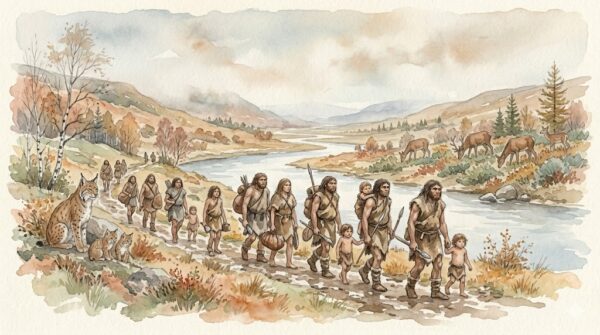
The most detailed genetic study of Neanderthal social organization to date was published in 2022, based on DNA extracted from 13 Neanderthal individuals at Chagyrskaya and Okladnikov Caves in the Altai Mountains of Siberia. Among the 11 Chagyrskaya individuals — seven males and six females across both sites, including eight adults and five children and adolescents — researchers identified a father and his teenage daughter, as well as a pair of second-degree relatives, possibly a boy and his aunt or grandmother. Shared genetic variants called heteroplasmies — which persist for only a few generations — confirmed that several of these individuals lived at the same time, within the same community.
The genetic diversity within this group was extremely low, consistent with a community of approximately 10 to 20 individuals. This is much smaller than the genetic diversity found in any known ancient or modern human population, and is more comparable to the group sizes observed in endangered species on the edge of extinction. These were not large, thriving populations. They were small, tight-knit bands whose survival depended on every member.
Footprint Analysis
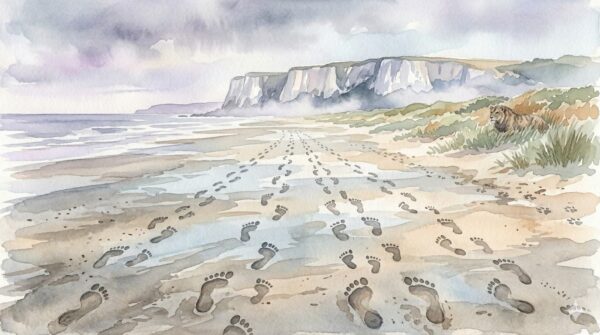
A separate line of evidence comes from footprint analysis. At Le Rozel in Normandy, France, 257 Neanderthal footprints were preserved in coastal dune sediments dating to approximately 80,000 years ago. Morphometric analysis of foot size indicated a group of 10 to 13 individuals, with the majority being children and adolescents — the youngest estimated at about two years of age. At El Sidrón Cave in Spain, the remains of 13 individuals — seven adults, three adolescents, two juveniles, and an infant — provide another snapshot of group composition, though here the group was more heavily adult.
Was There a Leader? What the Evidence Suggests About Paleolithic Leadership
No Neanderthal site has yielded evidence of a chief, a king, or a fixed hierarchy. There are no burial goods that distinguish one individual as more important than others. There are no structures that suggest a central authority figure’s dwelling or workspace. There is nothing in the archaeological record that resembles the status markers — elaborate ornaments, oversized dwellings, disproportionate food stores — that appear much later in human history. (Plausible but unproven — the absence of evidence does not confirm the absence of hierarchy, but no positive evidence exists.)
What the evidence does suggest is functional, situational leadership — the kind observed in small-scale hunter-gatherer societies documented by ethnographers around the world. In groups of 10 to 20 people, formal authority structures are unnecessary and often counterproductive. Instead, influence flows to whoever possesses the most relevant expertise for the task at hand. The best tracker leads the pursuit. The most experienced knapper guides tool production. The person with the deepest knowledge of plant resources directs foraging decisions. (Plausible but unproven — based on analogy with modern hunter-gatherer governance, not direct archaeological evidence. This must be treated as comparative framework, not evidence.)
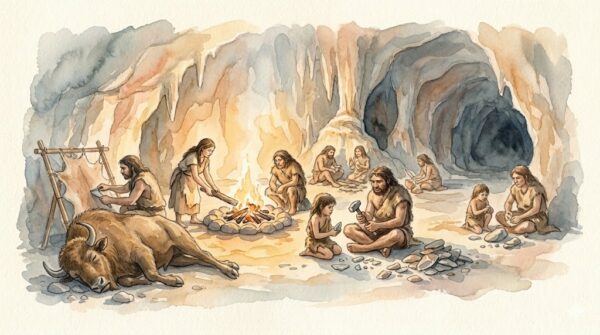
Several lines of indirect evidence support this model. The spatial organization of Neanderthal camps — with communal hearths, shared food processing areas, and no segregated zones indicating privileged access — is consistent with egalitarian social arrangements. The care of injured and disabled individuals documented at sites like Shanidar Cave, where severely wounded Neanderthals survived for years after debilitating injuries, implies collective decision-making about resource allocation — feeding and protecting individuals who could not reciprocate.
Did Women Move Between Groups? Genetic Evidence for Social Networks
The 2022 Chagyrskaya study revealed a striking pattern: mitochondrial DNA diversity — inherited from mothers — was significantly higher than Y-chromosome diversity — inherited from fathers. This implies that Neanderthal communities were connected primarily through female migration. Women moved between groups more frequently than men, carrying new genetic material into neighboring bands. This is consistent with a patrilocal residence pattern, in which males tend to remain in their birth group while females relocate upon reaching reproductive age.
An earlier genetic study of the El Sidrón group reached a similar conclusion, finding that the three adult males shared the same mitochondrial lineage while the three adult females each carried different lineages — suggesting the women had come from three separate groups. If this pattern was widespread, it has profound implications for Neanderthal social structure. It means that Neanderthal bands were not isolated units. They were nodes in a network — connected by the movement of women between groups, maintaining genetic diversity, transmitting knowledge, and building alliances that prevented complete reproductive isolation.
The raw materials found at Neanderthal sites reinforce this picture. Stone tools were predominantly made from local sources — typically within five kilometers. But occasional pieces came from 20, 30, or even over 100 kilometers away. Whether these distant materials arrived through trade, exchange, or the movement of individuals carrying their tool kits between groups, their presence confirms that Neanderthal bands were not self-contained. They maintained connections across landscapes.
What Role Did Elders Play in Neanderthal Society?
In a group of 10 to 20 individuals living through Ice Age winters, the accumulated knowledge of older members would have been invaluable. Where to find water when streams froze. Which valleys held game in late winter. Which plants were safe and which were toxic. When to move camp. This body of ecological knowledge — impossible to acquire in a single lifetime from scratch — represented the intellectual infrastructure of survival.
The skeletal record shows that some Neanderthals survived well into their forties and beyond, despite severe injuries and degenerative conditions. The individual known as Shanidar 1, for example, had suffered a crushing blow to the left side of the head, resulting in blindness in one eye and a withered right arm — injuries sustained years before death. He could not have hunted. He could not have defended himself effectively. Yet he survived, which means his group chose to sustain him. Whether this reflects compassion, obligation, or the practical value of his knowledge, it demonstrates that Neanderthal society placed value on individuals beyond their immediate physical utility.
Cooperation as Survival Strategy: How Neanderthal Intelligence Shaped Group Dynamics
The hunting evidence makes clear that Neanderthal subsistence required close coordination. Faunal assemblages from sites across Europe show selective hunting of large, dangerous game — bison, wild horses, red deer, and even mammoth and woolly rhinoceros. The close-range thrusting spears that constituted the primary Neanderthal hunting weapon demanded coordinated group action. Bringing down a horse or a bison with handheld spears is not a solitary activity. It requires planning, communication, and trust among multiple hunters acting simultaneously.
At some sites, kill assemblages suggest mass hunting events. At Mauran in France, remains estimated to represent approximately 4,000 bison have been interpreted as evidence of repeated, organized drives. At Salzgitter-Lebenstedt in Germany, specialized autumn reindeer hunting left behind extensive processing remains. These are not the activities of isolated individuals. They are the products of organized groups operating with shared goals, coordinated timing, and — almost certainly — recognized roles and responsibilities within the group.
What This Means Today
The Neanderthal model of leadership — situational, expertise-based, and embedded in a cooperative group structure — is remarkably similar to what organizational researchers now call “distributed leadership.” In small, high-stakes teams where survival depends on collective competence, rigid hierarchies are a liability. Influence flows to whoever knows the most about the problem at hand. The Neanderthal band, with its 10 to 20 members, its female-mediated social networks, and its collective care for the injured and elderly, was not a primitive arrangement. It was an adaptive social technology refined over hundreds of thousands of years.
How Neanderthal Leadership Was Rooted in Ecological Knowledge
Leadership in a Neanderthal band was inseparable from ecological competence. The individual who understood when the red deer would cross the river, where the flint outcrop was exposed after spring rains, or which cave offered shelter from specific wind patterns held practical authority that no amount of physical strength could replicate. Neanderthal daily life was governed not by who was strongest but by who knew the land best. This intimate, generation-spanning relationship with the landscape — accumulated through observation, transmitted through apprenticeship, and tested against the unforgiving realities of Ice Age survival — was the true currency of influence.
Lesser-Known Facts
Genetic analysis of the Chagyrskaya Neanderthals revealed that the community’s genetic diversity was comparable to endangered species on the brink of extinction — yet they sustained complex social behaviors and sophisticated tool production. The Le Rozel footprints show a group dominated by children and adolescents, suggesting that Neanderthal bands may have included significantly more young members than previously assumed. At El Sidrón, three adult males shared a single mitochondrial lineage while three adult females each carried different lineages — direct evidence that women moved between groups. Some Neanderthal stone tools originated from sources over 100 kilometers away, demonstrating long-distance connections between groups that extend far beyond the image of isolated cave-dwellers.
Myth vs. Evidence
Common misconception: Neanderthal groups were led by the biggest, strongest male — an “alpha” who dominated through physical force. Evidence: No archaeological evidence supports fixed dominance hierarchies in Neanderthal groups. The small group sizes, communal spatial arrangements, collective care of injured members, and coordinated hunting all point to cooperative, expertise-based social structures rather than strength-based dominance.
Try This
Next time you work on a group project — at work, in a community organization, or even organizing a family event — notice how leadership naturally shifts depending on the task. The person who plans the logistics is different from the person who mediates disagreements, who is different from the person who knows the technical details. That fluid, expertise-based leadership is likely the oldest form of human governance, practiced by Neanderthals for hundreds of thousands of years before the first king was crowned.
What We Still Don’t Know
Did Neanderthal bands have any form of recognized authority beyond situational expertise? Were there rituals or ceremonies that reinforced social bonds? Did alliances between bands involve formal agreements, or were they maintained purely through kinship and individual movement? How did groups resolve disputes when members disagreed about critical decisions like when to move camp? Did the female migration pattern hold across all Neanderthal populations, or was it specific to certain regions and time periods? And perhaps most intriguingly — what happened when a band’s most knowledgeable elder died? How much accumulated wisdom was lost, and how did the group recover?
Summary
Genetic evidence from Chagyrskaya Cave reveals that Neanderthal bands consisted of approximately 10 to 20 closely related individuals, connected to neighboring groups through the migration of women between communities. Footprint evidence from Le Rozel confirms these small group sizes and reveals a surprising proportion of children. The archaeological record shows no evidence of fixed hierarchy, but abundant evidence of cooperation — communal hearths, collective hunting of large game, and long-term care of disabled members. Neanderthal society was built on distributed, expertise-based leadership, ecological intelligence, and intergroup connectivity. Understanding this Paleolithic family structure reveals a social technology that sustained Neanderthal daily life across diverse environments and through hundreds of thousands of years of Ice Age survival.
