I once stood at the mouth of a limestone cave in southern France and tried to imagine two different peoples watching the same herd of red deer cross the same river — and doing so within a few generations of each other. Not in myth. Not as metaphor. As documented fact. The layers of sediment inside caves across Europe and the Levant contain alternating occupation deposits — Neanderthal tools in one stratum, Homo sapiens tools in the next, and sometimes both in the same region during the same centuries. The question is not whether these two species shared landscapes. The question is what happened when they did.
What Does the Genetic Evidence Tell Us About Neanderthal Coexistence?

The clearest proof of close contact between Neanderthals and Homo sapiens comes not from stone tools or hearths but from the genome. Every modern human population whose ancestry traces outside sub-Saharan Africa carries approximately one to four percent Neanderthal DNA. The percentage varies by region, with East Asian populations carrying roughly twelve to twenty percent more Neanderthal ancestry than European populations, a pattern that researchers continue to debate. Within Africa, low levels of Neanderthal DNA have also been identified, likely introduced through back-migrations of Eurasian populations over millennia.
Two major studies published in late 2024 refined the timeline considerably. Using ancient DNA from more than 300 genomes spanning the last 45,000 years — including some of the oldest sequenced Homo sapiens remains from Europe — both research teams independently concluded that the primary period of interbreeding between the two species began approximately 47,000 years ago and lasted for roughly 7,000 years. This is not a single event but an extended period of genetic contact, which implies sustained proximity and repeated encounters between Neanderthal and Homo sapiens groups across multiple regions.
Individuals who lived closer in time to the interbreeding events carried higher proportions of Neanderthal DNA. A jawbone from Peștera cu Oase in Romania, dated to roughly 40,000 years ago, belonged to a modern human with a Neanderthal ancestor as recent as four to six generations back — possibly a great-great-great-grandparent. This individual did not, however, contribute genes to any modern population. Other encounters may have occurred that left no trace in today’s gene pool.
Where Did the Two Species Overlap? Sites of Shared Habitation
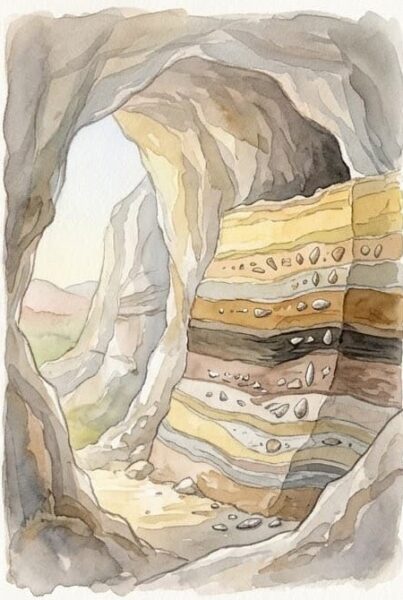
The Levant — the coastal and inland regions of modern-day Israel, Lebanon, Syria, and Jordan — is the most intensely studied zone of Neanderthal-Homo sapiens overlap. This region served as a corridor between Africa and Eurasia, and fossils of both species have been found in caves within a few dozen kilometers of each other. At Skhul and Qafzeh caves in Israel, early Homo sapiens were present between approximately 120,000 and 90,000 years ago. By around 70,000 years ago, Neanderthals had expanded into the same region, as evidenced at Tabun Cave and elsewhere. Then, after approximately 55,000 years ago, Homo sapiens permanently reoccupied the area.
Crucially, both species produced nearly identical Mousterian stone tools during their time in the Levant. Whether this reflects cultural transmission between the two groups or independent convergence toward similar solutions to identical environmental challenges remains debated. Some researchers argue for direct contact and learning. Others point out that similar raw materials, prey animals, and ecological pressures could produce functionally identical toolkits without any interaction at all.
A landmark 2025 study of Tinshemet Cave in central Israel offered the most direct evidence yet for meaningful cultural exchange. Researchers documented human burials, Mousterian tools, and extensive use of ochre pigment — all from layers dated to roughly 130,000 to 80,000 years ago and potentially associated with both Neanderthals and early Homo sapiens. The study concluded that different human groups in the mid-Middle Paleolithic Levant shared technology, hunting strategies, and symbolic behaviors including burial practices and body decoration.
Did Neanderthals and Homo Sapiens Meet in Europe?
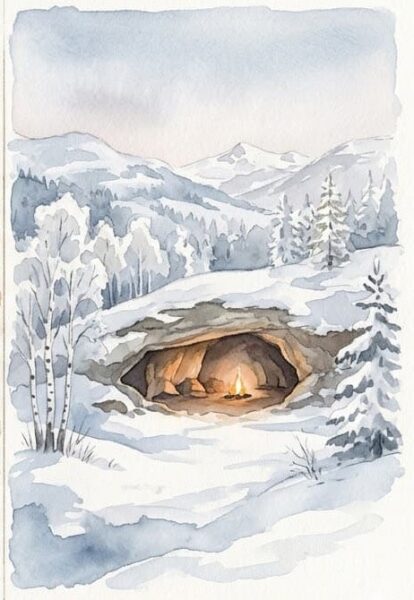
In Europe, the overlap was shorter but intense. Homo sapiens arrived carrying proto-Aurignacian technology — characterized by smaller, precisely worked blades — between approximately 42,200 and 42,600 years ago in France and northern Spain. Neanderthal-associated Châtelperronian tools persisted in the same region until approximately 39,800 to 40,800 years ago. Optimal linear estimation models suggest the two populations co-existed in this region for approximately 1,400 to 2,800 years — long enough for dozens of generations of potential contact.
The Châtelperronian industry itself sits at the heart of one of the most debated questions in paleoanthropology. These tool assemblages combine elements of the older Mousterian tradition — which is securely associated with Neanderthals — with features more typical of the Upper Paleolithic, including small blades, bone tools, and even shell ornaments. At the Grotte du Renne in Arcy-sur-Cure, France, Neanderthal remains have been directly associated with Châtelperronian layers containing sophisticated bone tools and body ornaments. Whether Neanderthals developed these innovations independently, borrowed them from neighboring Homo sapiens populations, or participated in a shared creative tradition remains one of the unresolved questions in Ice Age archaeology.
What About Denny? Direct Evidence of Interbreeding Between Archaic Humans
The most striking single piece of evidence for close encounters between different human species is a bone fragment discovered in Denisova Cave in the Altai Mountains of Siberia. Designated Denisova 11 and nicknamed “Denny,” this fragment belonged to a teenage girl who lived approximately 90,000 years ago. Genomic analysis revealed that she was a first-generation hybrid — her mother was a Neanderthal and her father was a Denisovan, a related but genetically distinct archaic human group. Her mitochondrial DNA, inherited exclusively from her mother, was Neanderthal. Her nuclear DNA was split nearly equally between Neanderthal and Denisovan chromosomes with minimal mixing — the hallmark of a direct first-generation cross.
Out of only about two dozen ancient hominin genomes sequenced from this period, two show recent hybrid ancestry — Denny and the Oase individual from Romania. The fact that two out of such a small sample carry clear signs of very recent interbreeding suggests that mating between different human species was not rare. It was likely a regular feature of life during the Late Pleistocene wherever different human populations overlapped.
What Does Neanderthal Coexistence Tell Us About Their Society?
The interbreeding evidence forces a reconsideration of how we think about Neanderthal social behavior. These were not brief or isolated contacts. A 7,000-year period of gene flow implies that generation after generation of Neanderthals and Homo sapiens encountered each other, recognized each other as potential mates, and raised children who survived to adulthood and reproduced. The gene flow appears to have been largely one-directional — Neanderthal DNA entered the Homo sapiens gene pool, but there is currently little evidence of substantial Homo sapiens DNA flowing into Neanderthal genomes. This asymmetry is not yet well understood and may reflect differences in population size, social structure, or simply the vagaries of preservation and sampling.
Several Neanderthal gene variants that entered the Homo sapiens genome proved advantageous — particularly those related to immune function, skin pigmentation, and metabolism, which increased in frequency over time. These contributions helped our ancestors adapt to Eurasian environments where Neanderthals had evolved for hundreds of thousands of years.
Not Replacement — Entanglement
The old narrative — Homo sapiens arrived, outcompeted Neanderthals, and replaced them — is now recognized as an oversimplification. The emerging picture is one of entanglement: overlapping territories, shared or convergent technologies, cultural exchange, and interbreeding that left a permanent genetic legacy. Neanderthals did not simply vanish. They were partly absorbed into the expanding Homo sapiens gene pool. Their DNA persists in billions of living humans today. Fossil evidence of trauma and eventual demographic decline suggest competition for resources occurred, particularly during climatic stress. (Plausible but unproven — direct evidence of violent interspecies conflict is absent.) But the dominant narrative is shifting from confrontation to complexity.
What This Means Today
The Neanderthal coexistence story carries an uncomfortable resonance. We tend to narrate encounters between different peoples as competition leading to replacement. The archaeological record suggests something more nuanced — that genetic and cultural exchange between different human groups is not an exception in our evolutionary history but a defining feature of it. The interbreeding was not catastrophic. It was adaptive. Neanderthal genes helped our ancestors survive. The lesson is not about one species triumphing over another. It is about what happens when closely related populations share space, share knowledge, and share their futures.
A Closer Connection to Prehistoric Ecology
Both Neanderthals and early Homo sapiens depended on the same ecosystems — the same herds of horses and reindeer, the same rivers and seasonal plant cycles, the same microclimates created by limestone cave systems. Their coexistence was mediated by the landscape itself. During warmer interstadial periods, resources were more abundant and the ecological niche could support both populations. During harsh climatic downturns, competition would have intensified. Understanding their overlap means understanding how two intelligent species navigated shared dependence on the same fragile environments — a dynamic that has obvious parallels to modern ecological challenges.
Lesser-Known Facts
Neanderthal DNA accounts for approximately one to four percent of the genome of every living non-African human — roughly 20 percent of the total Neanderthal genome survives in fragments distributed across the modern human population. A first-generation Neanderthal-Denisovan hybrid, discovered in Denisova Cave, demonstrates that interbreeding between different archaic human species also occurred. The primary period of Neanderthal-Homo sapiens interbreeding lasted approximately 7,000 years — not a single event but a sustained era of genetic contact. In the Levant, Neanderthals and Homo sapiens used virtually identical stone tool technologies for tens of thousands of years, making it sometimes impossible to determine which species made which tools from technology alone. Some Neanderthal gene variants, particularly those related to immune function and skin pigmentation, increased in frequency in human populations over time — evidence that they conferred survival advantages.
Myth vs. Evidence
Common misconception: Homo sapiens quickly replaced Neanderthals through superior intelligence or technology. Evidence: The two species coexisted in Europe for up to 5,400 years, and in the Levant for far longer. The overlap involved shared technologies, cultural exchange, and sustained interbreeding — not a simple takeover.
Try This
Next time you visit a natural area that borders different terrain types — a river valley meeting woodland, or lowland meeting hills — notice how different ecological zones attract different species that nonetheless share the same water, trails, and seasonal resources. This is the kind of overlapping landscape where two different human species once coexisted, competed, and occasionally merged.
What We Still Don’t Know
Why did gene flow appear to be primarily one-directional — from Neanderthals into the Homo sapiens genome? Was this a product of population size differences, social organization, or something else? Did Neanderthals and Homo sapiens communicate verbally, and if so, could they understand each other? Were hybrid children raised in Neanderthal groups, Homo sapiens groups, or both? What role did climate change play in determining when and where the two species overlapped? And did the interbreeding that contributed Neanderthal genes to our species also accelerate the demographic decline of Neanderthal populations? These questions remain open, awaiting new genomic data and archaeological discoveries.
Summary
Neanderthal coexistence with Homo sapiens was not a brief collision — it was a complex, multi-millennial entanglement that shaped both species. Genetic evidence confirms sustained interbreeding beginning approximately 47,000 years ago and lasting roughly 7,000 years, leaving a permanent legacy in modern human DNA. Archaeological sites across the Levant and Europe document overlapping habitation, shared tool technologies, and possible cultural exchange. The discovery of first-generation hybrid individuals demonstrates that encounters between different human species were intimate and not uncommon. Understanding Neanderthal daily life during this period of overlap — their Ice Age survival strategies, their intelligence, and their society — reveals that our evolutionary story is one of interaction, adaptation, and shared ancestry rather than simple replacement.
