I have walked past yarrow a hundred times without noticing it. It grows in meadow margins and along roadsides across temperate Europe, unremarkable to the hurried eye — a cluster of flat white flower heads above feathery leaves. And yet, roughly 49,000 years ago, inside a limestone cave in northern Spain, a Neanderthal individual with an abscessed tooth was chewing this exact plant. We know because the chemical traces of that decision survived inside the calcified plaque still clinging to their teeth, preserved for millennia in a silent archive of Paleolithic daily life.
That small, quiet act — selecting a bitter, non-nutritional plant and deliberately putting it into the mouth during a period of illness — tells us something remarkable about Neanderthal intelligence, ecological observation, and the deep roots of healing practices in our shared human lineage.
What Did Neanderthals Use as Medicine? Evidence Locked in Dental Calculus
The evidence comes from El Sidrón Cave in Asturias, Spain, where a community of at least thirteen Neanderthal individuals lived between approximately 47,300 and 50,600 years ago.

Researchers applied sequential thermal desorption-gas chromatography-mass spectrometry to samples of dental calculus — the mineralized plaque that accumulates on teeth over a lifetime, trapping microscopic particles of whatever passes through the mouth. Inside those tiny crusts of ancient plaque, the team discovered chemical compounds called azulenes and coumarins. These are signature molecules found in two plants: yarrow (Achillea millefolium) and chamomile (Matricaria chamomilla).
The chemical compounds were directly extracted from Neanderthal dental calculus and identified through mass spectrometry. The findings represent the first molecular evidence for the use of medicinal plants by a Neanderthal individual.
Neither yarrow nor chamomile has any meaningful nutritional value. Both are intensely bitter. That bitterness is a critical detail, because the same El Sidrón Neanderthals carried the TAS2R38 gene — the gene responsible for perceiving bitter taste. This means they could detect bitterness and, in everyday circumstances, would likely have avoided these plants.
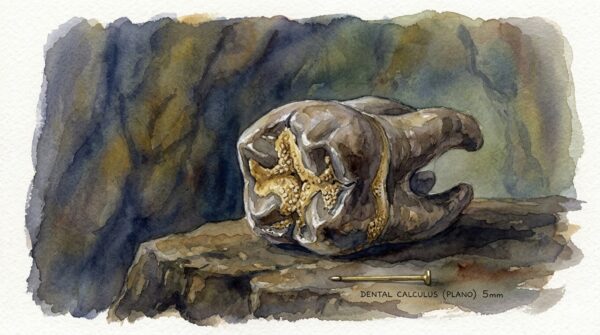
The fact that they consumed them anyway, and that one individual also had a dental abscess, strongly suggests deliberate ingestion during illness rather than accidental or routine consumption.
This kind of knowledge didn’t exist in isolation. The same people who understood which plants dulled pain also worked out how to bind stone to wood using materials that had to be prepared just as carefully.
How Did Neanderthals Know Which Plants Could Heal?
The question of how Neanderthals acquired this knowledge remains one of the most fascinating puzzles in Paleolithic research. No written record exists, of course, and we cannot reconstruct their teaching methods with certainty. But we can look at the broader context of observational intelligence in the animal world.
Chimpanzees and many other primates are known to chew on specific non-nutritional plants when they are ill — a behaviour well documented by primatologists studying self-medication in great apes. Given that Neanderthals shared close evolutionary kinship with both modern humans and common ancestors of apes, the capacity for recognising the medicinal properties of plants through careful observation and trial would have been deeply rooted in their cognitive toolkit.
This was not random grazing. It required the ability to observe what happened when a certain plant was consumed, to remember the effect, and to choose it again when similar symptoms returned. It required attention to the landscape across seasons — knowing where yarrow grew, when chamomile flowered, which parts of the plant to use. For a species living in small, mobile groups of perhaps ten to twenty-five individuals, this kind of accumulated ecological knowledge would have been essential to Neanderthal daily life and survival.
What Does the Archaeological Record Actually Show?
Beyond the El Sidrón dental calculus evidence, the archaeological record offers other tantalising connections between Neanderthals and healing plants. At Shanidar Cave in the Zagros Mountains of modern Iraq, excavations in the mid-twentieth century uncovered unusually high concentrations of pollen around a Neanderthal burial designated Shanidar IV. The pollen belonged to several plant genera with long-documented medicinal associations, including yarrow, mallow, and ephedra.
The El Sidrón dental calculus is more compelling precisely because it is direct: it connects specific bioactive plant compounds to an individual who was also suffering from a dental infection. Dental calculus traps what actually entered the mouth during life, making it one of the most reliable evidence types for reconstructing Paleolithic behaviour. Across multiple sites in Europe, researchers have now identified over sixty different plant taxa in Neanderthal dental calculus from at least seventeen archaeological sites, revealing evidence for the consumption of cooked starches, nuts, grasses, and green vegetables alongside the medicinal compounds. The use of medicinal plants implies a Neanderthal society that was more cognitively sophisticated than the old stereotype of the brute hunter ever allowed. Recognising that a particular bitter plant eases a toothache, and then deliberately seeking it out, requires a chain of reasoning that includes: identifying the illness, recalling a past remedy, locating the plant in the landscape, and preparing or ingesting it despite its unpleasant taste. It also suggests a social dimension. In a small group where every adult’s survival mattered, the knowledge of which plants could help a sick or injured member would have been shared — likely across generations, from elder to child, observed and learned through repeated demonstration. This fits a broader picture of Neanderthal caregiving. Across multiple sites, skeletal evidence reveals individuals who survived severe injuries and lived for years afterward, which would have been impossible without sustained care from others in their group. Neanderthal healing practices and Neanderthal society were clearly intertwined. It’s easy to separate “medicine” from “tools,” but for them it was all part of the same process — observe, test, remember. Yarrow is still used in traditional herbal practice across Europe as an astringent and anti-inflammatory. Chamomile remains one of the most commonly consumed herbal teas worldwide, valued for its calming and digestive properties. Both plants grow readily in temperate climates and require no cultivation — they are wild volunteers, appearing along paths and in meadows, exactly as they would have appeared in the landscapes Neanderthals walked. There is a lesson in this continuity that goes beyond botany. Neanderthals did not invent pharmaceutical companies or peer-reviewed clinical trials. But they did something that lies at the foundation of all medicine: they paid close attention to the natural world, noticed correlations between plant consumption and physical relief, and acted on those observations. The next time you steep a chamomile tea for a headache or an unsettled stomach, you are performing a version of a behaviour that may be at least 49,000 years old — and possibly far older. Important note: The plants discussed in this post are described in their archaeological and historical context. Some plants that were consumed in the Paleolithic can be toxic in incorrect dosages. Yarrow can cause skin irritation and allergic reactions in some individuals and should not be consumed during pregnancy. This post is not medical advice. Consult a qualified healthcare provider before using any plant for medicinal purposes. The relationship between Neanderthals and their plant environment was not one-directional. Neanderthal survival depended on ecological balance — on knowing which plants grew where, which seasons brought which resources, and how to use the landscape without exhausting it. Their small group sizes and mobile lifestyle meant they moved through territories without depleting any single area’s plant resources. This stands in sharp contrast to modern industrial agriculture and pharmaceutical extraction, which can strip ecosystems bare. The quiet sophistication of Neanderthal healing practices — grounded in direct observation rather than exploitation — offers a model of sustainable interaction with flora that modern readers may find surprisingly relevant as conversations about ecological balance and traditional botanical knowledge continue to grow. 1. Neanderthal dental calculus has preserved evidence of over sixty different plant taxa from twenty-six plant families across seventeen archaeological sites — far more than the “meat only” stereotype ever acknowledged. 2. Some starch granules found in Neanderthal dental calculus show evidence of having been cracked by heat, indicating that they cooked their plant foods — a previously unrecognised level of dietary sophistication. 3. The TAS2R38 bitter taste gene found in El Sidrón Neanderthals is the same gene present in many modern humans, suggesting a shared evolutionary heritage of plant-tasting ability. 4. Ancient bacteria have been found embedded in Neanderthal dental calculus, opening an entirely new window into Paleolithic oral health and potential disease. 5. Wood smoke compounds and bitumen residues were also found in El Sidrón dental calculus, providing the first molecular evidence that Neanderthals inhaled wood fire smoke regularly — an everyday marker of a fire-centred life. The evidence for Neanderthal medicinal plant use is compelling but narrow. We do not yet know how widespread this behaviour was across different Neanderthal populations and climates. We do not know whether they used plants externally — as poultices or wound dressings — because such applications leave almost no archaeological trace. The Shanidar pollen debate remains unresolved, and we cannot yet determine whether the plants found in dental calculus represent regular self-medication or occasional use during acute illness. Perhaps most importantly, we do not know how this knowledge was transmitted: whether it was taught deliberately, learned by imitation, or independently rediscovered by each generation. The dental calculus tells us what entered the mouth. It does not yet tell us the full story of why. Neanderthal healing practices were grounded in a sophisticated understanding of the natural world, as demonstrated by chemical evidence of yarrow and chamomile consumption preserved in 49,000-year-old dental calculus from El Sidrón Cave, Spain. These non-nutritional, bitter plants were likely consumed for their medicinal properties, suggesting that Neanderthal intelligence extended to observational ecology, plant knowledge, and care for the sick. This evidence reshapes our understanding of Neanderthal daily life, Neanderthal society, and the deep roots of Ice Age survival strategies built around ecological awareness and community compassion. Bumblebees will selectively visit plants containing compounds that reduce parasite loads — not for nectar, but for medicine. They can’t explain what they’re doing. They just know to do it. If a bumblebee can figure out which plant to visit when it’s sick — is it really so far-fetched that a Neanderthal could too? What This Suggests About Neanderthal Society and Intelligence
What This Means Today
How Did Neanderthals Survive Winter Without Modern Medicine?
Lesser-Known Facts
What We Still Don’t Know
Summary
