I try sometimes to strip the noise away. The electrical hum. The road traffic. The distant aircraft. I try to hear what someone sitting beside a fire would have heard 60,000 years ago, deep in a European winter, in a limestone cave overlooking a frozen valley. Not silence — never silence. The Pleistocene night was full of sound. Wind against rock. The crack of frost splitting wood. The low, shuddering calls of animals moving through darkness. And beneath it all, the steady pop and hiss of a fire that someone had to keep alive. This is not fiction. Every element of the soundscape I am about to describe is grounded in archaeological, paleoclimatic, and faunal evidence from Neanderthal occupation sites across Europe. No invented dialogue. No named characters. Just the sounds the evidence allows us to reconstruct.
How Did Neanderthals Experience Winter? Climate Evidence from the Late Pleistocene
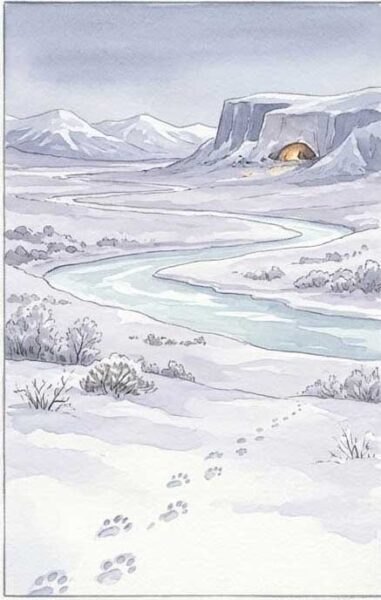
Neanderthals inhabited Europe during some of the most extreme climatic fluctuations of the last 400,000 years. During glacial periods, winter temperatures across central and western Europe dropped well below modern averages. Ice cores and deep-sea sediment records show that during Marine Isotope Stage 3 — roughly 60,000 to 30,000 years ago, the final millennia of Neanderthal existence — winter temperatures in regions like the Dordogne, the Cantabrian coast, and the Rhine Valley frequently fell to minus fifteen or minus twenty degrees Celsius. Snow cover persisted for months. Daylight hours in central Europe contracted to as few as eight per day. The nights were long, cold, and profoundly dark.
At the latitude of many known Neanderthal winter camps — approximately 43 to 50 degrees north — midwinter darkness would have lasted from late afternoon to well past dawn. Without artificial light beyond the hearth, the fire was the center of everything: warmth, light, protection, and the organizing principle of the group’s spatial life.
What Did the Fire Sound Like?
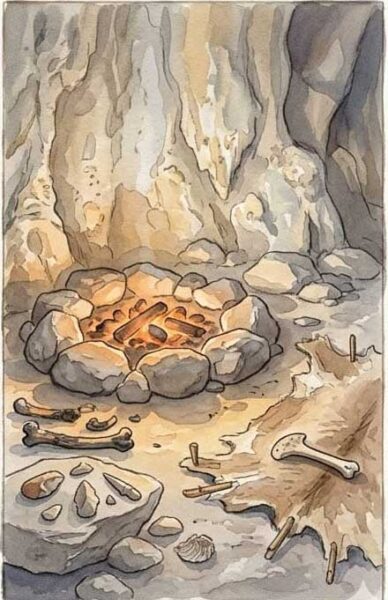
The hearth was the acoustic anchor of a Neanderthal winter camp. Fire produces a distinctive soundscape — the pop of moisture escaping from wood cells, the crackle of bark igniting, the soft roar of sustained combustion, and the periodic collapse of burning wood into embers. These sounds would have been continuous, varying in intensity as fuel was added or consumed.
At Bolomor Cave in eastern Spain, archaeologists documented a sequence of hearths spanning from approximately 350,000 to 100,000 years ago. The oldest combustion structures from this site include basin-shaped hearths and hearths built on prepared stone beds — insulation layers designed to protect the fire from damp ground. At the Navalmaíllo Rock Shelter near Madrid, spatial analysis of a Neanderthal hunting camp revealed that the distribution of lithic tools, animal bones, and coprolites clustered tightly around hearth locations — confirming that the fire served as the organizing backbone of camp activity.
Research at Lazaret Cave in southern France and at the recently studied Qesem Cave in Israel demonstrated that Neanderthals and earlier human groups placed their hearths at optimal positions to minimize smoke inhalation while maximizing usable space within the cave. Computer modeling of airflow dynamics at one well-studied site showed that the central cave area — precisely where prehistoric hearths were found — dispersed smoke most effectively. This means the fire’s sound was close. It was surrounded by people. It shaped the acoustic environment of every winter night.
What Animals Were Calling in the Night?
The Pleistocene soundscape outside the cave would have been profoundly different from anything we hear in modern Europe. Faunal assemblages from Neanderthal occupation layers — the bones they discarded, the species they hunted, and the predators whose remains accumulated naturally — paint a vivid picture of the animal communities that surrounded winter camps.
Wolves were omnipresent. Their bones appear at virtually every Neanderthal site across Europe. In winter, wolf packs are most vocal — long, resonant howls used for territorial communication carry for kilometers across open landscapes. A Neanderthal group camped in a river valley or at the base of a cliff would have heard these calls regularly, particularly at dusk and dawn. The howl of a Pleistocene wolf would have been deeper and more sustained than that of its modern descendant — the wolves of the Late Pleistocene were significantly larger than modern European wolves.
Cave hyenas occupied many of the same rock shelters that Neanderthals used, their coprolites and gnaw-marked bones interspersed with Neanderthal occupation layers across France, Spain, and Germany. The spotted hyena’s distinctive “whoop” call and unsettling social vocalizations carry for several kilometers — sounds that would have been impossible to ignore in the stillness of a Pleistocene night.
Cave lions, the largest cats of the Pleistocene, were present across Neanderthal territory. Their remains have been found in cave deposits alongside Mousterian tools. Modern lions produce roars audible at distances of eight kilometers. The cave lion was roughly 25 percent larger than its modern African relative. A roar from a cave lion in a frozen valley at night would have carried enormous distances across still, cold air — sound travels farther and more clearly in cold, dense atmospheric conditions.
What Sounds Came from the Land Itself?
Winter in the Pleistocene was an acoustic environment shaped by ice, wind, and stone. Frost-cracking — the splitting of rock caused by the expansion of frozen water in crevices — produces sharp, sudden reports that echo across cliff faces and valley walls, particularly during deep nighttime temperature drops. In limestone karst landscapes, where many Neanderthal caves are located, these sounds would have been frequent and startling.
Wind was a constant presence. Paleoclimatic modeling indicates that prevailing westerly winds during glacial periods were stronger than today, driven by steeper temperature gradients between ice sheets and the open Atlantic. At cave openings, wind creates distinctive sounds — low moans, high whistles, and fluctuating pressure changes audible inside the shelter. Some caves produce resonant tones when wind conditions are right.
Nearby streams would have shifted their acoustic character across the winter — from the murmur of open water to the grinding of shifting ice plates to the eerie stillness of a fully frozen watercourse, each stage amplifying every other sound in the landscape.
What Sounds Came from Inside the Camp?
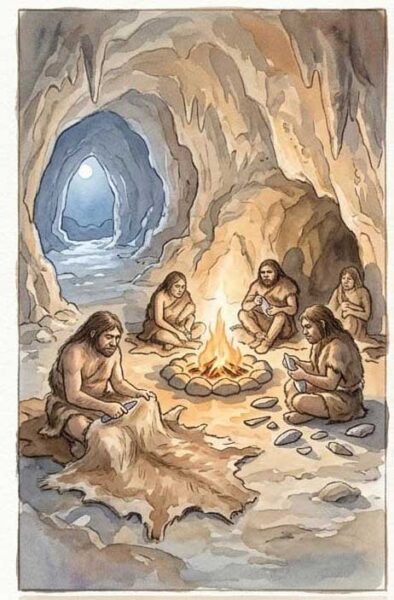
The sounds of Neanderthal daily life in a winter camp would have included stone-on-stone percussion from tool maintenance. Mousterian technology — the dominant Neanderthal toolkit — required regular resharpening and flake removal, processes that produce sharp, high-pitched knapping sounds. Use-wear analysis of tools found at winter occupation sites shows evidence of retouching and maintenance performed in situ, near hearths. The sound of a hammerstone striking a flint core is distinctive and percussive, audible across the length of a moderate cave.
Hide processing is another activity with a clear acoustic signature. Scrapers — among the most common tools in Neanderthal assemblages — were used to clean, soften, and prepare animal hides. Scraping hide produces a rhythmic rasping sound. Faunal analysis at many winter-associated Neanderthal sites shows high frequencies of medium-to-large mammal bones with cut marks consistent with skinning, defleshing, and hide removal. In a cold cave, this work may have continued by firelight during the long evenings.
And then there is vocalization. Whether Neanderthals possessed language in a form comparable to modern human speech remains debated. Anatomical evidence shows that Neanderthals possessed a hyoid bone — a small bone in the throat critical for speech — virtually identical in shape and structure to that of modern humans. Genetic evidence shows they carried a version of the FOXP2 gene associated with speech and language capacity in modern humans. Reconstructions of the Neanderthal vocal tract suggest they could produce a range of vowel and consonant sounds. Whether these capacities were used for structured language, simpler vocal communication, or something in between remains unknown. But a Neanderthal winter camp was not silent. People communicated. Children made noise. The human voice was part of the soundscape.
What This Suggests About Neanderthal Society
A group organized around a carefully positioned hearth, processing hides, maintaining tools, communicating vocally, and monitoring the calls of predators through long winter nights — this is not a picture of a species merely enduring cold. It is a picture of a species adapted to it. The acoustic environment — the wolves, the wind, the cracking frost — was as familiar to them as traffic noise is to a modern city-dweller. Neanderthal daily life in winter was not passive survival. It was active engagement with a complex, information-rich world.
What This Means Today
We have engineered silence into our lives at an extraordinary cost. Soundproofing, noise-cancelling headphones, and controlled indoor environments have severed our connection to the acoustic landscape that every human ancestor experienced. The Neanderthal winter night — with its layered complexity of wind, animal calls, fire, and human activity — reminds us that for most of our evolutionary history, sound was information. It told you where the predators were, whether the weather was changing, and whether the fire was dying. Paying attention to the natural soundscape around us is one of the oldest survival skills in the human lineage.
How Neanderthal Survival Depended on Ecological Awareness
Every sound in the Neanderthal winter night carried ecological information. Wolf howls indicated pack locations. Hyena calls signaled competition for carcasses. Frost-cracking warned of dangerous temperature drops. The absence of flowing water meant ice coverage affecting travel routes. Neanderthals who survived Ice Age winters read the landscape with all their senses, interpreting environmental signals in real time — a form of ecological intelligence sustained across hundreds of thousands of years.
Lesser-Known Facts
Computational modeling of cave airflow confirms that Neanderthals placed hearths in positions minimizing smoke while maximizing living space. Cave hyenas left coprolites and gnaw-marked bones in many of the same caves Neanderthals occupied, sometimes in alternating layers — suggesting direct competition for shelters. Cold air transmits sound more efficiently than warm air, meaning Neanderthals would have heard animal calls from significantly greater distances during winter. The oldest known evidence of deliberate fire-making dates to approximately 400,000 years ago in England.
Myth vs. Evidence
Common misconception: Neanderthals lived in caves as a last resort, huddled and miserable. Evidence: Hearth placement patterns, spatial organization of tools and food waste, and repeated seasonal reoccupation of the same sites demonstrate deliberate, planned use of cave shelters as structured living spaces — not desperate refuges.
Try This
On a clear winter night, step outside and stand still for five minutes. Close your eyes. Listen. Identify every layer of sound — wind, distant traffic, animal calls, the creak of tree branches. Now subtract the human-made sounds. What remains is closer to the acoustic world that Neanderthals navigated every night. Notice how much richer and more informative the natural soundscape is when you pay attention to it.
What We Still Don’t Know
Did Neanderthals use vocalization, song, or rhythmic sound-making during winter nights? No instruments have been unambiguously attributed to Neanderthals — the claimed bone flute from Divje Babe in Slovenia remains highly contested. Did they tell stories? The cognitive and anatomical evidence permits it, but direct evidence is absent. Did they respond to the sounds of predators with calls of their own, or maintain deliberate silence? How much of their nightly routine was shaped by acoustic monitoring of their environment? These questions sit at the boundary of what archaeology can recover and what must remain, for now, in the realm of informed imagination.
Summary
Reconstructing the soundscape of a Neanderthal winter night draws on paleoclimate data, faunal assemblages, hearth placement analysis, and acoustic science to create a picture grounded in evidence rather than fantasy. Neanderthal daily life during Ice Age winters revolved around fire — optimally placed for smoke management and spatial efficiency. The night beyond the cave mouth was populated by the calls of wolves, hyenas, and cave lions, the cracking of frost on stone, and the variable voice of wind and water. Inside, the sounds of tool maintenance, hide processing, and human vocalization filled the firelit space. This was not primitive survival. It was a deeply adapted existence within a complex prehistoric ecology — an Ice Age survival strategy shaped by hundreds of thousands of years of accumulated knowledge about how to live through the long darkness.
