The Cursed Harvest: When Farming Made Women Sick
Agriculture wasn’t a gift from the gods. For the first women who tried it, it was a biological horror story.
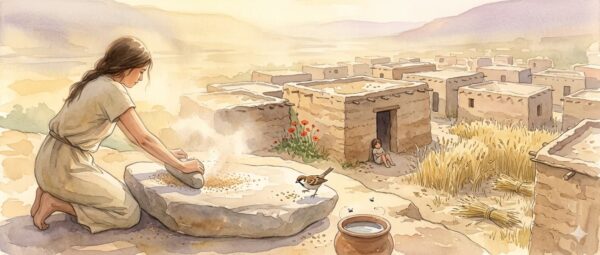
There is a grinding stone in every archaeological museum in the world. It sits in a glass case, usually near the flint tools and the pottery shards, with a small label that says something like “Neolithic, circa 7000 BCE, used for processing grain.”
Nobody stops to look at it. It’s a rock with a dip in the middle. Compared to a polished axe head or a painted pot, it is aggressively boring.
But if you could read that stone the way you read a skeleton — the wear pattern, the depth of the hollow, the silica dust ground into its pores — it would tell you a horror story. It would tell you about a woman who knelt on that stone for eight hours a day, every day, crushing emmer wheat into powder. It would tell you about the grit that wore her teeth to the pulp. The fungal spores — ergot, aspergillus — she inhaled with every stroke. The grinding stress that deformed her toe joints and collapsed the cartilage in her knees.
And if you could read the tiny skeleton buried near the stone — the child who didn’t make it past age four — it would tell you something worse. That child’s bones are porous, pitted, stunted. Its teeth came in soft and rotting. It died of something its grandmother’s grandmother had never seen.
The “gift” of agriculture was a curse. And women’s bodies paid the price first.
The Body Count
Bones don’t lie. Before agriculture, European forager men averaged about 178 centimeters tall. Women averaged 168. They were robust, long-limbed, and their skeletons show remarkably few signs of chronic disease. Their teeth were mostly intact.
After the transition to farming, men dropped to 165 centimeters. Women fell to 155. A loss of thirteen centimeters — over five inches — in a single generation. It took until the twentieth century for average European height to recover to pre-Neolithic levels. Ten thousand years to undo the damage of the first harvest.
Women were hit hardest. Skeletal studies spanning six thousand years show that female body size was disproportionately impacted — more growth impairment, more developmental stress, more bone lesions than males in the same settlements. Dental caries exploded: 68 percent of early Neolithic farmer adults had cavities, with women trending higher at most sites. Among foragers, the rate was near zero. Analysis of ancient dental plaque revealed that farming permanently altered the bacterial ecosystem inside the human mouth, shifting it toward a disease-associated state that has persisted for ten thousand years.
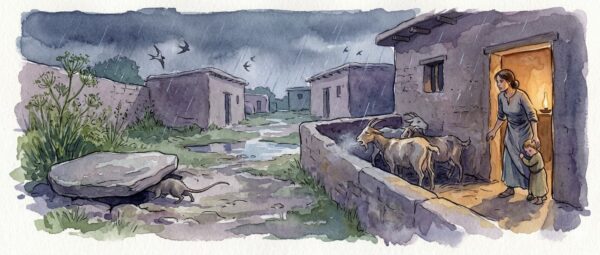
And it wasn’t just the food. For two hundred thousand years, humans had been too fast, too scattered, too few for a plague to catch. Then we stopped moving. We packed into mud-brick villages. We penned goats and cattle next to our sleeping quarters. We stored grain in underground pits that attracted rodents. For the first time in human history, we were dense enough to die.
Measles descended from rinderpest, a cattle plague. Influenza jumped from pigs and ducks. Tuberculosis likely crossed from cattle or goats. Brucellosis — which causes fever, joint pain, and miscarriage in pregnant women — spread through unpasteurized goat’s milk. At one of the world’s earliest farming towns in central Turkey, nine thousand years old, skeletons reveal a cascade of infections that foragers had never faced. A study of ancient DNA showed that the Neolithic literally rewired the European immune system — evolution favored genes that throttled back inflammatory responses, because hyper-inflammation was killing farmers faster than the diseases themselves.
And then came the fertility trap. More grain meant more calories. More calories meant earlier puberty, more pregnancies, shorter intervals between births. More babies born into a sick, pathogen-saturated village meant more infant death. The more they farmed, the more they bred. The more they bred, the sicker they got. The sicker they got, the more desperately they had to farm.
The first farmers didn’t just live next to animals. They lived inside the same disease cloud. And they had no immunity, no word for “contagion,” and no medicine that worked — yet.
This is what most stone age historical fiction gets wrong. The Neolithic is almost always written as progress — bigger villages, better food, the dawn of civilization. But the skeletons tell the opposite story. The first farmers were shorter, sicker, and died younger than the foragers they replaced. If your image of prehistoric fiction is brave hunters and golden harvests, the bones have bad news. The real stone age world was darker, stranger, and more desperate than any novel has dared to show — until now.
Pandora’s Jar Was a Grain Storage Vessel
Every early agricultural civilization tells the same story. Paradise was lost when humans started farming.
In Genesis, Eden is a garden where food grows without labor. God’s curse on Adam is not a metaphor — it is a clinical description of the Neolithic transition: “Cursed is the ground because of you; through painful toil you will eat food from it all the days of your life.” Scholars have argued directly that this story “seems openly to lament the Neolithic revolution” and “regards an agricultural way of life as a cursed way of life.”
In Greek myth, Hesiod describes a Golden Age when humans lived like gods — the earth gave food without toil, old age didn’t exist, disease was unknown. Then Pandora opens her pithos. Not a box — a storage jar, the signature container of grain-farming societies. Out pour disease, suffering, and death. Hesiod even instructs farmers to “build your granaries” — to pour their hope of survival into Pandora’s jar.
The Sumerian paradise of Dilmun — a place without sickness, death, or suffering — predates Genesis by centuries. Chinese tradition describes an “age of perfect virtue” destroyed by an unquenchable thirst for knowledge. The Popol Vuh of Mesoamerica recalls a beautiful land “full of pleasures” before the fall.
These myths aren’t allegories invented by philosophers. They are cultural memories — compressed and transmitted across millennia — of the most traumatic transition in human history. The skeletons confirm what the stories remember.
Every civilization recalled the same thing: there was a time before the grain, when we were taller, healthier, and free. We called it paradise. We called its loss a curse. The bones say we were right.
There’s a reason stone age fiction stays with you. Eden, Dilmun, the Golden Age — every culture on Earth remembers a paradise that was lost. We feel it when we read prehistoric fiction set before the harvest: something true underneath the story, something our bodies recognize even if our minds have forgotten. That feeling isn’t nostalgia. It’s ten thousand years of biological memory — encoded in our crowded teeth, our grain-dependent guts, and our immune systems still shaped by the first epidemic. The stone age world isn’t ancient history. It’s the operating system we’re still running.
The Healer’s War
Here is where the story turns. Because the cursed harvest didn’t just create disease. It created medicine.
The healers of the stone age world before farming carried knowledge that was tens of thousands of years deep. Dental calculus from a 50,000-year-old Neanderthal at a cave in northern Spain contained chemical residues of yarrow and chamomile — bitter plants with no nutritional value but potent anti-inflammatory and antimicrobial properties. Willow bark — the biochemical ancestor of aspirin — appears across the Paleolithic record. Birch bark tar, used as an antiseptic wound sealant, dates back over 200,000 years. Forager healers knew hundreds of plants: which roots reduced fever, which leaves stanched bleeding, which bark eased the pain of a difficult birth.
But that pharmacopoeia was built for forager problems — hunting injuries, parasitic infections, dental abscesses, wound care. It was not built for what the Neolithic unleashed: zoonotic fevers jumping from goats to humans, grain-storage mold poisoning winter food supplies, crowd diseases ripping through settlements of three hundred people sharing the same water, the same air, the same mud.
The elders wanted sacrifice. Kill a goat. Burn the grain. Appease the angry earth spirit. The healer was doing something else. She was looking at the water. She was looking at the rot in the stored grain. She was looking at the goat’s cough and the child’s fever and seeing a pattern — a connection between the animal pen and the sickroom that nobody else could see. She was the world’s first epidemiologist, and her only instruments were her tongue, her nose, and a memory of which roots her mother’s mother once used for something that felt like this but wasn’t quite the same.
And she found things.
In dental calculus from early Neolithic skeletons along the White Nile in Sudan, a plant called Cyperus rotundus — purple nutsedge — appears over and over. Today it’s the world’s most expensive weed, an agricultural pest that costs billions to control. But it has powerful antibacterial properties, including the ability to inhibit Streptococcus mutans, the primary bacterium behind tooth decay. The Neolithic population that consumed it regularly had unexpectedly low caries rates — far lower than their grain-heavy diet should have produced. Someone, somewhere, connected the weed to the absence of rot. Someone tested it. Someone passed the knowledge on.
At a site in what is now Baluchistan, nine-thousand-year-old molars show evidence of deliberate drilling — eleven teeth, bored with flint-tipped bow drills, with clear signs of bone healing around the holes. The patients survived. This is not crude butchery. This is Neolithic dentistry — a practiced technique, repeated across multiple patients, requiring anesthesia (likely herbal), precision, and nerve. At sites across Neolithic Europe, trepanation — the deliberate cutting of openings in the skull — appears with survival rates that prove these were not desperate last resorts but established medical traditions performed by people who had done it before and expected to do it again.
Fermentation, too, was likely a healer’s discovery as much as a brewer’s. Fermenting grain breaks down phytic acid — the compound that blocks iron absorption and contributes to the anemia visible in Neolithic bones. Fermented foods are easier to digest and less hospitable to the molds that poison raw stored grain. Beer may have been invented not as a luxury but as a medical intervention — a way to make the cursed harvest safe enough to eat.
The women who tended the sick were not passive victims. They brought the forager’s deep plant knowledge into the settlement and began testing it, systematically, against diseases the world had never seen. Where the old remedies failed, they improvised. Where improvisation succeeded, they taught their daughters. What emerged, across generations, was an entirely new tradition — agricultural herbalism, built on Paleolithic foundations but adapted to Neolithic horrors. The least documented and most consequential medical revolution in human history.
She couldn’t name the pathogen. She didn’t know what a bacterium was. But she found a weed that fought the rot, a ferment that unlocked the iron, and a drill that saved the tooth. Her pharmacy was a mortar and a fire. And it was enough to keep the species alive.
The Longest Prescription
Here is where it lands.
Around five thousand years ago — five thousand years after the cursed harvest began — someone in Sumer pressed a reed stylus into wet clay and wrote down the world’s first pharmacopoeia. Twelve recipes. Over 250 plants. Instructions for poultices, washes, and infusions. It is the oldest medical text on Earth. But the knowledge in it is not five thousand years old. It is the tail end of a transmission chain that stretches back through every generation of Neolithic healers who passed their discoveries from mother to daughter without a single written word.
Aspirin — the most consumed drug in human history — is synthesized salicylic acid. Its source is willow bark. The same willow bark found in the dental calculus of a Neanderthal who lived 50,000 years before the first pill was pressed. The World Health Organization estimates that 80 percent of the global population — roughly six billion people — still relies on traditional plant-based medicine as their primary form of healthcare. The woman with the mortar isn’t ancient history. She is the majority.
Twenty-five percent of all modern pharmaceutical drugs are derived directly from plants. Morphine from poppies. Quinine from cinchona bark. Digoxin from foxglove. Taxol, one of the most effective chemotherapy drugs ever developed, from the Pacific yew tree. Every one of these was a plant that somebody, somewhere, long before clinical trials and double-blind studies, put in their mouth and noticed what it did. Somebody who was desperate. Somebody who was watching a child die and refused to accept that the land was cursed.
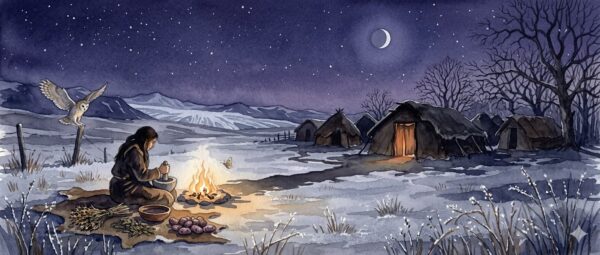
This is the story I keep coming back to in my fiction — the healer at the hinge of the world, holding knowledge the settlement doesn’t understand yet. In When Women Held the Fire, she doesn’t have a laboratory. She has a mortar, a fire, and ten thousand years of plant memory passed from mother to daughter in a chain that began when the first forager noticed that chewing a bitter root stopped the bleeding. That chain has never broken. Your pharmacist is standing at the end of it.
Ten thousand years ago, a woman knelt over a dying child with a handful of roots and no instructions. Tonight, in a village without a clinic, another woman is doing exactly the same thing. The mortar changed. The plants changed. The species of the pathogen changed.
The courage didn’t.
What to Read Next
If the cursed harvest gripped you, here are 3 more from the stone age world:
- What Neanderthals Chewed for Pain Relief — Dental calculus reveals a 50,000-year-old pharmacopoeia.
- Six Plants That Kept Stone Age People Alive — And You Can Still Find Them Today — From yarrow to plantain, the survivors’ toolkit.
- I Go to the Stone Age to Find Peace. Here’s Why – The story behind the book “When Women Held the Fire: Seven Prehistoric Stories of Healing and Survival in the Stone Age”
Share this post if it changed how you see a loaf of bread.
