I once stood in a museum gallery staring at a plaster cast of a skeleton so battered it looked like it had been through a war. Crushed eye socket. Withered arm. Two broken legs healed at odd angles. And yet the bones told a quieter story beneath the damage: this person had lived with those injuries for years, possibly more than a decade, before dying somewhere between the ages of 35 and 50. Someone had fed him. Someone had kept him warm. Someone had chosen, again and again, not to leave him behind. That skeleton belongs to a Neanderthal known to science as Shanidar 1, and what his bones reveal about Neanderthal society is among the most compelling evidence we have for deep compassion in the Ice Age.
How Long Did Neanderthals Actually Live?
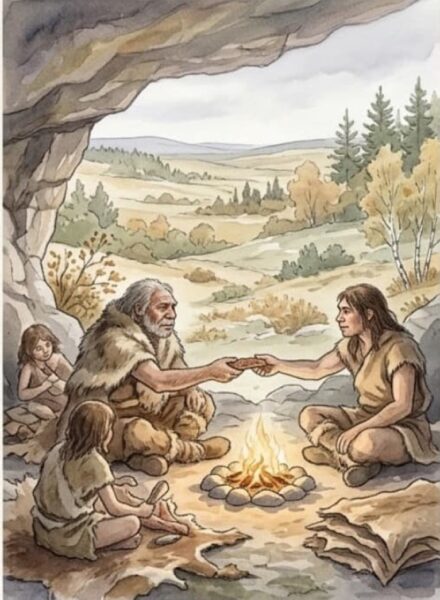
The popular image of Neanderthals dying young — collapsing at thirty from exhaustion and injury — is outdated. A 2019 genomic study using DNA methylation as a biological clock estimated a natural maximum lifespan of approximately 37.8 years for Neanderthals, nearly identical to the 38-year estimate for early Homo sapiens before modern medicine. But “natural lifespan” and “actual age at death” are not the same thing. Fossil analysis comparing adult mortality patterns in Neanderthal and early modern human populations found roughly equivalent proportions of individuals surviving past 40 in both groups. The scarcity of elderly Neanderthal remains in the fossil record likely reflects taphonomic bias — older individuals who could not keep pace with mobile groups may have died in locations where their remains were scattered by scavengers and lost to time, not a genuine absence of older individuals.
In short, the biology suggests that Neanderthals could live as long as contemporary Homo sapiens. Some individuals clearly did. The title of this post — “lived to 50 and 60” — reflects an estimate at the outer edge of possibility, based on skeletal aging methods that carry uncertainty margins. Whether any specific individual truly reached 60 remains unknown and debated, but reaching the late forties was demonstrably within range.
What Do Healed Bones Tell Us About Neanderthal Healing Practices?
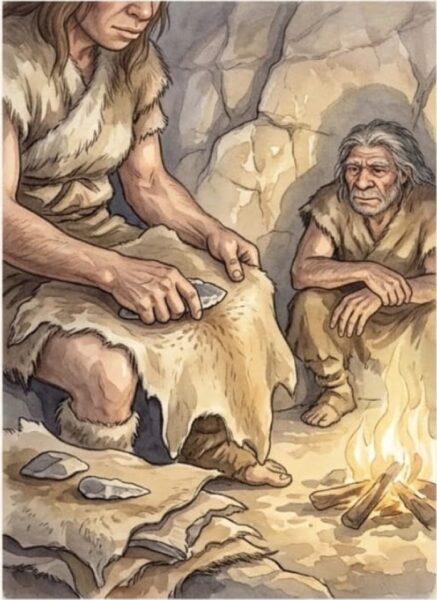
An estimated 79 to 94 percent of Neanderthal specimens show evidence of healed major trauma. That is a staggering number, and it tells two stories at once: Neanderthal daily life was physically brutal, and Neanderthal society was equipped to help people survive it.
Consider Shanidar 1, excavated from Shanidar Cave in Iraqi Kurdistan (dated to approximately 45,000–70,000 years ago). This individual suffered a crushing blow to the face, likely blinding or partially blinding the left eye. The damage to the brain area controlling the right side of his body led to a withered right arm — the lower arm and hand were eventually lost, possibly through deliberate amputation, one of the earliest known surgical interventions. He walked with a pronounced limp from two healed leg fractures. A 2017 analysis confirmed that bony growths in his ear canals would have caused profound hearing loss. Every one of these injuries shows signs of healing, meaning none of them killed him. He lived with this constellation of disabilities for an estimated ten to fifteen years before death.
He could not have survived alone. Provisioning food, maintaining warmth, assisting mobility, ensuring safety from predators — these are not passive kindnesses. They are sustained, daily acts of care that require group coordination.
Was Shanidar 1 an Exception?
He was not. Across Europe and the Levant, the pattern repeats. The individual known as La Chapelle-aux-Saints 1, excavated from a small cave in southwestern France (dated to approximately 50,000–60,000 years ago), suffered from extensive tooth loss with severe periodontal disease, degeneration of the jaw joint, osteoarthritis in both shoulders, a healed rib fracture, chronic inflammation in the hip, and massive degenerative disease in the neck vertebrae that would have restricted movement. Despite all of this, he survived for years with these conditions. A detailed bioarchaeology of care analysis concluded he likely received extensive healthcare provision, including assistance with feeding given his dental condition.
La Ferrassie 1, also from southwestern France (approximately 43,000–45,000 years ago), displayed evidence of recovered fractures in both legs, bilateral periostitis in the femur and tibia, and probable periods of severely limited mobility during recovery. That these individuals were mobile again after serious leg injuries suggests not merely passive tolerance but active support through immobilization, rest, and sustained provisioning during recovery periods.
Other examples span geographically from Krapina in Croatia to Kiik-Koba in Crimea to the Levant. The sheer number of healed injuries across the known Neanderthal skeletal sample — with 37 to 52 percent classified as severely injured — makes caregiving not an anomaly but a demographic pattern.
What This Suggests About Neanderthal Society
Debate continues about whether this care was motivated by emotional compassion or by practical calculation — keeping alive a valued group member who held cultural knowledge or high social status. Some researchers have argued that survival could result from passive group tolerance in small bands rather than active altruism. Others, particularly those working with the bioarchaeology of care methodology, argue that the severity and duration of disabilities in cases like Shanidar 1 required practices far beyond incidental food sharing: wound management, temperature regulation, hygiene assistance, sleep facilitation, and mobility support.
The truth may encompass both. In small groups of ten to twenty-five individuals — the likely size of a Neanderthal band based on archaeological and genetic evidence — the loss of even one member had outsized consequences. Healthcare provisioning made practical sense as a survival strategy, alongside other collaborative risk-pooling behaviors such as group hunting and food sharing. But the sustained, multi-year investment evident in cases like Shanidar 1 exceeds what simple utility would predict. Whatever word we use for it — altruism, kinship obligation, empathy — the bones point to something beyond indifference.
Did Neanderthal Elders Pass Down Knowledge?
No archaeological evidence directly confirms oral knowledge transmission in Neanderthals. However, the inference is ecologically compelling. Mastering Levallois and Mousterian stone tool production requires years of practice. Birch tar manufacture demands precise temperature control and multi-step planning. Identifying medicinal plants — evidenced by dental calculus analysis showing compounds like yarrow and chamomile — requires accumulated observational knowledge unlikely to be independently rediscovered by each generation. The survival of older, experienced individuals would have been the primary mechanism for transmitting this knowledge in a pre-literate society.
Living Within the Group: An Ecology of Mutual Dependence
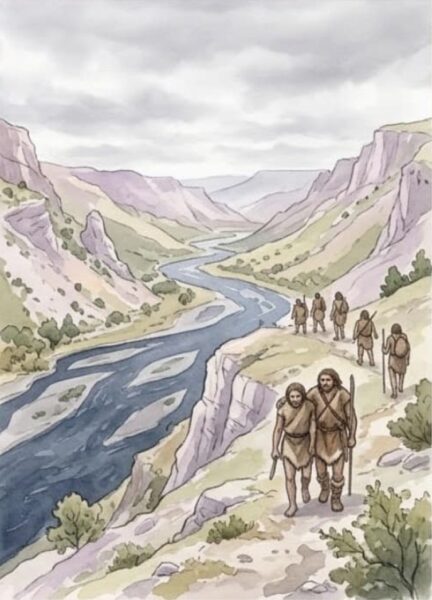
Neanderthal survival depended on ecological balance in a double sense: balance with the landscape and balance within the group. The same Ice Age survival strategies that demanded knowledge of seasonal animal migrations, plant availability, and terrain also demanded that no individual be treated as expendable. In a small band navigating a harsh Pleistocene environment, the elder who remembered where water flowed during drought, or which valley held shelter during storms, carried irreplaceable value. This is not a sentimental projection — it is a demographic and ecological reality. Neanderthal society, as revealed through the fossil record, appears to have been structured around mutual dependence rather than individual self-sufficiency.
What This Means Today
Modern societies often treat eldercare as a burden — an economic problem to be managed rather than a relationship to be honored. The Neanderthal evidence suggests a different framework: that caring for those who can no longer provide for themselves is not a luxury that only “advanced” civilizations can afford, but one of the oldest observable behaviors in our evolutionary lineage. It predates agriculture, writing, cities, and every institution we associate with civilization by tens of thousands of years.
Try This: Spend time with an elder in your community — a grandparent, a neighbor, a mentor — and ask them what they know that you do not. Seasonal patterns. Old remedies. The name of a plant or a bird. Notice how knowledge lives in people, not only in books.
Lesser-Known Facts
Neanderthals’ natural maximum lifespan, estimated through DNA methylation analysis, was nearly identical to that of early Homo sapiens — approximately 37.8 years before modern medicine, compared to our 38 years. The difference between them and us was not biology but circumstance.
Shanidar 1 may have undergone one of the earliest known surgical amputations. The sharp distal fracture of his right humerus is consistent with deliberate removal of the lower arm, and the bone had fully healed afterward.
The individual from La Chapelle-aux-Saints was originally reconstructed in 1911 as a stooped, brutish figure — an image that dominated public perception of Neanderthals for decades. Later re-examination showed the slouching posture reflected the scientist’s prejudices, not the skeleton’s anatomy. The individual’s degenerative arthritis was severe but would not have produced the posture originally depicted.
A 2018 analysis argued that Neanderthal healthcare was likely not exceptional behavior but an expected collaborative strategy, similar to group hunting and food sharing — a routine feature of Neanderthal daily life rather than a rare act of kindness.
Myth vs. Evidence
Misconception: Neanderthals rarely lived past 30.
Evidence: Fossil analysis and genomic studies indicate Neanderthals had the same biological potential for lifespan as early Homo sapiens, with confirmed individuals surviving well into their forties and possibly beyond.
What We Still Don’t Know
We do not know whether Neanderthal caregiving was motivated by emotional attachment, practical calculation, or something we have no modern word for. We cannot determine whether care was extended equally to all group members or was selective. The degree to which older individuals served as knowledge repositories — and whether their survival was partly valued for that reason — remains plausible but unproven. And the question of whether Neanderthals experienced grief, loneliness, or gratitude in ways comparable to our own lies beyond what bones alone can answer.
