Spears Didn’t Win the Ice Age. String Did.
And the People Who Made It Were Written Out of History
Anyone who has ever lashed a handle to a blade knows the truth before the archaeologists do.
The blade gets all the attention. You hold it up. People admire the edge, the symmetry, the knapping. But the binding — the cord twisted from bark or sinew that holds the handle to the stone — that’s what makes it a tool instead of a rock. Without the binding, you’re just holding a sharp thing that will slice your palm open the first time you swing it.
I think about this every time I carve. The wood gets the compliment. The joint gets ignored. But the joint is what makes the chair a chair. The lashing is what makes the axe an axe. The invisible thing — the flexible thing — is always doing the real work.
And it turns out, that’s the story of the entire stone age world. We just spent a century looking at the wrong half of it.
The Most Important Object Nobody Talks About
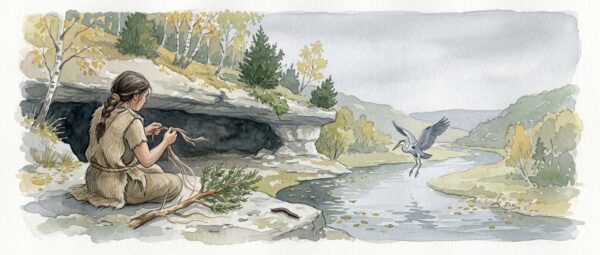
In a rock shelter in the Ardèche River valley of southeastern France — a place locals have used for shade since before anyone carved a name for it — a tiny scrap of cord was found stuck to the underside of a flint tool.
It is 6.2 millimeters long. About the width of a pencil eraser.
It is roughly 50,000 years old. And a Neanderthal made it.
Under a scanning electron microscope, this speck revealed three separate bundles of conifer bark fiber, each individually twisted clockwise, then plied together counter-clockwise to form a three-ply cord. That’s the same engineering principle used in modern climbing rope. Most survivalist cordage today is only two-ply. This Neanderthal outdid your average bushcraft YouTuber by one full ply — fifty millennia ago.
The cord survived only because it was trapped against the stone tool in sediment that sealed out air and moisture. Nobody was looking for string. They were looking for weapons.
For a century, archaeology had an unspoken rule: if it couldn’t kill something, it wasn’t important. That rule hid the most important technology humans ever invented.
The Math That Kills the Hero Story
Here’s the image we all carry in our heads: muscular men with heavy spears, charging a woolly mammoth across a frozen steppe. The apex predator. The conqueror. The survivor.
Here’s the math.
A mammoth kill yields roughly a million calories. Spectacular. But the hunt fails far more than it succeeds. Hunters get gored, trampled, broken. Between kills: days or weeks of nothing. Hungry children. Injured men who can’t hunt again for months. One bad season and the whole band is finished.
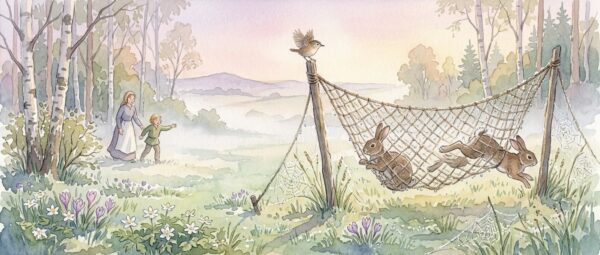
Meanwhile, one net — woven from twisted plant fiber, set overnight by a woman and two children — catches dozens of rabbits. Every morning. No danger. No drama. Just food.
At Ice Age sites across Iberia, rabbit bones make up over 90 percent of all recovered animal remains. Not mammoth. Not bison. Rabbit. Computer modeling published in 2024 showed that these massive rabbit accumulations are best explained by mass collection using nets and a division of labor that included women, children, and elders — not individual spear-wielding hunters.
The mammoth hunter makes a great bronze statue. But the person feeding the village was sitting by a hearth, checking snare lines at dawn.
And she didn’t leave a single artifact that survived in the ground. Because string rots. Stone doesn’t. We built a whole mythology around what happened to survive.
Why Neanderthals Had String but Still Went Extinct
This is the mystery at the heart of the story.
Neanderthals could make cord. That 50,000-year-old three-ply fragment proves it. They had the knowledge, the hands, and the cognitive ability. Making that cord requires understanding which inner bark to harvest (conifer — likely pine or juniper), which season to strip it (early spring, when the fibers thicken), how to twist fibers in one direction and ply them in the other, and how to track twist direction across multiple strands simultaneously. Linguists call that recursive logic — the same “infinite use of finite means” that underlies language.
So why are they gone?
Because they had the spark but never built the fire. Not a single confirmed Neanderthal site has yielded an eyed bone needle. No evidence of nets. No woven textiles. No tailored clothing. They could twist a cord. They couldn’t sew a sleeve.
And in the Ice Age, that was the difference between existing and extinction.
The Thermal Kill Line
This is the part that would make you stop scrolling.
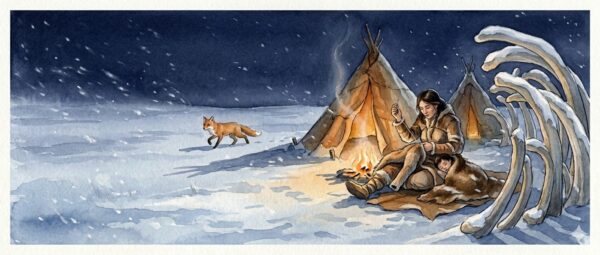
A draped fur cloak — a hide thrown over your shoulders, tied at the throat — provides roughly 1 clo of thermal insulation. (Clo is the actual unit scientists use to measure clothing warmth.)
Tailored, multi-layered fur garments — sleeves enclosing the arms, trouser legs, a fitted hood — provide 3 to 4 clo.
Arctic survival requires a minimum of 3–4 clo.
The difference between 1 and 4 is not “more comfortable.” It is alive versus dead in two hours.
A bone needle — five centimeters of carved bird bone with a tiny hole drilled through one end — is the only tool that turns 1 clo into 4. No needle, no sleeves. No sleeves, no sealed seams. No sealed seams, the wind enters and your core temperature drops and you die on your feet.
Near Moscow, at a burial site dating to roughly 34,000 years ago, an adult was interred with approximately 3,000 mammoth ivory beads, and two children with over 10,000 beads each, arranged in patterns tracing the outlines of fitted garments — shirts with sleeves, trousers with legs, and what appear to be two layers. Each bead took about an hour to produce. The children’s burial clothes alone represent years of accumulated labor.
Neanderthals, despite 200,000 years in Ice Age Europe, never made eyed needles. Their robust, stocky bodies — evolved for cold — reduced the pressure to innovate. When temperatures dropped beyond what biology-plus-draped-hides could handle, they had no technological reserve. Homo sapiens, the tropical newcomer who desperately needed technology to survive, had already invented the parka.
The Ice Age wasn’t won by whoever had the sharpest spear. It was won by whoever had the smallest needle.
The Oldest Cloth on Earth Was as Fine as Your T-Shirt
In the Pavlov Hills of southern Moravia — rolling countryside in what is now the Czech Republic, where vineyards grow above Ice Age mammoth-hunter camps — two clusters of sites have produced perhaps the most underappreciated discovery in all of archaeology.
Among thousands of fired clay fragments dating to 28,000–25,000 years ago, a tiny fraction — about 0.9 percent — bear impressions of woven material pressed into soft clay before firing. When these impressions were finally identified in 1993, they revealed an astonishing range of textile technology: single-ply and multi-ply cordage, braided string, knotted netting with identifiable weaver’s knots, plaited basketry, plain-woven cloth, twilled fabric, and diagonal twining. The finest examples had a thread count comparable to thin cotton or linen. At least eight distinct weaving techniques. Made from nettles — Urtica, the stinging weed you avoid on hiking trails.
The discovery was delayed by decades. Not because the evidence was hidden, but because nobody was looking for fabric at a mammoth-hunter camp. They were looking for mammoth. When the find was published, it met hostile resistance from some established scholars. The researchers who made the discovery eventually published a paper with the sardonic title “Their Fingers Were Too Fat to Weave” — a direct quote of the dismissal their work received.
Twenty-five thousand years ago, someone wove cloth as fine as modern linen. We didn’t notice for a century because it was pressed into clay, and we were too busy admiring the spear points beside it.
The Venus Figurines Were Wearing Clothes the Whole Time
For over a hundred years, the Gravettian “Venus” figurines were interpreted as naked women. Fertility symbols. Mother goddesses. Prehistoric pin-ups. Depends which decade you ask.
Then, in 2000, textile experts looked at them — and saw what everyone else had missed.
They’re dressed.
The Venus of Willendorf’s famous “hairstyle” is actually a radially hand-woven cap, resembling coiled basketry, with a visible knotted center. Figurines from sites in Russia display twisted bands worn across the chest — body bandeaux made from cord. And the Venus of Lespugue, from the foothills of the French Pyrenees and dated to about 25,000 years ago, wears what is unmistakably a string skirt. The carver incised not only the twist of individual strings but the way the twist angle changes — from about 40 degrees near the waist to nearly straight at the hem. The twist direction is identifiable as Z-twist.
That level of detail could only have been carved by someone who knew textile production intimately. Probably a weaver.
The garments provide neither warmth nor modesty. They are communicative — status markers, ritual wear, or signals of identity. And their appearance on female figurines, alongside the textile evidence from those same sites, suggests that fiber technology wasn’t marginal busywork. It was a domain of cultural prestige.
We spent a century staring at “naked prehistoric women.” They were dressed. We just didn’t know what clothes looked like before cloth.
The Baby Problem
Every other primate infant can cling to its mother’s body hair from birth. Chimpanzee babies grip. Gorilla babies grip. Orangutan babies grip.
Human babies cannot hold their heads up.
This is because our brains are enormous relative to our birth canals, so human infants are born at an earlier developmental stage than any other primate, with most brain growth happening after birth. The result is a uniquely helpless newborn — and a uniquely brutal engineering problem. A bipedal, hairless mother crossing frozen tundra with a baby she cannot put down and cannot carry one-handed. Without a sling, the baby dies. Without the baby, the lineage dies.
At a burial cave on the Ligurian coast of northwestern Italy, a female infant — nicknamed “Neve” by the excavation team — was found interred at roughly 40 to 50 days old, some 10,000 years ago. She was buried with more than 70 perforated marine shells, worn smooth from heavy use that couldn’t have occurred in her brief life. High-resolution imaging showed the beads curving around her upper arm bones, tracing the outline of something that had decayed — a wrap or carrier. Other beads were positioned as though sewn onto a garment. She was carried in a sling. The sling rotted. The beads stayed.
Every human alive descends from a mother who figured out how to carry a baby hands-free. That invention has no name, no credited inventor, and no museum exhibit. But without it, none of us exist.
“Text” Means “Woven”
The word “text” comes from Latin texere — to weave. “Fabric” gave us “fabricate.” “Spinster” meant a woman who spins thread. “Wyrd” — the Old English word for fate — shares a root with the Norse Norn Urd’s name, from Proto-Germanic “to turn,” the motion of a spindle.
Every civilization on Earth built the same myth: women who spin thread control life and death.
The Greek Moirai — Clotho the Spinner, Lachesis the Measurer, Atropos the Cutter — held the thread of every mortal life. Even Zeus could not overrule them. The Norse Norns tended the World Tree; in one poem, Valkyries weave warriors’ fates on a loom strung with human entrails. Slavic mythology preserves Mokosh — the only female deity in the old Kievan pantheon — a tall figure with long arms who spins flax at night and determines women’s fates. The Baltic goddess Laima prophesies newborns’ futures while spinning their life-threads. In Navajo tradition, Spider Woman was first to weave the web of the universe; a bit of spider web rubbed into an infant girl’s palms ensures she becomes a good weaver.
Fairy tales encode the same memory. Sleeping Beauty is cursed by a spindle. Rumpelstiltskin — estimated by folklorists to be roughly 4,000 years old — is about spinning straw into gold. In The Six Swans, a sister must weave shirts from stinging nettles to save her brothers. Stinging nettles — the same plant identified as the likely fiber source at those Moravian Ice Age camps, 25,000 years ago.
Every civilization encoded the same truth: the women who twisted thread held power over life itself. We put it in our fairy tales. Then we forgot it was real.
From the Hearth to the Charkha
The string skirt carved onto Venus figurines 25,000 years ago. The string skirt preserved on the Egtved Girl in a Danish peat bog, buried around 1370 BCE. The fringed apron still worn in Balkan folk costume into the twentieth century, where a divorced woman cuts the fringes to signal her changed status. One garment. Twenty-five thousand years. Unbroken.
String never stopped being power.
When the spinning wheel became so economically devastating that one person could produce more thread in a day than ten people working by hand, the British Empire banned hand-spinning in India to force dependence on English textile mills. A tropical colony reduced to buying back its own cotton as finished cloth. The oldest industrial exploitation in modern history — and it was about fiber.
Gandhi picked up the charkha. He spun cotton every day. He put the spinning wheel on the Indian flag. His revolution wasn’t fought with weapons. It was fought with string. The same technology that won the Ice Age won Indian independence.
And the loom’s binary logic — over/under, warp/weft — inspired the Jacquard punch card in the 1800s, which inspired Babbage’s engine, which inspired the computer. The fiber-optic cable carrying this blog post to your screen is literally a thread of glass transmitting light.
The Invisible Revolution
Here is the deepest irony of the stone age world.
The most important technology in human history is the one that almost never survives. String decays. Cloth rots. Baskets crumble. What endures is stone, bone, and fired clay — the hard, weapon-like artifacts that have shaped a century of prehistoric fiction and museum dioramas around the image of Man the Hunter.
But at the rare sites where preservation conditions are extraordinary — waterlogged lake edges, arid desert caves, impressions in accidentally fired clay — the perishable world floods back in. And it outnumbers stone tools twenty to one.
Our understanding of the entire stone age world — every documentary, every novel, every museum — is based on less than five percent of actual material culture. The other ninety-five percent rotted. And it took with it the contributions of the people who made it.
This is what I write about. The inventors history forgot. The women who wove the survival of our species into every basket, every stitch, every knot. The flexible technology that held everything together while the hard technology got all the credit.
Fifty thousand years ago, a Neanderthal twisted bark fibers into cord in a rock shelter in France. In 1947, a man in a loincloth spun cotton on a wooden wheel and broke the British Empire. You’re reading this on a glass thread.
The technology never changed. It was always string.
What to Read Next
If this story gripped you, here are five more from the stone age world that will change how you see prehistory:
- Clothing Before Needles: How Neanderthals Survived Ice Age Winters — The full story of what Neanderthals wore and why it wasn’t enough.
- The Moss, Resin, and Bark That Held the Ice Age Together — The other “invisible” technologies that don’t survive in the ground.
- Birch Tar, Bone Needles, and the Genius of Stone Age Engineering — The material science hiding in plain sight.
- When the Green Returned: Women, Gathering, and Daily Survival in the Stone Age — What plant knowledge really looked like.
- The First Doctors Were Women: Evidence for Healing in the Stone Age — Another domain of women’s expertise that archaeology overlooked.
If you love stone age fiction that takes the archaeology seriously: My novel When Women Held the Fire: Seven Prehistoric Stories of Healing and Survival in the Stone Age is available on Amazon. I don’t write about “crafting.” I have written the stories of the string-keepers and the needle-smiths — the women who realized that a twisted vine could be a bridge, a net, or a lifeline.
Please share this post if it changed how you see a piece of string – and women.
