Stone Age people couldn’t write. But they were never silent. From 77,000-year-old crosshatch drawings to cave handprints that were mostly made by women — the prehistoric world was full of records. We just forgot how to read them.
Blombos Cave, South Africa. Seventy-seven thousand years ago.
Someone is sitting near the mouth of the cave where the light is best. The Indian Ocean is louder than it will be in your lifetime — no engines, no harbor walls, just open water hitting rock. The person picks up a smooth, flat piece of ochre-stained silcite and dips a fingertip into a paste of liquefied red ochre mixed with bone marrow fat. Then, slowly and deliberately, they draw a series of crosshatched lines — six strokes, intersecting at angles, forming a clear geometric pattern.
They set the stone down. The pattern is complete. It means something.
We have absolutely no idea what.
But here’s what we do know: that small stone, recovered by archaeologists in 2011, holds the oldest known drawing made by a human hand. It predates the cave paintings of Europe by more than 40,000 years. It was made with intent — the lines are too regular, too controlled, too clearly patterned to be accidental scratching. Someone looked at a blank surface and decided to put a mark on it that would outlast the moment.
That impulse — to record, to mark, to say *this happened* or *this matters* or simply *I was here* — turns out to be one of the deepest and most persistent behaviors in the human lineage. It predates language as we understand it. It predates agriculture by 65,000 years. It predates cities by 70,000 years. And it wasn’t unique to Homo sapiens.
The Stone Age was full of people writing things down. They just weren’t using words.
Older Than You Think
The timeline of mark-making in the prehistoric world is longer than most people realize, and it keeps getting pushed back as new discoveries surface.
Start at Blombos — 77,000 years ago — with that crosshatched drawing. But Blombos also produced engraved ochre blocks dating to 100,000 years ago: geometric patterns deliberately carved into chunks of red iron oxide. These aren’t tools. They aren’t sharpened or shaped for practical use. Someone carved patterns into them because the patterns mattered.
Jump forward to 65,000 years ago. On the walls of caves in southern Spain — Ardales, Maltravieso, La Pasiega — red ochre marks have been dated using uranium-thorium analysis to at least 65,000 years before present. That’s 20,000 years before Homo sapiens arrived in Europe. These marks were made by Neanderthals.
Read that again. Neanderthals were making symbolic marks on cave walls. The idea that symbolic thought, abstraction, and record-keeping were exclusive to our species is dead. Neanderthals stood in the dark, held a piece of ochre to a rock face, and made a mark they intended to last. Why? We don’t know. But they did it, and the evidence is on the wall.
By 36,000 years ago, Chauvet Cave in southern France holds some of the most breathtaking artwork in human history — lions in mid-hunt, horses in motion, rhinoceroses facing off, rendered with a sophistication of line, shading, and perspective that art students study today. By 17,000 years ago, Lascaux offers its famous galleries of aurochs and deer. By 11,000 years ago, the carved stone pillars of Göbekli Tepe in Turkey — covered in animal reliefs and abstract symbols — represent a monumental expression of shared symbolic culture built by people who hadn’t yet invented farming.
This wasn’t a sudden invention. It was a slow, deep, cross-species accumulation. For at least 100,000 years, and possibly much longer, the human lineage has been compulsively making marks on things. The urge to record came long before the technology of writing. Writing, when it finally arrived around 3,200 BCE in Mesopotamia, wasn’t a revolution. It was the latest iteration of something Stone Age people had been doing since before the last Ice Age began.
Hands on Walls
Of all the marks left in the prehistoric world, the one that stops people cold — every time, in every culture, without exception — is the hand stencil.
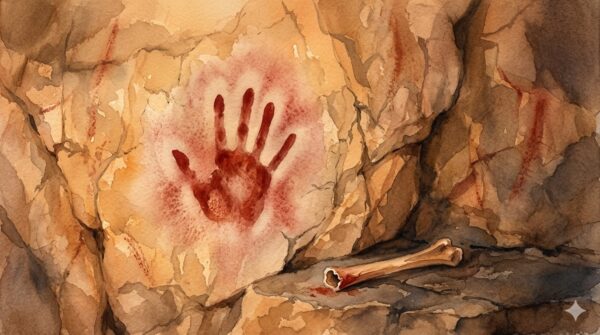
The technique is simple. Press your hand flat against a cave wall. Take a mouthful of wet ochre pigment — red, sometimes black — and blow it over and around your hand through a hollow reed or directly from your lips. Remove your hand. What remains is a negative image: the shape of a palm and five fingers, outlined in red mist on stone.
Hand stencils appear in caves across Europe, Indonesia, Australia, South America, and Africa. The oldest known examples — from Sulawesi, Indonesia — date to at least 40,000 years ago. Some researchers argue for even earlier dates. The practice spans tens of thousands of years and appears on every inhabited continent. It is, by any measure, the most universal single act of mark-making in human history.
And here’s the part that most people don’t know.
About ten years back a study was published analyzing the hand stencils in several European caves — including El Castillo in Spain and Gargas in France — using a technique based on the relative lengths of fingers. In humans, the ratio of index finger to ring finger length is sexually dimorphic: it differs, on average, between male and female hands. Snow’s analysis concluded that a significant majority of the hand stencils in the caves he studied were made by women and adolescents. Not men.
The image of the lone male shaman descending into the sacred cave to make his mark has been the default narrative for a century. The hands on the walls say otherwise. Women and young people were in those caves. They were the ones pressing their palms to the rock. They were the ones blowing red ochre through reeds in the torchlight and leaving something behind that would last thirty thousand years.
What were they saying? Nobody knows. But they were there, and they wanted it known.
Tallies, Notches, and the Birth of Counting
Not all Stone Age records were pictures. Some were data.
The Lebombo bone, found in the Border Cave between South Africa and Eswatini, is a baboon fibula with 29 deliberately incised notches. It’s approximately 43,000 years old. Twenty-nine notches. The number has driven researchers slightly mad. Twenty-nine is the length of a lunar month. Is this a lunar calendar? A menstrual tracker? A simple tally of days, kills, trades, or something else entirely?
The Ishango bone, found in the Democratic Republic of Congo and dated to roughly 20,000 years ago, is even more tantalizing. It’s a bone tool handle with three columns of grouped notches. The groups appear to follow mathematical patterns — some researchers see prime numbers, others see a lunar calendar, others see a doubling system. The interpretation is fiercely debated. What’s not debated is that the notches are deliberate, grouped, and patterned. Someone carved them with intent, following a system.
These aren’t decorations. Decorative marks are random, aesthetic, variable. Tallies are regular, sequential, and systematic. The difference between a pattern you carve because it looks nice and a pattern you carve because you’re tracking something across time is the difference between art and mathematics. Both existed in the Stone Age. The tally marks are the mathematics.
And mathematics requires abstraction. A notch on a bone that represents one day — or one moon, one deer, one anything — is a symbol. It stands for something other than itself. The person carving it has separated the concept of “three” from the experience of three actual things. That’s the cognitive leap that leads, eventually, to writing, to numerals, to algebra, to code. It started with a sharp flint and a bone.
Ochre: The First Ink
It runs like a red thread through the entire Stone Age. Ochre — iron oxide, ground to powder, mixed with fat or water — is the oldest and most ubiquitous material in the human symbolic toolkit. Its use goes back at least 300,000 years. Probably longer.
At Twin Rivers in Zambia, ground ochre pigments dating to 300,000 years ago show evidence of deliberate processing: grinding, heating to alter color, mixing. At Blombos Cave, ochre-processing kits — including abalone shell containers with residue of mixed ochre paste — date to 100,000 years ago. Ochre appears in burials, on tools, on bodies, on walls, on artifacts, on floors. It is everywhere, and it is always red.
Why red? Speculation is inevitable, but the cross-cultural consistency is striking. Red is the color of blood, birth, injury, menstruation, meat, life, death. It’s the most visible color in firelight. It stains skin in a way that signals deliberate alteration — you can see that someone has been marked. Across nearly every documented forager society that uses ochre, it’s associated with transitions: birth, puberty, marriage, death, healing, hunting. It marks the boundaries between states of being.
And it’s worth noting that ochre isn’t easy to work with. Finding good-quality ochre deposits, mining the stone, grinding it to a fine powder, heat-treating it to achieve the right shade (heating transforms yellow goethite into red hematite), and mixing it into a usable paste — this is a multi-step technical process requiring knowledge, tools, and time. You don’t smear ochre on a cave wall on a whim. You prepare it with intention because what you’re about to mark matters enough to justify the effort.
For 300,000 years, when humans needed to mark something as important — a wall, a body, a burial, a birth — they reached for red. We still do. Stop signs, fire engines, warning labels, the red carpet, the red dress. The colour hasn’t let go of us. Or we haven’t let go of it.
What Women Recorded
Here’s where the novelist in me meets the evidence and asks a question that archaeology alone can’t answer — but shouldn’t be afraid to ask.

If the hand stencils in caves were predominantly made by women. If the oldest possible lunar tallies — 29 notches on a bone — track a cycle that is both celestial and menstrual. If ochre processing, which requires the same kind of patient, sustained, multi-step work as plant-medicine preparation and hide-processing, was performed in camp by people whose daily routines kept them close to the hearth. If the earliest “records” in human history coincide not with hunting kill counts but with cycles, seasons, and biological rhythms —
Then it’s at least plausible, and I’d argue probable, that the earliest record-keepers were women tracking the things that mattered most to survival: when the baby is due, when the berries ripen, when the salmon run, when the moon turns, when the last frost came and when it will come again.
This is speculative. I want to be honest about that. We cannot excavate intention from a 43,000-year-old bone. But the inference is grounded in evidence — the hand stencils, the tally patterns, the ochre-processing contexts — and it aligns with what we observe in living forager societies, where women are consistently the primary keepers of seasonal, biological, and ecological calendars.
The first records weren’t account books or king lists. They were a woman’s scratched count of the days since her last bleeding, or the moons since the last flooding of the river, or the notches that told her the herbs would be ready in three more suns.
She was writing before writing existed. She just used bone instead of paper and ochre instead of ink.
The Mark Remains
Go back to Blombos Cave. Seventy-seven thousand years.
That crosshatch pattern on the silcrete flake has outlasted every empire that will ever rise and fall on the continent above it. It’s older than agriculture, older than cities, older than every written language, every alphabet, every holy book. The pyramids are young beside it. Rome is an infant. The internet is a blink.
Someone sat in the light at the mouth of a cave and decided that a blank surface was unbearable. That something needed to be marked. That the moment — whatever it contained — deserved to last beyond itself.
We still don’t know what the pattern means. Maybe it was a count. Maybe it was a signature. Maybe it was a message, a map, a prayer, a doodle by someone killing time while the fish dried. It doesn’t matter. What matters is the impulse: the first time a human hand moved across a surface not to make a tool, not to prepare food, not to survive — but to record. To say: this is real. This happened. Remember.
Seventy-seven thousand years later, you’re reading marks on a screen that say the same thing.
The technology changed. The impulse didn’t. She started it. The mark remains.
