There is a moment in every hike when I pick up a piece of birch bark from the forest floor and feel how papery and light it is — almost translucent, peeling in sheets. It seems like the most delicate thing in the woods. And yet this fragile material was the starting point for one of the oldest synthetic substances ever made by any human species. Sometime around 200,000 years ago, a Neanderthal somewhere in Europe figured out how to transform that white, flimsy bark into a black, viscous, waterproof adhesive strong enough to bind stone to wood and hold a hunting weapon together under the stress of a kill. No other animal has ever done anything like it.
The story of Neanderthal adhesives — birch tar, pine resin, fibre cordage, and the quiet technologies of moss and bark — is a story about invisible sophistication. These were not the dramatic tools that survive easily in the archaeological record. They were the subtle ones. And they may tell us more about Neanderthal intelligence than any hand axe ever has.
How Did Neanderthals Make Glue? The Birch Tar Evidence
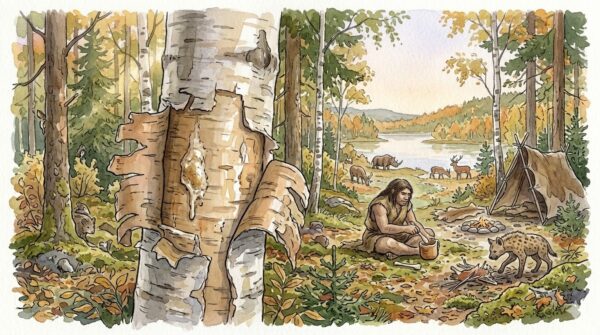
Birch bark tar is currently the oldest known adhesive substance in the archaeological record. The earliest confirmed example comes from Campitello Quarry in Italy, dating to at least 190,000 years ago. Additional finds from Königsaue in Germany (over 43,000 years old) and the Zandmotor site in the Netherlands (approximately 50,000 years old) confirm a long tradition of tar production across Neanderthal populations in Europe. In every case, the tar was found encasing or once having encased a flint tool — evidence of hafting, the process of attaching a stone blade to a wooden or bone handle using adhesive.
The birch tar artefacts have been chemically identified through gas chromatography-mass spectrometry, and their Neanderthal association is supported by stratigraphic context, dating, and the absence of anatomically modern human presence at these sites during the relevant periods.
What makes birch tar remarkable is that birch trees do not produce any visible sticky exudate. Unlike pine or spruce, which ooze resin from wounds in their bark, birch offers no obvious hint that it could become an adhesive. The bark must be fundamentally transformed using heat — a process called dry distillation — to extract the tar. This is not something one stumbles upon by accident in the obvious sense. It requires fire, raw material, and some form of controlled process.
Did Neanderthals Use Simple or Complex Methods to Produce Birch Tar?
This question has been at the centre of a vigorous scientific debate over the past decade, and the answer appears to be: both, depending on when and where.
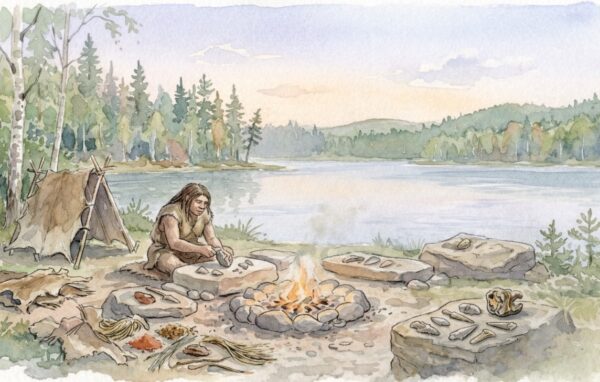
A 2019 experimental study demonstrated that usable quantities of birch tar can be produced simply by burning birch bark near a vertical stone surface. The tar deposits naturally on the stone and can be scraped off — a process that requires no underground structures, no containers, and no especially demanding cognitive planning. This discovery suggested that tar making could have been a relatively simple, even accidentally discoverable, process.
However, a 2023 study fundamentally changed the picture. Researchers conducted a comparative chemical analysis of the two birch tar pieces from Königsaue, Germany, against a large reference collection of tars produced using Stone Age techniques. They found that the Neanderthals who made the Königsaue tar did not use the simplest method. The chemical signatures matched an underground, oxygen-restricted distillation process — a technically demanding method that requires burying the bark, controlling heat from above, and extracting tar through a transformative process where the critical steps happen out of sight, beneath the ground. This means the maker could not observe or correct the process once it began, requiring a precise setup and pre-existing understanding of the materials’ behaviour.
The researchers concluded that this degree of complexity was unlikely to have been invented spontaneously. Instead, it suggests a cumulative technological tradition — one that started with simpler methods and was refined over time through experimentation, learning, and transmission between individuals and possibly generations. Birch tar, in this light, becomes evidence not just of Neanderthal technology but of Neanderthal cultural evolution.
Among all these materials, birch bark tar stands out — not because it was the only solution, but because it reveals the same underlying intelligence in its clearest form. That single material, and what it implies about Neanderthal thinking, is explored in how they made synthetic glue 200,000 years ago.
What Were Neanderthal Composite Tools? Beyond the Stone
Birch tar was the enabling technology behind composite tools — tools made of multiple materials joined together. A hafted spear, for instance, combines a stone point, a wooden shaft, and an adhesive binding. Creating such a tool requires planning across multiple steps: selecting the right stone, shaping it, choosing an appropriate shaft, preparing the adhesive, and assembling the components before the tar cooled and hardened.
Finds from the Dutch North Sea and the Italian site of Campitello show that Neanderthals used birch bark tar as backing on small domestic stone tools — not only large weapons but everyday implements. The tar was water-resistant and resistant to organic decomposition, making it an ideal long-lasting adhesive in cold, wet Ice Age conditions.
Neanderthals also used pine resin, sometimes mixed with beeswax, and bitumen as adhesives at different sites across Europe and the Near East. This range of materials suggests that Neanderthal intelligence included a flexible understanding of available resources — they adapted their adhesive technology to whatever their local environment provided.
Did Neanderthals Make String? The Fibre Evidence
In 2020, researchers published a discovery that stunned much of the archaeological community. On a stone tool recovered from the Abri du Maras site in southeastern France, they found a fragment of a three-ply cord made from inner bark fibres. The fragment was only about 6.2 millimetres long and 0.5 millimetres wide, but its structure was unmistakable: three bundles of fibres twisted with an S-twist, then plied together with a Z-twist — the same basic technique used in rope-making throughout human history.
The fibres were identified as gymnosperm (conifer) inner bark through the presence of bordered pits with torus-margo membranes. The tool was recovered in situ, and the cord fragment’s context is secure.
Twisted fibre technology is the foundation for string, rope, bags, nets, mats, and clothing construction. Its presence in a Neanderthal context suggests that these supposedly “invisible” technologies — the perishable materials that almost never survive in the archaeological record — were part of Neanderthal daily life. Most of what Neanderthals made has simply rotted away. The cord from Abri du Maras survived only because of the unique microenvironment immediately surrounding the stone tool. It is a rare window into what researchers have called “the missing majority” of Paleolithic material culture.
What This Suggests About Neanderthal Society
The combined evidence of birch tar production, composite tool assembly, and fibre technology paints a picture of Neanderthal society that is far more technically accomplished than the old stereotype of the simple cave-dweller. These were people who understood the properties of different tree species — that birch bark could yield adhesive, that conifer inner bark could be twisted into cord, that boxwood was dense enough for shaping into tools using fire. At the 171,000-year-old site of Poggetti Vecchi in Italy, Neanderthals were using fire to soften extremely hard boxwood for carving digging sticks. At Schöningen in Germany, they selected the root of fifty-to-sixty-year-old spruce trees for spear tips, exploiting the hardest part of the tree.
This is not mindless tool production. It is arboreal knowledge — an intimate, detailed understanding of the forest as a resource system, accumulated and transmitted over vast spans of time. Every tree was a potential toolkit, and Neanderthal intelligence lay in knowing which part of which species, prepared in which way, served which purpose.
What This Means Today
We live in a world of industrial adhesives, synthetic fibres, and engineered materials. It is easy to take for granted that binding one material to another is a solved problem. But the capacity to create an adhesive from scratch — to look at a birch tree and envision the sticky black substance locked inside its bark — represents one of the most significant cognitive leaps in all of human evolution. It is the first documented instance of any human species creating a truly synthetic material: something that does not exist anywhere in nature until it is manufactured through a deliberate, transformative process.
Modern interest in biomimicry and sustainable materials is, in a sense, rediscovering what Neanderthals already knew: that natural materials, carefully understood and processed, can meet sophisticated engineering needs without the environmental costs of petrochemical production. Birch tar is biodegradable, made from a renewable resource, and requires no infrastructure beyond fire and raw materials. The quiet sophistication of Neanderthal technology offers a reminder that innovation does not always require complexity — sometimes it requires intimacy with the materials at hand.
Forests as Laboratories: Neanderthals and Ecological Balance
Neanderthal survival depended on the health of the forests around them. Birch bark, conifer fibres, boxwood, spruce — all of these resources required living, functioning woodland ecosystems. Unlike later human populations that cleared forests for agriculture, Neanderthals lived within these ecosystems as participants rather than managers. Their harvesting of bark, resin, and fibres would have been small-scale, drawn from a vast and continually regenerating resource base.
This sustainable relationship with the forest was not a moral choice in the modern sense — it was simply the reality of a species that depended on ecological balance for every tool, every weapon, every binding and cord. But it serves as a powerful illustration that sophisticated technology and environmental stewardship are not opposites. For hundreds of thousands of years, the most advanced adhesive technology on Earth was produced by people who took bark from trees without felling them.
Lesser-Known Facts
1. Birch bark tar is the oldest known synthetic substance in human history, predating any adhesive associated with anatomically modern humans by at least 100,000 years.
2. A 5,700-year-old piece of chewed birch bark tar found in Denmark preserved a complete human genome and oral microbiome — the oldest complete human genome recovered from anything other than bone.
3. The three-ply cord from Abri du Maras is only 6.2 millimetres long, yet its structure demonstrates mathematical understanding of pairs, sets, and sequential operations.
4. Neanderthals at Königsaue used an underground distillation method to produce birch tar — a process where the critical transformation happens out of sight, requiring the maker to plan every step in advance.
5. Birch bark tar is naturally water-resistant and resistant to organic decomposition, making it an ideal adhesive for tools used in wet, cold Ice Age environments.
What We Still Don’t Know
Several fundamental questions remain unanswered. We do not know exactly how Neanderthals discovered that birch bark could be transformed into adhesive — whether the discovery was accidental (a by-product of fire-making) or the result of deliberate experimentation. We do not know how the knowledge was transmitted across generations or between groups. The debate about whether simple or complex production methods were used at different sites and time periods is ongoing, with chemical analysis of additional archaeological tar samples still needed. We also lack direct archaeological evidence of the production structures themselves — the pits, bark rolls, or hearth configurations that would definitively confirm which techniques were used at specific sites. Perhaps most intriguingly, we do not yet know the full range of Neanderthal fibre technology, because organic materials survive so rarely in Paleolithic contexts. The cord fragment from Abri du Maras may represent just a tiny fraction of a rich and complex material culture that has been almost entirely lost to time.
Summary
Neanderthal technology extended far beyond stone tools to include the production of birch bark tar — the oldest synthetic substance in human history, dating to at least 200,000 years ago — as well as pine resin adhesives, composite hafted tools, and twisted fibre cordage. Evidence from sites across Europe, including Campitello (Italy), Königsaue (Germany), and Abri du Maras (France), demonstrates that Neanderthal intelligence included sophisticated knowledge of forest materials, transformative manufacturing processes, and cumulative cultural innovation. These prehistoric technologies challenge outdated stereotypes about Neanderthal daily life and reveal a species whose Ice Age survival strategies were built on intimate ecological knowledge and quiet engineering brilliance.
