She bypassed abundant, perfectly comfortable plant material in favor of specific species with specific chemical properties. The healer who selected insecticidal leaves was practising applied chemistry.
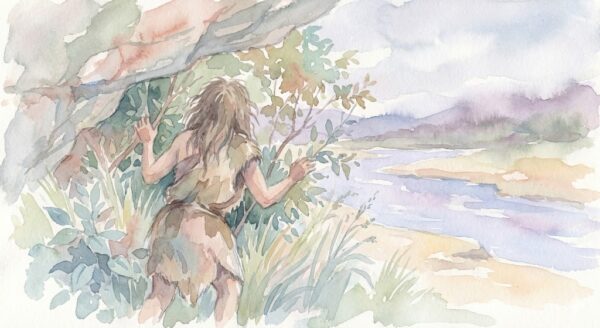
The woman moved through the vegetation fringing the rock shelter, her fingers brushing past a dozen species she could have chosen. Soft grasses grew thick along the riverbank. Broad-leafed plants spread in lush carpets beneath the canopy. Any of them would have made a comfortable bed. But comfort wasn’t her only concern.
She stopped at a river wild-quince tree—Cryptocarya woodii—and began stripping its aromatic leaves with practiced hands. She already had armfuls of sedges bundled and waiting back at Sibudu Cave, layered across the sandy floor where her people slept. The sedges would provide cushioning. But these leaves, laid on top like a final green blanket, would do something else entirely. They would keep the biters away.
She couldn’t have named the chemistry. She didn’t need to. Generations of women before her had learned—through observation, through experiment, through the slow accumulation of trial and sleepless error—that these particular leaves meant a peaceful night. That knowledge was more precious than any single tool in the shelter.
What the Dirt Told Us
In 2011, archaeologists announced a finding that rewrote assumptions about how far back botanical sophistication reaches. Excavating at Sibudu Cave in KwaZulu-Natal, South Africa, they uncovered layers of constructed bedding dating to approximately 77,000 years ago—the oldest known example of deliberate bed-making in the archaeological record.
But it wasn’t just the age that stunned researchers. It was the composition. The bedding wasn’t random vegetation heaped together for softness. It was engineered. A base of sedges and rushes provided the mattress, and on top of that, the inhabitants had laid leaves of Cryptocarya woodii, a tree whose chemical properties read like a pharmacist’s inventory.
When research team analyzed those ancient leaves, they found them loaded with α-pyrones, cryptofolione, and goniothalamin—compounds with documented insecticidal and larvicidal properties. These aren’t obscure trace chemicals. They are potent bioactive agents that kill insects and disrupt larval development. The people of Sibudu hadn’t stumbled onto a pleasant-smelling plant. They had selected, with precision, a species whose chemistry served as a Stone Age bug bomb woven directly into where they laid their heads.
As the researchers themselves concluded, “the selection of these leaves for the construction of bedding suggests that the early inhabitants of Sibudu had an intimate knowledge of the plants surrounding the shelter, and were aware of their medicinal uses.” This wasn’t instinct. It was knowledge—specific, testable, and deliberately applied.
The Chemistry of a Good Night’s Sleep
To appreciate what those ancient bedding-makers achieved, it helps to understand the compounds they were harnessing.
α-Pyrones are a class of organic compounds found across the plant kingdom that exhibit a range of biological activities, including antimicrobial and insecticidal effects. Cryptofolione, specific to Cryptocarya species, has demonstrated toxicity to insects in laboratory studies. Goniothalamin, perhaps the most potent of the three, shows both insecticidal and larvicidal properties—meaning it doesn’t just repel adult insects, it kills their young before they can mature and bite.
Layered into bedding, these compounds would have created a chemical zone of protection around sleepers. Anyone who has ever tried to sleep through a night of mosquito whine or woken covered in flea bites understands the stakes. Sleep disruption from insect harassment isn’t merely annoying—it cascades into real health consequences, affecting cognitive function, healing, immune response, and the ability to function the next day. Protecting sleep was protecting survival itself.
The Fire Ritual
Here’s where the story gains another layer of sophistication. The Sibudu bedding wasn’t permanent. Wadley’s excavations revealed that the inhabitants periodically burned their bedding before constructing fresh layers—a practice documented as early as 73,000 years ago.
At first glance, torching your own bed seems counterintuitive. But considered through the lens of pest management, it’s brilliant. Over time, even chemically treated bedding accumulates organic debris—dead skin, food particles, moisture—that becomes a nursery for fleas, lice, and other parasites that thrive in exactly these conditions. Flea larvae in particular require organic detritus for development, making old bedding an ideal breeding ground.
By burning the bedding before departing camp—or upon arriving at a previously used site—the inhabitants accomplished a complete reset. Fire killed adult insects, larvae, and eggs alike. The ash layer left behind offered its own residual protection, as fine ash clogs the breathing apparatus of crawling insects, creating a hostile surface for any survivors. Fresh bedding laid atop this sterile ash layer gave sleepers a clean start.
This wasn’t a one-off innovation. The archaeological layers at Sibudu show this burn-and-rebuild cycle repeated over thousands of years, suggesting a deliberate, culturally maintained practice passed down through generations.
Deeper in Time: Border Cave
If Sibudu’s 77,000-year-old bedding seemed ancient, Border Cave pushed the timeline even further into the past. At this site, also in South Africa, researchers found evidence of grass bedding placed atop layers of ash dating to approximately 200,000 years ago. Burned camphor leaves found within the bedding material added another dimension—camphor is a well-known insect repellent, used in various cultures around the world right up to the modern era.
The ash-beneath-bedding arrangement at Border Cave mirrors the Sibudu pattern and suggests a deep, shared tradition of using fire residue as an insect barrier. Two hundred thousand years ago, humans were already combining multiple pest-control strategies in a single sleeping system: chemical repellent plants, physical ash barriers, and periodic burning. This is not a single clever idea. It is an integrated technology.
Knowledge That Traveled Through Time
What connects a woman selecting Cryptocarya leaves at Sibudu Cave 77,000 years ago with a medieval European housewife tucking tansy sprigs between her mattress and sheets? Or a Roman farmer who followed Varro’s advice to never build near a marsh? The common thread is accumulated botanical and ecological knowledge, tested across generations and transmitted as cultural inheritance.
This kind of knowledge doesn’t emerge spontaneously. Someone, at some point deep in prehistory, noticed that bedding made with certain plants resulted in fewer bites and better sleep. That observation was shared, repeated, refined. Over centuries and millennia, it became embedded tradition—the kind of knowledge that feels like common sense to those who hold it, invisible to those who don’t.
The research from Central European contexts confirms this same pattern extending into later periods. Medieval strewing herbs—tansy, wormwood, pennyroyal, mint—scattered across floors and tucked into bedding were the direct descendants of this ancient tradition. The chemistry changed (thujone, pulegone, and various terpenoids replaced the tropical α-pyrones), but the underlying principle remained identical: select specific plants whose chemistry repels or kills the creatures that steal your sleep and carry disease.
Not Magic. Science.
It’s tempting to frame the healer’s knowledge as mysterious, as some kind of intuitive communion with nature that modern people have lost. That framing sells short the women and men who developed and maintained this expertise.
What the bedding at Sibudu and Border Cave reveals is something far more impressive than mysticism. It reveals systematic empirical knowledge. The inhabitants of these sites didn’t just grab whatever was closest. They bypassed abundant, perfectly comfortable plant material in favor of specific species with specific chemical properties. They combined multiple strategies—chemical, physical, and thermal—into integrated pest management systems. They maintained these practices across millennia, teaching each generation the difference between a bed that merely cushions and a bed that protects.
The healer who selected insecticidal leaves for her family’s bedding was practicing applied chemistry. The woman who burned old bedding and laid fresh material on the sterile ash was practicing sanitation science. They didn’t use those words. They didn’t need to. The knowledge was in their hands, in their choices, in the quiet competence of a person who knows exactly which leaves to pick and why.
Why does a 77,000-year-old bed matter to a novelist? Because it proves that the “wise woman” archetype isn’t a modern invention projected backward. When I write about the ancient stone age healers — women who know which roots reduce fever, which smoke drives off biting flies, which leaves belong in a sleeping mat — I’m not imagining capabilities. I’m understating them. The real women of prehistory knew things we’re only now rediscovering through chemistry labs and excavation trenches. Stone Age women’s fiction isn’t fantasy. It’s restoration.
This post is part of a series exploring the surprisingly sophisticated ways our prehistoric ancestors managed the insects that shared their world.
