I keep thinking about fingers pressed into soft stone. Not the kind of accidental smudge you leave on a windowpane, but deliberate, organized strokes — someone dragging their fingertips through damp cave walls to produce patterns of lines, curves, and dots. When this was first identified at a cave in the Loire Valley of France, the instinct was to credit Homo sapiens. Our species, after all, was supposed to hold the patent on art. But the cave had been sealed by sediment for more than 57,000 years — thousands of years before any modern human is known to have set foot in the region. The fingers that made those marks belonged to Neanderthals. And they were not working at random.
What Were Neanderthals Marking on Cave Walls?
The evidence for Neanderthal visual expression comes from a growing number of sites scattered across Europe, each contributing a different piece to the puzzle. The most significant cases span from France to Spain to Germany to Gibraltar, and they involve both pigment application and physical engraving — two distinct techniques that imply different methods of preparation and intent.
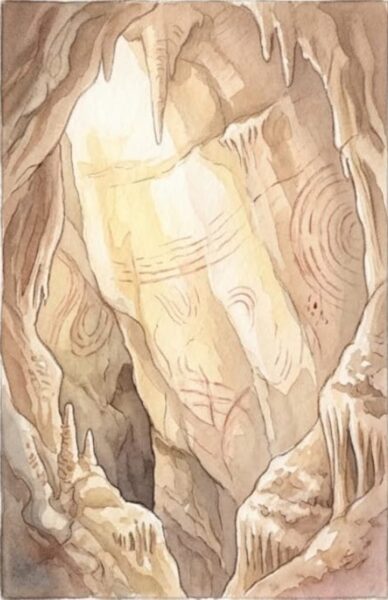
At La Roche-Cotard cave in the Centre-Val de Loire region of France, researchers identified hundreds of finger-flutings — marks made by pressing and dragging fingers through soft tuffeau limestone — distributed across the longest and smoothest wall of the cave interior. A 2023 study published in PLoS ONE used 3D photogrammetry to create precise digital models of the marks and compared them to both known human-made finger flutings from other caves and experimental flutings made by researchers in laboratory conditions. The shape, spacing, and arrangement of the La Roche-Cotard marks matched intentional human finger-work, not animal scratches or natural weathering.
Critically, optically-stimulated luminescence dating of the cave’s sediments established that the entrance became sealed by flood deposits approximately 57,000 years ago, with stratigraphic evidence suggesting the markings may be closer to 75,000 years old. All stone tools found in the cave are exclusively Mousterian — the technology associated with Neanderthals. No Homo sapiens artifacts were found. The researchers described the marks as forming organized panels — a circular composition of ogive-shaped tracings and a separate wavy panel of sinuous lines — arranged in what appears to be a deliberate spatial composition on the wall.
Did Neanderthals Use Pigment? Evidence from Iberian Caves
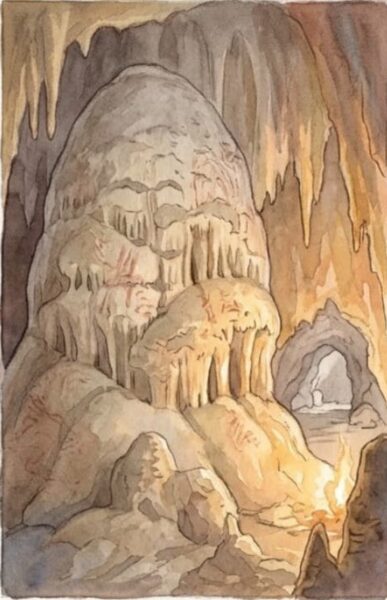
Three caves in Spain — La Pasiega in Cantabria, Maltravieso in Extremadura, and Ardales in Andalusia — have produced some of the most provocative and contested evidence for Neanderthal pigment use. Uranium-thorium dating of calcium carbonate crusts overlying painted surfaces yielded minimum ages of approximately 64,800 years for a red ladder-like pattern at La Pasiega, more than 66,000 years for hand stencils at Maltravieso, and over 60,000 years for red ochre applied to a stalagmite dome at Ardales. All three dates predate the earliest confirmed arrival of Homo sapiens in Europe by approximately 20,000 years.
At Ardales, a 2021 chemical analysis demonstrated that the red pigment on a massive stalagmite dome was ochre brought from outside the cave — not naturally occurring iron oxide. Multiple application methods were identified, including spattering and blowing, with different pigment compositions at different layers indicating the stalagmite was visited and marked on multiple occasions. The dome sits more than 100 meters into the cave, requiring prepared light sources and deliberate navigation through total darkness.
Skeptics have raised legitimate concerns about the uranium-thorium dating methodology, noting that irregular cave formation growth and uranium leaching can distort age calculations. However, the chemical evidence confirming the pigment was transported into the cave and applied by deliberate action is not in dispute.
What About Engraving? The Gorham’s Cave Cross-Hatch
At Gorham’s Cave on the Rock of Gibraltar, archaeologists identified a cross-hatched engraving carved into a bedrock platform — intersecting lines approximately 20 centimeters wide and 18 centimeters high. Microscopic analysis revealed that the first eight lines required between 179 and 312 individual strokes each with a pointed stone tool. The engraving was sealed beneath an undisturbed Mousterian layer dated to between 38,500 and 30,500 years ago. Use-wear analysis showed the marks were made by a right-handed individual sitting near the platform, at a point approximately 90 meters from the cave mouth where the cave changes orientation — a transitional zone that may have held significance for its occupants. The labor-intensive nature of the carving rules out accidental or utilitarian origin.
A Carved Bone from Unicorn Cave: Planning, Preparation, and Symbolism
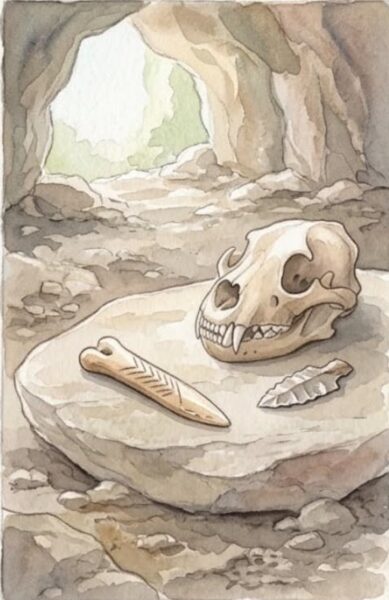
In 2019, archaeologists working at Einhornhöhle (“Unicorn Cave”) in the Harz Mountains of central Germany uncovered a small bone — the toe bone of a giant deer — engraved with a chevron pattern of stacked inverted V-shapes. Radiocarbon dating placed the object at a minimum of 51,000 years old, and the archaeological context was exclusively Middle Paleolithic, associated with Neanderthals. A 2021 study published in Nature Ecology and Evolution described it as representing one of the most complex known expressions of Neanderthal symbolic behavior.
Several details make this find remarkable. The giant deer was exceptionally rare north of the Alps at this time, suggesting the bone was chosen for its rarity and possibly its association with an impressive animal bearing enormous antlers. Experimental recreation using cow bones showed that the bone was almost certainly boiled before carving — softening it to allow deep, controlled incisions with a flint tool. This implies a multi-step production process: acquiring a rare bone, preparing it through heating, and then executing a precise geometric design. The study concluded that the artifact had no practical utility — the geometric pattern itself was the entire purpose of the object.
The carved bone was found alongside the shoulder blade of a deer and the intact skull of a cave bear, an assemblage that researchers noted may suggest a ritual context. With a calibrated age predating the arrival of Homo sapiens in central Europe by approximately 10,000 years, the researchers argued for independent Neanderthal authorship — though one commentary noted that recent genetic evidence of interbreeding could not entirely rule out some earlier exchange of knowledge between populations.
What Does This Tell Us About Neanderthal Intelligence?
The cognitive implications are significant. Creating marks deep inside caves required advance planning: preparing light sources, carrying pigment or tools into darkness, navigating to specific locations. Applying pigment across multiple visits implies both remembered intention and a transmittable cultural practice. Carving a design into softened bone requires sequential planning across at least three distinct stages. These behaviors require what cognitive scientists call conceptual imagination — the capacity to envision a design before executing it. The emerging pattern suggests that symbolic expression in Neanderthals was geographically widespread, appearing independently across western Europe over tens of thousands of years.
From Shells to Symbols: Early Ornaments at Cueva de los Aviones
Even older evidence comes from southeast Spain. At Cueva de los Aviones, perforated marine shells and shell containers bearing pigment residues — red and yellow colorants — have been dated to between 115,000 and 120,000 years ago using uranium-thorium methods. If the dates hold, these represent the oldest known personal ornaments anywhere in the world, predating equivalent African finds by 20,000 to 40,000 years. This challenges not only the assumption that symbolic behavior was unique to Homo sapiens but also the directional model in which cultural complexity always flowed from Africa to Europe.
Ecology and Expression: Why Caves Mattered
Neanderthals did not mark random surfaces. The pattern across sites — deep cave interiors, impressive geological formations, transitional zones — suggests the choice of location was itself meaningful. Caves were not merely shelters; they were landscape features with acoustic, spatial, and visual qualities that Neanderthals recognized and responded to. Marking a stalagmite dome 100 meters underground, or engraving a platform where a cave turns, reflects an awareness of environment beyond utilitarian survival. This relationship between Neanderthal daily life and the places they inhabited is part of a broader pattern of prehistoric ecology — a deep engagement with terrain that modern societies have largely lost.
What This Means Today
The idea that art is uniquely human has been central to how we define ourselves as a species. The Neanderthal evidence does not demolish that claim — figurative art, representational painting, and sculptural traditions remain firmly associated with Homo sapiens. But it complicates the boundary. If symbolic thought, abstract mark-making, and the deliberate creation of non-utilitarian objects existed in our closest evolutionary relatives, then the capacity for creative expression is older and more broadly distributed in the human family tree than once believed. That realization should inspire humility rather than alarm.
Try This: Find a natural surface — a patch of soft earth, wet sand, clay by a riverbank — and make a deliberate mark with your hand. Notice how it feels to leave a trace of yourself on the landscape. Then consider that this impulse may be more than 100,000 years old.
Lesser-Known Facts
The La Roche-Cotard cave in France was sealed by natural sediment approximately 57,000 years ago and not reopened until quarry workers accidentally exposed the entrance in 1846. The finger-flutings inside had been preserved in their original condition for the entire intervening period.
The giant deer bone carved at Einhornhöhle was almost certainly boiled before engraving. Experimental recreation showed that the deep, controlled incisions could not be replicated on raw bone with Paleolithic flint tools — only on bone softened by boiling.
At Cueva de los Aviones in southeast Spain, perforated shells and pigment containers dated to approximately 115,000–120,000 years ago may represent the oldest known personal ornaments on Earth — tens of thousands of years older than equivalent finds in Africa.
The “Mask of La Roche-Cotard,” a proto-figurine consisting of a flint nodule with a bone fragment inserted into a natural hole to enhance a face-like appearance, was found in the Mousterian layer at the cave entrance. It has been dated to approximately 75,000 years ago and remains one of the most debated Neanderthal artifacts.
Myth vs. Evidence
Misconception: Neanderthals were incapable of symbolic thought and only Homo sapiens produced art.
Evidence: Multiple independent lines of evidence — finger-flutings in France, pigment application in Spain, engraving in Gibraltar, carved bone in Germany, and ornamental shells in southeast Spain — demonstrate that Neanderthals engaged in deliberate, non-utilitarian mark-making and object creation tens of thousands of years before Homo sapiens arrived in Europe. The dating of some sites remains debated, but the overall pattern is increasingly difficult to dismiss.
What We Still Don’t Know
We do not know what any of these marks meant — whether they functioned as territorial signals, personal expressions, group identifiers, spatial markers, or something outside our conceptual vocabulary. We cannot determine whether Neanderthal symbolic practices were transmitted culturally or independently reinvented by different groups. The uranium-thorium dates for the Spanish cave paintings remain contested. Most fundamentally, we do not know whether Neanderthal and Homo sapiens symbolic traditions developed in parallel from shared cognitive ancestry, whether one influenced the other during periods of coexistence, or whether the similarities reflect convergent cognitive evolution.
