I go to the Stone Age to find peace.
Not to escape reality exactly — more to find a version of it that makes sense. The modern world moves in a particular kind of chaos: loud, fast, saturated with noise that pretends to be information. The Stone Age is none of those things. It is cold air, woodsmoke, the weight of a decision that matters. When I am there — reading the archaeology, following the evidence, imagining the life underneath it — something in me settles.
That is where this book came from. Not from a plan, but from a need.
What I Learned from Archaeology About Stone Age Healing
The deeper I went into the archaeology, the harder it became to stop. Not because the Stone Age was dramatic in the way we usually mean — but because it kept surprising me.
Female burials from the Neolithic containing herb bundles, grinding stones stained with plant residue, bone spatulas for mixing salves. At Belovode in Serbia, crucibles holding traces of pine resin, juniper, and meadowsweet — ingredients for antiseptic salves, mixed five thousand years before anyone wrote down a recipe. Ötzi the ice mummy, carrying birch polypore fungus on a leather thong — a natural antibiotic. Someone taught him that. Someone figured it out first. Who was she?
Small Things They Knew
- They burned green wood and damp plant matter — such as pine, juniper, or leafy branches — to create thick, lingering smoke when insects became unbearable, consistent with patterns seen in hearth remains.
- They crushed yarrow and pressed it directly into wounds to slow bleeding, a use supported by repeated finds of yarrow in habitation and burial contexts.
- They stripped bark from willow and used it in times of pain or fever, with plant residues and remains indicating deliberate, repeated use.
- They carried birch polypore fungus and used it to treat infections or internal illness, as seen in preserved individuals where it was kept with personal items.
- They used charcoal when food or illness affected the body, inferred from its repeated presence in domestic contexts beyond simple fuel use.
- They mixed animal fat — from animals such as deer or wild cattle — with crushed plant material or ash to form salves that could be applied to skin or wounds, consistent with residue traces found on tools and containers.
- They lined storage pits with bark and leaves — including birch bark, which resists moisture and decay — supported by preserved pit structures in waterlogged sites.
- They used soft plant materials such as moss and fibers — including highly absorbent mosses found in wet environments — to pack wounds and absorb blood, a practical use consistent with the materials available to them.
- They gathered strongly scented plants — such as mugwort and wild herbs — and kept them near living areas when insects became a problem, with plant remains frequently found in domestic contexts.
- They crushed aromatic plants — including species like mint or mugwort — and applied them to the skin to reduce insect bites, consistent with their repeated presence in habitation layers.
Prehistory. One Valley. Four Thousand Years.
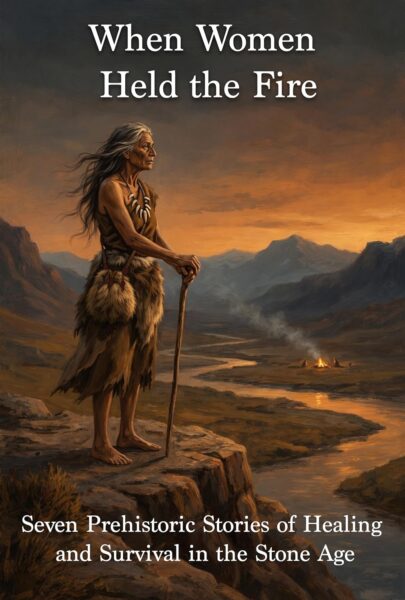
When Women Held the Fire follows seven women healers across four thousand years in prehistoric Central Europe — from 6000 BCE, when glaciers were still retreating, to 2600 BCE, when communities were raising the great stone monuments.
For a long time I struggled to explain what this book really is. Not a single story. Not quite a series either.
It is one valley. One place. And the lives of women who held knowledge across four thousand years in the same valley — each choosing what must be done to survive in the valley that kept changing in vast and terrifying ways.
The crises are real. Glacial meltwater poisoning rivers — that happened. Copper smelting producing toxic fumes — that happened. Volcanic ash burying entire regions — that happened. Stored grain developing deadly mould — that happened. Copper vessels leaching poison into acidic liquids — that happened, and people died from it for centuries before anyone understood why.
I didn’t need to invent dangers. Prehistory supplied more than enough.
What Surprised Me Most
These weren’t primitive people stumbling through a hostile world. They were sophisticated observers who understood their environment with an intimacy we’ve largely lost.
They knew that meadowsweet reduced fever — the same plant that contains the compound we now synthesise as aspirin. They knew that yarrow stopped bleeding — modern studies confirm it promotes clotting. They knew that charcoal could bind poisons in the gut — activated charcoal is still used in emergency rooms today.
They figured all of this out without chemistry, without microscopes, without clinical trials. Just by watching. Remembering. Teaching the next generation.
And when I sit with that — really sit with it — the modern chaos gets quieter. Four thousand years of upheaval, survived not through power or dominance but through knowledge passed quietly between women who paid attention. That perspective doesn’t solve anything. But it helps.
Who This Book Is For
If you loved Clan of the Cave Bear and wished there were more books like it — grounded in real archaeology, centred on strong women, set in a prehistoric world that feels alive — this is for you.
If you’re fascinated by herbalism, ancient medicine, or the question of how knowledge survived before writing existed — this is for you.
If you want fiction where the drama comes from the land, the weather, the body, and the brutal realities of survival — not from magic or prophecy — this is for you.
And if you’ve been looking for somewhere quieter to be for a while — this is for you.
When Women Held the Fire is available now on Amazon.
Available worldwide — search “When Women Held the Fire” on your local Amazon store.
If you’ve been reading the blog posts about Stone Age herbal medicine,prehistoric fauna, and life before civilisation — those topics come alive in these stories. The research behind the blog is the same research behind the book. The difference is that in the book, you’re standing beside the healer when the child stops breathing, when the volcano darkens the sky, when forty tons of stone crashes into a pit with someone you love trapped beneath it.
This isn’t the Stone Age behind glass. You’re in it.
When Women Held the Fire: Seven Prehistoric Stories of Healing and Survival in the Stone Age
The Seven Stories — At a Glance
Truth over survival: The glaciers had started melting toward the end of the Ice Age, bringing new surprises for the people of the valley.
Lera showed that a healer who stands for truth must have greater courage than the beast-hunters.
Fire that poisons: The age of copper was dawning. In the valley, a young man had learned to make stone bleed fire.
Saira had to decide whether she should destroy this invention to protect the village from its harmful smoke.
Salt or war: The glacier-covered valley was transformed into a marshland rich with fish. Trouble brewed between clans.
Sola had to convince her chief that the messenger she had saved was there to help them find salt — not to stir conflict.
Ash from sky and earth: The valley changes in vast and terrifying ways. Ash from distant eruptions covered the marshes and the sky darkened.
Brynja raced against time to protect the copper smelters from both the ash of the heavens and the ash from the pit.
Harvest with a hidden cost: The ash-covered land turned fertile. Fields of barley and emmer spread across the valley.
But new diseases emerged, and only Enea’s wisdom could guide her people forward.
Trade that turns dangerous: The valley became a place of trade and gathering.
Maera must prevent a catastrophic conflict with a powerful trader-king.
Stone that demands blood: Monumental stone structures rose across the valley.
Rilka must act before her adopted son is crushed beneath them.
The Corridor of First Fires
Lands of the Healer Women
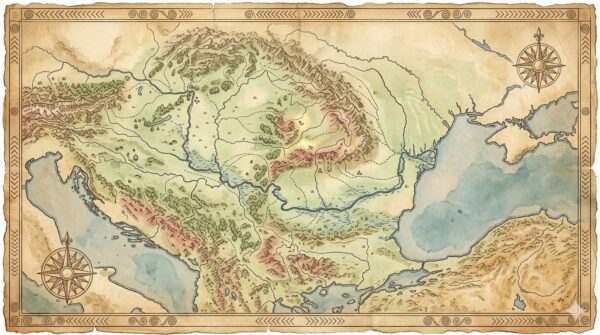
This is the world as it was before anyone thought to name it. A corridor of forest, marsh, and mountain stretching from the Carpathian arc to the Anatolian plateau — where glaciers withdrew and left fertile valleys behind, where copper first bled from stone, where salt moved along rivers that had no borders. Seven healers lived here across thirty-four centuries. This is the land that shaped them.
The Valley at the Edge of the Ice
The Heart of the Corridor
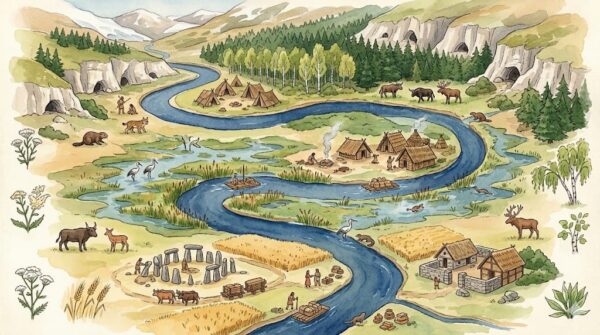
This is the valley where it happened. Not a grand landscape — a contained one. A river, a hillside, a coppersmith’s fire, a stand of willows where the healer gathered bark in autumn. Small enough that everyone knew everyone. Large enough that what one woman decided could change everything for the people who came after her. The glacier shaped it. The ash buried it. The river remade it. And through all of it, someone here knew what to do.
Archaeological Evidence Behind the Stories
I built these stories on archaeological evidence of how people lived, healed, and survived in prehistoric Europe — from plant residues and healing tools found in burials, to early copper smelting sites, to layers of volcanic ash that reshaped entire landscapes.
The dangers in the stories are real. The knowledge is real. What I have done is imagine the people who carried it.
Afterword
I started visiting the stone age people to relax. And then I started enjoying their company for what they taught me.
As I stand on my farm in the summer evening, I worry not about the coyote growling in my barn, nor about the mama wolverine with the cubs whom I saw prowling on the edges of the farm. I am more troubled by the mosquitoes biting me everywhere.
And then I remember what I learned from the ancient healer women — burn green wood, damp pine branches, or dried aromatic herbs like mugwort when the insects become unbearable. The smoke does what it has always done. It works the same way it worked fifty thousand years ago.
I grounded these stories in real evidence of prehistoric herbal medicine, early survival strategies, and daily life in the Stone Age world because I wanted the people, dangers, and knowledge to feel as true as possible.
Each story stands alone. Each features a different healer facing a different crisis. But they’re all connected by a lineage — a seed pouch passed from hand to hand, a greenstone knife re-hafted across generations, and a body of healing knowledge that grows with every woman who carries it.
In this blog, I explore Stone Age life, prehistoric healing, and how early humans survived through plants, observation, and knowledge passed across generations — the same knowledge that first drew me in, and keeps me returning to it.
