Have you ever stood in a natural history museum staring at the reconstructed skeleton of a woolly mammoth? The shoulder height of the woolly mammoth was about three metres — roughly level with the top of a delivery van. The tusks curved forward and upward like enormous parentheses, each one longer than you are tall. Standing there, youl may try to imagine being a Neanderthal on a cold steppe, armed with a wooden spear, facing this animal in the flesh. Not in a display case but in a world where it was breathing, moving, capable of killing you with a single swing of its head. And then you try to imagine something harder: living alongside this animal for tens of thousands of years without driving it to extinction.
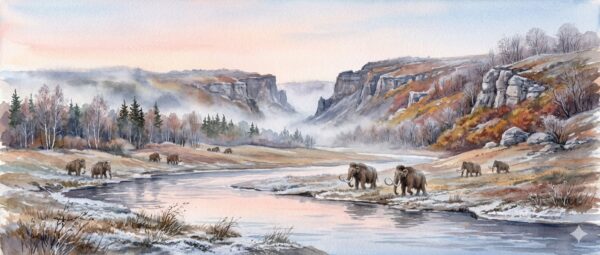
That is precisely what Neanderthals did. For over 200,000 years, they coexisted with woolly mammoths, woolly rhinoceroses, giant deer, cave bears, cave lions, and a suite of other megafauna across Europe and western Asia. They hunted some of these animals. They competed with predators for access to others. And yet, throughout the entire span of Neanderthal existence, these great Ice Age animals persisted. The megafauna extinctions that did eventually sweep across the globe came later — long after Neanderthals themselves had disappeared.
What Animals Did Neanderthals Hunt? Faunal Evidence from Kill Sites
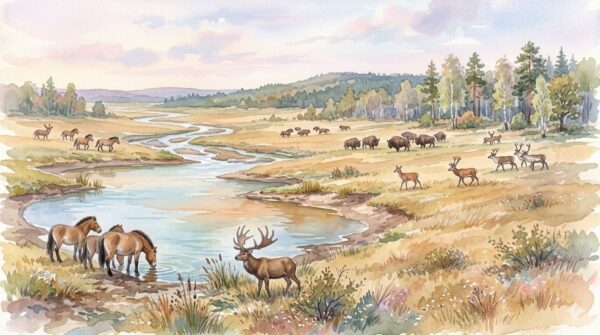
The archaeological record offers detailed evidence of Neanderthal hunting, primarily through the analysis of faunal remains — animal bones found at occupation sites and kill sites. Across hundreds of Middle Paleolithic sites in Europe, the most commonly hunted prey were medium-to-large ungulates: red deer, horses, bison, aurochs, ibex, chamois, and reindeer. These were the staple prey species that formed the backbone of Neanderthal subsistence.
Faunal assemblages from major sites such as Abric Romaní in Spain, Pech-de-l’Azé in France, and Grotta di Fumane in Italy consistently show that Neanderthals focused their hunting efforts on medium-sized herbivores. Cut marks on bones, patterns of marrow extraction through deliberate fracturing, and the selective transport of high-yield carcass parts (particularly hindlimbs rich in meat and fat) all confirm active, organised hunting rather than opportunistic scavenging.
Megafauna — mammoths, woolly rhinoceroses, and straight-tusked elephants — do appear in the faunal record at Neanderthal sites, but typically in smaller proportions. At Spy Cave in Belgium, mammoth remains account for about ten percent of the faunal assemblage, while horse dominates at nearly forty percent. At a Norfolk quarry in eastern England, a cluster of mammoth remains was found alongside Neanderthal hand axes, with one tool actually lodged inside a mammoth skull. Whether this represents direct hunting or processing of a naturally deceased animal remains debated at this and many similar sites.
Were Neanderthals Selective Hunters or Opportunistic Killers?
One of the most illuminating lines of research into Neanderthal hunting behaviour comes from mortality profiles — the analysis of the ages at death of prey animals. By examining tooth eruption patterns and wear stages in the teeth of hunted animals, researchers can determine whether Neanderthals were targeting specific age classes or killing indiscriminately.
At Abric Romaní, a major Neanderthal rock shelter occupied between roughly 43,000 and 55,000 years ago, the evidence shows that Neanderthals employed both selective and non-selective hunting strategies depending on the prey species and circumstances. Horses consistently show prime-dominated mortality profiles, meaning Neanderthals targeted animals in their physical prime — the individuals carrying the most meat and fat. Deer show more variable profiles, suggesting a mix of targeted ambush hunting and opportunistic encounter hunting.
At the French site of Mauran, thousands of bison bones reveal that Neanderthals used natural landscape features — bottlenecks, ravines, natural depressions — to funnel herds into positions where they could be ambushed and killed in large numbers. But even here, the evidence reveals selectivity: after the kill, Neanderthals chose the fattest carcasses for processing and transported only the highest-value body parts back to their living sites, leaving less desirable portions behind. They were, as one analysis memorably concluded, excellent tacticians and discerning diners.
Did Neanderthals Follow Seasonal Hunting Patterns?
Evidence from multiple sites indicates that Neanderthal hunting was organised around seasonal cycles. At Axlor Cave in the Basque Country of northern Spain, dental analysis of prey teeth shows that different species were hunted at different times of the year: wild goat and bison in spring, red deer, wild goat, and possibly horse in summer, and the widest range of species in autumn, when animals were carrying their heaviest fat reserves before winter. Winter hunting appears to have been avoided at this particular site.
Seasonal scheduling has also been identified at sites in southwestern France, where reindeer were exploited at specific times that coincide with their seasonal migration patterns. At Abri du Maras, a reindeer-dominated assemblage dated to the beginning of Marine Isotope Stage 3 reveals a focused, almost monospecific hunting pattern targeting at least sixteen individual reindeer — evidence of seasonal, scheduled subsistence embedded in a broader pattern of landscape mobility.
This kind of temporally structured hunting — arriving at the right place at the right time to intercept prey on predictable seasonal routes — requires sophisticated knowledge of animal behaviour, landscape geography, and climatic patterns. It is the hallmark of a species that had mapped its world with considerable precision.
Why Didn’t Neanderthals Drive Megafauna to Extinction?
This is perhaps the most interesting question of all, and the answer appears to lie in a combination of population size, hunting strategy, and ecological integration.
Neanderthal populations were small — genetic evidence consistently points to low population densities across their entire geographic range. Groups likely numbered between ten and twenty-five individuals, and total Neanderthal population at any given time may have been in the low thousands across all of Europe. This alone meant that their collective hunting pressure on megafauna populations was far lower than the pressure later exerted by anatomically modern humans, who eventually reached much higher population densities.
Additionally, Neanderthals appear to have focused their regular hunting efforts on medium-sized prey — deer, horse, bison — rather than routinely targeting the largest and most dangerous animals. Mammoth and rhinoceros were hunted or scavenged occasionally, but they were not the dietary staple. Isotope analysis of Neanderthal bones confirms a heavily meat-based diet, but zooarchaeological data — the actual bones found at sites — suggest that the meat came primarily from medium-sized ungulates, not megafauna.
There may also have been an element of ecological pragmatism. Killing a mammoth was extraordinarily dangerous for close-range hunters who did not possess projectile weapons like bows or atlatls. The caloric reward was enormous, but so was the risk. At the German site of Taubach, where Neanderthals hunted rhinoceros at warm springs around 120,000 years ago, the prey profile is telling: forty out of a minimum seventy-six rhinoceros individuals were juveniles between one and one-and-a-half years old. The hunters waited for calves to wander far enough from their mothers before striking. This was not reckless aggression — it was calculated risk management.
What This Means Today
The modern world is in the midst of a biodiversity crisis driven largely by habitat destruction, industrial agriculture, and overexploitation of wildlife. Against this backdrop, the Neanderthal record offers a striking counterpoint: a human species that lived alongside large, ecologically important animals for hundreds of thousands of years without precipitating their collapse.
This is not to romanticise Neanderthal life or to suggest they were conscious conservationists. They were not. But the structural conditions of their existence — small populations, localised hunting pressure, seasonal mobility, and a deep dependence on functioning ecosystems — created a dynamic in which human predation and megafaunal survival were compatible. The animals were not just prey. They were part of the system that made Neanderthal daily life possible: mammoths maintained open steppe habitats through their grazing, large herbivores cycled nutrients through the landscape, and the predator-prey relationships that Neanderthals navigated kept ecosystems in dynamic balance.
The broader research on megafauna extinctions increasingly points to later human populations — with higher densities, more effective projectile weapons, and landscape-level habitat modification — as the primary drivers of large mammal loss. The Neanderthal period, by contrast, demonstrates that coexistence with megafauna is possible when human impact remains within ecological limits.
Neanderthal Hunting and Ecological Balance
The relationship between Neanderthals and Ice Age megafauna was not one of dominance but of interdependence. Neanderthals needed the animals for food, fat, hide, and bone. The animals needed functioning habitats that Neanderthals, by virtue of their small numbers and mobile lifestyle, did not significantly alter. Predator respect — an awareness of the danger posed by cave lions, hyenas, and bears competing for the same prey — further modulated Neanderthal behaviour. They were not the apex predator of their world in the way modern humans have become. They shared the landscape with formidable competitors, and their survival strategies reflected that reality.
This mutual embeddedness in a shared ecosystem offers a model of sustainable hunting that contemporary conservation science is beginning to take seriously. Concepts like rewilding, trophic cascades, and the ecological role of large herbivores are all premised on the same insight that Neanderthal survival embodied: large animals are not just resources to be extracted. They are structural components of the ecosystems on which all life — including human life — depends.
Lesser-Known Facts
1. At Neumark-Nord in Germany, cut marks on 120,000-year-old fallow deer bones match the trajectory of wooden spear thrusts, providing direct forensic evidence of cooperative Neanderthal hunting with hand-crafted weapons.
2. Neanderthals and woolly mammoths shared molecular adaptations to cold climates, including variants in genes related to fat storage, hair and skin, and thermoregulation — a remarkable case of convergent evolution in two African-origin species that independently adapted to Ice Age Europe.
3. Neanderthals were adept at identifying landscape features that disadvantaged prey — ravines, blind corners, natural bottlenecks, and watering holes — and reused the same kill sites over long periods, indicating detailed territorial knowledge.
4. At Grotta di Fumane in Italy, Neanderthals selectively transported only the highest-yield body parts (femora, tibiae, metatarsals) from kill sites back to camp, leaving bulky, low-nutrition components behind — a practice that mirrors modern field-dressing techniques.
5. Marks on the ribcage of a 48,000-year-old cave lion skeleton in Germany suggest that Neanderthals killed even apex predators on occasion — possibly in territorial defence or for the use of pelts.
What We Still Don’t Know
The question of whether Neanderthals actively hunted mammoths or primarily scavenged from natural deaths and predator kills remains contested at many sites. The proportion of megafauna in their diet versus medium-sized prey continues to be refined through new isotope analyses. We do not know whether different Neanderthal populations had markedly different hunting strategies across their vast geographic range — from the Iberian Peninsula to the Altai Mountains of Siberia. The role of inter-species competition (with hyenas, cave lions, and wolves) in shaping Neanderthal hunting behaviour is still poorly understood. And perhaps most importantly, we do not yet have a clear picture of how Neanderthal hunting patterns changed over time as climate shifted between glacial and interglacial periods, bringing different megafaunal communities into and out of their territories. The Ice Age was not a single, static cold spell — it was a dynamic sequence of environmental transformations, and understanding how Neanderthals adapted their hunting to each phase is one of the great ongoing projects in Paleolithic archaeology.
Summary
Neanderthals coexisted with Ice Age megafauna — including woolly mammoths, woolly rhinoceroses, and cave lions — for over 200,000 years without driving any of these species to extinction. Faunal evidence from kill sites across Europe reveals that Neanderthal hunting was selective, seasonally organised, and primarily focused on medium-sized prey such as deer, horse, and bison. Neanderthal intelligence included detailed knowledge of animal behaviour, landscape geography, and sustainable hunting strategies that kept human predation within ecological limits. This Neanderthal coexistence with Homo sapiens-era megafauna contrasts sharply with later extinction events and offers lessons for modern conversations about prehistoric ecology, Ice Age survival strategies, and the ecological role of large animals in healthy ecosystems.
