I once watched a nine-year-old try to split a river cobble with a hammerstone at an experimental archaeology workshop. She swung hard, missed the platform angle, and sent the cobble flying off the leather pad. Her second try produced a thick, useless chunk. Her third attempt — after watching more carefully, adjusting her grip, and placing the stone more deliberately — finally popped off a recognizable flake. Her face lit up. That moment of frustration followed by correction followed by success is exactly what archaeologists now believe they can identify in the stone tool record of Neanderthal children. The evidence is subtle — malformed flakes, over-struck cores, and learning curves preserved in lithic assemblages — but it tells us something remarkable. Neanderthal children were not passive. They were apprentices. And someone was teaching them.
What Evidence Exists for Neanderthal Children Making Stone Tools?

Roughly half of all known Neanderthal skeletal remains belong to children and adolescents — a proportion that reflects high juvenile mortality but also confirms that children were present at occupation sites in significant numbers. These were not background figures. They lived in the same caves, handled the same materials, and left traces of their activity in the archaeological record.
The most direct evidence comes from lithic analysis — the study of stone tools and the waste products of their manufacture. At Neanderthal sites across Europe, researchers have identified cores and flakes that bear distinctive marks of inexperienced knapping. These include “face battering” — repeated unfocused strikes on the same surface without proper platform preparation — “stacked steps” — sequences of failed flake removals that climb the core face rather than removing material cleanly — and unusually thick, asymmetric flakes with irregular edges. At one well-studied site in the Netherlands, over 85 percent of cores exhibited error patterns commonly attributed to novice knappers.
A critical study at Nesher Ramla, a Middle Paleolithic open-air site in Israel, applied 3D-based analysis to identify decision errors in knapping sequences. The researchers found a clear correlation between the degree of technological complexity and knapper expertise: simple core technologies — pebble cores and irregular multi-surface cores — were associated with novice work, while more structured technologies, particularly Levallois reduction, were exclusively linked to experienced knappers. This gradient from simple to complex provides a direct window into the learning process. Beginners started with basic techniques. Over time, they progressed to the demanding Levallois method — a technique requiring mental planning, spatial visualization, and precise motor control.
How Long Did It Take to Learn? Evidence for Extended Apprenticeship
Modern experimental studies illuminate the time investment required. In one study, 26 untrained participants attempted to learn Late Acheulean handaxe production — a technology that shares cognitive demands with Neanderthal Levallois knapping. After up to 90 hours of guided training over several months, most still had not achieved consistent competence. The study identified social support, persistence, and self-control as key factors in successful learning.
A separate experiment tested whether stone knapping can be learned without any cultural transmission. Twenty-eight naive participants given raw materials but no instruction were able to produce basic Oldowan-style flakes through trial and error. However, more complex techniques — including the systematic platform preparation characteristic of Neanderthal Levallois technology — remained beyond what individual learning could produce. This suggests that while basic flaking may be individually discoverable, the sophisticated reduction sequences found at Neanderthal sites almost certainly required social learning — watching, imitating, and being corrected by experienced practitioners.
Further experiments compared knapping acquisition under imitation-only, gestural instruction, and verbal instruction conditions. Both gestural and verbal teaching significantly improved performance over imitation alone, with verbal teaching producing the greatest gains. This is relevant to the debate about Neanderthal language — even without full spoken language, gestural demonstration would have substantially accelerated skill transfer from adults to children.
Did Neanderthals Teach Their Children Around the Fire?

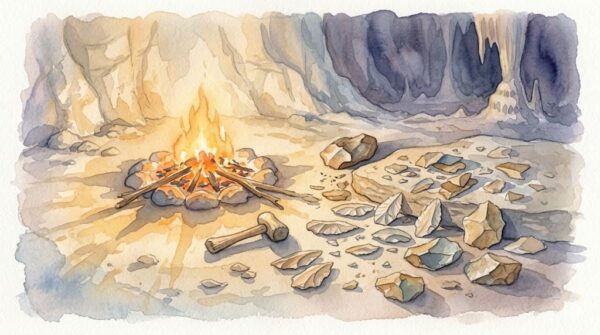
At Qesem Cave in Israel — a site occupied from roughly 400,000 to 200,000 years ago — researchers found more than a thousand flint cores in close proximity to a large, repeatedly used central hearth. Some cores showed expert knapping — long, smooth reduction faces with controlled removals. Others bore the unmistakable marks of beginners — irregular, frustrated sequences of failed removals. Critically, both types were concentrated around the hearth, suggesting that expert and novice knappers worked side by side in the same space, near the fire.
The researchers interpreted this as evidence of intergenerational teaching. The fire served not only as a source of warmth and light but as the spatial center of learning — a place where children watched skilled adults, received cores to practice on, and gradually developed their own technique. This pattern — expert and novice production debris co-located around hearths — has been identified at other prehistoric sites as well, suggesting it was a widespread feature of Paleolithic family structure.
What Else Did Neanderthal Children Need to Learn?
Stone knapping was only one component of a vast body of knowledge required for Ice Age survival. Fire management demanded understanding fuel selection, fire architecture, and ember maintenance — skills that cannot be acquired in a single season. Evidence from sites across Europe demonstrates that Neanderthals maintained fires over extended periods and positioned hearths for optimal airflow.
Plant identification carried life-or-death stakes. Dental calculus analysis from Neanderthal teeth at sites including El Sidrón in Spain and Shanidar Cave in Iraq has revealed traces of cooked plant starches and bitter medicinal compounds that were deliberately consumed. Distinguishing edible from toxic plants, recognizing seasonal availability, and understanding medicinal properties requires accumulated observational knowledge transmitted across generations.
Hunting required extensive ecological knowledge beyond physical strength. Faunal evidence from Neanderthal sites shows selective, seasonal hunting of specific prey species — red deer in autumn, reindeer in winter, ibex in highlands — implying deep understanding of animal behavior and migration patterns. The Levallois point — a carefully prepared stone projectile tip — required precise shaping, hafting with adhesive, and attachment to a wooden shaft. Integrating all these elements into a functional weapon was the culmination of years of progressive learning.
What Can Childhood Growth Patterns Tell Us About Neanderthal Learning?
How long Neanderthal childhood lasted directly affects how much time was available for learning. Early dental studies suggested accelerated development — faster tooth formation and earlier eruption — implying shorter childhoods. A study of the Scladina juvenile in Belgium found second molars emerging years earlier than in modern children.
However, more recent evidence complicates this picture. A partial skeleton of a 7.7-year-old Neanderthal from El Sidrón Cave in Spain showed limb bone maturation rates comparable to modern children, though the brain had reached only about 87 percent of expected adult size — compared to 90 percent in modern humans by the same age. This suggests Neanderthal brains may have taken slightly longer to reach full size, allowing more time for cognitive development.
A 2020 study of three Neanderthal milk teeth from northeastern Italy found that weaning began at five to six months — identical to modern humans — and that deciduous tooth growth rates were comparable between species. The researchers concluded that early-life metabolic demands, driven by growing a large brain, were similar in both species. If the earliest months were metabolically equivalent, the cognitive infrastructure for extended learning may have been in place from birth.
What Does This Tell Us About Neanderthal Intelligence?
Levallois technology — the flagship of Middle Paleolithic stone tool production — requires the knapper to visualize a finished tool within an unworked stone, plan a reduction sequence involving dozens of preparatory removals, and execute each step with precise motor control while adjusting to the raw material’s properties. Teaching this skill to a child requires the ability to model a mental process, recognize errors, and communicate corrections — capacities that overlap with what cognitive scientists consider hallmarks of advanced social cognition.
The gradient from simple to complex technology visible at sites like Nesher Ramla is a learning curve — the same progression that modern apprenticeship systems produce. The concentration of expert and novice work around hearths suggests this learning occurred in a structured social context, mediated by proximity, observation, and guided practice.
What This Means Today
Every modern education system — from trade apprenticeships to university lectures — rests on the same basic architecture: an experienced practitioner demonstrates a skill, a novice observes and attempts to replicate it, errors are identified and corrected, and competence develops through repetition over time. The evidence from Neanderthal sites suggests that this pattern extends back at least 200,000 years. Neanderthal children did not stumble into competence by accident. They were guided into it by adults who invested time, attention, and patience in their development. The next time you watch a child struggle with a new skill and then finally get it right, you are witnessing a cognitive process that is, in its essentials, older than our species.
How Neanderthal Learning Depended on Ecological Knowledge
Much of what Neanderthal children needed to learn was ecological. Which plants were safe to eat and when they ripened. Where prey animals moved in different seasons. Which stream crossings were passable in winter. Where to find specific types of stone for different tools. This body of environmental knowledge — accumulated over generations and transmitted from elder to child — was the foundation of Ice Age survival strategies. Losing this knowledge through population decline, group fragmentation, or disruption of teaching chains would have been as devastating as losing access to food or fire. The parallel to modern concerns about the loss of indigenous ecological knowledge is direct and sobering.
Lesser-Known Facts
Over 85 percent of stone cores at one Neanderthal-associated site in the Netherlands show novice error patterns, suggesting children actively practiced tool-making at occupied camps. Modern experiments show that learning competent handaxe production requires up to 90 hours of guided practice — and participants still do not reach expert levels. Neanderthal dental calculus preserves traces of cooked plants and medicinal compounds, meaning children needed to learn complex botanical identification over years. A 7.7-year-old Neanderthal from El Sidrón had bones maturing at modern rates but a brain still growing — suggesting a longer developmental window than previously assumed.
Myth vs. Evidence
Common misconception: Neanderthals operated on instinct rather than learned skill, with each individual figuring out survival independently. Evidence: The complexity of Levallois technology, the presence of learning curves in lithic assemblages, and the co-location of expert and novice work around hearths all point to structured, intergenerational teaching — a hallmark of cultural transmission, not instinct.
Try This
Pick up a smooth river stone and try to chip a flake off it using another stone. Notice how much harder it is than it looks — the angle, the force, the aim all have to coordinate simultaneously. Now imagine a child doing this for the first time 100,000 years ago, watching an adult’s hands for guidance. That gap between your first failed attempt and your first successful flake is the learning space where Neanderthal education happened.
What We Still Don’t Know
At what age did Neanderthal children begin knapping practice? The lithic evidence does not yet permit a reliable answer. Were there gender differences in which skills children were taught? No direct evidence confirms or denies this for Neanderthals, though some isotopic studies suggest possible differences in diet and mobility between males and females. Was teaching always patient and supportive, or did it involve coercion? We cannot know. Did Neanderthal children play, and if so, does play-related tool production exist in the lithic record, distinguishable from formal learning? This is an active area of research. And the largest question of all: did Neanderthal teaching involve language — spoken instructions, corrections, encouragement — or was it conducted entirely through demonstration, gesture, and observation? The evidence permits either possibility, and the answer would fundamentally reshape our understanding of Neanderthal cognition.
Summary
Archaeological evidence demonstrates that Neanderthal children were active participants in tool production, leaving diagnostic error patterns that trace learning trajectories from simple to complex technologies. Experimental archaeology confirms that Levallois technique — central to Neanderthal daily life — could not have been acquired without social learning. The co-location of expert and novice production debris around hearths at multiple sites points to fire-centered apprenticeship. Combined with evidence for extended brain development comparable to modern humans, the picture is one of a species that invested substantially in its children’s education — a key feature of Neanderthal society and Neanderthal intelligence that undermines any characterization of these people as cognitively simple.
