
I once stood at the edge of a forest clearing in central Germany, watching a pair of ravens circle overhead while a fox picked through scrub at the treeline. It struck me then — not for the first time — that the animals around us are watching, always watching. They notice where we go, what we leave behind, what patterns we repeat. And they adjust. If that’s true now, in our world of concrete and noise, imagine how much truer it was two hundred thousand years ago, when a small band of Neanderthals moved through an Ice Age valley, trailing the scent of blood and fire. Who was paying attention? Almost certainly, wolves. Almost certainly, ravens. And the relationships that grew from that mutual awareness may have been among the most quietly important in all of Neanderthal daily life.
Did Wolves Follow Neanderthal Camps?
Wolves and Neanderthals were both apex predators occupying the same Ice Age ecosystems across Europe and western Asia. They hunted the same prey — red deer, reindeer, horses, and occasionally larger animals like bison. They both operated in cooperative social groups. They both relied on seasonal knowledge of prey movements. In ecological terms, they were competitors. But competition does not always mean conflict. In environments where resources are patchy and unpredictable, scavenging becomes a survival strategy. And where there are successful hunters, scavengers gather.
It is archaeologically confirmed that wolves and Neanderthals coexisted across Europe for hundreds of thousands of years. Faunal assemblages from Neanderthal occupation sites frequently include wolf remains, though the nature of that presence — whether hunted, scavenged, or simply overlapping — is debated. What we can say with confidence is that wolves would have been drawn to kill sites. A group of Neanderthals butchering a deer carcass would have generated blood, viscera, and marrow-cracked bone — an olfactory signal detectable by wolves from considerable distance. Over time, wolves trailing Neanderthal groups would have learned that these bipedal hunters meant food. This is strong inference from ecological modelling, though direct archaeological proof of sustained wolf-camp association in the Middle Palaeolithic remains limited.
The key question — did Neanderthals tolerate or even encourage this trailing behaviour? — has no definitive answer. No Neanderthal sites have yet produced canid remains that show clear evidence of domestication or deliberate partnership, unlike later Homo sapiens sites in Central and Eastern Europe. But absence of evidence is not evidence of absence. Wolves circling a camp at a respectful distance, cleaning up discarded bone and sinew, would have left little archaeological trace. And Neanderthals, who survived in these landscapes for over three hundred thousand years, were keen observers of animal behaviour. They would have noticed the wolves. The question is what they did about it.
What Were Ravens Doing at Neanderthal Kill Sites?
Ravens are among the most intelligent bird species alive today, and they have an ancient, well-documented relationship with large predators. In modern ecosystems, ravens follow wolf packs to scavenge from their kills. They also follow human hunters. This behaviour — called synanthropy, meaning an ecological dependence on human activity — may go back tens of thousands of years, possibly much further.
A study published in Nature Ecology and Evolution examined raven bones from Gravettian archaeological sites in Moravia (modern Czech Republic), dating to over 30,000 years ago. Stable isotope analysis of those bones revealed that the ravens’ diet overlapped significantly with human food sources, suggesting they were feeding on scraps from human hunting camps. The number of raven remains at sites like Předmostí was remarkably high — unusual for wild bird assemblages of that period. Researchers concluded that ravens had adapted their feeding behaviour around human settlement activities, one of the earliest known examples of this pattern.
But the connection goes deeper — and older. Research from Gibraltar’s Gorham’s Cave and other sites has demonstrated that Neanderthals had a sustained and widespread association with corvids (the raven and crow family) and raptors (eagles and vultures). A landmark study analysing nearly 1,700 Pleistocene bird fossil sites across Eurasia found a statistically significant correlation between Neanderthal occupation and the presence of corvids and raptors. Crucially, the bird bones found at these sites were disproportionately wing bones — not the breast or leg bones you would expect if the birds were being eaten for meat. And many of these wing bones showed cut marks from stone tools, concentrated precisely where large flight feathers attach. This is archaeologically confirmed evidence that Neanderthals were removing feathers from ravens, eagles, and vultures — almost certainly for symbolic or decorative use.
A decorated raven bone from Zaskalnaya VI in Crimea, dated to between 38,000 and 43,000 years ago, shows deliberate, evenly spaced notches that microscopic analysis confirmed were intentionally carved, not accidental. Two additional notches appear to have been added later to improve the visual regularity of the pattern. This is one of the earliest known examples of deliberate mark-making on bone — and it was made by Neanderthals, on a raven.
How Does Shared Landscape Create Interdependence?
The archaeological evidence does not support claims that Neanderthals domesticated wolves or kept ravens as companions in any modern sense. That would be overclaiming. What the evidence does suggest — and this is strong inference from multiple data sources — is that Neanderthals existed within a web of ecological relationships with these species that went beyond simple predator-prey dynamics.
Wolves following camps. Ravens trailing kills. Eagles circling overhead. These animals were not passive features of the landscape. They were active participants in Ice Age ecosystems, and their behaviours were shaped by what Neanderthals did. In turn, Neanderthal intelligence — their capacity for observation, pattern recognition, and ecological knowledge — would have made them acutely aware of what these animals could signal. A circling raven might indicate a carcass. Wolves gathering in a valley might mark the path of a migrating herd. These are the kinds of ecological cues that experienced hunters read instinctively.
This suggests a Neanderthal society embedded in its environment, not standing apart from it. Their survival depended on reading the land, the weather, and — critically — the other animals sharing that land. Ice Age survival strategies were not just about making tools and building fires. They were about understanding the network of life in which Neanderthals were one node among many.
What Neanderthal Ecology Teaches About Living with the Natural World
Neanderthal survival depended on ecological balance in ways we have largely forgotten. They did not manage their environment — they participated in it. The wolves that trailed their camps were not pests to be exterminated; they were fellow travellers in a landscape of shared risk and shared reward. The ravens that picked at their kill sites were not nuisances; they were indicators, part of a vast information network written in movement and sound.
Modern conservation biology increasingly recognises that ecosystems function through webs of interdependence. The reintroduction of wolves to certain landscapes has cascading positive effects — controlling deer populations, allowing vegetation to recover, stabilising riverbanks. Ravens serve as indicator species, their behaviour reflecting the health of the broader ecosystem. These insights feel modern, but Neanderthals lived them daily for hundreds of millennia. They had no choice. In a world without agriculture, without storage infrastructure, without any buffer against ecological collapse, staying attuned to the animals around you was not philosophy. It was survival.
Try This: Spend a week observing the birds in your neighbourhood. Notice which species appear at what times of day, what they eat, and how they respond to human presence. You may be surprised how much information about your local ecology is written in their behaviour — information our ancestors would have read fluently.
Lesser-Known Facts
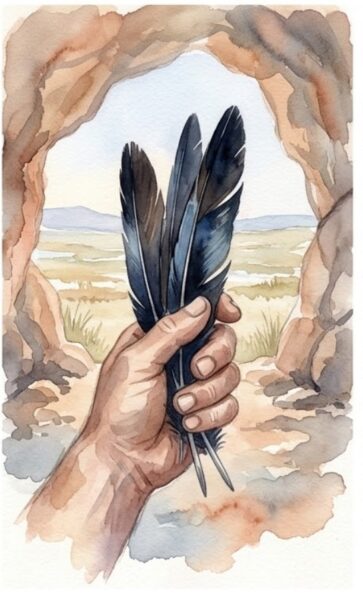
Neanderthals appear to have preferentially collected feathers from dark-plumed birds — ravens, black vultures, choughs — suggesting an aesthetic or symbolic preference for dark feathers. This is supported by statistical analysis of bird species found at Neanderthal sites compared to the regional species pool.
The Golden Eagle was the most frequently targeted raptor by Neanderthals, consistent with its prominence in human cultures across Eurasia and North America in later periods. The tradition of catching large raptors appears to date back at least 130,000 years.
Eagle talons found at the Krapina Neanderthal site in Croatia — dating to approximately 130,000 years ago — show signs of having been strung together, possibly as a necklace or other ornament. This is among the oldest known evidence of jewelry in the human lineage.
A 46,000-year-old three-ply cord fragment from Abri du Maras in France suggests Neanderthals had sophisticated fibre technology. If they could make string, they could have made snares, nets, or tethers — technologies that would have significantly expanded their interactions with animals.
No Neanderthal sites have yet been found containing canid remains that clearly demonstrate domestication. The wolf-human partnership that eventually produced dogs appears to have been established by Homo sapiens, possibly between 23,000 and 40,000 years ago — after the Neanderthal period.
Common Misconception vs Evidence
Misconception: Neanderthals were solitary brutes who had no relationship with other species beyond hunting them.
Evidence: Multiple lines of archaeological data — feather extraction, eagle talon collection, raven bone decoration, and faunal association patterns — demonstrate that Neanderthals had complex, sustained relationships with birds and likely with wolves. These relationships involved symbolic behaviour, ecological awareness, and possibly mutual benefit. The emerging picture is of a species deeply embedded in its ecosystem, not isolated from it.
What We Still Don’t Know
Did Neanderthals deliberately encourage wolves to follow their groups, or simply tolerate their presence? Were raven behaviours incorporated into Neanderthal hunting strategies — for example, following ravens to locate carcasses? Did the collection of dark feathers serve a ritual, identity, or purely aesthetic purpose? Why did Neanderthals apparently not develop the kind of wolf-human partnership that later Homo sapiens did — was this a matter of cognitive difference, social structure, population density, or simply timing? How far back do these interspecies relationships extend — were early Neanderthals 300,000 years ago already paying attention to the animals that followed them? These are questions the archaeological record has not yet answered, and may never fully resolve. What is clear is that Neanderthal coexistence with other species was richer and more layered than we once imagined.
Summary
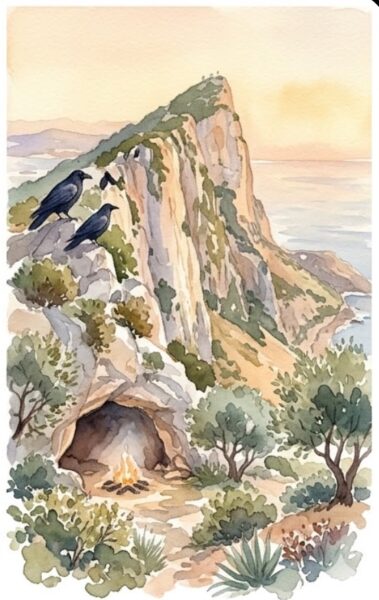
Neanderthal daily life unfolded within a complex Ice Age ecosystem where wolves, ravens, eagles, and other animals were constant companions — not as domesticated allies, but as ecological partners shaped by shared landscapes and overlapping survival strategies. Archaeological evidence from sites across Europe confirms that Neanderthals systematically collected raptor and corvid feathers, decorated raven bones, and existed in close ecological proximity to wolves. These early human-animal relationships offer a window into Neanderthal intelligence, Neanderthal society, and the deep roots of interspecies interdependence. Understanding how Neanderthals coexisted with the animals around them challenges the outdated image of these Ice Age people as simple or solitary, and reveals a world of quiet observation, ecological knowledge, and shared survival that resonates with modern insights into prehistoric ecology and sustainable living.
