Think about putting on a coat this winter. You reach into a closet, pull something off a hanger, and zip it up in three seconds. Now strip that away — all of it. No zippers, no buttons, no thread, no needles, no loom, no cotton, no wool from domesticated sheep. You are standing in a European river valley sixty thousand years ago. The temperature is dropping below minus twenty. Wind is cutting across open steppe. You have stone tools, fire, and the body of a deer you killed this morning. And you need to be warm enough to survive the night, and the next night, and every night through a winter that will last five months. This was the world Neanderthals inhabited. They did not merely endure it — they thrived in it for over three hundred thousand years, across some of the coldest periods the Northern Hemisphere has experienced. How they clothed themselves without any of the technologies we associate with garment-making is one of the most fascinating puzzles in Paleolithic archaeology.
Did Neanderthals Actually Wear Clothes?
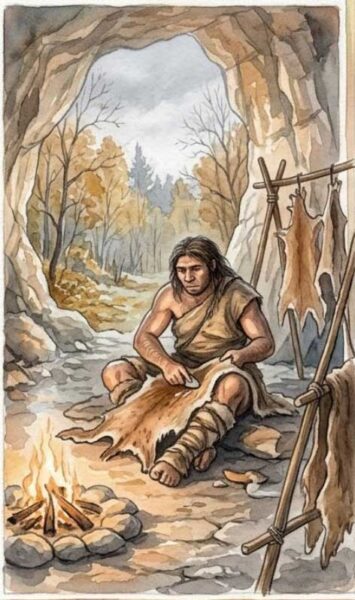
The short answer is: almost certainly yes, at least in colder regions. The longer answer involves a surprising amount of debate, because Neanderthal clothing — made from animal hides, furs, and possibly plant fibres — does not survive in the archaeological record. Leather and fur decompose completely within a few thousand years under most conditions. No Neanderthal garment has ever been found. We have a 5,000-year-old leather outfit from the famous Alpine mummy, but nothing remotely that old from Neanderthal contexts. As one biological anthropologist has noted, we are likely never going to find direct archaeological evidence of Neanderthal clothes — the materials simply do not preserve.
What we have instead is a rich body of indirect evidence. First, there is the thermoregulation argument. Neanderthals lived from the Iberian Peninsula to Siberia, across a range of climates that included full glacial conditions. Their bodies were cold-adapted — stocky, broad-chested, with shorter limbs that reduced heat loss — but physiological modelling studies indicate that body shape alone would not have been sufficient for survival in the coldest periods without some form of thermal insulation. Exposed skin in sustained sub-zero temperatures leads to frostbite and tissue death. Analysis of Neanderthal skeletal remains has revealed surprisingly little evidence of frostbite damage, which researchers have cited as indirect evidence that extremities were covered. If Neanderthals were regularly going bare in deep winter, we would expect to see far more cold-injury pathology than we do.
What Tools Did Neanderthals Use to Process Hides?

The strongest archaeological evidence for Neanderthal clothing comes not from garments themselves but from the tools used to make them. Neanderthal lithic assemblages are rich in scrapers — stone tools with a worked edge designed for drawing across a surface. Use-wear analysis of these scrapers reveals microscopic patterns consistent with hide processing: the distinctive polish, edge rounding, and striations that form when stone is repeatedly dragged across animal skin to remove flesh, fat, and membrane. These patterns are archaeologically confirmed at numerous sites across Europe and the Levant.
At the site of Neumark-Nord in Germany, dating to approximately 200,000 years ago, a stone scraper was found with organic residue still adhering to its surface. Chemical analysis revealed that this residue contained tannin from oak bark — a substance used in tanning, the process of chemically preserving animal hides to prevent decay and make them supple. If confirmed as intentional tanning, this would be the oldest known evidence of leather production in the world.
Bone tools add further depth to the picture. At several Neanderthal sites, including Pech-de-l’Azé and Abri Peyrony in France, researchers have found “lissoirs” — smooth, rounded bone tools interpreted as leather-working implements. Similar tools are still used today by traditional leather workers to smooth and soften hides. At the Grotte du Renne in France, bone smoothers found in Châtelperronian layers associated with late Neanderthals (approximately 45,000–42,000 years ago) confirm that hide-working was part of Neanderthal technological practice.
Additionally, stone and bone awls — pointed tools suitable for piercing holes in hide — appear at some late Neanderthal sites. These suggest Neanderthals could have joined pieces of hide together by threading cordage or sinew through punched holes, even without the eyed needles that appear only later in association with Homo sapiens.
How Did Neanderthals Make Clothing Without Needles?
This is where archaeology meets inference. Eyed needles — the kind with a hole for threading — first appear in the archaeological record around 40,000 years ago, primarily at Homo sapiens and possibly Denisovan sites. No eyed needles have been found at Neanderthal sites. This absence has led some researchers to argue that Neanderthals wore only simple, cape-like wraps rather than fitted, tailored garments.
But the distinction between “wrapped” and “tailored” may be overstated. You do not need a needle to create functional cold-weather clothing. Awls can punch holes through which sinew or cord can be threaded. Strips of hide can be tied, knotted, or wrapped. Birch bark tar — which Neanderthals were manufacturing up to 200,000 years ago — could have been used to glue edges of hide together or to seal seams against wind and moisture. A 2023 experimental pilot study suggested that birch bark glue was a plausible component for making waterproof garments. And the three-ply cord fragment discovered at Abri du Maras in France, dating to between 41,000 and 52,000 years ago, demonstrates that Neanderthals had the fibre technology needed for lacing, binding, and tying — skills directly applicable to garment construction.
Dental wear patterns in some Neanderthal populations are consistent with using teeth to soften hides — a technique documented among historical Inuit peoples, who chew leather to make it pliable for clothing. Cut marks on the foot bones of wolves, foxes, and other fur-bearing animals at Neanderthal sites indicate careful skinning — the kind of precise hide removal needed to preserve pelts intact for clothing use.
Were Neanderthal Bodies Their First Line of Defence?

Before focusing entirely on technology, Neanderthal bodies were themselves a form of cold-weather adaptation. Their physique — barrel-shaped torsos, broad shoulders and pelvises, relatively short forearms and lower legs — follows biogeographical rules for cold-adapted mammals: maximise volume relative to surface area, and reduce extremity length. Their larger nasal cavities warmed and humidified cold air before it reached the lungs. This is archaeologically confirmed through extensive skeletal analysis.
But physiology has limits. Thermal modelling indicates Neanderthal body shape alone sustained comfortable activity only down to roughly 0–5°C without clothing. Below that — and Ice Age winters routinely plunged far below — additional insulation was necessary. The combination of biological adaptation and hide technology represents a dual strategy: the body provided thermal baseline, and clothing extended it into survivable territory. This integration of biology and technology is itself a form of intelligence.
What Neanderthal Clothing Tells Us About Sustainable Craft
Every Neanderthal garment was locally sourced, biodegradable, and produced with zero waste. The hide came from an animal that also provided meat, marrow, sinew, and bone tools. Processing used stone scrapers that could be resharpened indefinitely, bone tools shaped from the same carcass, and adhesives made from locally gathered birch bark. Nothing was imported. Nothing was synthetic.
This offers a striking contrast with modern textile production, which generates enormous quantities of waste annually. Neanderthal clothing was slow fashion in its purest form: made by the wearer, from materials the wearer hunted and processed, to meet real rather than manufactured needs. Understanding how Neanderthals clothed themselves illuminates the hidden labour behind every garment — killing the animal, skinning it precisely, scraping the hide, softening the leather, punching holes, lacing pieces together. A single hide garment represented hours of skilled work. Neanderthal society depended on that labour and transmitted the knowledge to make it possible.
Try This: Visit a local leather-working shop or craft fair and ask about the process of hand-tanning a hide. The steps — fleshing, dehairing, softening, stretching — are essentially the same ones Neanderthals performed with stone and bone tools. Feeling the weight of an unprocessed hide helps you appreciate the physical effort involved in every garment our ancestors made.
Lesser-Known Facts
Evidence Snapshot:
The oldest direct evidence of fibre technology — a three-ply cord made from conifer inner bark — was found on a Neanderthal stone tool at Abri du Maras in France, dating to between 41,000 and 52,000 years ago. The ability to make cord implies the ability to lace, bind, and attach hides — fundamental skills for garment construction.
Neanderthal lithic assemblages contain significantly higher proportions of scrapers compared to many early Homo sapiens assemblages. The frequency of these hide-working tools correlates strongly with colder climate periods, suggesting that clothing production intensified when temperatures dropped.
Bones of fur-bearing animals — wolves, foxes, bears — appear at Neanderthal sites in higher proportions than would be expected for food alone. Cut marks on paw bones indicate precise skinning to preserve pelts intact.
Genetic studies of human head lice and body lice suggest these populations diverged between 83,000 and 170,000 years ago. Body lice live exclusively in clothing, so their evolutionary origin provides a molecular clock for when habitual clothing use began — well within the Neanderthal period.
Neanderthals at Abri du Maras also processed reindeer sinew, which can be used as strong, flexible thread for stitching hides together. Evidence comes from use-wear analysis of stone tools.
Common Misconception vs Evidence
Misconception: Neanderthals were covered in thick body hair like apes and did not need or wear clothing.
Evidence: There is no evidence that Neanderthals had significantly more body hair than modern humans. Genetic analysis of Neanderthal DNA has not identified genes associated with heavy body hair coverage. Their cold-adapted body shape provided some thermal advantage, but thermal modelling confirms this was insufficient for deep winter survival. Stone scrapers, bone smoothers, hide-processing residues, and faunal evidence collectively indicate that Neanderthals processed animal hides into functional garments — and may have been doing so for over 200,000 years.
What We Still Don’t Know
We do not know what Neanderthal clothing looked like. Were garments simple wraps or more structured coverings with laced seams? Did they include separate pieces for different body parts, including feet? The absence of eyed needles at Neanderthal sites is suggestive, but needles are small and fragile — their absence may reflect preservation bias. We do not know whether Neanderthals in warmer regions wore clothing regularly or only seasonally, nor whether clothing influenced social identity or was decorated. The organic materials that would answer these questions have long since returned to the earth, leaving us to reconstruct an invisible technology from the stone and bone shadows it left behind.
Summary
Neanderthals survived Ice Age winters for over three hundred thousand years by combining cold-adapted physiology with sophisticated hide-processing technology — stone scrapers, bone smoothers, fibre cordage, and birch tar adhesives — to create functional clothing without needles or thread. Understanding Neanderthal clothing challenges assumptions about their intelligence, reveals the complexity of Paleolithic family life, and offers a counterpoint to modern disposable fashion. Their Ice Age survival strategies remind us that ecological knowledge, skilled handcraft, and resourcefulness sustained human populations long before industrial technology — and that Neanderthal society deserves recognition as one of the most durable and adaptable cultures in human history.
