She hunted. She healed. She painted the cave walls. Here are the books that let you live inside her world.

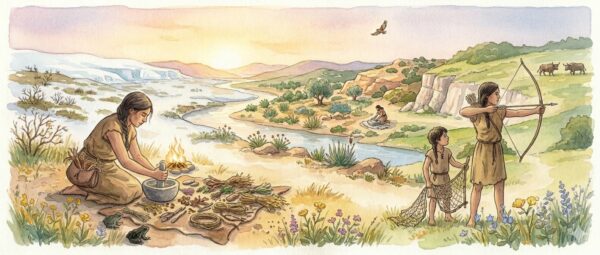
Nine thousand years ago, in the high Andes of Peru, a young woman was buried with her hunting toolkit — projectile points, scrapers, processing blades. For decades, archaeologists assumed the skeleton was male. It wasn’t. Genomic analysis confirmed what the grave goods had been saying all along: she hunted big game, and she was buried with the tools of her craft.
She wasn’t alone. A broader study of early American burials found that women with hunting toolkits weren’t rare exceptions — they were a substantial presence in the archaeological record. Meanwhile, in a cave in northern Spain, analysis of 50,000-year-old Neanderthal teeth revealed that women’s teeth bore distinctive wear patterns from repetitive skilled work — gripping, pulling, scraping — the signatures of hide preparation and craft production that had left their mark on the body itself. In Mesolithic Germany, a woman was buried wearing an antler headdress, surrounded by ornaments and ochre, in an assemblage so extraordinary that it’s become one of the most studied ritual burials in European prehistory. And on cave walls across Ice Age Europe, biometric analysis of hand stencils suggests that women and children pressed their palms against the rock alongside the men — participants in the oldest art tradition on Earth.
The bones are telling us something. The teeth are telling us something. The graves and the cave walls are telling us something. And increasingly, so are the books.
This is a reading list — but I didn’t write it as one. I wrote it as a journey. It starts in the Ice Age and ends in the present, and every book on it was chosen because it drops you inside a woman’s world so completely that a historical era becomes something you feel rather than study. Not women who set out to change history. Just women who lived — and whose daily reality, when you inhabit it through a great book, changes how you see everything.
If you’re looking for the best books about women in history, the best prehistoric fiction with female protagonists, or just your next immersive page-turner — start walking. The trail begins 30,000 years ago.
What makes this list different from other book lists about women in history? Most lists start at ancient Greece. This one starts in the Stone Age — because the story of women doesn’t begin with civilization. It begins with survival. The prehistoric fiction section is the longest, the deepest, and the part you won’t find anywhere else. If you love books like Clan of the Cave Bear, this is where you’ll find your next ten reads.
The Deep Past: When Survival Was the Story
Prehistoric fiction · Stone age historical fiction · Ice Age to Neolithic · 30,000–3,000 BCE
This is my territory. The stone age world is what I write about, what I read about, and what I dream about. If you’re here because you searched for “stone age historical fiction” or “books like Clan of the Cave Bear” — welcome. You’ve found the right campfire. This section is the longest by design, because prehistoric fiction centered on women is a richer genre than most readers realize, and some of its finest works are almost unknown.
The Clan of the Cave Bear — Jean M. Auel (1980)
Ice Age Europe, ~30,000 BCE · Over 45 million copies sold
You already know this one. Ayla, a Cro-Magnon orphan raised by Neanderthals, grows from terrified child to brilliant healer to outcast — navigating a clan whose rules mark her intelligence as dangerous. The first book is an absolute page-turner and the reason an entire generation fell in love with prehistoric fiction. The six-volume Earth’s Children series follows Ayla across Ice Age Europe through love, motherhood, innovation, and spiritual awakening. Auel’s depiction of Neanderthal–Sapiens interbreeding was remarkably prescient — confirmed by DNA evidence decades after she imagined it. If you haven’t read it, start here. If you have, keep reading — because the books below will take you places Auel never went.
★ Reindeer Moon — Elizabeth Marshall Thomas (1987)
Ice Age Siberia, ~20,000 BCE · The hidden masterpiece
Yanan is thirteen years old, living in Ice Age Siberia. She will marry, bear children, starve, and die before the book is half over — and then keep narrating from the spirit world, inhabiting the bodies of animals as she watches over the descendants she left behind. Thomas spent years living with !Kung San hunter-gatherers in the Kalahari, and her ethnographic experience saturates every sentence. You will shiver with cold. You will ache with hunger. This is arguably the most anthropologically authentic prehistoric novel ever written — and it appears on almost no recommendation lists. A genuine hidden masterpiece that I recommend to everyone who loves stone age fiction.
Mother Earth Father Sky — Sue Harrison (1990)
Prehistoric Alaska, ~7000 BCE · Translated into 13 languages
Chagak’s entire tribe has been massacred. She is alone in the Arctic, pregnant, with nothing but the skills her mother taught her — how to hunt seals, build a skin boat, and survive. Harrison studied six Native American languages over nine years of research, and the cultural specificity shows on every page. The Ivory Carver Trilogy follows three generations of women, each centering a different kind of survival. The Washington Post called it more successful than Clan of the Cave Bear.
Daughter of the Red Deer — Joan Wolf (1991)
Ice Age France (Pyrenees), ~15,000 BCE · The fastest page-turner in the genre
Alin, daughter of a matriarchal tribe’s priestess, is captured by men of a patriarchal horse-hunting clan — and must negotiate power, love, and the possibility of a new kind of society from inside the world of her captors. This moves faster than anything else on this list. Kirkus called it an exceedingly strong contender with sharper characters than Auel. If you love prehistoric fiction with romance, start here.
★ The Year the Horses Came — Mary Mackey (1993)
Neolithic Brittany to the Ukrainian steppe, ~4372 BCE · NYT Bestseller
Marrah is a young priestess of a peaceful, matrilineal coastal society. Then the horse-nomads arrive from the East, and her world shatters. This is the Neolithic collision that may have transformed gender relations across an entire continent — dramatized with scholarly depth by an author who holds a PhD and based the story on archaeologist Marija Gimbutas’s groundbreaking research. The four-volume EarthSong Series has been translated into twelve languages. If you want stone age historical fiction grounded in real archaeological theory, this is the one.
★ The Gathering Night — Margaret Elphinstone (2009)
Mesolithic Scotland, ~6000 BCE · One of the finest novels of prehistory
The women of the Auk People gather around a campfire and tell stories. Slowly, through their overlapping voices, a world emerges — foraging on the Scottish coast, healing, birth, kinship, the arrival of a stranger, and then the tsunami (the real Storegga Slide that destroyed Doggerland). Elphinstone made flint tools and built a cowhide coracle for research. The authenticity shows in every detail. This isn’t a conventional page-turner — it’s a campfire you sit down beside and don’t leave until morning. Ranked alongside Reindeer Moon by critics as one of the two finest novels of prehistory.
Children of the Ice — Charlotte Prentiss (1993)
North America, ~15,000–2,000 BCE · Five volumes spanning 15,000 years
Laena leads her people south from the Bering land bridge at the end of the Ice Age. Each subsequent volume follows one of her female descendants across thousands of years — facing raiders, drought, a warming world. The five-volume Laena’s Children saga is one of the most ambitious spans in all of prehistoric fiction. Adventure-driven and compulsive.
People of the Fire — Kathleen O’Neal Gear & W. Michael Gear (1991)
Prehistoric Montana, ~5000 BCE · Over 18 million copies sold across the series
A fearless woman faces drought-stricken Montana in this entry from the massive North America’s Forgotten Past series — nineteen novels spanning from 13,000 BCE through pre-Columbian civilizations, all written by professional archaeologists. The authenticity is real, and the adventure is relentless.
She Who Remembers — Linda Lay Shuler (1988)
American Southwest, ~1200s CE · Literary Guild selection
Kwani is called a witch by her people. She becomes “She Who Remembers” — keeper of ancient women’s knowledge passed through generations — while navigating spiritual power and the politics of cliff-dwelling societies. Three volumes of immersive pre-Columbian life.
When Women Held the Fire: Seven Prehistoric Stories of Healing and Survival in the Stone Age — Zavesti
Neolithic Europe, ~6000–2600 BCE
Seven women across four thousand years of the stone age world — healers, mothers, foragers, survivors — each facing a crisis that archaeology says actually happened. The plant medicine is real. The archaeological sites are real. The women are imagined from the evidence they left behind. If you’ve read this far and you want prehistoric fiction that uses specific archaeological discoveries as plot drivers rather than backdrop, this is what I wrote it for. Available on Amazon.
If you’re searching for stone age historical fiction with strong female characters, the books above represent the most comprehensive collection of prehistoric fiction centered on women available anywhere. From Ice Age Siberia to Mesolithic Scotland to Neolithic Brittany, these novels immerse you in the daily lives of ancient women — their plant knowledge, their survival skills, their healing, their art. This is the stone age world as it was actually lived, and women were at the center of it.
The nonfiction that changed everything: Three books belong on every shelf next to the fiction. The Invisible Sex by J.M. Adovasio and Olga Soffer argues that women invented the technologies that actually mattered — clothing for cold climates, nets for communal hunting, ropes for rafts. Women’s Work: The First 20,000 Years by Elizabeth Wayland Barber proves that textile production was one of the most important technologies in human history, and it was overwhelmingly done by women. And Lady Sapiens by Thomas Cirotteau synthesizes research from 33 specialists to reconstruct prehistoric women as hunters, artists, toolmakers, and community leaders. Together, these three books demolish every outdated stereotype about women in prehistory.
The Ancient World Through Her Eyes
Bronze Age · Classical Greece · Ancient Egypt · Biblical era
The mythological past has experienced a renaissance in women-centered retellings, and the best of these don’t just retell old stories — they excavate the female experience that was always there but never given voice.
Circe — Madeline Miller (2018) · #1 NYT Bestseller, 32+ languages, Goodreads Choice Award
The goddess born powerless among Titans, exiled to an island, who discovers witchcraft and chooses mortality. Miller’s prose has a dreamlike luminosity, and the story of a woman finding her voice in a world that punishes female power is timeless. Read it in one sitting.
The Red Tent — Anita Diamant (1997) · 25+ languages, Lifetime miniseries
Dinah, the voiceless daughter of Jacob in Genesis, finally tells her own life — childhood, womanhood, exile — inside the tent where women give birth, share stories, and forge bonds that outlast wars. A massive word-of-mouth phenomenon.
The Silence of the Girls — Pat Barker (2018) · Shortlisted for Women’s Prize for Fiction
The Trojan War from the women’s side. Briseis, a queen enslaved by Achilles, witnesses the Iliad from the powerless center. More visceral than Circe — a perfect companion that shows the same world through very different eyes. First of the magnificent Women of Troy trilogy.
Lavinia — Ursula K. Le Guin (2008) · Locus Award for Best Fantasy Novel
Le Guin’s last novel — Lavinia, the silent wife of Aeneas, tells her own story in the half-wild world before Rome existed. Quieter and more luminous than anything else here. Pure linguistic beauty.
Nefertiti — Michelle Moran (2007) · National Bestseller, 20+ languages
Through the eyes of Nefertiti’s pragmatic younger sister — palace intrigues, religious revolution, opulent temples, Nile-side gardens. Moran delivers the sensory experience of ancient Egypt more vividly than almost any other novelist.
Hand of Isis — Jo Graham (2009)
Cleopatra’s half-sister narrates the last days of pharaonic Egypt — political intrigue, love, and the fall of a dynasty in atmospheric Hellenistic Alexandria.
Medieval Women in Full Dimension
7th century through the Renaissance · Norway · England · Ireland · Florence
These books demolish the myth that medieval women were passive bystanders. They were headstrong, brilliant, fierce, and fully alive.
Kristin Lavransdatter — Sigrid Undset (1920–1922) · Nobel Prize in Literature (1928)
A headstrong Norwegian woman followed from childhood through forbidden love, turbulent marriage, motherhood of seven sons, and final reckoning during the Black Death. At 1,124 pages, it is the most psychologically honest portrayal of a medieval woman’s complete life ever written. Read the Tiina Nunnally translation.
Hild — Nicola Griffith (2013) · Washington State Book Award, Nebula finalist
The future Saint Hilda of Whitby navigates Anglo-Saxon Northumbria as a king’s seer — mead halls, marshes, forges, and an extraordinary mind reading the world like a map. Compared to Wolf Hall for its dense immersion in a vanished political world.
Matrix — Lauren Groff (2021) · National Book Award finalist, Obama’s Favorite Books
Marie de France, cast out of Eleanor of Aquitaine’s court, transforms a crumbling abbey into a thriving women’s community through sheer will and radical vision. At 260 pages, the shortest and most concentrated entry here — poetic intensity on every page.
The Birth of Venus — Sarah Dunant (2003) · International bestseller
Fifteen-year-old Alessandra in 1490s Florence, caught between art and arranged marriage as Savonarola’s fanaticism threatens everything beautiful. Dunant writes like a painter.
Daughter of the Forest — Juliet Marillier (2000) · ALA Alex Award
Sorcha must remain completely silent while weaving shirts from stinging nettles to save her six enchanted brothers — enduring exile, pain, and an impossible choice. Readers describe devouring it in one sitting. Historical fantasy at its most immersive.
The Pillars of the Earth — Ken Follett (1989) · Oprah’s Book Club, one of the bestselling novels of all time
Aliena — stripped of everything, rebuilt through the wool trade — is the emotional heart of this 900-page cathedral epic. The ultimate big-canvas page-turner.
Early Modern Women: Constrained, Inventive, Brilliant
Dutch Golden Age · Elizabethan England · Jacobean witch trials · Victorian London
An era when a woman’s world was often the size of a single household — and the household itself became an arena of power, desire, and resistance.
Girl with a Pearl Earring — Tracy Chevalier (1999) · 5 million copies, 39 languages, Oscar-nominated film
Griet, a maid in Vermeer’s household, becomes the painter’s secret muse. You’ll feel the scrub brush on your knuckles and the cold light of Delft on your skin.
Hamnet — Maggie O’Farrell (2020) · Women’s Prize for Fiction
Shakespeare’s wife — never named, only “the wife,” “the mother” — as a fierce healer, herbalist, and falconer whose world collapses when plague takes her son. The domestic world of Elizabethan herbal medicine, childbirth, and mourning becomes as vivid as any stage. Over 2 million copies sold.
Year of Wonders — Geraldine Brooks (2001) · By the Pulitzer Prize-winning author of March
Anna Frith becomes an unlikely healer when her village quarantines itself during the plague of 1666. Based on the true story of Eyam, Derbyshire — the village that sealed itself shut to save its neighbors.
The Miniaturist — Jessie Burton (2014) · Waterstones Book of the Year, BBC series
Nella arrives in 1686 Amsterdam for an arranged marriage and discovers candlelit canals, warehouse secrets, and a mysterious dollhouse maker who seems to know the future. Atmospheric and suspenseful — over a million copies in its first year.
The Confessions of Frannie Langton — Sara Collins (2019) · Costa First Novel Award
Frannie, educated as a scribe on a Jamaican plantation, stands trial for murder in Georgian London — narrating a story of love, identity, and fierce intelligence. A gothic page-turner that won one of Britain’s most prestigious literary prizes.
The Familiars — Stacey Halls (2019) · Sunday Times bestseller
A pregnant gentlewoman discovers her midwife has been accused of witchcraft during the Pendle trials of 1612. Pregnancy, herbal medicine, and the lethal intersection of women’s knowledge and suspicion.
Fingersmith — Sarah Waters (2002) · Shortlisted for the Booker Prize
A young pickpocket is recruited for a con targeting a naïve heiress — then the plot spirals into one of the most audacious twists in modern fiction. Victorian domestic detail so thick you can smell the glove leather. Adapted as the acclaimed Korean film The Handmaiden.
Modern Women, Modern Witness
China · Korea · Naples · Occupied France · Ghana · American South · Idaho
These books carry the weight of living memory — often written by women about periods their own mothers and grandmothers survived.
Wild Swans: Three Daughters of China — Jung Chang (1991) · 13 million copies, 37 languages
The book that inspired this entire list. Three generations of Chinese women — bound feet, Communist fervor, Cultural Revolution — whose daily lives immerse you in a century of upheaval without a single moment that feels like a textbook. If you read one book on this list, let it be this one.
Pachinko — Min Jin Lee (2017) · NYT 100 Best Books of the 21st Century, Apple TV+ series
Sunja, a fisherman’s daughter in occupied Korea, launches four generations fighting poverty and prejudice in 20th-century Japan. Kimchi-making, market stalls, raising children — an epic told through the texture of ordinary life.
My Brilliant Friend — Elena Ferrante (2012) · Named #1 NYT Best Book of the 21st Century
Elena and Lila in postwar Naples — two girls forging a friendship of fierce intellectual rivalry and desperate love that spans decades. Thousands of readers report being unable to stop until they’ve finished all four volumes.
The Nightingale — Kristin Hannah (2015) · 4.5 million copies, 45 languages
Two French sisters during WWII — one keeping her daughter alive under occupation, one smuggling Allied pilots over the Pyrenees. Inspired by real-life Belgian heroine Andrée de Jongh. A quintessential page-turner.
Homegoing — Yaa Gyasi (2016) · PEN/Hemingway Award for Debut Novel
Two half-sisters in 18th-century Ghana — one married to a British slaver, one sold into slavery beneath the same castle — launch parallel lineages across 300 years. Gyasi was 26 when she wrote it.
The Color Purple — Alice Walker (1982) · Pulitzer Prize, National Book Award
Celie, writing letters to God, slowly finds her voice and self-worth through the love of other women. The daily texture of early 20th-century Black Southern life — kitchen, church, porch — becomes viscerally real. The first novel by an African American woman to win the Pulitzer.
Beloved — Toni Morrison (1987) · Pulitzer Prize; Morrison won the Nobel Prize in Literature
The weight of history in a woman’s body. Sethe, an escaped slave, is haunted by the ghost of the daughter she lost. Morrison’s prose is dense, lyrical, and unforgettable — ranked #1 work of American fiction by a New York Times survey of writers and critics.
Educated — Tara Westover (2018) · #1 NYT Bestseller for 132+ weeks, TIME’s 100 Most Influential People
No birth certificate, no schooling, survivalist parents, and the long road from an Idaho junkyard to a PhD at Cambridge. A riveting account of intellectual freedom fought for tooth and nail.
The Glass Castle — Jeannette Walls (2005) · 5 million copies, NYT Bestseller for 420+ weeks
A chaotic, nomadic childhood with a brilliant alcoholic father and an artist mother — hunger, resilience, and escape. Reads like an adventure novel. Adapted into a film with Brie Larson.
Nonfiction That Changes How You See Everything
These aren’t academic texts. They’re page-turners that happen to be true — and each one reshapes your understanding of women’s place in the human story.
Invisible Women — Caroline Criado Pérez (2019) · Royal Society Science Book Prize, FT Business Book of the Year
Exposes the gender data gap — from crash-test dummies built for male bodies to cities planned for male commuters. Infuriating in the best possible way. #1 international bestseller.
Women & Power: A Manifesto — Mary Beard (2017) · NYT Bestseller
Traces the silencing of women in public life back to Homer’s Odyssey. At 128 pages, it can be read in one sitting and will rearrange your thinking permanently.
The Dawn of Everything — David Graeber & David Wengrow (2021) · #1 NYT Bestseller
A 30,000-year history of human social arrangements — including women-led governance, seasonal shifts between hierarchy and equality, and female-centered agricultural innovation. Seven hundred pages of ideas that haven’t stopped generating new conversations since publication.
A Room of One’s Own — Virginia Woolf (1929)
The foundational argument that women need financial independence and physical space to create. Based on lectures at Cambridge in 1928. At 112 pages, it reads in an afternoon — and its insights have only deepened with time.
The Trail Circles Back
I started this list with a 9,000-year-old female hunter in the Andes. Let me end with three more facts that the archaeology keeps delivering.
In Bronze Age Spain, a woman was buried beneath a building that archaeologists describe as a palace — wearing a silver diadem, surrounded by emblems of political authority. She wasn’t an “elite wife.” The evidence suggests she was the ruler.
In Neolithic and Bronze Age Bavaria, isotope analysis of cemetery populations revealed that women were more mobile than men — traveling between communities, carrying knowledge, forming the alliances that built new societies. Women weren’t static. They were the demographic engine that connected the ancient world.
And in a Latvian Stone Age cemetery spanning five thousand years, a 2025 study found that flaked stone tools — long assumed to be male grave goods — were deposited with women and children just as often as with men. The assumption that “tools = man” was never based on evidence. It was based on habit.
The archaeology keeps revising itself. The bones keep surprising us. And every time they do, the story gets bigger, richer, and more interesting.
Every book on this list is a doorway into a woman’s world — a world that archaeology is now confirming was far more complex, more skilled, and more powerful than anyone assumed. The best stone age historical fiction isn’t just entertainment. It’s an act of reconstruction — imagining the lives that the evidence insists were there.
I wrote When Women Held the Fire because I wanted to live inside those lives. The 40+ books above are the ones that let me do exactly that — and I hope they do the same for you.
If this list introduced you to a book you love, share it with another reader. The trail is better with company.
What to Read Next on This Site
- The String Revolution: The Technology That Won the Ice Age
- When Women Held the Fire: Seven Prehistoric Stories of Healing and Survival in the Stone Age
- List of feminist literature
- Books about women’s history
- Books about women
