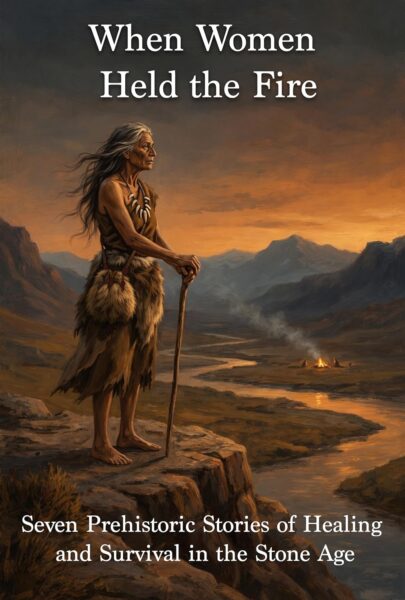
It started with a question that wouldn’t leave me alone: who was the first person to figure out that a certain leaf could stop bleeding, that a certain root could bring down a fever, that a certain bark could ease the pain of childbirth?
Not a priest. Not a king. Not a warrior.
Almost certainly a woman. Probably one nobody remembers.
The Invisible Women of Prehistory
Archaeologists keep finding them — or rather, finding the traces they left behind. Female burials from the Neolithic period containing herb bundles, grinding stones stained with plant residue, bone spatulas for mixing salves. At Belovode in Serbia, crucibles hold traces of pine resin, juniper, and meadowsweet — ingredients for antiseptic salves, mixed five thousand years before anyone wrote down a recipe. Ötzi, the famous ice mummy, carried birch polypore fungus on a leather thong — a natural antibiotic. Someone taught him that. Someone figured it out first.
These women developed what we’d now call pharmacology through centuries of observation, experimentation, and knowledge passed from mother to daughter. They didn’t have writing. They didn’t have laboratories. They had their eyes, their hands, their memory, and the accumulated wisdom of every healer who came before them.
I wanted to tell their stories.
Four Thousand Years in One Valley
When Women Held the Fire follows seven women healers across four thousand years in prehistoric Central Europe — from 6000 BCE, when glaciers were still retreating, to 2600 BCE, when communities were raising the great stone monuments.
Each story stands alone. Each features a different healer facing a different crisis. But they’re all connected by a lineage — a seed pouch passed from hand to hand, a greenstone knife re-hafted across generations, and a body of healing knowledge that grows with every woman who carries it.
The crises are real. Glacial meltwater poisoning rivers — that happened. Copper smelting producing toxic fumes — that happened. Volcanic ash burying entire regions — that happened. Stored grain developing deadly mold — that happened. Copper vessels leaching poison into acidic liquids — that happened, and people died from it for centuries before anyone understood why.
I didn’t need to invent dangers. Prehistory supplied more than enough.
What Surprised Me During the Research
The deeper I dug into the archaeology, the more astonished I became. These weren’t primitive people stumbling through a hostile world. They were sophisticated observers who understood their environment with an intimacy we’ve largely lost.
They knew that meadowsweet reduced fever — the same plant that contains the compound we now synthesize as aspirin. They knew that yarrow stopped bleeding — modern studies confirm it promotes clotting. They knew that charcoal could bind poisons in the gut — activated charcoal is still used in emergency rooms today.
They figured all of this out without chemistry, without microscopes, without clinical trials. Just by watching. Remembering. Teaching the next generation.
That struck me as one of the great unsung achievements of human history. And it deserved a story — not a textbook, but a story you could feel in your chest.
Who This Book Is For
If you loved Clan of the Cave Bear and wished there were more books like it — grounded in real archaeology, centred on strong women, set in a prehistoric world that feels alive — then this is for you.
If you’re fascinated by herbalism, ancient medicine, or the question of how knowledge survived before writing existed — this is for you.
If you want fiction where the drama comes from the land, the weather, the body, and the brutal realities of survival — not from magic or prophecy — this is for you.
When Women Held the Fire is available now on Amazon.
Available worldwide — search “When Women Held the Fire” on your local Amazon store.
A Taste of the World
If you’ve been reading my blog posts about Stone Age herbal medicine, prehistoric fauna, and life before civilization — those topics come alive in these stories. The research behind the blog is the same research behind the book. The difference is that in the book, you’re standing beside the healer when the child stops breathing, when the volcano darkens the sky, when forty tons of stone crashes into a pit with someone you love trapped beneath it.
This isn’t the Stone Age behind glass. You’re in it.
