What prehistoric women knew about bark, leaves, and roots — and what you can still do with that knowledge tonight.
She crouches at the edge of a cold river in what will one day be northern Spain, though no one has named it yet. The water runs fast and brown with spring melt. Her fingers — cracked, stained dark at the nails — grip a willow branch and strip a long curl of pale inner bark with one practiced pull. She doesn’t hesitate over which layer to take. The outer bark is useless for what she needs. The inner bark, the wet, bitter ribbon that smells faintly of green and iron — that’s the one that stops pain.
She’s not experimenting. Her mother showed her. Her mother’s mother showed her mother.
Forty-nine thousand years later, a team of researchers in Barcelona will scrape calcified plaque from a Neanderthal tooth found at El Sidrón and discover traces of poplar bark — a plant with no nutritional value but plenty of salicylic acid, the compound we now synthesize and sell as aspirin. That Neanderthal wasn’t eating poplar because it tasted good. It tastes terrible. That Neanderthal was taking medicine.
Here’s what will really bother you: every single plant that woman used to keep her people alive is still growing within a twenty-minute walk of wherever you’re reading this.
You’ve just stopped noticing them.
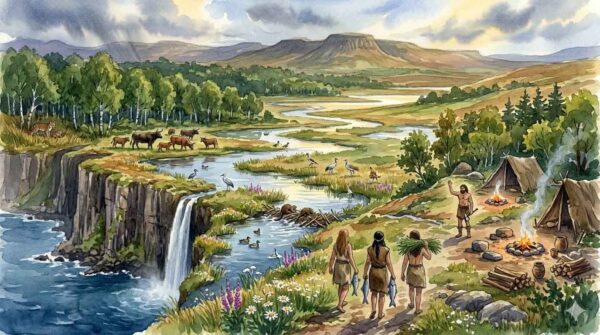
Hunting kept Stone Age people alive. Plant knowledge kept them alive comfortably — and sometimes, when the hunt failed, it kept them alive at all. The women returning to camp carry both: fish from the river, and a bundle of herbs that could ease a fever, stop a wound from festering, or make the difference between a difficult birth and a fatal one.
The plants were never secondary. They were the margin between survival and something closer to safety.
Willow: The Painkiller in the Ditch
You’ve seen it a hundred times — that droopy tree by the pond in the park, trailing its fingers in the water. Salix. Willow.
The inner bark contains salicin, which your liver converts into salicylic acid — the active compound in aspirin. Stone Age people across Europe and the Near East used it for pain, fever, and inflammation. We know this not from guesswork but from direct chemical analysis of Neanderthal dental calculus at El Sidrón, Spain, dating to roughly 49,000 years ago. The individual had a dental abscess. The same tooth showed traces of the antibiotic-producing mold Penicillium and poplar bark. This wasn’t someone eating randomly. This was someone treating a specific problem with specific plants.
Willow bark tea is still used in herbal medicine today. You can buy it at any health food store. Or you can walk to the nearest stream, find a willow, and understand — in your hands, in that bitter smell — exactly what she knew.
What she knew that we forgot: Fresh willow bark works faster if you chew it than if you brew it. The saliva starts breaking down the salicin immediately. She didn’t have a kettle. She had teeth.
Yarrow: The Wound-Stopper
If you’ve ever walked through a meadow in summer and seen flat-topped clusters of tiny white flowers on stiff stems, you’ve walked through a Stone Age pharmacy. Achillea millefolium — yarrow. Named after Achilles, who supposedly used it to treat his soldiers’ wounds at Troy. But the plant was stopping bleeding tens of thousands of years before anyone invented Greeks.
Yarrow is a hemostatic — it helps blood clot. It’s also antimicrobial and anti-inflammatory. Crush the leaves, pack them into a wound, and bleeding slows. This isn’t folk wisdom. It’s confirmed pharmacology. The plant contains achilleine, which has been shown to reduce clotting time.
The famous Shanidar Cave pollen debate — where clusters of flower pollen, including yarrow, were found around a Neanderthal burial roughly 60,000 years old — remains contested. Some researchers argue the pollen was carried in by bees, not placed deliberately. But even the skeptics acknowledge that yarrow was abundant in the environment and that its medicinal properties would have been discoverable by any observant person who noticed that chewing certain leaves made a cut stop bleeding faster.
And here’s what’s worth knowing: wilderness first-aid courses still teach yarrow as an emergency wound treatment. If you’re hiking and you cut yourself and you don’t have a first-aid kit, look for yarrow. The Stone Age solution is still the backup plan.
Birch Bark: Glue, Antiseptic, and the Oldest Synthetic Material on Earth
This one should permanently end every sentence that starts with “primitive cave people.”
At Königsaue, Germany, archaeologists found lumps of birch bark tar dating to roughly 200,000 years ago. It was made by Neanderthals. To make birch bark tar, you need to heat birch bark to between 340°C and 400°C in the absence of oxygen — a process called dry distillation. Too cool, nothing happens. Too hot, it burns. There is no kiln. There is no thermometer. You need to bury bark in a sealed clay structure near a fire and manage the temperature by controlling airflow and distance.
Modern experimental archaeologists have tried to replicate this. Some of them struggled.
Neanderthals used the resulting tar to glue stone points onto wooden spear shafts. It’s the oldest known synthetic material — a substance that does not exist in nature and must be manufactured through a multi-step chemical process. Two hundred thousand years ago.
But birch bark was also medicine. Betulin, a compound in the outer bark, is antiseptic and anti-inflammatory. Birch bark poultices appear in folk medicine across Northern Europe, Siberia, and North America — everywhere birch grows and humans live. Ötzi the Iceman, that 5,300-year-old man found frozen in the Alps, carried birch bark containers. One of them held embers wrapped in maple leaves — a fire-starting kit. Birch bark burns hot and slow. It waterproofs. It heals.
One tree. Glue, medicine, fire, waterproofing. No wonder they kept coming back to the birch stands every spring.
Cattail: The Supermarket of the Stone Age
If willow was the pharmacy, cattail was the grocery store, the hardware shop, and the first-aid station rolled into one. Typha — the tall brown-topped reeds you see at the edge of every pond and marsh.
Every part of it is useful. The young shoots are edible raw. The pollen is edible and highly nutritious — basically a protein-rich flour you can shake into a basket. The roots contain starch that can be processed into a kind of flatbread base. The fluff from the seed heads is an insulator, a wound dressing, and a fire starter. The leaves can be woven into mats, baskets, and temporary shelter walls.
Stone Age people living near wetlands — and many did, because wetland margins are among the richest ecosystems on earth — would have known cattails the way you know your kitchen cupboard. Reach in, grab what you need. Need dinner? Roots. Need tinder? Fluff. Need to pack a wound? Also fluff.
The fun test: Next time you walk past a pond with cattails, pull one seed head apart. Feel the fluff. It’s soft, slightly oily, and extraordinarily fine. Now imagine packing that into a deep cut. It mats down, absorbs blood, and holds a poultice in place. She figured this out before anyone invented cotton, gauze, or bandages.
Nettle: The Sting That Fed and Clothed Them
Nobody loves nettles. Urtica dioica stings, it’s aggressive, it takes over every neglected corner of damp ground. Prehistoric people loved it precisely because it’s aggressive. It’s always there. It’s reliable.
Boiled, nettle leaves lose their sting and become a rich, iron-heavy green — edible, nutritious, and available earlier in spring than almost anything else. In that hungry gap between winter stores running out and the first real harvests, nettles were the bridge.
But the real trick was fiber. Nettle stems contain bast fibers that, when retted (soaked until the outer layers rot away) and processed, produce a strong, fine thread. Nettle fiber textiles have been found in Bronze Age contexts, and the processing technique is simple enough that it almost certainly goes back much further. Cord. Nets. Snares. Stitching.
You can try this yourself. Pull a dried nettle stem, crack it open, and peel the outer fibers. Twist them between your palms. Congratulations — you’re making cordage exactly the way she did.
Meadowsweet: The Aspirin Plant They Buried Their Dead With
Filipendula ulmaria. Tall, creamy-white flower heads that smell like honey and almonds. It grows in damp meadows across Europe, and it contains the same salicylate compounds as willow — but sweeter, gentler, and with that extraordinary fragrance.
Meadowsweet has been found in Bronze Age burial vessels and funerary contexts — residue analysis confirms it was deliberately placed, not accidental contamination. It appears to have served double duty: medicine for the living, fragrance for the dead. A painkiller and a funeral flower. The same plant eased your fever and honored your passing.
The name “aspirin” actually derives from meadowsweet’s old botanical name, Spiraea. The drug was literally named after this plant.
She knew it by a different name, or by no name at all — just by its smell on her hands after gathering, and by the way a feverish child cooled after drinking the tea she brewed from its flowers.
What She Knew
Six plants. All still growing. All still medicinally active. All within walking distance of wherever you are in the Northern Hemisphere.
The woman at the river stands up, bark in her pouch. She’s carrying a pharmacy, a first-aid kit, and four hundred thousand years of accumulated knowledge — passed voice to voice, hand to hand, mother to daughter, healer to apprentice.
She didn’t write it down. She didn’t need to. She remembered, because forgetting meant someone died.
The next time you walk past a willow, a nettle patch, a stand of cattails by a pond — stop. Look. You’re standing in her world. It hasn’t gone anywhere. We just stopped paying attention.
She never did.
In Closing
All of this comes together in one place — as something I have realized and learned over time. I tried to capture that in this piece on finding something steady in the Stone Age.
