Archaeology publishes discoveries. This site looks for what sits between them.

A burial here. A dental calculus analysis there. A tally bone from one continent, a hand stencil from another. Taken individually, each finding is a data point. Cross-referenced, they start to suggest something else — patterns of behaviour, daily rhythms, social structures, ways of knowing — that the science itself, bound by what it can prove, rarely has the liberty to name.
That’s where this site operates. Not in speculation, but in the gap between confirmed evidence and the living world that evidence implies.
The method is deliberate: take multiple independent lines of archaeological and ethnographic research, look for where they converge, and follow the pattern they point toward. What emerges isn’t invented — it’s inferred. And inference, done carefully, can surface stories that dry science keeps just below the surface by necessity rather than by design.
The stories on this site are grounded in that evidence. They are imagined in the sense that all historical reconstruction is imagined — you cannot excavate a conversation or a decision. But they are not invented. The plants are real. The ecological pressures are documented. The social dynamics are drawn from ethnographic analogy with living forager societies. The biology is human and therefore familiar.
What interests me most is not the drama of prehistory but its texture. The weight of a decision made without certainty. The knowledge of which root to reach for when a child stops breathing normally. The reading of a landscape for what it will yield next month rather than today. These are not primitive concerns. They are the same concerns we have, stripped of the infrastructure we use to manage them.
The Stone Age was not a simpler world. It was a world where the complexity was elsewhere — in ecological literacy, in embodied knowledge, in the social technologies of transmission and memory that left almost no trace in the record. This site is an attempt to reconstruct that complexity from what did survive: the bone, the stone, the calculus, the pigment, the seed.
And occasionally, where the evidence converges clearly enough, to let it breathe as story.
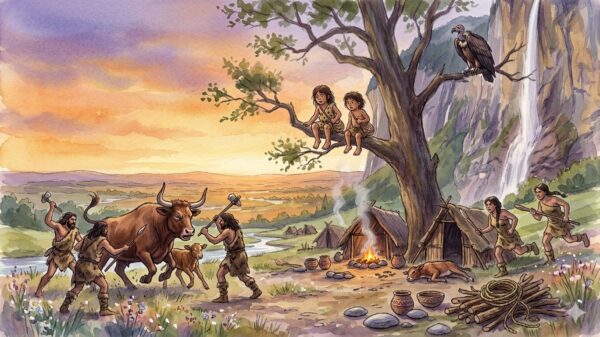
The Stone Age was not a constant struggle, nor was it a static harmony.
It was a world of rhythms and interruptions, of brief abundance and long preparation. What counted as success was often quiet: a tool that held its edge, a wound that healed, a plant that returned on time. What counted as loss was not always death, but erosion—of strength, of predictability, of margin. These measures of life are harder to see archaeologically, yet they shaped how people understood risk, security, and continuity.
This site grows from that fascination: with how people lived inside uncertainty, how they valued what endured, and how daily choices—often invisible—held human life together long before certainty, surplus, or control became possible.
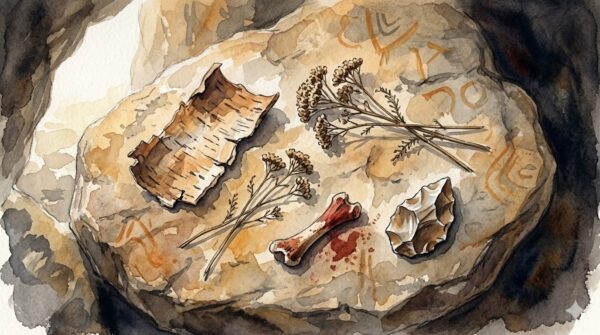
Timeline of human history from pre-Neanderthals and Neanderthals through the Stone Age, Bronze Age, and modern period.
> 700,000 – 400,000 years ago
Pre-Neanderthals (early Homo species in Europe)> 400,000 – 40,000 years ago
Neanderthals
(Middle Paleolithic)> 300,000 years ago – present
Homo sapiens> 45,000 – 12,000 years ago
Upper Paleolithic
(Stone Age hunter-gatherers)> 12,000 – 6,000 years ago
Mesolithic
(Post-Ice Age foragers)> 6,000 – 3,000 years ago
Neolithic
(Early farming societies)> 3,000 – 1,200 BCE
Bronze Age> 1,200 BCE – present
Iron Age → Historical periods → Modern world
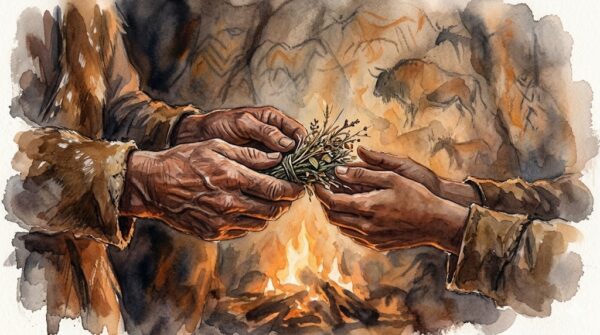
Much of what I keep returning to is the work that doesn’t show up cleanly in the archaeological record: the continuous, unglamorous labour of maintaining life across seasons — preparing materials, tending injuries, preserving knowledge about plants, bodies, and places. This work is hard to see archaeologically, yet without it survival would have been fragile. The evidence suggests much of it was done by women. That gap between visibility and importance is where most of this site lives.
The posts here pair restrained storytelling with archaeological evidence — not to invent the past, but to stay close to what the material record allows us to infer. These are not prehistoric fantasies. They are reflections grounded in anthropology, material culture, and the quiet, durable realities of keeping people alive.
This site explores women-centered historical fiction grounded in archaeology, anthropology, and deep-time ecology, with a focus on Stone Age life before agriculture, writing, and modern social structures. Its essays draw on material culture, prehistoric flora and fauna, ancient tools, care and healing, and survival strategies to reflect how early humans lived, adapted, and made meaning across deep history.